
The Chaos Control Plane: Automating Disaster Recovery Drills During Business Hours
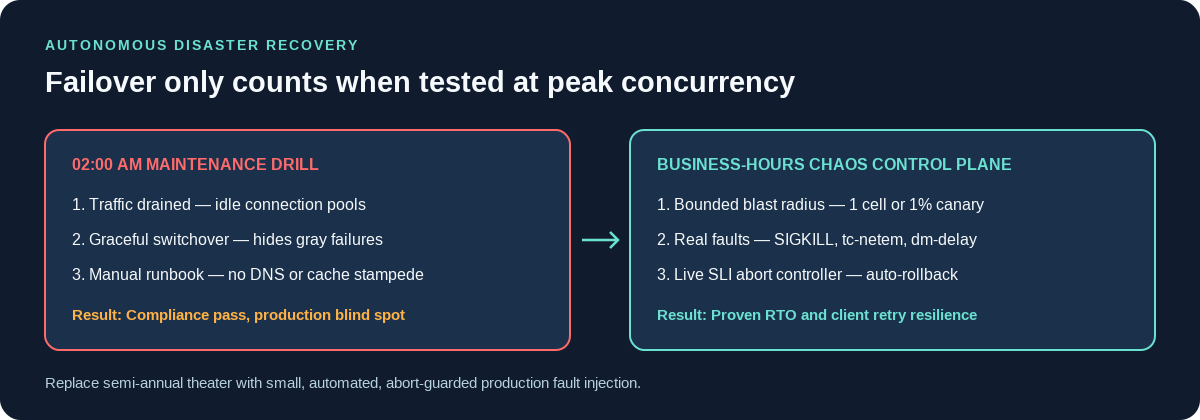
Disaster Recovery testing conducted during low-traffic weekend maintenance windows is operational theater; if your database failover automation has never survived a sudden primary crash on a Tuesday morning at peak concurrency, your system is not highly available.
TL;DR
- Problem: Off-hours DR drills drain traffic and run graceful switchovers, hiding connection storms, cold buffer caches, gray-failure quorum flaps, and stale client DNS caches that turn peak-hour failovers into outages.
- Answer: Run an autonomous chaos control plane during business hours against one isolated cell at a time (1%–2% blast radius), gated by
pg_stat_replicationlag checks, a 1-second SLI abort watchdog, and a host-local deadman timer.- Watch out: Never inject faults into a monolithic database or without a local deadman switch; if network chaos partitions the abort controller from the host, the fault persists until manual intervention.
Situation
Organizations operating transactional platforms routinely commit to availability SLAs of 99.99% or higher (at most 52.6 minutes of downtime per year). To support these commitments, database platform teams deploy active-passive PostgreSQL clusters coordinated via Patroni and etcd or Consul, multi-region Amazon Aurora clusters, or Oracle Data Guard with Fast-Start Failover (FSFO).
To satisfy compliance frameworks such as SOC 2 Type II or ISO 27001, teams schedule recurring DR drills semi-annually. Because operators fear customer impact, those drills run under synthetic conditions at 02:00 AM on a Sunday: application traffic is drained, batch jobs are paused, and engineers step through rehearsed switchover runbooks. When the standby mounts and accepts a test write, the team records a pass.
Production infrastructure failures do not wait for maintenance windows. Availability Zone network partitions, hypervisor panics, EBS volume I/O stalls, and power events happen at 10:00 AM on a Tuesday during peak concurrency.
The Problem
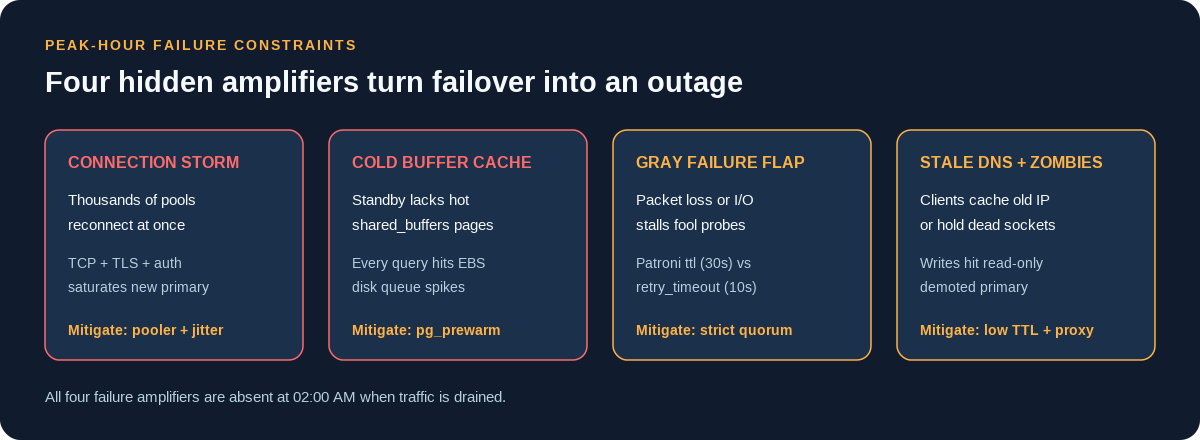
Off-hours drills leave four production constraints untested. Each constraint has a measurable mechanism that only triggers under live load.
- Peak-Concurrency Connection Storms: At 02:00 AM, application connection pools (HikariCP,
pgxpool) sit mostly idle. During a 10:00 AM crash, thousands of active worker threads lose their sockets simultaneously. Consider the arithmetic: 500 microservice pods each holding amaxPoolSizeof 20 connections represent 10,000 concurrent database sessions. The instant a standby promotes, every pod initiates TCP, TLS, and PostgreSQL SCRAM-SHA-256 authentication handshakes at once. Because PostgreSQL spawns one OS backend process per connection (fork()), 10,000 simultaneous connection attempts saturate CPU on TLS key exchange and process creation before a single query executes, starving Patroni’s local health-check queries unless PgBouncer or client-side connection rate limiting meters the surge. - Cold Buffer Pool Cache Stampedes: A primary under steady load serves most reads from RAM (
shared_buffersin PostgreSQL or the InnoDB buffer pool in MySQL). A standby that only applies WAL records has a cold buffer cache unless pre-warmed. Redirecting peak read QPS to a cold standby forces physical 8 KB page reads from block storage, driving up EBS read queue depth and tail latency across upstream microservices. At 20,000 random 8 KB reads per second against a cold cache, storage must sustain 160 MB/s of random read IOPS immediately; if the volume is provisioned below that burst threshold,iowaitclimbs and application request queues back up into upstream timeouts. - Gray Failures and Quorum Timing Loops: Graceful switchovers test clean process exits. Real cloud failures are often partial: packet loss, asymmetric routing, or stalled disk I/O. In Patroni, failover timing is governed by three DCS parameters—
ttl(default30seconds),loop_wait(default10seconds), andretry_timeout(default10seconds)—which must satisfyloop_wait + 2 * retry_timeout <= ttl. Under gray packet loss or disk stalls near those thresholds, health checks oscillate and risk demotion loops if fencing and quorum are misconfigured. - Client-Side DNS Caching: In Java runtimes,
networkaddress.cache.ttlis a security property in$JAVA_HOME/conf/security/java.security(not a-Dsystem property). When a SecurityManager is enabled or on older JDK configurations, it defaults to-1(cache forever); without a SecurityManager in modern OpenJDK, it defaults to30seconds. Applications with-1or long TTLs keep sending writes to the demoted read-only primary until pods restart, burning retry budgets against a node that now rejects writes withread-only transactionerrors.
How can platform teams continuously validate automated database failover under peak production concurrency while mathematically bounding customer blast radius?
Options Considered
| Option | What It Gets Right | Where It Breaks | Verdict |
|---|---|---|---|
| Off-hours manual drills | Zero peak-hour customer risk; satisfies basic audit checkboxes. | Drained pools, warm assumptions, and manual switchovers hide connection storms and gray failures. | Rejected — creates false confidence. |
| Staging load replay | Safe to inject destructive faults freely without impacting customers. | Staging diverges in dataset size, DNS resolution, IAM rules, and real microservice retry behavior. | Partial — pre-prod gate only. |
| Full-fleet chaos without cells | Tests real production topology and connection pools. | A single uncontained fault on a monolithic database impacts 100% of customer traffic. | Rejected — unacceptable blast radius. |
| Bounded cellular chaos control plane | Tests real pools, caches, and DNS under live load with automated SLI abort. | Requires cellular sharding, live SLI telemetry, and a host-local deadman switch. | Chosen — bounded to 1%–2% of traffic. |
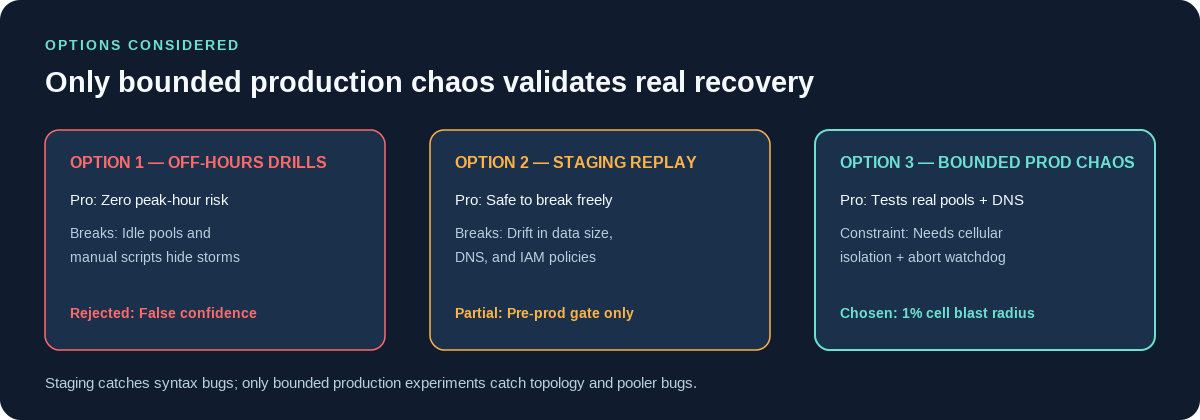
Off-hours drills and staging replay remain useful as compliance artifacts and pre-production smoke tests, respectively, but neither exercises the production control plane under live concurrency. Unbounded production chaos fails the blast-radius constraint on monolithic databases. A cellular chaos control plane is the only option that tests real failure modes while capping worst-case impact.
The Chaos Control Plane Architecture
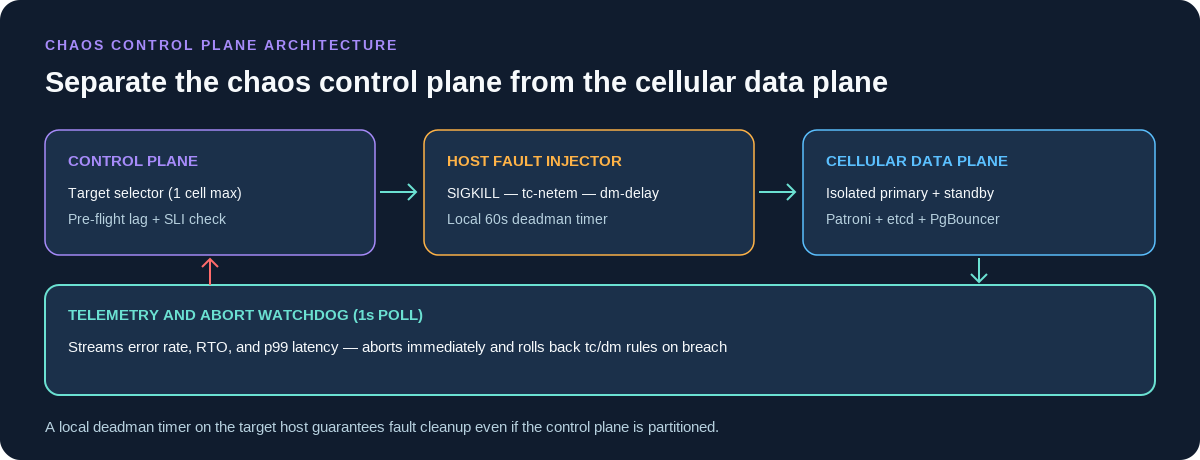
The architecture separates scheduling and safety evaluation (the Chaos Control Plane) from fault execution (host-level agents) and database state (the Cellular Data Plane). Rather than treating disaster recovery as a semi-annual event, the control plane runs scheduled experiments during business hours when engineers are online.
1. Failure Primitives at the Kernel Boundary
The fault injector avoids graceful database shutdown commands and operates at the OS process, network, and block-device layers:
- Hard Process Termination (
SIGKILL): Sendingkill -9to the PostgreSQL postmaster forces crash recovery, WAL replay, and Patroni DCS lock expiration without clean TCPFINpackets. - Gray Network Degradation (
tc-netem): To verify that Patroni and client pools handle partial packet loss without flip-flopping, the agent injects delay and loss on the database interface:
# Inject 350ms delay (+/- 50ms jitter) and 5% packet loss on eth0
tc qdisc add dev eth0 root netem delay 350ms 50ms loss 5%
- Storage I/O Latency and Errors (
dm-delayanddm-dust): Linux Device-Mapper targets test two distinct storage failures.dm-delayintercepts block I/O and adds configurable read/write latency (for example,500ms read delay) to simulate congested EBS volumes, whereasdm-dustemulates failing sectors by returning-EIOread errors on configured blocks until overwritten.
2. Blast Radius Containment via Cellular Sharding
Continuous production chaos is unsafe against a single monolithic primary. The data plane must be partitioned into independent database cells (for example, 50 to 100 tenant shards), each with its own primary, standbys, and connection poolers. The target selector enforces a hard lock so that at most one cell is under active fault injection at any instant, capping the maximum blast radius to 1%–2% of total traffic. Cells are tagged by criticality tier so that staging and non-financial workloads absorb early fault-injection runs before tier-1 transactional cells enter the rotation. Each cell also maintains its own Patroni scope and connection-pooler tier so that a failover or cache miss in one cell never shares worker threads or lock contention with healthy cells.
3. The Safety Invariant and Automated Abort Controller
The abort controller polls cell-level Service Level Indicators (SLIs) every second from Prometheus or Datadog and terminates the experiment immediately if error rate, recovery time, or p99 latency crosses a threshold. Crucially, the host agent also arms a local 60-second deadman timer before applying any tc-netem or dm-delay rule: if the network fault itself severs connectivity between the control plane and the target host, the local agent automatically tears down the fault rules when the timer expires.
// Automated Chaos Safety Invariant Controller in Go
type SafetyController struct {
    metricsClient        *MetricsClient
    maxAllowedSLIErrors  float64
    maxAllowedRTOSeconds int
}

func (sc *SafetyController) MonitorExperiment(ctx context.Context, cellID string, abortChan chan<- string) {
    ticker := time.NewTicker(1 * time.Second)
    defer ticker.Stop()

    startTime := time.Now()

    for {
        select {
        case <-ctx.Done():
            return
        case <-ticker.C:
            sli := sc.metricsClient.FetchCellSLI(cellID)

            // Invariant 1: Error rate must stay below threshold after transient failover window
            if sli.ErrorRate > sc.maxAllowedSLIErrors && time.Since(startTime) > 15*time.Second {
                abortChan <- fmt.Sprintf("SAFETY VIOLATION: Cell %s error rate %.4f%%", cellID, sli.ErrorRate*100)
                return
            }

            // Invariant 2: Primary promotion must complete within RTO budget
            if !sli.PrimaryHealthy && time.Since(startTime) > time.Duration(sc.maxAllowedRTOSeconds)*time.Second {
                abortChan <- fmt.Sprintf("RTO BREACH: Cell %s failed recovery within %ds", cellID, sc.maxAllowedRTOSeconds)
                return
            }

            // Invariant 3: P99 latency must return to baseline within 45 seconds
            if sli.P99LatencyMS > 50.0 && time.Since(startTime) > 45*time.Second {
                abortChan <- fmt.Sprintf("LATENCY BREACH: Cell %s P99 latency %.2fms", cellID, sli.P99LatencyMS)
                return
            }
        }
    }
}
How It Rolls Out
Deploying a chaos control plane directly against tier-1 production databases invites self-inflicted outages. Roll out in four gated phases, each with an explicit validation check and rollback action:
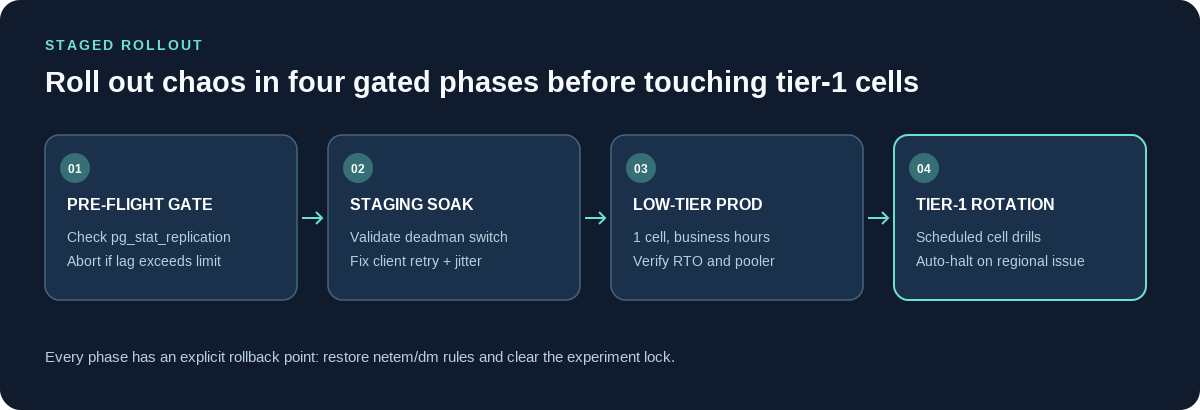
- Phase 1 — Pre-Flight Replication and Region Gate: Before every experiment, the control plane queries
pg_stat_replication(replay_lagand WAL LSN byte delta viapg_wal_lsn_diff(pg_current_wal_lsn(), replay_lsn)) alongside regional health status. If standby lag exceeds the RPO budget (for example, 100 ms) or an active incident is open, the scheduler aborts before injecting any fault. For read-heavy cells, pre-flight also verifies thatpg_prewarm(autoprewarm) or standby buffer-warming cron jobs have populated hot relation pages inshared_buffersso failover does not trigger an immediate EBS read queue stall. Rollback: none required (no fault injected). - Phase 2 — Staging Soak and Deadman Verification: Validate the host-local 60-second deadman timer in staging by severing control-plane connectivity while
tc-netemis active. Confirm the local agent clearsqdiscrules automatically when its timer expires, and verify thatdmsetup removecleans up anydm-delayordm-dusttest mappings cleanly without leaving dangling device nodes. Rollback:tc qdisc del dev eth0 root. - Phase 3 — Low-Tier Production Cells (Business Hours): Enable
SIGKILLandtc-netemon internal or low-criticality production cells during weekday business hours. Fix exposed defects—such as missing client retry jitter, unthrottled pool reconnects, or long JVM DNS TTLs—before expanding scope. Rollback: abort controller restores network/device-mapper rules and releases the cell lock. - Phase 4 — Tier-1 Cell Rotation: Graduate tier-1 cells into a weekly rotation with a strict single-cell concurrency lock and automated alert suppression for expected failover events, paging on-call engineers only on SLI or RTO breaches. Each completed drill writes an immutable audit record—cell ID, fault primitive, measured failover duration, and peak error rate—so compliance teams receive continuous evidence instead of semi-annual manual sign-offs. Rollback: global kill switch disables the scheduler across all cells.
In Practice
The bounded production chaos model described here is grounded in documented hyper-scale engineering practice and named system behavior:
- Netflix ChAP (Chaos Automation Platform): In its published ChAP architecture, Netflix routes 1% of active users to an isolated canary cluster and 1% to a baseline control cluster via Zuul and Spinnaker, leaving over 98% of production traffic untouched. ChAP enforces a 5% global cap on concurrent experiments within any AWS region, restricts execution to weekday business hours (09:00 AM–05:00 PM), automatically halts during regional traffic evacuations, and uses Kayenta to abort experiments immediately on KPI degradation.
- PostgreSQL and Patroni Behavior: Under
SIGKILL, PostgreSQL replays WAL from the last checkpoint on the surviving primary or promotes a standby via Patroni’s DCS lock. Because Patroni requiresloop_wait + 2 * retry_timeout <= ttl(defaults:10 + 2 * 10 <= 30), a primary that loses DCS connectivity for longer thanttldemotes itself while the standby promotes. Withoutpg_prewarmor burstable IOPS, the newly promoted standby services queries from a coldshared_bufferscache, amplifying EBS read latency. - CARL Acknowledgment: I have not operated a 100-cell PostgreSQL chaos control plane at Netflix scale personally; the architecture above synthesizes Netflix’s documented ChAP safety invariants with PostgreSQL, Patroni, and Linux kernel (
tc-netem,dm-delay,dm-dust) mechanics.
Where It Breaks
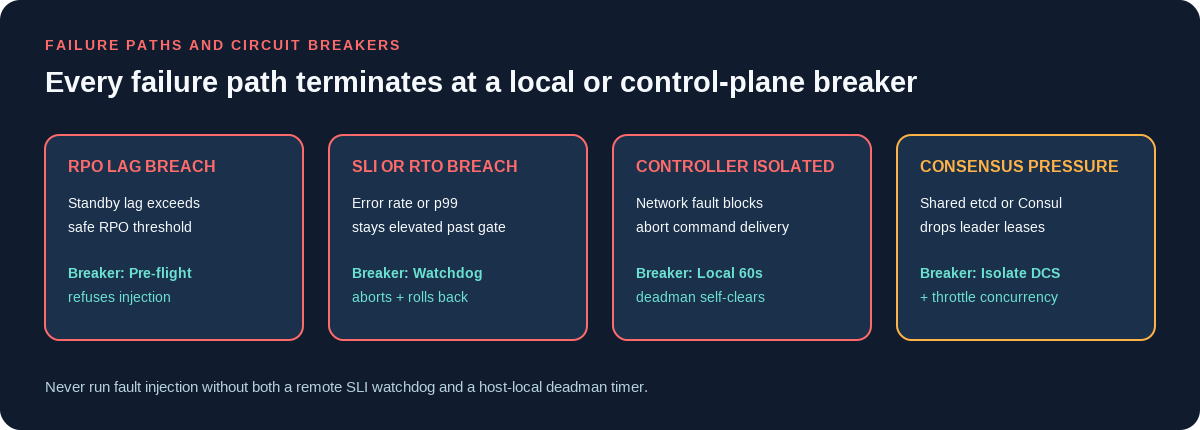
| Condition | Breaks How | Detect | Mitigate |
|---|---|---|---|
| Split-brain under network partition | Quorum coordinator fails to fence partitioned primary; both nodes accept writes. | Divergent WAL timelines or dual-leader metric in Patroni/etcd. | Enforce strict majority quorum (3+ DCS nodes) and OS/hardware fencing (STONITH). |
| Upstream thread pool exhaustion | Injected latency spikes query duration; callers without circuit breakers hang. | API 5xx rate and exhausted HTTP worker thread pools. | Mandate client circuit breakers and aggressive socketTimeout on DB drivers. |
| Alert storm fatigue | Chaos kill triggers dozens of infra pages, masking real incidents. | High page volume during scheduled chaos windows. | Suppress expected infra alerts during active chaos locks; page only on SLI/RTO breach. |
| Replication lag RPO breach | Primary killed while asynchronous standby lags behind WAL stream. | pg_stat_replication replay_lag or LSN byte delta. | Gate experiment start on replay_lag below RPO threshold; abort if exceeded. |
| Cold buffer pool saturation | Failover shifts read QPS to cold standby, saturating EBS read IOPS. | Disk read queue depth and p99 query latency spike. | Run pg_prewarm on standbys and provision sufficient EBS IOPS headroom. |
| Shared DCS (etcd/Consul) overload | Concurrent chaos drills saturate consensus disk or CPU, dropping leases. | Leader election churn and DCS request latency alerts. | Isolate DCS on dedicated SSDs and enforce a single-cell concurrency lock. |
| Logon storm on promoted primary | Thousands of pods reconnect simultaneously without pacing or poolers. | CPU 100% on fork()/TLS handshake; listener queue drops. | Place PgBouncer/Envoy in front of DBs and add exponential backoff with jitter. |
| Abort controller network isolation | tc-netem or iptables rule blocks control-plane rollback signal. | Watchdog heartbeat timeout on target host. | Run a host-local 60s deadman timer that auto-clears all fault rules on expiry. |
Key Takeaways
- Off-hours DR drills only prove recovery on an idle system: Peak-hour outages are driven by connection storms, cold caches, gray packet loss, and stale DNS—none of which appear at 02:00 AM.
- Cellular isolation is the prerequisite for production chaos: Partitioning the data plane into independent cells lets you cap worst-case experiment blast radius to 1%–2% of traffic.
- Patroni timing math sets your minimum failover floor: With default
loop_wait: 10,retry_timeout: 10, andttl: 30, failover detection alone takes up to 30 seconds before client reconnection and cache warm-up begin. - Use the right kernel fault primitive for the failure mode: Use
tc-netemfor packet delay/loss,dm-delayfor slow block I/O, anddm-dustfor-EIObad-sector read errors. - Always pair a remote SLI watchdog with a local deadman timer: A 1-second control-plane abort loop protects SLIs, while a host-local timer guarantees fault cleanup if the network partition isolates the controller.
What to Do Next
- Problem: Audit your last three DR drills and verify whether application traffic, connection pools, and DNS caches were under real load or artificially drained.
- Solution: Design a cellular chaos control plane that injects
SIGKILL,tc-netem, anddm-delayfaults against one non-critical cell during weekday business hours, guarded by a 1-second SLI abort loop and a local deadman timer. - Proof: Run a controlled
kill -9on a staging primary under synthetic peak load and measure time-to-write-recovery, connection storm CPU, and client error rate before touching production. - Action: This week, check
networkaddress.cache.ttlin your JVM services, verify Patroni’sttl/loop_wait/retry_timeoutinvariant, and add pre-flightpg_stat_replicationlag checks to your failover runbook.
Sources
- Netflix ChAP (Chaos Automation Platform) — Automating Chaos Experiments in Production (arxiv.org/abs/1702.05843)
- Patroni Documentation — Dynamic Configuration (
ttl,loop_wait,retry_timeout) (patroni.readthedocs.io) - Linux Kernel Documentation —
dm-delayanddm-dustDevice-Mapper Targets (docs.kernel.org) - Oracle Java Documentation —
InetAddressNetworking Properties (networkaddress.cache.ttl) (docs.oracle.com)