
Active-Active Routing is a Myth: The Physics of Multi-Region Data Consistency
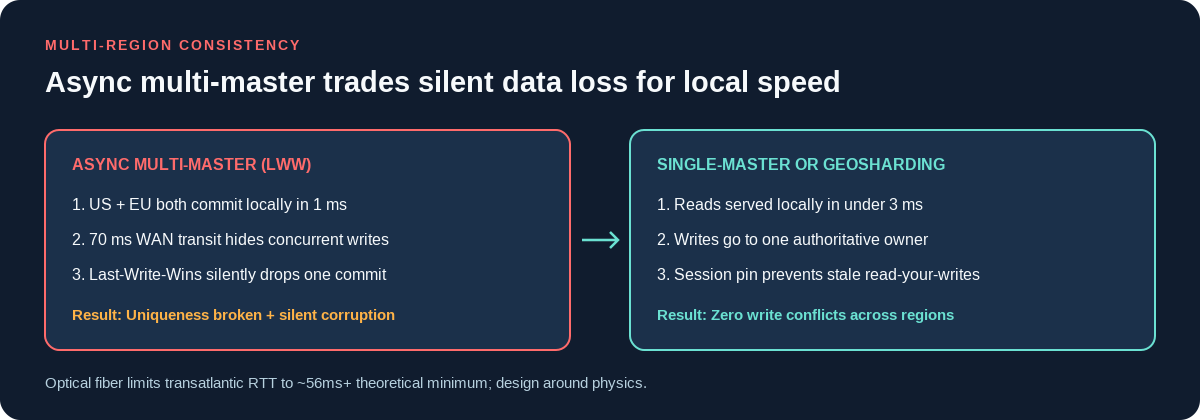
Promising global Active-Active multi-region database writes with sub-millisecond latency is not an engineering achievement; it is a fundamental violation of the speed of light that guarantees silent data corruption under asynchronous replication.
TL;DR
- Problem: Transatlantic fiber limits round-trip time (RTT) to ~55.7 ms minimum (68–78 ms in production), so synchronous multi-region writes stall row locks while asynchronous multi-master with Last-Write-Wins silently overwrites conflicting commits.
- Answer: Route writes to a single authoritative owner per row using either Global Active-Passive with write-forwarding + 5s session pinning, or Strict Geographic Sharding ($S_{\text{US}} \cap S_{\text{EU}} = \emptyset$).
- Watch out: Never automate cross-region failover between only two regions; without an independent third-region witness, a WAN partition produces a dual-primary split-brain.
Situation
Engineering teams are routinely asked to deploy transactional applications in an “Active-Active” configuration across continents—such as AWS us-east-1 and eu-west-1. The goal is straightforward: users in London and New York both read and write to local database nodes in under 5 ms while the database keeps both regions synchronized and survives a full regional blackout with zero downtime.
To build this, teams reach for bidirectional replication tools: Oracle GoldenGate multi-master, PostgreSQL logical replication meshes, or MySQL multi-source replication. Traffic routers send European requests to Europe and North American requests to Virginia, with both databases operating in read-write mode and streaming change data capture (CDC) events across the Atlantic.
In low-concurrency staging tests where users update disjoint rows, the setup looks clean. As soon as production traffic hits shared inventory, account balances, or reservation seats concurrently, physical network latency breaks the illusion.
The Problem
Multi-master database replication across continents collides with four hard constraints:
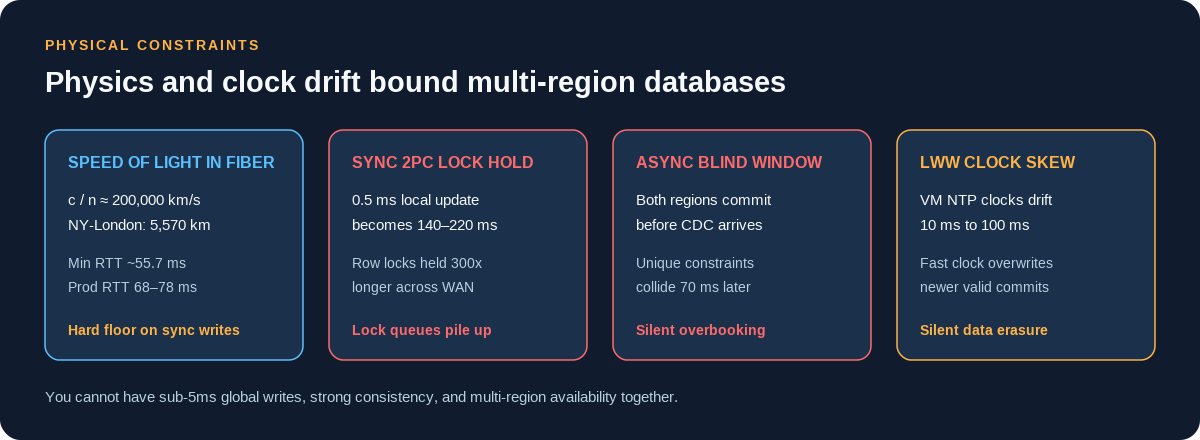
- Speed-of-Light Floor: Light travels in a vacuum at ~300,000 km/s, and in single-mode optical fiber at roughly two-thirds that speed ($c/n \approx 200,000\text{ km/s}$). New York and London are ~5,570 km apart along a great-circle path. Even ignoring terrestrial fiber detours and optical switches, the theoretical minimum round-trip time is $2 \times 5,570 / 200,000 \approx 55.7\text{ ms}$. Production transatlantic paths typically measure 68 ms to 78 ms RTT, and transpacific paths (California to Tokyo) measure 110 ms to 130 ms RTT.
- Synchronous 2PC Lock-Hold Explosion: Enforcing strict serializability across regions requires synchronous consensus or two-phase commit (2PC) over the WAN. A local
UPDATEthat holds a row lock for 0.5 ms now holds that lock for 140 ms to 220 ms across two round trips—a 300x increase in lock-hold duration. By Little’s Law, a single hot inventory row that supports $1 / 0.0005\text{ s} = 2,000\text{ serial TPS}$ locally collapses to $1 / 0.150\text{ s} \approx 6.7\text{ TPS}$ under 150 ms cross-region lock holds, regardless of how many vCPUs or IOPS the database has. - The Asynchronous Blind Window: To preserve 1 ms local writes, teams make replication asynchronous. During the ~70 ms WAN transit window, both regions accept writes independently. If a New York user and a London user both claim the last seat on a flight or the last unit of inventory within that window, both primaries validate
CHECK (quantity >= 0)orUNIQUEconstraints against their local snapshot and commit. Seventy milliseconds later, the replication streams collide with an unresolvable constraint violation—and even PostgreSQLON CONFLICTor custom merge handlers cannot undo two already-acknowledged inventory decrements without overselling stock. - Last-Write-Wins (LWW) Silent Data Loss: Automated conflict resolution commonly defaults to “Latest Timestamp Wins.” Cloud VM NTP clocks routinely drift by 10 ms to 100 ms, meaning a region with a fast clock systematically overwrites newer valid commits from the slower region. Even with zero clock skew, LWW silently discards one committed transaction after the client has already received an HTTP 200 confirmation.
How can platform architects deliver low-latency local reads and multi-region resilience without falling into asynchronous multi-master conflict corruption?
Options Considered
| Option | What It Gets Right | Where It Breaks | Verdict |
|---|---|---|---|
| Async multi-master with LWW | Sub-5 ms local reads and writes in every region. | Concurrent writes to shared keys collide; LWW silently erases committed rows. | Rejected — violates transactional integrity. |
| Synchronous WAN 2PC / Paxos | Zero write conflicts; strict external consistency. | 140–220 ms WAN lock holds crush hot-row OLTP throughput. | Niche — viable only for low-contention workloads (e.g., Spanner). |
| Active-Passive + write-forwarding | 2 ms local reads everywhere; single authoritative writer prevents conflicts. | Cross-region writes pay 1 WAN RTT (~70 ms) and need Read-Your-Writes pinning. | Chosen — for global shared datasets. |
| Strict Geographic Sharding | Sub-5 ms local reads and writes with zero write conflicts. | Cross-region foreign keys and global uniqueness require async sagas. | Chosen — for tenant-partitionable workloads. |
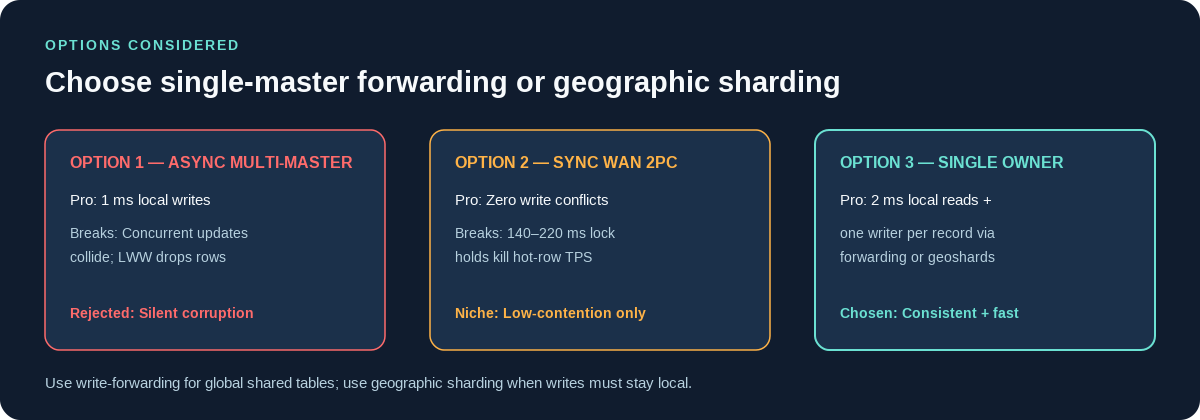
Asynchronous multi-master is acceptable only for mathematically conflict-free structures such as CRDT counters or append-only logs—never for relational inventory, balances, or reservations. Similarly, GeoDNS or BGP anycast routing solves edge ingress proximity, not database state convergence: routing two continents to two writable primaries simply shifts the conflict from the network layer into the storage engine. Teams must separate multi-region read scaling (where local read-only replicas serve 90%+ of traffic safely) from multi-region write authority. For relational OLTP, you must choose between centralizing writes per table (Active-Passive) or partitioning write authority per tenant (Geographic Sharding).
The Global Active-Passive and Geosharded Architecture
Both sound architectures enforce one invariant: every mutable row has exactly one authoritative primary at any point in time.
1. Global Active-Passive with Write-Forwarding
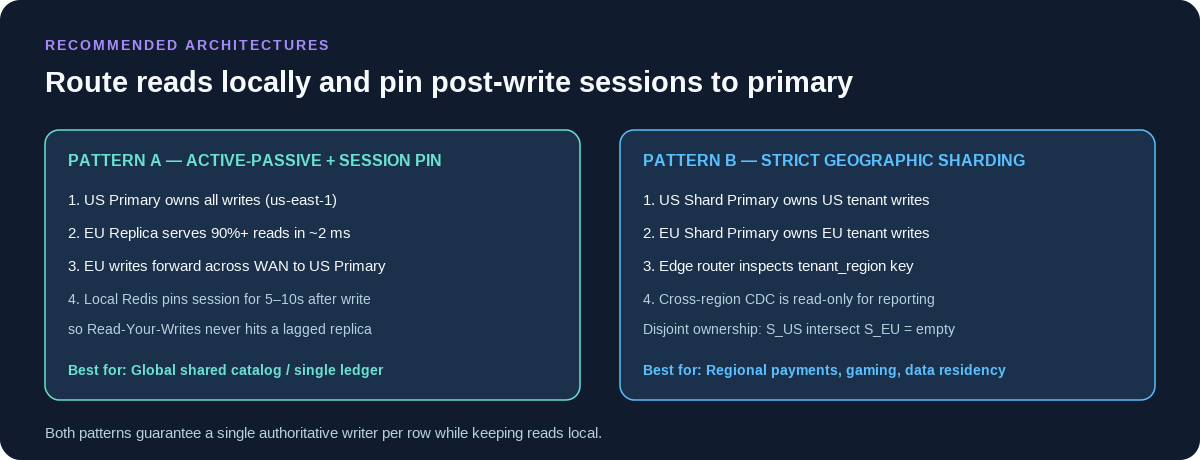
For unified datasets (e.g., a global product catalog or shared order system) where typical OLTP traffic is 90%–95% reads, designate one region (us-east-1) as the authoritative read-write primary and deploy read-only replicas in secondary regions (eu-west-1, ap-southeast-1). Local reads complete in ~2 ms. Write statements from European users forward over the private cloud backbone to the US primary, paying one ~70 ms WAN RTT on mutations while guaranteeing zero write collisions.
To avoid multiplying that 70 ms penalty on multi-statement transactions (BEGIN, SELECT ... FOR UPDATE, UPDATE, COMMIT), never chatty-forward individual SQL statements from an EU application server to a US database over the WAN—five sequential round trips would stall a single checkout for 350 ms+ while holding row locks in Virginia. Instead, forward the entire write RPC or service command to a stateless worker in us-east-1 (or invoke a single stored procedure) so all transactional round trips execute locally within 1 ms inside the primary region.
2. Session-Pinned Read-Your-Writes Routing
Because cross-region WAL replication lags by 100 ms to 500 ms, a user who updates their profile (forwarded to us-east-1) and immediately refreshes the page (served by eu-west-1) can read stale data and re-submit the form. An application router eliminates this by pinning the user’s session to the primary in a local low-latency cache for a short window after any mutation:
// Read-Your-Writes Session Pinning Router in Go
type RequestRouter struct {
    primaryPool  *pgxpool.Pool // Authoritative Primary (us-east-1)
    replicaPool  *pgxpool.Pool // Local Read Replica (eu-west-1)
    sessionCache *redis.Client // Local Redis (noeviction policy)
}

func (r *RequestRouter) HandleQuery(ctx context.Context, userID, sql string, isWrite bool) (*pgx.Rows, error) {
    if isWrite {
        rows, err := r.primaryPool.Query(ctx, sql)
        if err == nil {
            r.sessionCache.Set(ctx, "pinned:"+userID, "1", 5*time.Second)
        }
        return rows, err
    }
    if pinned, _ := r.sessionCache.Exists(ctx, "pinned:"+userID).Result(); pinned > 0 {
        return r.primaryPool.Query(ctx, sql)
    }
    return r.replicaPool.Query(ctx, sql)
}
3. Strict Geographic Sharding
When every region requires sub-5 ms write latency (payments, regional gaming state, strict GDPR data residency), partition the database by tenant or geography (tenant_region = 'EU' vs 'US'). Frankfurt is the sole primary for EU accounts; Virginia is the sole primary for US accounts. Any cross-region CDC stream is strictly unidirectional and read-only for analytics, so $S_{\text{US}} \cap S_{\text{EU}} = \emptyset$ and write conflicts cannot occur. For the rare operations that span regions—such as migrating an enterprise tenant from us-east-1 to eu-west-1 or maintaining a global routing directory—use a transactional outbox and an idempotent saga rather than distributed 2PC foreign keys, fencing the tenant to read-only during the ownership handoff so only one shard ever holds write authority.
How It Rolls Out
Replacing an existing multi-master topology without downtime proceeds in four reversible stages:
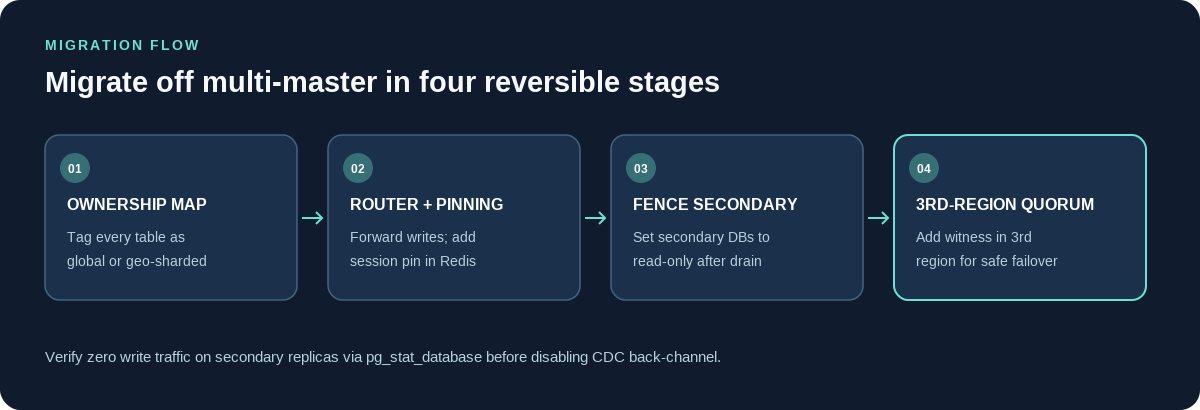
- Phase 1 — Table Ownership Classification: Audit every table and classify it as either global single-primary (forwarded writes) or geographically sharded (partitioned by
tenant_region). Rollback: none (read-only schema audit). - Phase 2 — Write-Forwarding Router and Session Pinning: Deploy the application router with session pinning (or enable managed write forwarding) while dual-region replication is still monitored. Verify that EU reads hit the local replica and post-write reads route to the primary during the pin window. Rollback: toggle router feature flag back to direct local writes.
- Phase 3 — Fence Secondary Writers: Drain in-flight local writes on the secondary region, verify zero
INSERT/UPDATE/DELETEactivity viapg_stat_database(tup_inserted,tup_updated,tup_deleted), and flip the secondary database todefault_transaction_read_only = onbefore retiring bidirectional CDC. Rollback: re-enable read-write mode if write-forwarding fails. - Phase 4 — Third-Region Witness for Automated Failover: Place an independent failover coordinator or witness in a third region (
us-west-2oreu-central-1) so neither primary nor secondary can promote itself during a transatlantic network cut. Ifus-east-1truly goes dark, the witness andeu-west-1form a 2-of-3 quorum and promote the secondary; if only the transatlantic fiber degrades whileus-east-1remains reachable fromus-west-2, the primary keeps quorum andeu-west-1stays read-only. Rollback: revert failover automation to manual promotion.
In Practice
The constraints and patterns above reflect documented behavior in production multi-region database engines:
- AWS Aurora Global Database Write Forwarding: For Aurora PostgreSQL (versions 14.9, 15.4, 16+, and higher), AWS supports native write forwarding controlled by
apg_write_forward.consistency_mode. Its modes map directly to the Read-Your-Writes tradeoff:eventual(fastest, may read stale replica state),session(default: replica waits for the session’s own Virtual Data LSN before serving subsequent reads), andglobal(strongest: waits for all globally committed LSNs, paying full WAN sync latency). - Google Cloud Spanner TrueTime: Spanner achieves global external consistency not by bypassing the speed of light, but by bounding clock uncertainty $\epsilon = (\text{latest} - \text{earliest}) / 2$ using GPS and atomic clocks (typically 1–4 ms under normal operation) and forcing transactions to wait out $2\epsilon$ via Commit Wait before releasing locks—proving that even specialized hardware pays a latency tax for global linearizability.
- CRDTs vs. Relational OLTP: Redis Enterprise Active-Active CRDBs use vector clocks and Conflict-Free Replicated Data Types (CRDTs) for strong eventual consistency on counters, sets, and maps—whereas open-source Valkey uses standard asynchronous primary-replica replication. CRDTs solve set/counter convergence, not relational
UNIQUEconstraints or multi-row foreign-key invariants. - CARL Acknowledgment: I have not operated a global airline or Spanner-scale multi-region deployment personally; the analysis here synthesizes documented Aurora Global Database, Spanner TrueTime, and optical networking constraints.
Where It Breaks
| Condition | Breaks How | Detect | Mitigate |
|---|---|---|---|
| Clock skew in LWW multi-master | NTP drift (10–100 ms) lets older writes overwrite newer commits. | Silent row regressions and audit log timestamp inversions. | Eliminate LWW on transactional tables; enforce single-writer ownership. |
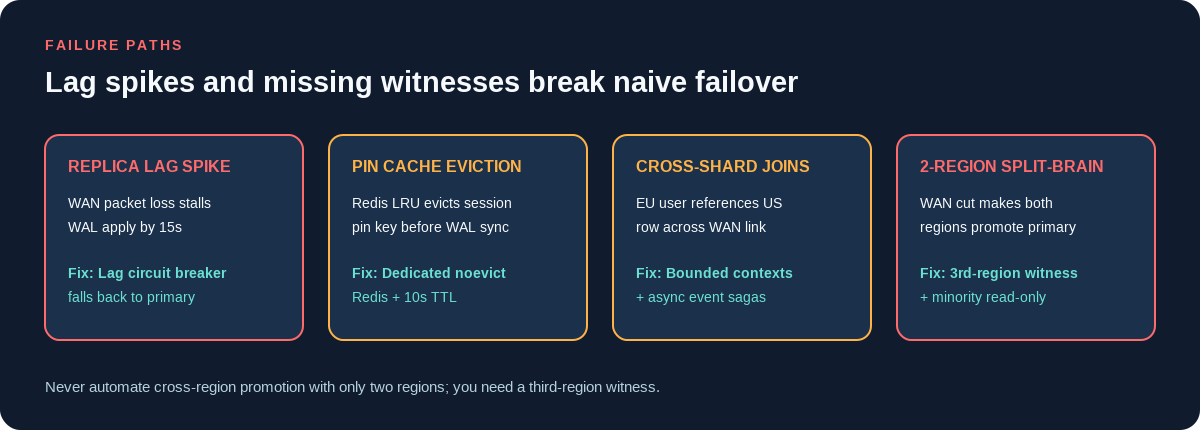
| Cross-region replication lag spike | WAN congestion pushes replica lag from 200 ms to 15s. | Replica replay_lag alert exceeds SLO threshold. | Add a lag circuit breaker that routes reads to primary when lag > 2s. |
| Session-pin Redis eviction | Redis LRU evicts pin key before WAL catches up on replica. | Read-your-writes regression immediately after form submit. | Run pin store on noeviction memory policy with conservative 10s TTL. |
| Two-region failover split-brain | WAN cut isolates US and EU; both regions promote to primary. | Dual-primary health state and divergent WAL timelines. | Require a 3rd-region witness for failover quorum; fence minority to read-only. |
| Cross-shard foreign keys | EU tenant row joins or enforces FK against US shard over WAN. | 200 ms+ distributed query tail latency and timeout spikes. | Decouple shards into bounded contexts; coordinate via async event sagas. |
| Uncompressed WAN CDC egress | Full-row before/after WAL images stream continuously across regions. | Sudden spike in cross-region data transfer billing. | Enable replication stream compression and replicate changed columns only. |
Beyond replication lag and failover quorum, teams migrating off multi-master must budget for schema-migration serialization and sequence/identity key collisions. In a single-primary topology, DDL migrations (ALTER TABLE, index creation) execute sequentially on the primary and replicate deterministically down the WAL stream to read replicas. Under multi-master CDC, running an uncoordinated DDL change on one region while the peer region still holds the previous table definition breaks logical apply workers and stalls the replication queue until an operator manually skips or replays the conflicting transaction. Similarly, auto-increment integer sequences that rely on odd/even offsets across two regions fail silently when a third disaster-recovery region is added or when a load balancer shifts traffic mid-failover; migrating to UUIDv7 or region-prefixed composite keys removes sequence coordination from the critical write path. Finally, test connection-pool draining under simulated WAN brownouts: if the session-pinning cache becomes unreachable, the router must fail closed to the single primary rather than serving stale local reads to post-write requests.
Key Takeaways
- The speed of light sets a hard ~56 ms+ transatlantic RTT floor: No database vendor or replication protocol can deliver sub-5 ms synchronous global commits across continents.
- Asynchronous multi-master with LWW trades integrity for local speed: Concurrent writes during the WAN transit window collide and silently overwrite committed customer state.
- Active-Passive + write-forwarding fits global shared tables: Local replicas serve 90%+ reads in ~2 ms, while writes forward to one primary and session pinning preserves Read-Your-Writes.
- Geographic sharding fits sub-5 ms global writes: Partitioning write ownership by
tenant_regioneliminates conflicts mathematically ($S_{\text{US}} \cap S_{\text{EU}} = \emptyset$). - Never automate failover with only two regions: Always place an independent witness in a third region so a WAN partition cannot trigger dual-primary promotion.
What to Do Next
- Problem: Audit any architecture labeled “Active-Active Multi-Region” to check whether two regions can mutate the same primary key concurrently.
- Solution: Standardize on Global Active-Passive with write-forwarding (for shared data) or Strict Geographic Sharding (for tenant-isolated data).
- Proof: Measure the actual inter-region RTT between your target cloud regions and check
apg_write_forward.consistency_modeor session-pinning behavior under simulated 500 ms replication lag. - Action: This week, add Read-Your-Writes session pinning in your API router and verify that cross-region failover quorum depends on a third-region witness.
Sources
- Amazon Aurora Documentation — Write Forwarding in Aurora Global Database (PostgreSQL) (docs.aws.amazon.com)
- Google Cloud Spanner Documentation — TrueTime and External Consistency (cloud.google.com/spanner/docs/true-time-external-consistency)
- Redis Documentation — Active-Active Geo-Distribution (CRDBs) (redis.io) and Valkey Replication (valkey.io)
- Martin Kleppmann — Designing Data-Intensive Applications: Chapter 5 (Replication) & Chapter 9 (Consistency and Consensus)