
The Cost of High Availability: Modeling the Financial Impact of Cloud Database Architectures
In enterprise engineering meetings, requesting ‘five nines of availability’ is often treated as a casual baseline specification; in financial reality, jumping from 99.99% to 99.999% uptime introduces an exponential cost curve that can erase operating margins.
TL;DR
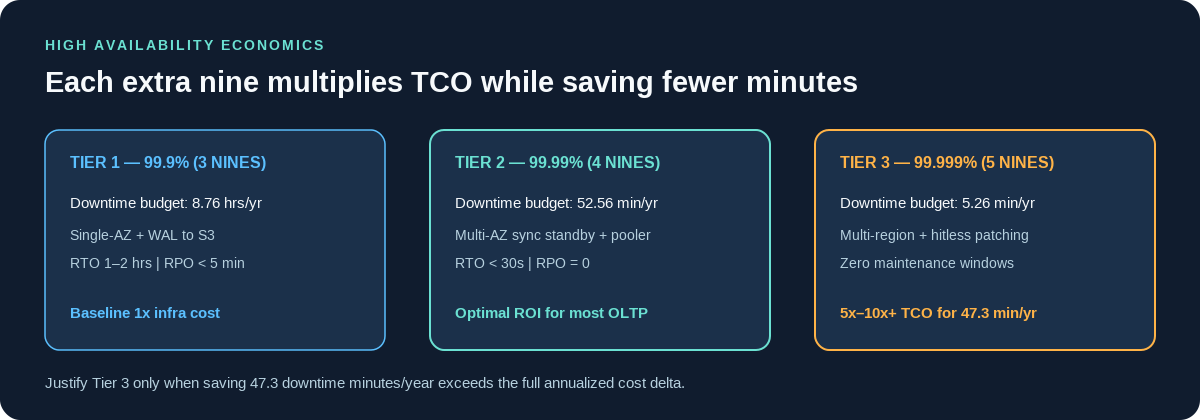
- Problem: Moving from 99.99% (52.56 min/yr downtime) to 99.999% (5.26 min/yr) saves only 47.3 minutes per year while multiplying infrastructure, licensing, and SRE toil costs by 5x–10x+.
- Answer: Replace blanket five-nines mandates with an ROI-gated three-tier HA menu (Tier 1: 99.9%, Tier 2: 99.99%, Tier 3: 99.999%) where upgrades require $\Delta \text{Downtime Minutes Saved} \times \text{Cost/Min} > \Delta \text{TCO}_{\text{Annual}}$.
- Watch out: Managed AWS RDS Multi-AZ replication traffic is free, but self-managed EC2 cross-AZ replication and cross-AZ app-to-DB traffic still incur $0.02/GB total transfer charges; never downsize standbys to cut costs.
Situation
Platform architects routinely receive product or compliance mandates demanding “zero-downtime, five-nines (99.999%)” database infrastructure. Stakeholders equate downtime directly with lost revenue and SLA penalties, so request-for-proposal (RFP) documents often specify 99.999% as a default baseline across every service.
To meet that mandate, database teams design multi-region topologies: OCI Exadata Maximum Availability Architecture, Amazon Aurora Global Databases, or multi-region PostgreSQL clusters coordinated via Patroni and etcd with synchronous intra-region standbys, cross-region DR replicas, third-region witnesses, and hitless proxy draining.
The architecture is sound on paper, yet when multi-year cloud and licensing invoices arrive, the fully burdened cost—compute, provisioned IOPS, cross-AZ and cross-region network transfer, commercial processor licenses, and dedicated SRE headcount—frequently dwarfs the actual revenue at risk from the downtime it prevents.
The Problem
Availability is an asymptotic cost curve: every additional “nine” removes ten times less downtime while demanding disproportionately more infrastructure and operational complexity:
| Availability Tier | Annual Downtime Allowance | Monthly Downtime Allowance | Weekly Downtime Allowance |
|---|---|---|---|
| 99.0% (“Two Nines”) | 3.65 days (87.6 hours) | 7.30 hours | 1.68 hours |
| 99.9% (“Three Nines”) | 8.76 hours | 43.8 minutes | 10.1 minutes |
| 99.99% (“Four Nines”) | 52.56 minutes | 4.38 minutes | 1.01 minutes |
| 99.999% (“Five Nines”) | 5.26 minutes (315 seconds) | 26.3 seconds | 6.05 seconds |
Four concrete cost multipliers explain why blanket five-nines mandates break budgets:
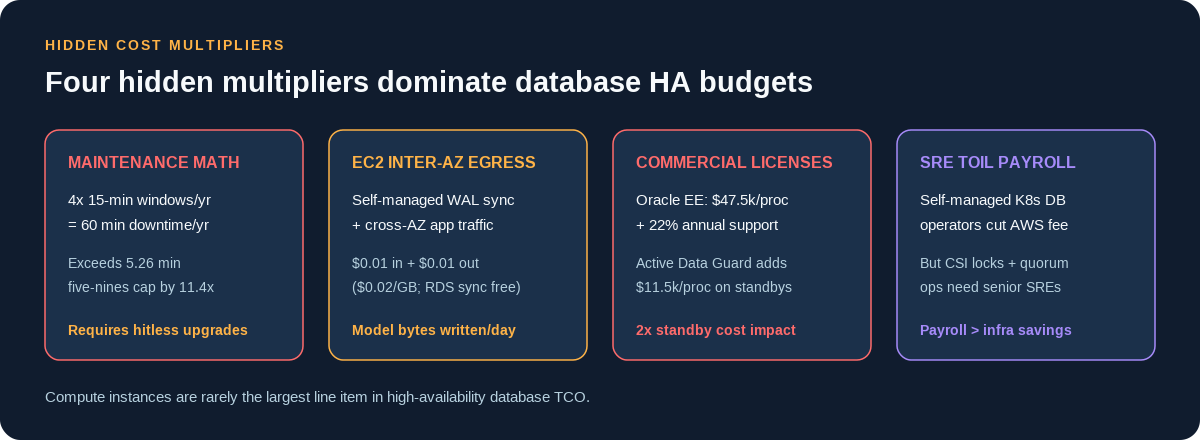
- The Planned Maintenance Math and Failover Budget: A single 15-minute maintenance window once per quarter for OS kernel patches or database point upgrades consumes 60 minutes per year—already exceeding the entire 5.26-minute annual five-nines budget by more than 11x before a single hardware failure occurs. Even on automated failovers, DNS TTL propagation (often 60 seconds), stale connection-pool drain, and WAL crash recovery routinely take 60–180 seconds; a single 3-minute unplanned failover consumes 57% of the year’s 99.999% allowance. True 99.999% requires hitless rolling upgrades, proxy connection draining, and automated sub-second health-check routing.
- Inter-AZ and Cross-Region Network Egress: Managed Amazon RDS Multi-AZ does not charge for internal primary-to-standby replication traffic. However, self-managed databases on EC2 (such as Patroni/PostgreSQL streaming WAL across AZs) and cross-AZ application-to-database traffic incur standard inter-AZ transfer fees of $0.01/GB out + $0.01/GB in ($0.02/GB total). Streaming 10 TB/day across AZs on self-managed EC2 costs $200/day, or ~$6,000/month ($72,000/year) in network transfer alone. Even on managed RDS, an application fleet spread evenly across three AZs sending 5 TB/day of query results from a single-AZ primary sends two-thirds of its traffic across AZ boundaries: $5\text{ TB/day} \times \frac{2}{3} \times 30\text{ days} = 100\text{ TB/month} \times $0.02/\text{GB} \approx $2,048/\text{month}$ ($24,576/year) in unbudgeted cross-AZ egress.
- Commercial Software Licensing Multipliers: Oracle Database Enterprise Edition carries a published list price of $47,500 per processor (multiplied by the 0.5 core factor for modern x86 Intel/AMD processors, so an 8-core server requires 4 processor licenses = $190,000) plus 22% annual support ($41,800/year). While standard Data Guard for a passive mounted DR standby is included with Enterprise Edition, opening a standby for real-time read queries or automatic block repair requires the Active Data Guard option ($11,500 per processor list price), and active standby processing can double full database licensing obligations.
- SRE Payroll vs. Managed DBaaS Markup: Teams sometimes replace managed RDS with self-managed Kubernetes database operators (CloudNativePG, Percona) to avoid the managed-service markup. While raw EC2 + EBS spend drops, managing CSI volume detachments, etcd quorum, and backup verification requires dedicated senior database SRE capacity—payroll that easily exceeds cloud markup at small or medium fleet sizes.
How can platform architects model the fully burdened Total Cost of Ownership across HA tiers so stakeholders fund reliability proportional to real downtime risk?
Options Considered
| Option | What It Gets Right | Where It Breaks | Verdict |
|---|---|---|---|
| Blanket 99.999% everywhere | Maximizes theoretical uptime across all services. | Pays 5x–10x+ TCO for internal tools and async queues that lose negligible revenue per minute. | Rejected — destroys operating margin. |
| Self-managed K8s everywhere | Eliminates cloud DBaaS compute markup. | Dedicated SRE payroll for CSI/quorum ops exceeds managed markup on smaller fleets. | Partial — viable only at large fleet scale. |
| Undersized DR standbys | Cuts standby compute bill in half. | Smaller standby crashes under peak traffic the moment failover promotes it. | Rejected — breaks failover reliability. |
| ROI-gated 3-tier HA menu | Matches SLA, RTO, and RPO to quantified cost per minute of outage. | Requires product and finance teams to price downtime honestly before provisioning. | Chosen — rational capital allocation. |
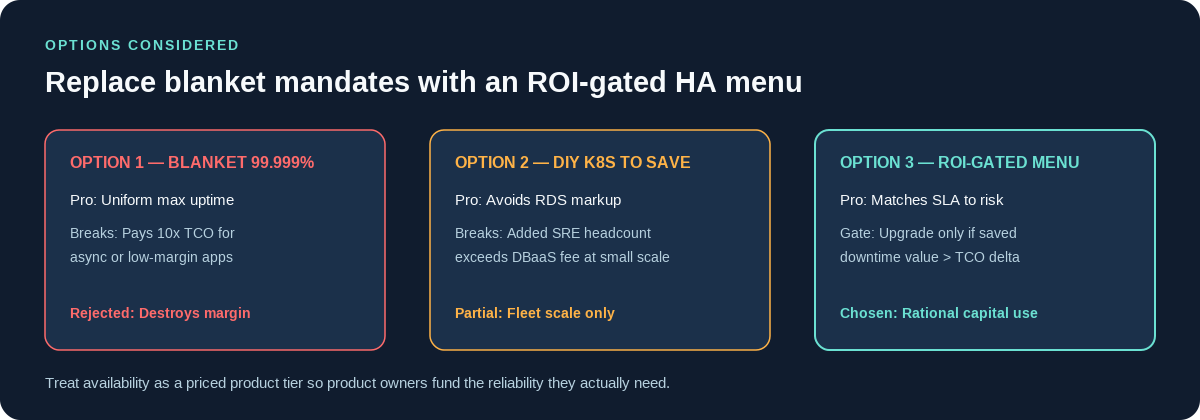
Standardizing on a single “maximum availability” tier wastes capital on asynchronous and internal workloads, while cutting costs by downsizing standbys invalidates failover. The steepest cost cliff sits between intra-region Multi-AZ (99.99%) and multi-region Active-Passive/DR (99.999%): intra-region Multi-AZ roughly doubles compute and storage with sub-2 ms replication latency, whereas crossing regions introduces WAN egress billing, a third-region witness, duplicate observability pipelines, and hitless expand-contract schema migration tooling. An ROI-gated service menu forces every Tier 3 upgrade to clear a financial break-even test.
The Menu-Driven High-Availability TCO Architecture
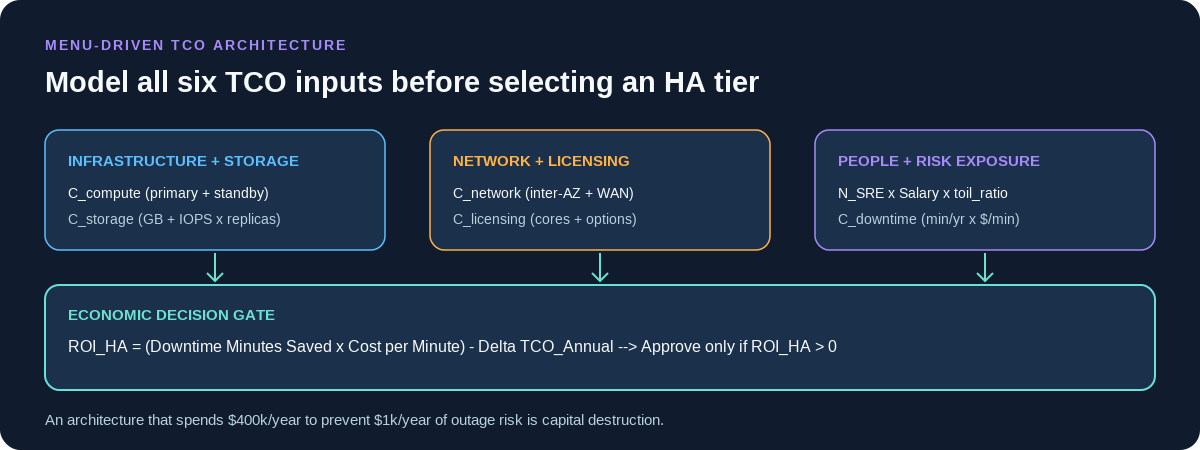
Platform engineering should publish a formal three-tier database catalog pairing concrete SLA, RTO, and RPO targets with annualized TCO, evaluated against a six-component cost formula.
1. The Six-Component Annual TCO Model
$$\text{TCO}{\text{Annual}} = C{\text{compute}} + C_{\text{storage}} + C_{\text{network}} + C_{\text{licensing}} + (N_{\text{SRE}} \times S_{\text{SRE}} \times \alpha_{\text{toil}}) + C_{\text{downtime_risk}}$$
- $C_{\text{compute}}$: Annualized compute across primary, standbys, and witnesses (3-year Reserved/Savings Plans).
- $C_{\text{storage}}$: Provisioned capacity, IOPS, and throughput across all replicas.
- $C_{\text{network}}$: Self-managed inter-AZ WAL transfer, cross-AZ app traffic, and cross-region replication egress.
- $C_{\text{licensing}}$: Amortized commercial processor licenses plus 22% annual support.
- $N_{\text{SRE}} \times S_{\text{SRE}} \times \alpha_{\text{toil}}$: Burdened SRE payroll fraction spent on patching, backups, and failover drills.
- $C_{\text{downtime_risk}}$: Expected annual outage minutes $\times$ verified revenue/SLA cost per minute.
2. The Three Architectural Tiers
- Tier 1 — 99.9% (Three Nines, 8.76 hrs/yr allowance): Single-AZ instance (
db.m6g.xlargeclass) with GP3 storage, daily snapshots, and continuous WAL archiving to S3. RTO is 1–2 hours; RPO is under 5 minutes. Appropriate for internal portals, reporting backends, and staging. - Tier 2 — 99.99% (Four Nines, 52.56 min/yr allowance): Primary plus synchronous standby across two AZs (RDS Multi-AZ or Patroni + etcd) with PgBouncer/Envoy connection pooling. Guarantees $RPO = 0$ and automated failover under 30–60 seconds. Optimal default for customer-facing OLTP APIs. Note that in traditional EBS-backed topologies (RDS Multi-AZ or self-managed Patroni), adding a standby or read replica duplicates the full EBS volume and Provisioned IOPS spend per node, whereas shared-storage engines like Amazon Aurora decouple compute replica count from the underlying 6-copy storage volume.
- Tier 3 — 99.999% (Five Nines, 5.26 min/yr allowance): Multi-region active-passive with local Multi-AZ synchronous quorum, third-region witness, hitless rolling upgrades, and 24/7 SRE coverage. Reserved strictly for payment clearing, card authorization, or real-time trading cores where outages immediately burn revenue and cannot be buffered in queues.
3. The Economic Decision Gate
// Financial Decision Gate evaluating Tier 2 -> Tier 3 Upgrade ROI
type BusinessImpactSpec struct {
    CostPerMinuteOfDowntime float64 // Direct margin loss + SLA penalties
}

type HATier struct {
    Name                  string
    AnnualCost            float64
    AnnualDowntimeMinutes float64
}

func EvaluateOptimalTier(biz BusinessImpactSpec, tier2, tier3 HATier) string {
    minutesSaved := tier2.AnnualDowntimeMinutes - tier3.AnnualDowntimeMinutes // 52.56 - 5.26 = 47.3 min
    valueSaved := minutesSaved * biz.CostPerMinuteOfDowntime
    costDelta := tier3.AnnualCost - tier2.AnnualCost
    netBenefit := valueSaved - costDelta

    if netBenefit > 0 {
        return fmt.Sprintf("APPROVED: %s justified. Net annual value: $%.2f", tier3.Name, netBenefit)
    }
    return fmt.Sprintf("REJECTED: Spending $%.2f/yr to protect $%.2f/yr in outage risk.", costDelta, valueSaved)
}
Consider the arithmetic on a $10M/year retail service where 100% downtime costs ~$19/minute ($1,140/hour). Moving from Tier 2 (52.56 min/yr) to Tier 3 (5.26 min/yr) saves 47.3 minutes per year, worth $898.70/year. Spending an extra $400,000/year on Tier 3 infrastructure to insure against $898.70 of annual downtime risk is financially indefensible.
How It Rolls Out
Transitioning an organization from ad-hoc availability demands to an ROI-gated catalog takes four auditable steps:
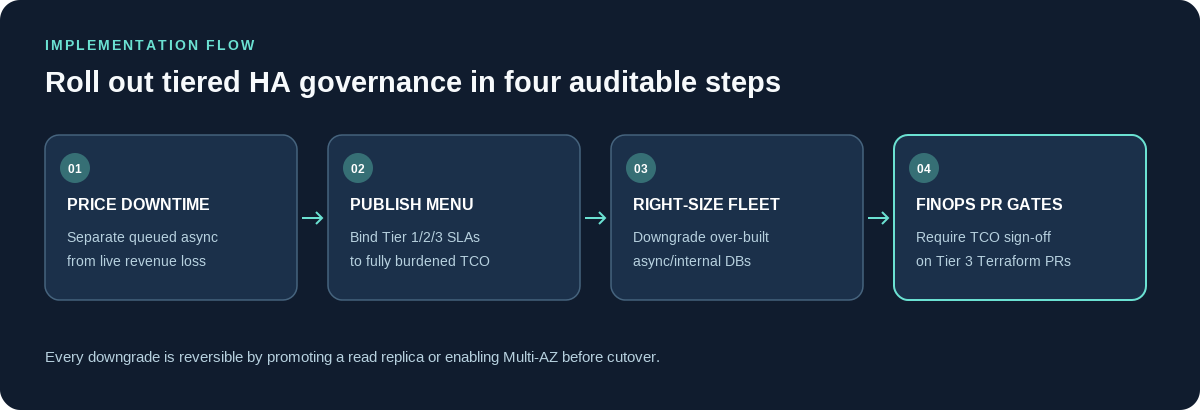
- Phase 1 — Price Downtime Honestly: Classify every workload by whether requests fail permanently during an outage (live checkout) or buffer safely in durable queues (async loan processing, webhooks). Compute true cost per minute using lost contribution margin, not gross revenue. Rollback: none (analysis phase).
- Phase 2 — Publish the Three-Tier Catalog: Pair each Terraform database module (
tier1,tier2,tier3) with its monthly TCO estimate, RTO/RPO SLA, and whether it supports zero-downtime maintenance. Rollback: keep legacy modules deprecated but callable during migration. - Phase 3 — Right-Size Existing Clusters: Downgrade over-provisioned Tier 3 clusters serving async or internal workloads to Tier 2 or Tier 1, and align application pods into the same AZ as their primary where possible to cut cross-AZ egress. Rollback: promote a read replica or toggle Multi-AZ before cutover.
- Phase 4 — Enforce FinOps PR Gates: Add cost-estimation checks (such as Infracost or OpenCost) to database Terraform PRs so any Tier 3 request requires written sign-off on the
EvaluateOptimalTierROI calculation. Rollback: disable the PR gate check if it blocks emergency capacity scaling.
In Practice
The cost multipliers and architectural boundaries in this model derive from published cloud pricing and database engine behavior:
- AWS Data Transfer vs. Managed RDS Multi-AZ: AWS documentation explicitly distinguishes between managed RDS Multi-AZ replication traffic (which is free between the primary and standby) and cross-AZ application-to-database or self-managed EC2 database replication traffic (which is billed at $0.01/GB in and $0.01/GB out, or $0.02/GB total). Teams migrating off RDS onto self-managed EC2 Patroni clusters frequently miss this line item in TCO comparisons.
- Oracle Processor Licensing Rules: Under Oracle’s published Technology Global Price List, Enterprise Edition is $47,500 per processor with 22% annual support, scaled by the Processor Core Factor (0.5 for Intel Xeon and AMD EPYC). Standard Data Guard is included for passive mounted DR, whereas opening a standby for real-time read queries requires Active Data Guard ($11,500 per processor) across the environment.
- Amazon Aurora Storage Decoupling: Aurora separates compute from a distributed storage volume that maintains 6 copies across 3 Availability Zones (2 copies per AZ), tolerating the loss of up to 2 copies for writes and 3 copies for reads without compute-driven block replication.
- CARL Acknowledgment: The arithmetic examples in this post use published list prices and AWS Well-Architected availability math rather than private corporate financial records.
Where It Breaks
| Condition | Breaks How | Detect | Mitigate |
|---|---|---|---|
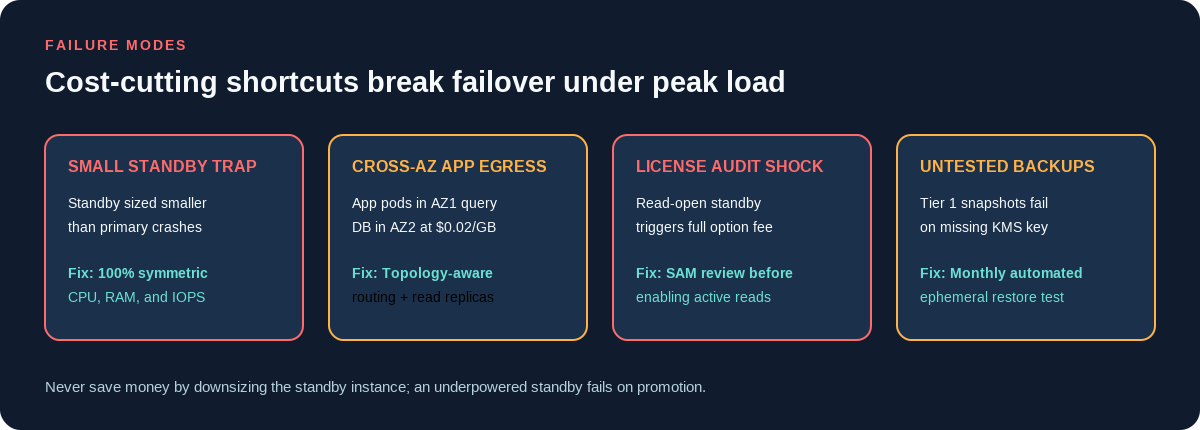
| Undersized DR standby | Standby has fewer vCPUs/RAM than primary; crashes immediately upon failover promotion. | CPU/OOM spike during failover chaos test. | Mandate 100% symmetric CPU, RAM, and IOPS sizing on fail-over standbys. |
| Cross-AZ app-to-DB egress | App pods in AZ1 query RDS primary in AZ2 at $0.02/GB total. | Unexpected DataTransfer-Regional-Bytes line item on cloud bill. | Enable topology-aware routing or AZ-local read replicas for read-heavy paths. |
| Commercial license audit | Standby opened for read queries without licensing Active Data Guard. | Software Asset Management (SAM) audit finding. | Run formal SAM review before enabling read offload on commercial standbys. |
| Cross-region sync latency | Synchronous replication across WAN regions adds 70 ms+ per commit. | Write p99 latency spikes and connection pool exhaustion. | Restrict synchronous replication to intra-region AZs (< 2 ms); use async cross-region. |
| Manual patching on “5-nines” DB | Architecture has multi-AZ HA, but human executes OS/DB patch out of sequence. | Unplanned outage consuming >5.26 min annual budget. | Automate rolling upgrades via durable workflows and hitless proxy draining. |
| K8s CSI volume detach stall | Pod fails over, but EBS CSI driver hangs detaching volume from dead node. | Pod stuck in ContainerCreating past RTO target. | Test CSI detach timeouts and enforce node fencing before volume re-attach. |
| Untested Tier 1 backups | Snapshot exists, but KMS key policy or catalog corruption blocks restore. | Failed monthly restore drill. | Automate monthly ephemeral restore tests that verify table counts and checksums. |
A practical TCO review also accounts for IOPS headroom and backup-retention compounding across tiers. When a team upgrades a single-AZ database to synchronous Multi-AZ or adds cross-region read replicas, storage and provisioned IOPS charges scale linearly with every full physical copy, and automated snapshot retention plus transaction-log archives grow with write churn rather than static table size. Modeling storage IOPS, cross-AZ data transfer, and commercial processor cores together inside the Terraform catalog ensures engineering leads compare full monthly run-rates rather than base compute hourly prices alone.
Key Takeaways
- Every additional nine saves 10x less downtime at 5x–10x+ the cost: Jumping from 99.99% to 99.999% saves only 47.3 minutes per year while eliminating planned maintenance windows.
- Know what AWS bills for inter-AZ traffic: Managed RDS Multi-AZ replication is free, but self-managed EC2 WAL streaming and cross-AZ app-to-DB queries cost $0.02/GB total.
- Model SRE payroll alongside cloud markup: Self-managed Kubernetes database operators only beat managed DBaaS TCO when fleet size amortizes dedicated database SRE headcount.
- Never downsize standbys to save money: A smaller standby will collapse under peak production concurrency the moment failover promotes it.
- Gate Tier 3 requests on ROI math: Only approve 99.999% when the value of 47.3 saved downtime minutes per year exceeds the full annualized TCO delta.
What to Do Next
- Problem: Audit your database estate for services running expensive multi-region or commercial HA tiers without a documented cost-per-minute outage justification.
- Solution: Publish a three-tier HA service catalog (99.9%, 99.99%, 99.999%) with fully burdened TCO (compute, storage, network, licensing, SRE toil).
- Proof: Check your last cloud bill for
DataTransfer-Regional-Bytesand verify whether your standbys are symmetrically sized to handle peak primary load. - Action: This week, compute
EvaluateOptimalTierfor your top three production databases and add a TCO sign-off gate to Tier 3 Terraform modules.
Sources
- AWS Pricing & Knowledge Center — Amazon RDS Multi-AZ Replication and EC2 Inter-AZ Data Transfer (repost.aws)
- Amazon Aurora Documentation — Aurora Storage Architecture (6 Copies / 3 AZs) (docs.aws.amazon.com)
- Oracle Technology Global Price List — Database Enterprise Edition & Active Data Guard Processor Metrics (oracle.com)
- Google Site Reliability Engineering — Embracing Risk and Availability Math (sre.google/sre-book/)