
Zero-Trust Oracle Database Security on Oracle AI Database@AWS: mTLS, Security Groups, and Identity-Bound Access
Colocating Oracle Exadata inside an AWS Availability Zone collapses cross-cloud network latency to sub-millisecond round-trips, which also removes the physical firewall boundary that previously separated EKS workloads from port 1521.
TL;DR
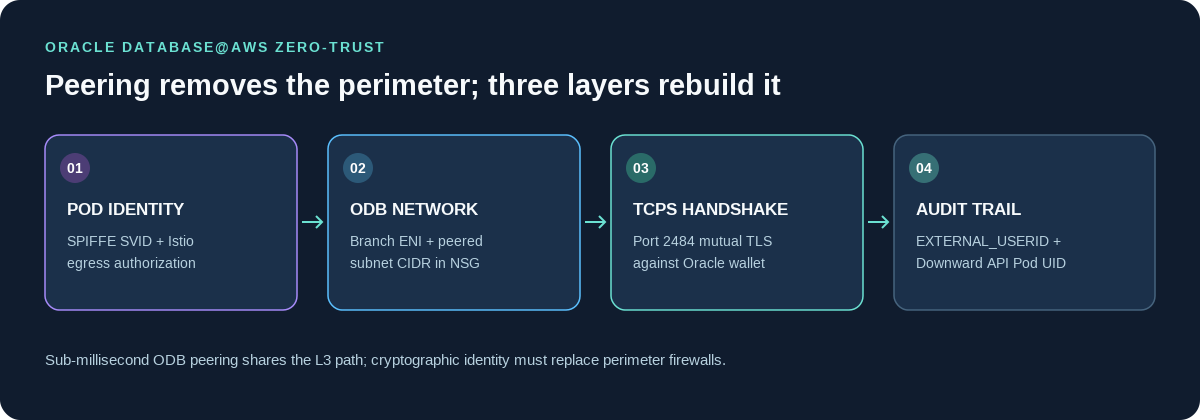
- Problem: ODB peering places EKS pods and Exadata listeners on a flat private network where node-level Security Groups cannot isolate individual pods or attribute database sessions to Kubernetes workloads.
- Answer: Combine three enforcement planes: EKS Security Groups for Pods (branch ENIs on a dedicated subnet CIDR), SPIFFE/SPIRE short-lived X.509 SVIDs with Istio egress
AuthorizationPolicy, and Oracle TCPS (SSL_CLIENT_AUTHENTICATION = TRUE) on port 2484 withDBMS_SESSION.SET_IDENTIFIER.- Watch out: Branch ENIs consume one trunk ENI slot per Nitro node, AWS Security Group references do not cross ODB peering into OCI-managed NSGs, and Oracle 19c requires RU 19.32 or later with the next-gen cryptographic provider for TLS 1.3.
Situation
Oracle Database@AWS (including Oracle AI Database@AWS) provisions Oracle Exadata Database Service and Autonomous Database clusters on OCI-managed infrastructure physically hosted inside AWS data centers. Instead of routing application traffic over an IPsec VPN or AWS Direct Connect link to an external OCI region, the service attaches the Exadata VM cluster to an ODB network (Oracle Database Network) inside the same AWS Availability Zone. Application workloads running in Amazon EKS connect to the Exadata SCAN listeners over an ODB peering connection.
When an ODB network is created, Oracle automation provisions a baseline set of seven default Network Security Groups (NSGs) to govern intra-cluster RAC traffic, listener ingress, backup traffic to Amazon S3, and DNS/management flows. On the AWS side, administrators control which Amazon VPCs peer with the ODB network and which subnet CIDRs are permitted to reach the Exadata listener ports.
The operational shift is significant. In a traditional AWS-to-OCI topology, security teams relied on transit gateways, AWS Network Firewall, or OCI firewall appliances at the cross-cloud boundary. With ODB peering inside the Availability Zone, those perimeter chokepoints are bypassed by default to preserve OLTP latency. If an engineering team peers a broad EKS worker-node subnet CIDR into the ODB network without workload-level controls, any pod scheduled on those worker nodes inherits L3 reachability to the Exadata listener.
The Problem
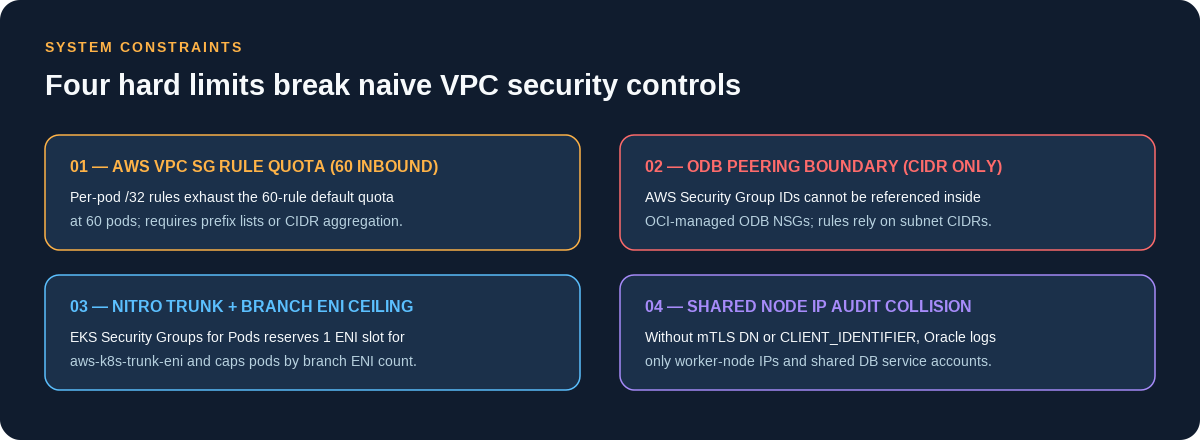
Enforcing zero-trust access between ephemeral Kubernetes pods and an Exadata VM cluster over ODB peering runs into four concrete architectural constraints:
- AWS VPC Security Group rule quota (60 inbound rules default). By default, AWS limits each Security Group to 60 inbound and 60 outbound rules (adjustable via AWS Service Quotas, but still bounded by total rules per ENI). Writing per-pod
/32CIDR rules exhausts a 60-rule Security Group at 60 pods. In a 1,000-pod EKS cluster where pod IPs churn during deployments and autoscaling, tracking individual pod IPs in Security Groups or ODB NSG CIDR lists is operationally unworkable:1,000 pods / 60 rules per SG = 17 Security Groupsjust to enumerate IPs that change every rolling restart. - ODB peering does not support AWS Security Group ID referencing. Within a single Amazon VPC (or standard same-region VPC peering), an EC2 Security Group can reference another Security Group ID (
--source-group sg-...) so rules track ENI membership automatically. Across an ODB peering boundary into OCI-managed ODB NSGs, Security Group IDs are not valid rule targets; the ODB NSG filters traffic by peered IP CIDR blocks (typically the EKS pod subnet CIDR). - EKS Security Groups for Pods consumes Nitro ENI capacity. Amazon EKS does provide a native pod-level Security Group mechanism (
SecurityGroupPolicywithENABLE_POD_ENI=truein the Amazon VPC CNI). On AWS Nitro instances, the VPC Resource Controller attaches oneaws-k8s-trunk-eniper node and assignsaws-k8s-branch-eniinterfaces to matching pods. However, the trunk interface occupies one of the node’s standard ENI slots—meaning autoscalers like Karpenter must setRESERVED_ENIS=1or miscalculatemax-podsand fail pod scheduling—and non-Nitro or burstable instances such ast3.mediumdo not support ENI trunking at all. - Shared node IPs break database audit attribution. In standard EKS networking without branch ENIs, outbound connections from pods share the worker node’s ENI or pod subnet NAT. Oracle’s
UNIFIED_AUDIT_TRAILrecords the client host/IP and database username, not the Kubernetes namespace or Pod UID. When a shared application service account is used by multiple microservices,V$SESSIONandUNIFIED_AUDIT_TRAILcannot distinguish which pod issued a query without correlating VPC Flow Logs, Kubernetes API audit logs, and connection timestamps after the fact.
How do you enforce pod-level network isolation and cryptographic database session identity across an ODB peering boundary without exceeding AWS ENI/rule quotas or breaking Exadata listener performance?
Options Considered
Platform teams evaluating EKS-to-Exadata access control typically consider four architectures. None of the single-layer approaches satisfy both network isolation and database auditability.
| Option | Isolation Granularity | Crosses ODB Peering? | Audit Attribution | Why Chosen / Rejected |
|---|---|---|---|---|
| Node-Group Security Group | Worker node ENI | CIDR only | Node IP + shared DB user | Rejected: Any compromised pod on the node shares the node’s egress access to port 1521/2484. |
| EKS Security Groups for Pods only | Pod branch ENI | CIDR only (unless isolated subnet) | Pod branch IP + shared DB user | Partial: Isolates pod egress on Nitro nodes, but ODB NSGs still see CIDR blocks and Oracle sees no cryptographic pod identity. |
| Static Oracle Wallet in K8s Secrets | Pod secret mount | Yes (via TCPS) | Mapped cert DN | Rejected: Long-lived private keys in Kubernetes Secrets create rotation toil and credential sprawl if a pod is compromised. |
| Layered Mesh + Branch ENI + TCPS | Pod SVID + Branch ENI + DB cert | Yes (dedicated DB-client subnet + TCPS 2484) | EXTERNAL_USERID + CLIENT_IDENTIFIER | Chosen: Combines network subnet isolation, Istio egress policy, short-lived SPIRE SVIDs, and Oracle TCPS mutual TLS. |
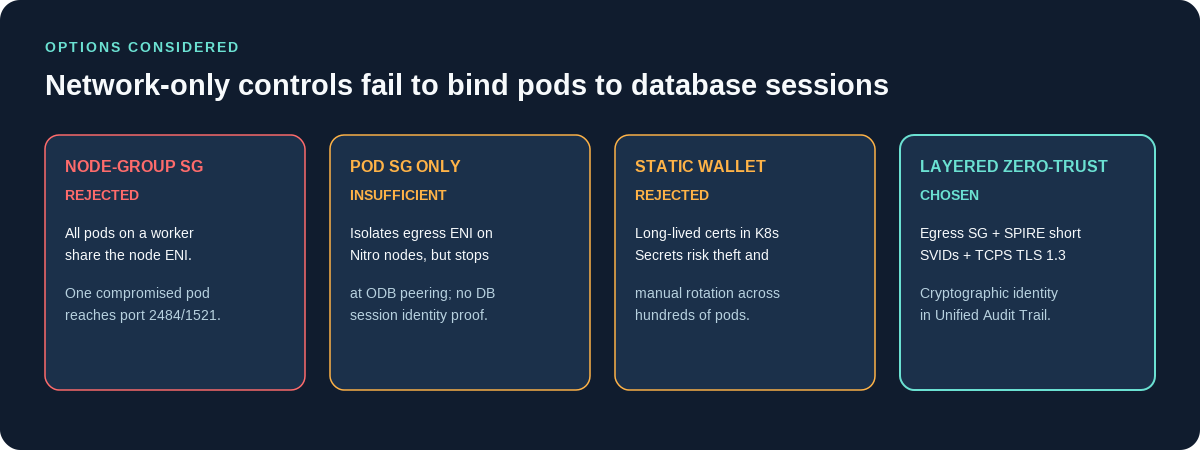
Using EKS Security Groups for Pods alone is tempting because it stays native to AWS. The limitation is twofold: first, if DB-client pods share the same pod subnet CIDR as non-DB pods, the ODB NSG on the Exadata side cannot tell them apart because ODB NSGs filter by CIDR, not AWS Security Group ID. You can work around that by assigning DB-client pods to a dedicated secondary pod subnet via custom VPC CNI networking (ENI_CONFIG), which gives the ODB NSG a clean CIDR boundary. Even then, network-layer isolation stops at the TCP socket—it does not authenticate the workload to Oracle or write a workload identifier into UNIFIED_AUDIT_TRAIL.
Conversely, relying on static Oracle wallets mounted as Kubernetes Secrets provides TCPS mutual TLS without a service mesh, but forces platform teams to manage manual CA and leaf-certificate rotation across every deployment. Short-lived X.509 SVIDs issued by SPIRE eliminate static client keys while preserving cryptographic authentication at the Oracle listener.
The Layered Zero-Trust Architecture
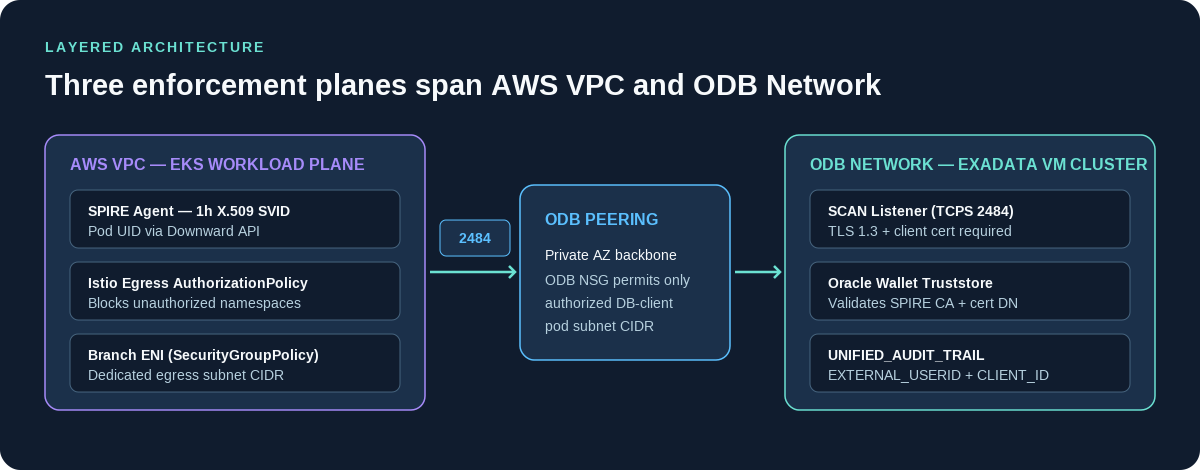
The target design separates enforcement into three independent planes—AWS VPC workload networking, SPIFFE/Istio workload identity, and Exadata ODB Network + Oracle TCPS—so bypassing any single layer is insufficient to query the database.
Plane 1: AWS VPC and Dedicated Pod Egress Subnet
On the EKS side, DB-authorized pods are scheduled onto AWS Nitro worker nodes configured with ENABLE_POD_ENI=true and RESERVED_ENIS=1 (in Karpenter or node-group bootstrap). A SecurityGroupPolicy binds a dedicated AWS Security Group (sg-oracle-clients) to pods carrying the label db-access: oracle-exadata. Using VPC CNI custom networking, those branch ENIs draw IPs from a dedicated /24 or /25 pod subnet (10.20.40.0/24), while general application pods draw from a separate subnet (10.20.10.0/22).
In the ODB Network’s OCI-managed NSG for the Exadata VM cluster, ingress on TCP port 2484 (TCPS) is restricted strictly to 10.20.40.0/24—never the entire VPC CIDR. Port 1521 (unencrypted SQL*Net) is removed from the ODB NSG once migration completes.
# Retrieve the EKS cluster security group (not remoteAccessSecurityGroup, which is SSH-only)
EKS_CLUSTER_SG=$(aws eks describe-cluster \
  --name "${EKS_CLUSTER}" \
  --query 'cluster.resourcesVpcConfig.clusterSecurityGroupId' \
  --output text)

# Create a dedicated Security Group for pods authorized to reach Exadata TCPS
ORACLE_CLIENT_SG=$(aws ec2 create-security-group \
  --group-name "sg-eks-oracle-tcps-clients" \
  --description "Egress SG for EKS pods authorized for Oracle Database@AWS TCPS" \
  --vpc-id "${VPC_ID}" \
  --query 'GroupId' --output text)

# A new security group allows all egress by default; remove that rule first,
# otherwise the "only Exadata" restriction below is not enforced
aws ec2 revoke-security-group-egress \
  --group-id "${ORACLE_CLIENT_SG}" \
  --ip-permissions '[{"IpProtocol":"-1","IpRanges":[{"CidrIp":"0.0.0.0/0"}]}]'

# Permit outbound TCPS (2484) only to the Exadata ODB subnet CIDR
aws ec2 authorize-security-group-egress \
  --group-id "${ORACLE_CLIENT_SG}" \
  --protocol tcp \
  --port 2484 \
  --cidr "${ODB_EXADATA_SUBNET_CIDR}"
Plane 2: SPIFFE/SPIRE Workload Identity and Istio Egress Policy
SPIRE runs as a DaemonSet on EKS nodes and attests each pod via the Kubernetes workload API before issuing a 1-hour X.509 SVID (ttl: 3600s). Only pods matching both the Kubernetes ServiceAccount and the db-access: oracle-exadata label receive an SVID scoped for database access. Istio can enforce that only those SPIFFE principals reach port 2484 on the Exadata SCAN endpoint, but only at an egress gateway: an AuthorizationPolicy on the application pod filters inbound traffic and would not restrict egress. Route the Exadata ServiceEntry through the egress gateway and attach the policy there.
apiVersion: spire.spiffe.io/v1alpha1
kind: ClusterSPIFFEID
metadata:
  name: payment-api-oracle-access
spec:
  spiffeIDTemplate: "spiffe://cluster.local/ns/{{ .PodMeta.Namespace }}/sa/{{ .PodSpec.ServiceAccountName }}"
  podSelector:
    matchLabels:
      app: payment-api
      db-access: "oracle-exadata"
  ttl: 3600s
---
apiVersion: security.istio.io/v1beta1
kind: AuthorizationPolicy
metadata:
  name: oracle-exadata-egress-allow
  namespace: istio-system
spec:
  # Applied on the egress gateway, not the app pod: AuthorizationPolicy only enforces
  # on inbound traffic to the selected workload. Requires a ServiceEntry for the Exadata
  # SCAN endpoint and routing that traffic through the egress gateway.
  selector:
    matchLabels:
      istio: egressgateway
  action: ALLOW
  rules:
    - from:
        - source:
            principals: ["cluster.local/ns/payments/sa/payment-api"]
      to:
        - operation:
            ports: ["2484"]
Plane 3: Exadata TCPS, Oracle Wallet, and Audit Attribution
It is important to be exact about what an Istio Envoy sidecar does and does not do: Envoy is a TCP/TLS proxy. It does not parse Oracle TNS/SQL*Net packets or inject fields like OS_PROGRAM or CLIENT_IDENTIFIER into the Oracle wire protocol. Instead, workload identity enters Oracle through two explicit mechanisms:
- Client certificate validation at the Oracle listener: When the client (or TLS-originating proxy) presents an X.509 certificate signed by the trusted SPIRE CA inside the Oracle wallet,
SSL_CLIENT_AUTHENTICATION = TRUEvalidates the certificate chain during the TCPS handshake. If the database account is configured for external SSL authentication (IDENTIFIED EXTERNALLY AS 'CN=...'), Oracle records the verified identity inSYS_CONTEXT('USERENV', 'AUTHENTICATED_IDENTITY')andEXTERNAL_USERIDinUNIFIED_AUDIT_TRAIL. - Pod UID propagation via Downward API: For connection pools that authenticate with a service account or OCI IAM token, the application reads
metadata.uidfrom the Kubernetes Downward API and callsDBMS_SESSION.SET_IDENTIFIERon connection checkout soV$SESSION.CLIENT_IDENTIFIERandUNIFIED_AUDIT_TRAIL.CLIENT_IDENTIFIERcapture the exact Pod UID.
On Oracle Database 19c, TLS 1.3 requires Release Update 19.32 or later with the next-generation cryptographic provider enabled; earlier 19c RUs support TLS 1.2 (TLS_VERSION = (1.2)). Oracle Database 23ai supports TLS 1.3 natively. Oracle also recommends TLS_VERSION over the legacy SSL_VERSION parameter.
# sqlnet.ora on Exadata VM Cluster nodes
SQLNET.ENCRYPTION_SERVER       = REQUIRED
SQLNET.ENCRYPTION_TYPES_SERVER = (AES256)
SQLNET.CRYPTO_CHECKSUM_SERVER  = REQUIRED

SSL_CLIENT_AUTHENTICATION      = TRUE
TLS_VERSION                    = (1.2, 1.3)   # 19c uses SSL_VERSION; newer releases document TLS_VERSION. Use the parameter your release documents.
WALLET_LOCATION                = (SOURCE = (METHOD = FILE) (METHOD_DATA = (DIRECTORY = /var/opt/oracle/dbaas_acfs/grid/wallet)))
On Exadata, listeners are managed by Oracle Grid Infrastructure (srvctl), not a standalone HOST = 0.0.0.0 listener.ora. You add the TCPS endpoint to the SCAN and node listeners using srvctl modify scan_listener and srvctl modify listener, then verify endpoints with lsnrctl status.
# Add TCPS port 2484 to Exadata SCAN listener via Grid Infrastructure
srvctl modify scan_listener -p TCP:1521/TCPS:2484
srvctl reload scan_listener

# Create auto-login wallet and import SPIRE cluster CA
orapki wallet create -wallet /var/opt/oracle/dbaas_acfs/grid/wallet -auto_login -pwd "${WALLET_PWD}"
orapki wallet add -wallet /var/opt/oracle/dbaas_acfs/grid/wallet \
  -trusted_cert -cert /tmp/spire-cluster-ca.pem -pwd "${WALLET_PWD}"
orapki wallet display -wallet /var/opt/oracle/dbaas_acfs/grid/wallet
To verify session attribution in UNIFIED_AUDIT_TRAIL, query AUTHENTICATION_TYPE, EXTERNAL_USERID, and CLIENT_IDENTIFIER rather than OS_PROGRAM:
SELECT event_timestamp,
       dbusername,
       authentication_type,
       external_userid,
       client_identifier,
       action_name,
       return_code
FROM   unified_audit_trail
WHERE  event_timestamp > SYSTIMESTAMP - INTERVAL '1' HOUR
  AND  (external_userid IS NOT NULL OR client_identifier LIKE 'k8s-pod-%')
ORDER BY event_timestamp DESC
FETCH FIRST 50 ROWS ONLY;
How It Rolls Out
Cutover from unencrypted port 1521 to zero-trust TCPS on port 2484 should run in four gated phases so application teams can roll back by switching a JDBC connection string without touching Exadata binaries.
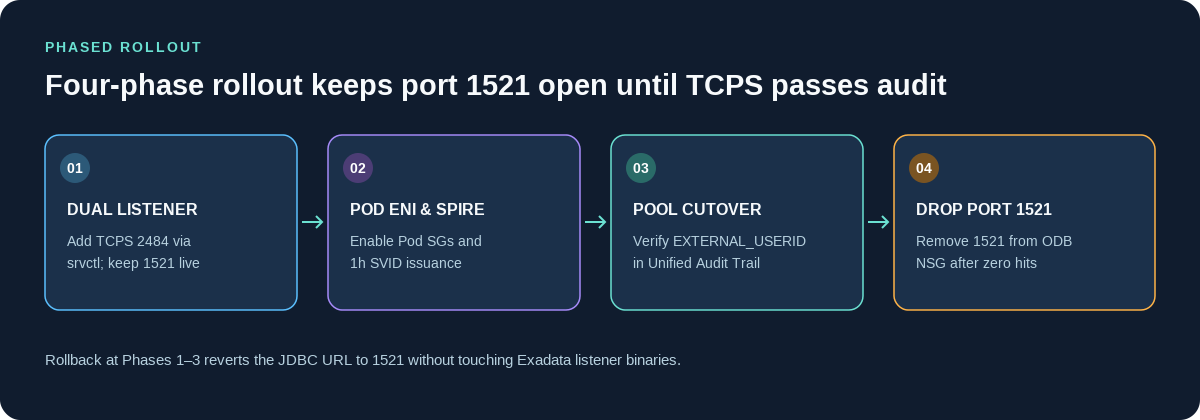
- Phase 1 — Dual Listener and Wallet Truststore. Create the Oracle auto-login wallet on the Exadata VM cluster, import the SPIRE cluster CA, set
TLS_VERSION = (1.2, 1.3)insqlnet.ora, and addTCPS:2484alongsideTCP:1521usingsrvctl modify scan_listener. Validation gate: Verify a test client with a valid SVID completes a TCPS handshake on 2484 while production traffic continues undisturbed on 1521. Rollback: RemoveTCPS:2484viasrvctl. - Phase 2 — Dedicated Pod Egress Subnet and Branch ENIs. Enable
ENABLE_POD_ENI=trueandRESERVED_ENIS=1on a dedicated Nitro node pool, deploy theSecurityGroupPolicyandClusterSPIFFEID, and open port 2484 in the ODB NSG exclusively for the dedicated pod subnet CIDR. Validation gate: Confirm pods schedule withoutFailedCreatePodSandBoxENI errors andkubectl describe podshows the branch ENI IP from the dedicated subnet. Rollback: Remove thedb-access: oracle-exadatapod label to revert to standard node-pool scheduling. - Phase 3 — JDBC Pool Cutover and Audit Verification. Update application JDBC URLs to
PROTOCOL=TCPSon port 2484, set connection poolmaxLifetimeto 50 minutes (3000s, strictly below the 3600s SVID TTL), and inject the Downward API Pod UID viaDBMS_SESSION.SET_IDENTIFIER. Validation gate: ConfirmUNIFIED_AUDIT_TRAILrecordsTCPSinAUTHENTICATION_TYPEand non-nullEXTERNAL_USERID/CLIENT_IDENTIFIERfor 100% of active sessions. Rollback: Revert the JDBC URL to port 1521 in the application ConfigMap. - Phase 4 — Port 1521 Removal. Monitor
UNIFIED_AUDIT_TRAILand ODB flow logs until port 1521 shows zero connections across a full batch/business cycle, then remove TCP 1521 from the ODB NSG andsrvctl modify scan_listener.
In Practice
- ODB Network isolation behavior (AWS & Oracle documentation): Oracle Database@AWS isolates Exadata VM clusters inside an ODB network governed by seven default OCI-managed NSGs, connected to customer Amazon VPCs via ODB peering. Because AWS Security Group IDs do not cross ODB peering, placing DB-authorized EKS pods on a dedicated subnet CIDR via VPC CNI custom networking is what makes ODB NSG CIDR rules enforceable at the workload tier.
- AWS EKS Security Groups for Pods behavior (AWS EKS documentation): Enabling
ENABLE_POD_ENI=trueattaches anaws-k8s-trunk-eniinterface to Nitro worker nodes. UnlessRESERVED_ENIS=1is configured in Karpenter or node-groupmax-podscalculations, the scheduler overestimates available ENI slots and leaves pods stuck inContainerCreating. - Oracle Database@AWS IAM authentication distinction: Unlike Amazon RDS (which uses
aws rds generate-db-auth-tokenfor 15-minute AWS IAM tokens on supported engines), Oracle Database@AWS uses AWS IAM for infrastructure control-plane and AWS KMS TDE key management, while database-level token federation relies on OCI IAM identity domains or Oracle certificate/wallet authentication. Teams expectingaws rds generate-db-auth-tokento work against Exadata on Oracle Database@AWS must use OCI IAM tokens or TCPS client certificates instead. - Oracle 19c vs. 23ai TLS 1.3 behavior (Oracle Net Services documentation): Enforcing
TLS_VERSION = (1.3)against an Oracle 19c home patched below RU 19.32 fails at listener startup or handshake because the default legacy 19c cryptographic provider only supports up to TLS 1.2. Supporting(1.2, 1.3)during upgrades prevents cipher-negotiation outages.
Where It Breaks
| Condition | Breaks How | Detect | Mitigate |
|---|---|---|---|
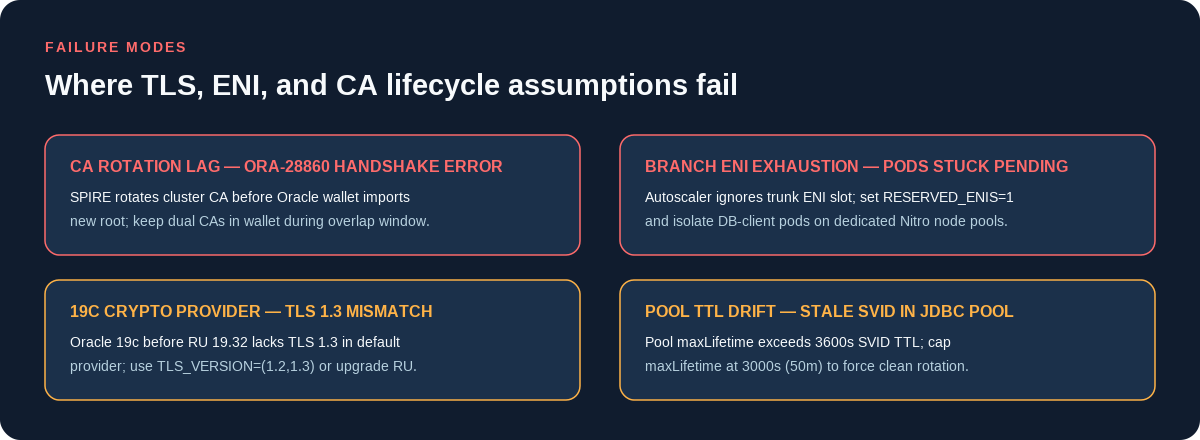
| SPIRE CA rotates before Exadata wallet updates | Existing JDBC pools fail TLS renegotiation with ORA-28860 fatal SSL error once the old CA expires | Monitor ORA-28860 spikes in listener log.xml and pool checkout errors | Automate wallet update via OCI/Oracle management before old CA NotAfter; keep both old and new CAs in the wallet during overlap |
| Karpenter / node autoscaler ignores trunk ENI | aws-k8s-trunk-eni consumes 1 ENI slot; pods stall in Pending or ContainerCreating at scale | Kubernetes events showing InsufficientAttachableENIs or VPC CNI allocation failures | Set RESERVED_ENIS=1 in Karpenter EC2NodeClass and isolate DB-client pods on dedicated Nitro node pools |
| Oracle 19c pre-19.32 configured for TLS 1.3 only | Default legacy cryptographic provider rejects TLS 1.3 handshakes; all new connections fail | lsnrctl status and sqlnet.log reporting unsupported TLS version | Patch to 19.32+ with next-gen crypto provider or set TLS_VERSION = (1.2, 1.3) |
JDBC maxLifetime exceeds 3600s SVID TTL | Pooled connections hold expired client certificates until pool eviction, causing intermittent failures | Mixed ORA-28860 errors correlated with pod age > 1 hour | Cap JDBC maxLifetime at 3000s (50 minutes) so pools refresh before the 1-hour SVID expires |
| High connection churn on TCPS listener | Per-connection TLS 1.3 handshakes increase listener and sidecar CPU utilization (measure the overhead under your own target connections per second) | Listener process CPU saturation and rising sqlnet connect latency | Use persistent JDBC connection pools (UCP/HikariCP) or terminate client TLS at Oracle Connection Manager (CMAN) |
| Exadata DomU wallet exposed on host | Compromised OS user with oracle privileges reads auto-login cwallet.sso | File integrity monitoring alerts on wallet directory | Restrict wallet permissions (0600 oracle:oinstall), enable OCI Vault / KMS backing where supported, and rotate CAs on host compromise |
Key Takeaways
- ODB peering removes the cross-cloud firewall without adding AWS SG referencing: Because OCI-managed ODB NSGs filter by CIDR rather than AWS Security Group IDs, DB-authorized EKS pods need a dedicated egress subnet CIDR via VPC CNI custom networking.
- EKS Security Groups for Pods is necessary for egress isolation, not sufficient for DB identity: Branch ENIs stop unauthorized pods at the VPC layer, but Nitro
aws-k8s-trunk-eniconsumes one ENI slot per node (RESERVED_ENIS=1) and still leaves Oracle blind to which pod owns a session. - Istio Envoy does not rewrite Oracle TNS packets: Do not rely on a service mesh sidecar to populate
OS_PROGRAMorCLIENT_IDENTIFIER; pass workload identity through Oracle TCPS client certificates (EXTERNAL_USERID) or explicitDBMS_SESSION.SET_IDENTIFIERcalls using the Downward API Pod UID. - Match JDBC pool
maxLifetimeto SVID TTL: Setting poolmaxLifetimebelow the 1-hour SPIRE SVID lifetime (3000svs.3600s) prevents connection pools from serving stale certificates across rotations. - Keep port 1521 dual-stacked until
UNIFIED_AUDIT_TRAILproves 100% TCPS coverage: Usingsrvctl modify scan_listener -p TCP:1521/TCPS:2484gives every microservice a zero-downtime rollback path during cutover.
What to Do Next
- Problem: ODB peering puts EKS pods and Exadata listeners on a flat sub-millisecond network where broad subnet CIDRs expose port 1521 to every container in the cluster.
- Solution: Isolate DB-authorized pods onto a dedicated egress subnet with EKS Security Groups for Pods, enforce short-lived SPIRE SVIDs via Istio
AuthorizationPolicy, and require Oracle TCPS (SSL_CLIENT_AUTHENTICATION = TRUE) on port 2484 withDBMS_SESSION.SET_IDENTIFIER. - Proof: Query
UNIFIED_AUDIT_TRAILafter Phase 3 cutover and confirmAUTHENTICATION_TYPEshowsTCPSwith non-nullEXTERNAL_USERIDorCLIENT_IDENTIFIERfor every application session. - Action: Inspect your ODB Network NSGs and AWS Security Groups this week for any ingress rule permitting TCP
1521from a general worker-node or VPC-wide CIDR, and schedule Phase 1 dual-listener (TCPS:2484) enablement in non-production.
Interactive tools for this topic