
From OPatch to Immutable Oracle Homes: Why Out-of-Place Patching Wins
Patching the active Oracle Home couples binary mutation, relinking, inventory updates, database downtime, and recovery into one maintenance-window transaction; an out-of-place home moves most of that uncertainty into a testable build artifact, but rollback is safe only when binary and SQL patch state are designed together.
TL;DR
- Problem: Running
opatch applyagainst the active$ORACLE_HOMEputs archive extraction, conflict detection, relinking, and inventory writes inside the production downtime window.- Answer: Build and verify the next
$ORACLE_HOMEoffline withrunInstaller -applyRU, then use the maintenance window only to stop instances, pivotsrvctlor/etc/oratab, start on the new home, and rundatapatch.- Watch out: Preserving the old binary home does not make SQL changes automatically reversible—once
datapatchmutatesCDB_REGISTRY_SQLPATCH, rollback requires the patch README’s SQL reconciliation or a backup restore.
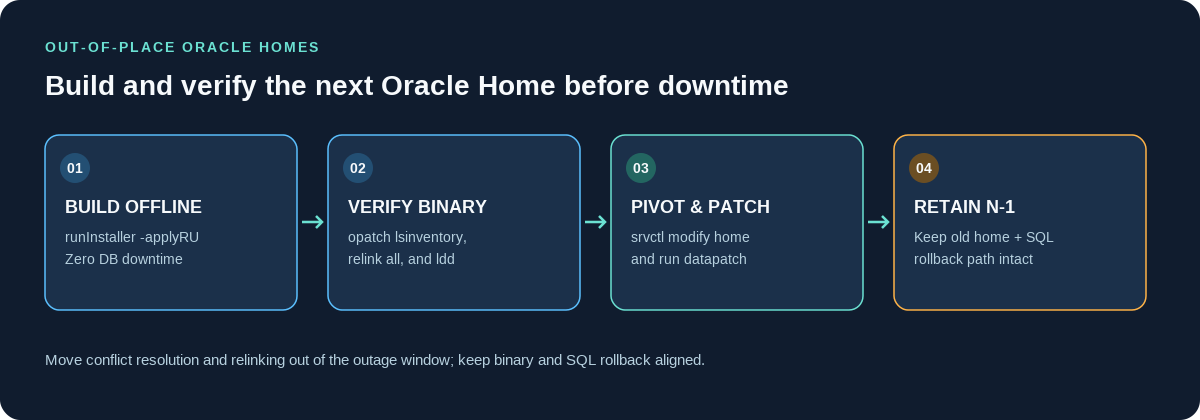
Production Context: 2022 | Enterprise Oracle Infrastructure | Technical Review: September 2026
Situation
Enterprise database administration teams responsible for mission-critical Oracle database estates operate under continuous pressure to apply quarterly Release Updates (RUs), security vulnerability fixes (Critical Patch Updates / CPUs), and interim bug fixes. In organizations operating dozens of standalone servers, Oracle Real Application Clusters (RAC), and Exadata machines, maintaining binary currency is mandatory to eliminate software bugs, patch Common Vulnerabilities and Exposures (CVEs), and retain Oracle Premier Support.
Historically, the universal standard operating procedure for Oracle patching was In-Place Patching. When an RU arrived, the Database Administrator (DBA) scheduled a weekend maintenance window, notified business stakeholders of planned downtime, brought down the production database instances and listeners running out of $ORACLE_HOME, and invoked the opatch apply utility directly against the active software directory (e.g., /u01/app/oracle/product/19.0.0/dbhome_1). The OPatch utility decompressed patch archives, interrogated the central Oracle Inventory (oraInventory), extracted modified object files (.o), linked new executables using the operating system linker (ld via makefiles such as ins_rdbms.mk), and updated local inventory metadata.
When the binary patching phase concluded without errors, the DBA started the database instances in upgrade mode and executed the SQL patch utility (datapatch) to apply data dictionary transformations into the database catalog.
While functional in small, single-instance dev environments, this in-place patching model introduces massive operational fragility when scaled across enterprise fleets.
The Problem
The Non-Deterministic Failure Modes of In-Place Binary Patching
Executing in-place binary patching during live production maintenance windows creates acute operational risks due to the stateful, mutative nature of traditional software updates:
- Binary Mutation Under Time Pressure: A Release Update replaces libraries, object files, and patch metadata and may invoke relinking for affected executables. When
opatch applymutates the active home, prerequisite checks, file replacement, inventory writes, and any relink happen inside the outage. CPU contention, full staging filesystems, permissions, or missing operating-system libraries can therefore consume the recovery budget while the database is unavailable. - Patch Conflict Paralysis: In enterprise environments, production database homes frequently contain one-off interim patches applied over several years to remediate specific vendor bugs. When a new Quarterly Release Update is applied in-place, OPatch frequently detects binary conflicts: a modified module in the new RU conflicts with an existing one-off patch. OPatch halts immediately with an error (
Conflict detected with patch...). At 02:00 AM on a Sunday, the on-call DBA is faced with an impossible choice: abort the patching and attempt to roll back, or open an emergency Sev-1 ticket with Oracle Support requesting an urgent “Merge Patch,” leaving the database offline for hours while waiting for vendor engineers. - A Coupled Rollback Path:
opatch rollback -id <patch_number>depends on the active home’s inventory and.patch_storagestate. A rollback can also cross two independent boundaries: restoring binaries and reconciling SQL changes recorded inDBA_REGISTRY_SQLPATCH. Reverting only one side can leave an unsupported binary/catalog combination. - Unbounded Planned Downtime: Because prerequisite validation, file mutation, inventory updates, and relinking occur after shutdown, the outage duration inherits every host-specific difference. A defensible window must be based on rehearsal measurements and a tested restore path, not a universal three-hour estimate.
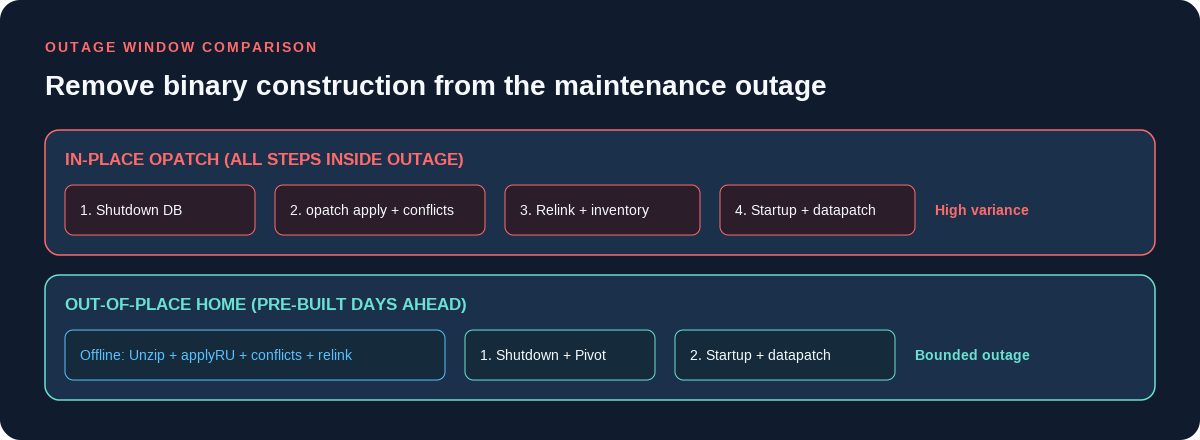
The central engineering challenge is: How can database platform architects move binary construction and conflict resolution out of the production outage while preserving a tested, version-compatible rollback for both the Oracle Home and the database catalog?
Options Considered
Four patching strategies define the operational trade-offs for Oracle 19c fleets.
| Option | Conflict Isolation | Rollback Boundary | Inventory Overhead | Best Fit |
|---|---|---|---|---|
In-Place opatch apply | None — discovered during outage | Coupled to .patch_storage | Low | Rejected for production |
| Manual Home Clone | Offline | Prone to manual oraInventory drift | High | Small static estates only |
Gold Image + runInstaller -applyRU | Offline + signed artifact | Clean N-1 home + SQL check | Moderate | Universal standalone and RAC |
| Oracle Fleet Patching & Provisioning (FPP) | Managed working copies | Built-in rhpctl switchback | Low at scale | Large Grid Infrastructure fleets |
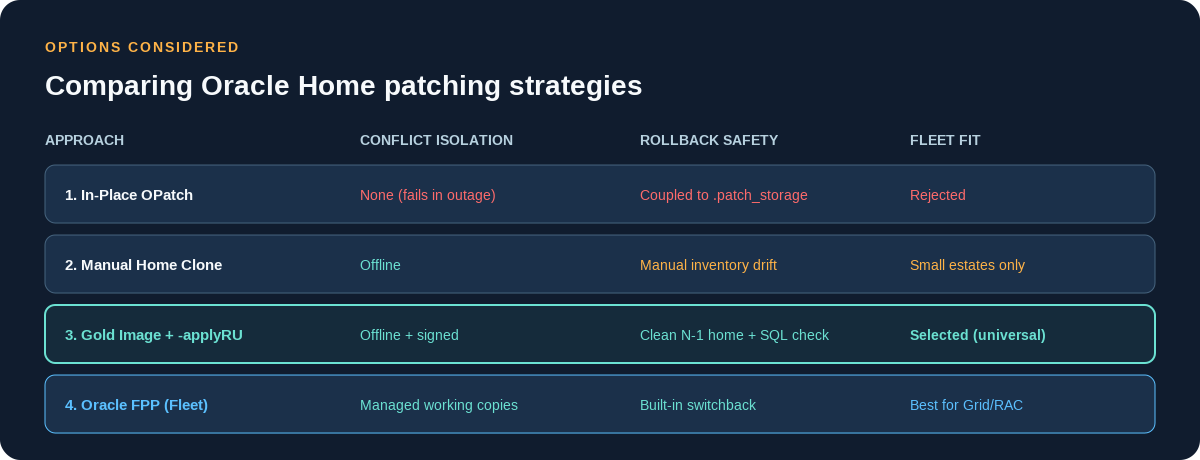
In-place opatch apply minimizes disk usage because only one $ORACLE_HOME exists per release, but it was rejected because any conflict, disk-full condition, or relink failure extends production downtime directly. Manual home cloning moves binary work offline, but copying directories by hand without central-inventory registration and checksum verification creates silent drift between hosts. Oracle FPP (rhpctl) is the strongest managed option for large Grid Infrastructure and RAC estates, though it requires running an FPP server infrastructure. Signed gold images with runInstaller -applyRU deliver the same immutable-home guarantees across standalone, Oracle Restart, and RAC deployments using standard Oracle installer primitives.
Immutable Oracle Homes: The Out-of-Place Architecture
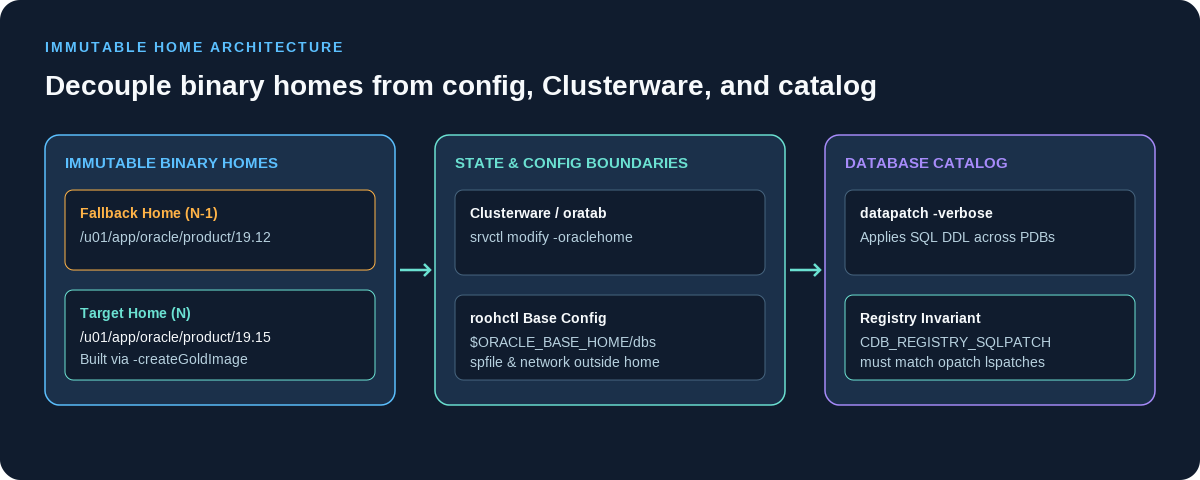
The engineering solution is to treat the $ORACLE_HOME not as a mutable pet, but as an Immutable Binary Artifact. Instead of modifying the active production software directory, the platform adopts Out-of-Place Patching.
Platform engineers build, patch, relink, and validate a new, isolated $ORACLE_HOME days before the maintenance window. The running database remains on the current home. During the outage, automation stops services, changes the Clusterware or standalone-home registration, starts from the target home, runs datapatch, and verifies application services. This is a controlled state transition, not an atomic filesystem-pointer swap: Grid Infrastructure metadata, listeners, SQL patch state, and application routing are separate failure domains.
1. The Pre-Maintenance Build and Verification Phase
All heavy lifting—unzipping archives, checking prerequisites, resolving patch conflicts, and compiling binary code—takes place in the background days prior to scheduled maintenance:
# -------------------------------------------------------------
# Out-of-Place Oracle Home Provisioning Script
# Target: Oracle Database 19c RU 19.15.0.0.0
# -------------------------------------------------------------
export ORACLE_BASE=/u01/app/oracle
export OLD_HOME=/u01/app/oracle/product/19.12.0/dbhome_1
export NEW_HOME=/u01/app/oracle/product/19.15.0/dbhome_1
export PATCH_DIR=/u01/stage/patches/19.15

mkdir -p $NEW_HOME
cd $NEW_HOME

# 1. Extract Base 19.3.0.0 Software Image
unzip -q /u01/stage/LINUX.X64_193000_db_home.zip -d $NEW_HOME

# 2. Setup Oracle Home and Apply RU 19.15 via runInstaller in Silent Mode
./runInstaller -silent -waitforcompletion \
  -applyRU $PATCH_DIR/33806152 \
  -applyOneOffs $PATCH_DIR/33803476 \
  ORACLE_BASE=$ORACLE_BASE \
  ORACLE_HOME=$NEW_HOME \
  ORACLE_HOME_NAME=OraDB19Home_1915 \
  oracle.install.db.InstallEdition=EE

# 3. Verify Inventory and Relink Binaries
$NEW_HOME/OPatch/opatch lsinventory -detail
$NEW_HOME/bin/relink all

# 4. Capture evidence used by the change gate
$NEW_HOME/OPatch/opatch lspatches
$NEW_HOME/bin/sqlplus -V
ldd $NEW_HOME/bin/oracle | grep 'not found' && exit 1 || true
The production pipeline must additionally verify the image checksum and signature, confirm the supported OPatch version from the RU README, run the installer-required root scripts, and record the central-inventory entry. Patch numbers in examples are not portable configuration: the pipeline must resolve the correct RU, OJVM, and interim patches from the approved manifest for the target platform and quarter.
Why Conflict Risk is Neutralized
If a patch conflict occurs during Step 2, zero production downtime has occurred. The live database continues running on $OLD_HOME. The DBA can open a ticket with Oracle Support, request a merge patch, or adjust the patch payload during normal business hours without any operational emergency.
2. The Maintenance Window Execution Protocol
During the actual maintenance window, the database is offline only for the time required to stop the instance, swap paths, start the instance, and execute SQL dictionary scripts:
Step 1: Quiesce and Database Shutdown
Client connections are drained via connection pools, and the database is shut down cleanly:
SHUTDOWN IMMEDIATE;
Step 2: Clusterware-Aware Home Pivot
For a standalone database, /etc/oratab and service-unit environments may define the active home. For Oracle Restart or RAC, Clusterware owns that state; editing /etc/oratab alone does not move the resource. The runbook records the current configuration before changing it:
# Capture rollback evidence
srvctl config database -db DB19C

# Oracle Restart or RAC — execute with the documented owner and version-specific syntax
srvctl modify database -db DB19C -oraclehome "$NEW_HOME"

# Standalone deployments only: update an exact, validated oratab entry
cp -p /etc/oratab /etc/oratab.pre-1915
sed -i 's|^DB19C:/u01/app/oracle/product/19.12.0/dbhome_1:|DB19C:/u01/app/oracle/product/19.15.0/dbhome_1:|' /etc/oratab

# Source the new environment
export ORACLE_SID=DB19C
. /usr/local/bin/oraenv
Step 3: Database Startup and SQL Patch Execution
The database mounts using the new binaries, and datapatch runs to apply SQL catalog changes:
sqlplus / as sysdba << EOF
STARTUP;
EXIT;
EOF

# Execute SQL patch utility
cd $ORACLE_HOME/OPatch
./datapatch -verbose

# Recompile invalid objects
sqlplus / as sysdba << EOF
@?/rdbms/admin/utlrp.sql
EXIT;
EOF
The maintenance outage is now dominated by shutdown, resource relocation, startup, SQL patching, and validation rather than construction of the Oracle Home.
That duration is an acceptance target, not a property of out-of-place patching. datapatch runtime depends on component inventory, PDB count, invalid objects, and SQL patch payload. Production scheduling must use rehearsal percentiles for the same topology and must reserve time for service validation and a rollback decision.
3. The Version-Compatible Rollback Path
Out-of-place patching preserves the previous binary home, but it does not make every rollback instantaneous. Before the change, the team must classify rollback boundaries from the RU README and rehearse them on a production-like clone:
- Capture
opatch lspatches,DBA_REGISTRY_SQLPATCH, database component status, Clusterware configuration, and application-service placement. - Define the last point at which a binary-only reversal is supported. Once
datapatchchanges the catalog, use the patch-specific SQL rollback procedure; do not label it optional. - Stop application admission before changing homes. A write admitted after the pivot may make storage or application rollback—not merely binary rollback—the relevant recovery path.
- Restore the Clusterware resource or standalone configuration to
$OLD_HOME, reconcile SQL patch state using the documented procedure, start services, and verifyDBA_REGISTRY,DBA_REGISTRY_SQLPATCH, alert logs, listeners, and synthetic transactions. - If the patch README marks SQL changes irreversible, or validation cannot establish a supported binary/catalog pairing, restore the rehearsed database backup or snapshot instead of improvising an OPatch sequence.
The rollback service-level objective is therefore measured from rehearsals. The defensible guarantee is that the old binary artifact is preserved and the recovery procedure is known—not that every database returns in three minutes.
How It Rolls Out
The control plane should persist the patch transition independently of the shell process executing it. Modeling the rollout as explicit states—IMAGE_VERIFIED, RESOURCE_STOPPED, HOME_REGISTERED, SQL_PATCHED, and VALIDATED—ensures that a retry observes reality before acting and never assumes a timed-out SSH or srvctl call failed.
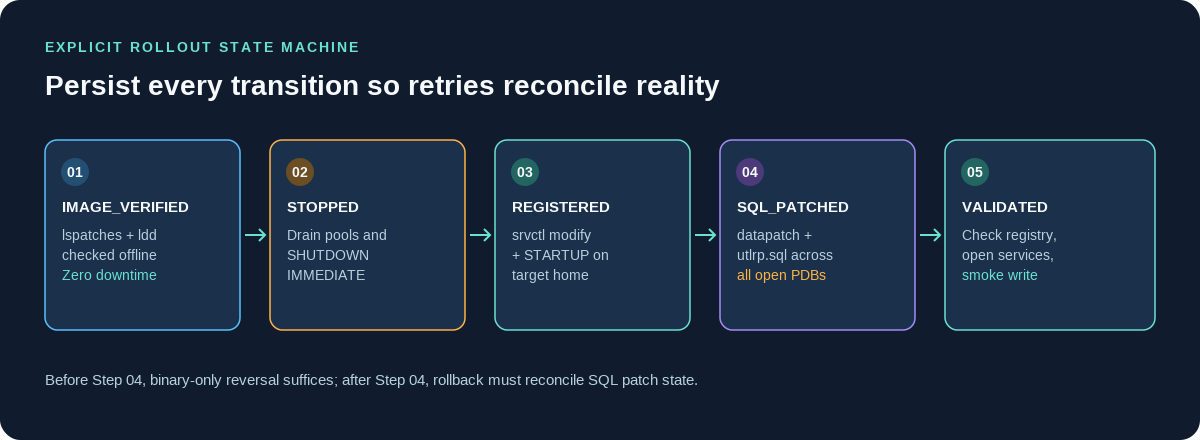
Each transition records its command, start and finish timestamps, exit status, and evidence URI. Three invariants prevent the most damaging partial states:
- One admitted writer: application services remain disabled until the intended database role is read-write, the expected home owns the running processes, and synthetic writes commit successfully.
- Binary/catalog compatibility: the active home’s
opatch lspatchesoutput and the successful rows inCDB_REGISTRY_SQLPATCHmatch the approved manifest for every open PDB. A successful instance startup is not sufficient evidence. - Recoverable old home: the fallback home remains read-only to automation, registered or re-registerable, and covered by a rehearsed SQL reconciliation or database-restore procedure until the observation window closes.
The post-start gate should collect evidence rather than return a single Boolean:
SELECT name, open_mode, database_role FROM v$database;

SELECT con_id, patch_id, patch_type, action, status, action_time
FROM   cdb_registry_sqlpatch
ORDER  BY action_time DESC;

SELECT con_id, comp_id, comp_name, version, status
FROM   cdb_registry
WHERE  status <> 'VALID'
ORDER  BY con_id, comp_id;

SELECT con_id, name, open_mode, restricted
FROM   v$pdbs
ORDER  BY con_id;
The operating-system side records ps -ef executable paths, srvctl config database, srvctl status database -verbose, listener service registration, alert-log errors since startup, and filesystem capacity for both homes. Application validation must include authentication, a transaction with commit and read-after-write, connection-pool recycling, and the workload’s highest-risk SQL paths. Only after these independent signals pass should the orchestrator enable normal admission.
The observation window is also explicit. During it, alerting compares parse failures, invalid objects, ORA-00600 or ORA-07445 incidents, logon rate, database time, and critical SQL plan hashes against the pre-change baseline. Crossing a predefined threshold disables further fleet rollout and triggers the rehearsed rollback decision; it does not automatically run destructive rollback commands on every symptom.
In Practice
Oracle’s documented image-based installation and Fleet Patching and Provisioning workflows establish the production pattern without requiring an invented estate or invented success metrics. runInstaller -createGoldImage packages an Oracle Home image; Fleet Patching and Provisioning models software homes as managed gold images and deploys working copies to targets. The operational conclusion is derived from those documented mechanics: construct and validate the home before downtime, then move the database resource to a known artifact.
A production evidence pack should make that conclusion testable for each fleet:
- Artifact provenance: record base-image checksum, RU and one-off identifiers, OPatch version, build host OS release, compiler/runtime dependencies, signing identity, and immutable object-store URI.
- Compatibility evidence: run
opatch prereq CheckConflictAgainstOHWithDetail, compareopatch lsinventory, validate the RU README’s platform prerequisites, and test every installed option used by the target database. - Database rehearsal: restore a recent production-like clone, attach it to the candidate home, run
datapatch -verbose, open every PDB, compile invalid objects, and execute workload-specific smoke tests. A successful binary install alone is not a database validation. - Measured decision thresholds: retain stop, start,
datapatch, listener-registration, PDB-open, and synthetic-transaction durations separately. Set the maintenance window and abort point from observed percentiles rather than universal claims. - Rollback proof: rehearse the exact old-home restoration and SQL reconciliation path. Save the commands and outputs as change evidence, including the conditions that escalate to database restore.
Where It Breaks
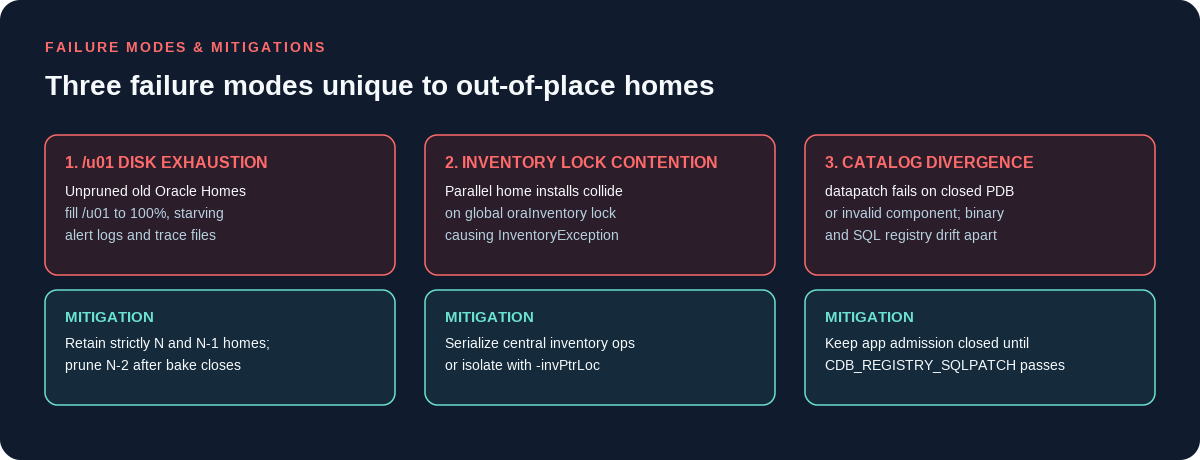
| Operational Scenario / Environmental Edge Case | Failure Mechanism | Architectural Consequence | Mitigation Protocol |
|---|---|---|---|
Storage Exhaustion on /u01 Mount Point | Storing multiple 12 GB Oracle homes fills the root or software filesystem to 100%. | Server runs out of disk space; cannot write logs or create trace files; database crashes. | Implement automated home lifecycle cleanup; strictly retain only active home ($N$) and previous fallback home ($N-1$). |
Central Inventory (inventory.xml) Lock Contention | Multiple automated scripts attempt to register new homes concurrently against the global inventory. | Inventory lock acquisition times out; runInstaller fails with InventoryException. | Serialize inventory registration steps or utilize local per-home inventories using -invPtrLoc. |
| Static Listener Configuration Desynchronization | Database listener configured with static SID descriptors pointing to the old $ORACLE_HOME path. | Connections succeed to database, but external tools and OEM fail to resolve service handlers. | Standardize on dynamic service registration via LOCAL_LISTENER; update static listener entries in automation. |
| Datapatch Catalog Failure | Component errors, closed PDBs, invalid prerequisites, or patch SQL failures prevent catalog reconciliation. | Binaries and SQL registry diverge; opening applications risks operating an unsupported state. | Run clone rehearsals and component checks; retain datapatch logs; stop application admission until registry and PDB validation pass. |
| Hardcoded Environment Paths in Cron Scripts | Legacy cron jobs and shell scripts hardcode /u01/.../19.12.0/dbhome_1 in their script headers. | Scripts continue executing against the inactive, un-patched home after the database pivots. | Ban hardcoded paths; mandate that all operational scripts source /usr/local/bin/oraenv dynamically. |
| OJVM Patch-Mode Mismatch | Automation assumes an OJVM patch is rolling without checking the patch README and RAC mode prerequisites. | Nodes or catalogs enter incompatible patch states and the rolling plan becomes invalid. | Derive rolling eligibility and SQL steps from the exact OJVM README; test the same RAC topology before production. |
| Missing Kernel OS Shared Library Symlinks | New home compiled on a build server with slightly different OS glibc or patch levels. | Executables fail to mount on target hosts due to missing shared object dependencies (libaio.so.1). | Enforce strict operating system gold image parity via Terraform and Ansible across all database hosts. |
Read-Only Oracle Home (roohctl) Path Divergence | Utilizing Read-Only Oracle Home where configuration files (dbs, network/admin) live outside the home in $ORACLE_BASE_HOME and $ORACLE_BASE_CONFIG. | Pointer scripts fail to locate parameter files (spfile) during startup from the new directory. | Standardize on roohctl -enable before DB creation and resolve paths via orabasehome / orabaseconfig. |
April 2026 Update
Advancements in Oracle database lifecycle management and cloud automation between 2022 and 2026 have made out-of-place patching the mandated industry standard:
- Read-Only Oracle Homes: Oracle supports a read-only home configuration that relocates instance-specific files under
ORACLE_BASE. It improves separation between software and configuration, but it is an installation choice with documented path changes—not a claim that every 19c home is immutable by default. - Fleet Patching and Provisioning: FPP manages gold images and working copies and provides version-aware fleet operations for supported Oracle Database and Grid Infrastructure deployments. It reduces custom orchestration, but change owners still validate database state, application services, and rollback boundaries.
- Artifact attestation: Modern pipelines should add signed manifests, software-bill-of-material records, checksum verification, and promotion history to the Oracle gold image. These controls establish which bytes entered production; they do not replace Oracle inventory and
datapatchvalidation.
Key Takeaways
- Treat
$ORACLE_HOMEas an immutable build artifact: RunningrunInstaller -applyRU -applyOneOffsoffline removes archive extraction, conflict resolution, and relinking from the maintenance window. - Keep
oraInventoryand Clusterware aligned: On Oracle Restart or RAC,srvctl modify database -oraclehomeowns the home pointer—editing/etc/oratabalone leaves Clusterware starting the old home. - Binary rollback and SQL rollback are separate gates: Keeping the
N-1home intact preserves binary recovery, but oncedatapatchupdatesCDB_REGISTRY_SQLPATCH, reversal requires the patch README’s SQL rollback or a snapshot restore. - Persist rollout state externally: Recording
IMAGE_VERIFIED,RESOURCE_STOPPED,HOME_REGISTERED,SQL_PATCHED, andVALIDATEDensures retries reconcile reality rather than re-running destructive steps. - Prune strictly to
NandN-1: Retaining unbounded historical homes fills/u01; automateN-2cleanup only after the post-patch observation window closes.
What to Do Next
- Problem: Identify whether your database operations team still executes
opatch applydirectly against running production Oracle homes during scheduled maintenance windows. - Solution: Mandate out-of-place patching as the sole authorized lifecycle standard across your enterprise database fleet.
- Proof: Conduct an audit of your previous year’s database maintenance incidents. Quantify how many hours of extended downtime were caused by patch conflicts, compilation stalls, or failed rollbacks.
- Action: Build a signed gold-image pipeline using
runInstaller -createGoldImage, rehearse the exact Clusterware and SQL transition on a production-like clone, and set downtime and rollback objectives from measured results.
Sources to Verify
- Oracle Database 19c Installation Guide — Image-Based Installation and Read-Only Homes
- Oracle Clusterware Administration and Deployment Guide — Fleet Patching and Provisioning
- Oracle OPatch User’s Guide — Patch Prerequisite Checks
- Oracle Database 19c Upgrade Guide — Datapatch and Post-Patch Processing
- Oracle Database 19c Reference — DBA_REGISTRY_SQLPATCH
- Oracle Critical Patch Update Advisory — April 2022
Interactive tools for this topic