
Database Provisioning as a Distributed System: Abstracting DBCA via Microservices
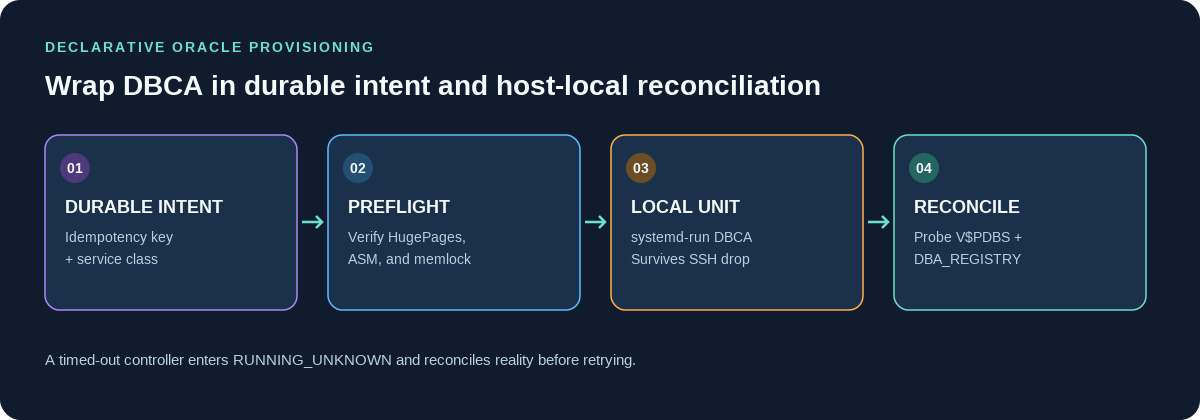
A DBCA command is not a provisioning control plane: without durable intent, idempotency keys, host-local execution ownership, secret boundaries, and reconciliation after ambiguous failures, a transient orchestrator outage can create duplicate databases or destroy the evidence needed to recover safely.
TL;DR
- Problem: Push-based Ansible/SSH DBCA wrappers lose state on network drops, saturate controller forks under fan-out, and expose
SYS/PDB passwords in process args or response files.- Answer: Separate a central desired-state API (with idempotency keys and weighted admission control) from a host-local agent that runs DBCA inside a
systemd-rununit and reconcilesRUNNING_UNKNOWNoutcomes against Oracle itself.- Watch out: A zero exit code from DBCA is not readiness—explicitly probe
V$PDBS,DBA_REGISTRY, listener registration, and workload-identity secret read-back before markingREADY.
Production Context: 2022 | Enterprise DBaaS Control Planes | Technical Review: September 2026
Situation
Organizations delivering SaaS or managing multi-tenant ERP estates continuously provision Oracle Database 19c instances across bare metal, VMware, and cloud VMs in AWS and OCI. Historically, platform teams automated those builds with push-based Configuration Management tools (Ansible, Puppet, Chef) or Bash wrappers: an orchestrator connects over SSH, copies a dbca.rsp file, and runs dbca -silent -createDatabase -responseFile /u01/stage/dbca.rsp. The runner holds the SSH socket open while DBCA formats data files, creates SYSTEM/SYSAUX/UNDOTBS1, initializes redo groups, configures the listener, and runs catalog.sql and catproc.sql.
At low volume, operators reconcile ambiguous failures manually. As concurrency grows, human reconciliation becomes a queueing and correctness bottleneck.
The Problem
The Distributed Fragility of Push-Based DBCA Provisioning
Relying on centralized, imperative push scripts to execute stateful, long-running database creation commands introduces acute distributed failure modes:
- Ambiguous Remote Execution: DBCA is a multi-phase process that creates files, starts an instance, runs catalog scripts, and registers configuration. If an SSH transport disappears, the controller often cannot distinguish “command failed,” “command is still running,” and “database completed but acknowledgement was lost.” Whether the child receives
SIGHUPdepends on the remote shell, pseudo-terminal, privilege wrapper, and service manager; assuming either success or termination is unsafe. - Controller Backpressure: Ansible and similar push systems consume forks, file descriptors, SSH connections, memory, and log bandwidth for each active target. Fifty connections do not exhaust a normal ephemeral-port range by themselves, but unrestricted fan-out can saturate configured forks, bastions, API quotas, storage throughput, or the controller’s CPU. Concurrency must be an explicit capacity limit with queueing and admission control.
- Static Inputs vs. Governed Topologies: A response file is not inherently static; it can be generated from inventory. The failure is accepting arbitrary host-derived values without policy. Memory, process limits, ASM disk groups, HugePages, NUMA layout, filesystem capacity, and license constraints must be validated against an approved service class before DBCA starts.
- Credential Exposure in Automation Logs: Passing
SYS,SYSTEM, or PDB administrator passwords in command-line arguments or unprotected response files expands their exposure to process inspection, automation output, shell history, diagnostic capture, backups, and audit records. Oracle explicitly warns that response files may contain plain-text passwords and recommends restricting ownership and deleting or securing them when unused.
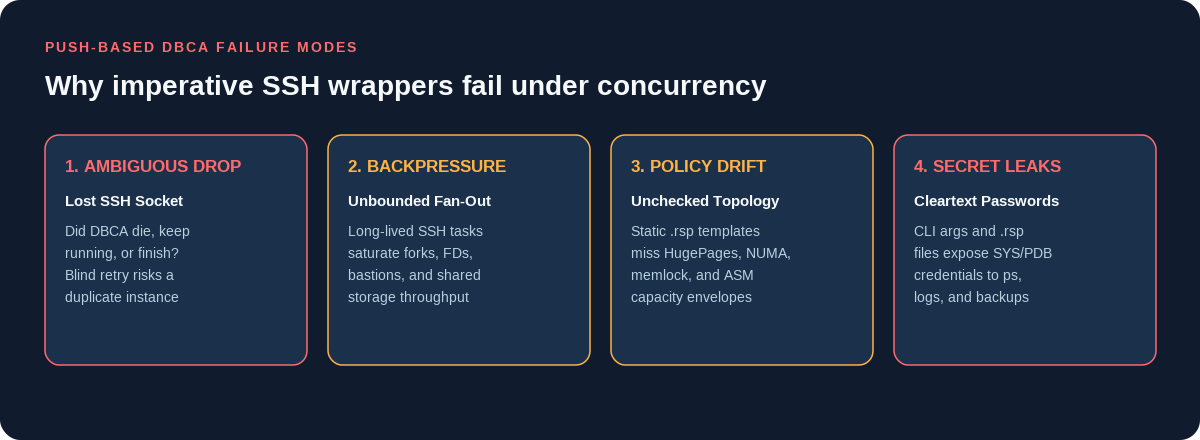
The engineering question is: How should a database vending platform preserve one durable provisioning intent across retries, process restarts, host failures, and uncertain DBCA outcomes without creating a second database or losing the evidence needed for recovery?
Options Considered
Four provisioning models represent the realistic architectural choices for Oracle fleets.
| Architecture | Crash Recovery | Secret Boundary | Blast Radius | Verdict |
|---|---|---|---|---|
| Push Ansible / SSH | Ambiguous on socket drop | Controller holds secrets | Controller fan-out saturation | Rejected at scale |
Pull Agent + systemd-run | RUNNING_UNKNOWN + lease | Local CSPRNG + tmpfs | Isolated per host | Selected for VM/BM |
| Warm CDB + PDB Clone | Fast tenant creation | Shared CDB admin plane | Shared CDB failure domain | Complementary |
| Oracle K8s Operator | K8s controller loop | K8s Secrets / external vault | Requires K8s runtime | K8s estates only |
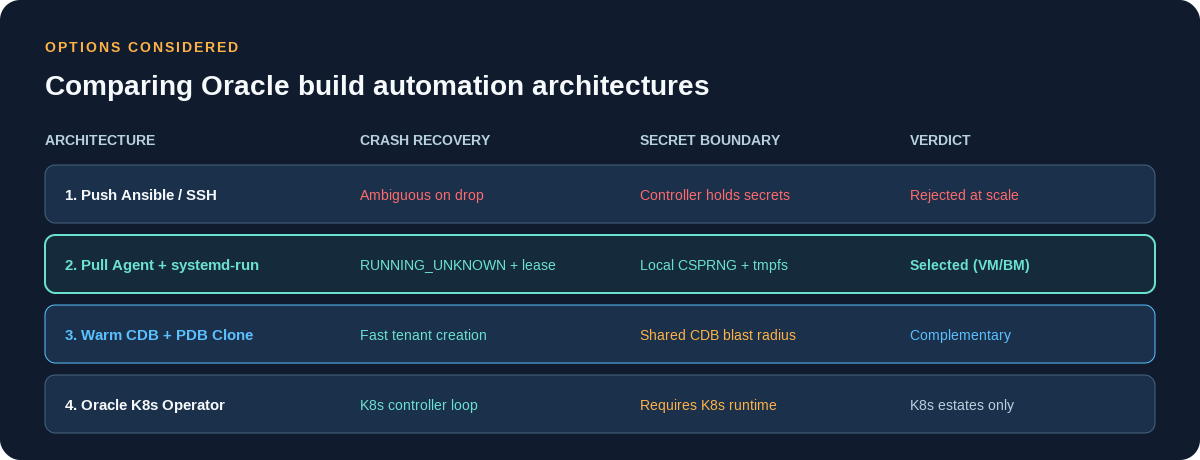
Push Ansible/SSH works for low-volume manual runs, but it was rejected because long-lived SSH sessions turn transient network drops into ambiguous outcomes. Warm CDB + PDB cloning accelerates tenant onboarding when multi-tenancy is acceptable, but it shares CDB patching and outage domains across tenants. Oracle’s Kubernetes Operator provides reconciliation natively if the fleet already runs on Kubernetes, though it does not cover bare-metal or VM-based ASM estates. A pull-based host agent with systemd-run provides durable local execution and clean secret boundaries across VM and bare-metal Oracle hosts.
The Declarative Provisioning Architecture: Pull-Based Agent Orchestration
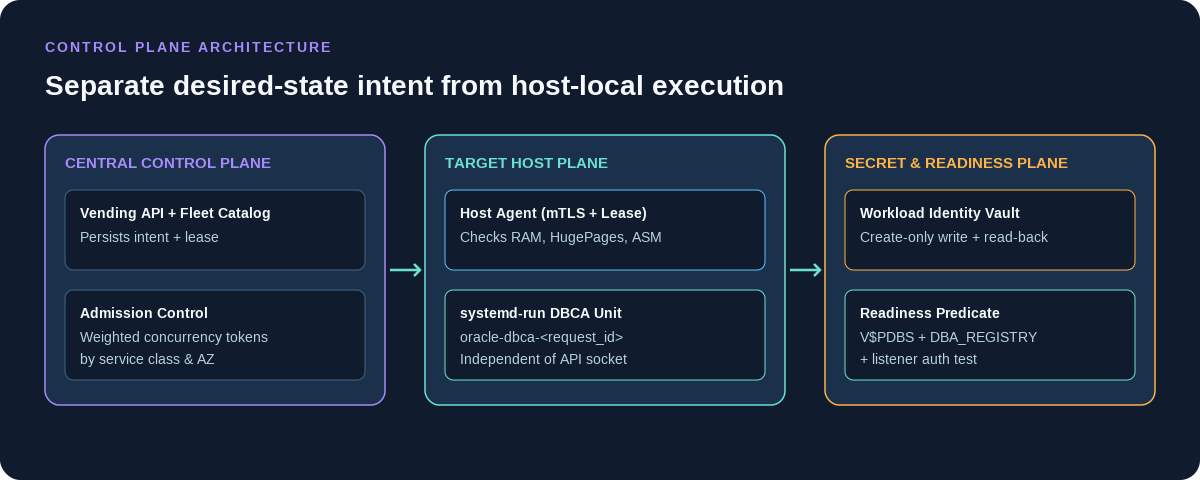
The scalable solution is to separate a durable desired-state API from host-local execution. Pull-based agents are one valid implementation, but they are not automatically safer: the safety comes from durable state, authenticated work claims, idempotent reconciliation, bounded concurrency, and explicit cleanup ownership.
The platform constructs a central Database Vending API (a Go microservice) that records declarative desired state in an authoritative fleet catalog and provisions an unconfigured host VM. On the target host, a Host Provisioning Agent starts under systemd, authenticates via mTLS, claims one intent generation, validates an approved DBCA plan against local hardware, launches a host-local systemd-run unit, and reports observed state with evidence.
1. Dynamic Hardware Discovery and DBCA Synthesis
Rather than relying on static .rsp text templates, the local Go agent programmatically evaluates the host’s actual hardware topology before invoking DBCA:
// Policy-bounded DBCA plan synthesis. Secrets are deliberately absent.
type HostTopology struct {
    TotalRAMMB       int
    CPUCores         int
    HugePagesFreeMB  int
    ASMDiskGroups    map[string]bool
}

type DatabaseIntent struct {
    RequestID       string `json:"request_id"`
    DatabaseName    string `json:"database_name"`
    PDBName         string `json:"pdb_name"`
    ServiceClass    string `json:"service_class"`
}

type ServiceClass struct {
    SGAMB, PGAMB, Processes int
    MinRAMMB, MinCores      int
}

func SynthesizeDBCACommand(topo HostTopology, in DatabaseIntent, classes map[string]ServiceClass) ([]string, error) {
    if !regexp.MustCompile(`^[A-Z][A-Z0-9_]{0,7}$`).MatchString(in.DatabaseName) {
        return nil, fmt.Errorf("invalid database name")
    }
    class, ok := classes[in.ServiceClass]
    if !ok || topo.TotalRAMMB < class.MinRAMMB || topo.CPUCores < class.MinCores {
        return nil, fmt.Errorf("host does not satisfy service class %q", in.ServiceClass)
    }
    if !topo.ASMDiskGroups["+DATA"] || !topo.ASMDiskGroups["+RECO"] {
        return nil, fmt.Errorf("required ASM disk groups are not mounted")
    }
    if topo.HugePagesFreeMB < class.SGAMB {
        return nil, fmt.Errorf("insufficient HugePages for requested SGA")
    }

    args := []string{
        "-silent",
        "-createDatabase",
        "-templateName", "General_Purpose.dbc",
        "-gdbName", in.DatabaseName,
        "-sid", in.DatabaseName,
        "-createAsContainerDatabase", "true",
        "-numberOfPDBs", "1",
        "-pdbName", in.PDBName,
        "-storageType", "ASM",
        "-diskGroupName", "+DATA",
        "-recoveryAreaDestination", "+RECO",
        "-characterSet", "AL32UTF8",
        "-nationalCharacterSet", "AL16UTF16",
        "-initParams", fmt.Sprintf("sga_target=%dM,pga_aggregate_target=%dM,processes=%d",
            class.SGAMB, class.PGAMB, class.Processes),
    }
    return args, nil
}
The host data is used to reject an incompatible placement, not to invent database sizing from a percentage. Service classes are reviewed configuration with workload-tested SGA, PGA, process, storage, and license envelopes. Exadata storage servers are not DBCA targets; DBCA runs from the database home on database nodes. Exadata-specific placement must validate the database-server and Grid Infrastructure topology separately.
2. Durable Execution and Reconciliation
POSIX process-group detachment is not a durable job system. A service restart may terminate every process in its systemd cgroup, and a detached child does not preserve an authoritative state transition. The host agent instead creates a uniquely named systemd unit from the immutable request ID, persists the unit name before launch, and reconciles the unit and database state after every restart:
func StartDBCAUnit(ctx context.Context, requestID string, dbcaArgs []string) error {
    uuid := regexp.MustCompile(`^[0-9a-f]{8}-[0-9a-f]{4}-[1-5][0-9a-f]{3}-[89ab][0-9a-f]{3}-[0-9a-f]{12}$`)
    if !uuid.MatchString(requestID) {
        return fmt.Errorf("invalid request ID")
    }
    unit := "oracle-dbca-" + requestID

    // The create-only local record is fsync'd before process submission.
    // An existing record is reconciled; it is never interpreted as permission
    // to launch the command again.
    op, created, err := CreateOperationIfAbsent(requestID, unit, HashPlan(dbcaArgs))
    if err != nil {
        return fmt.Errorf("persist operation intent: %w", err)
    }
    if !created {
        return ReconcileOperation(ctx, op)
    }

    args := []string{
        "--unit", unit,
        "--property=User=oracle",
        "--property=Group=oinstall",
        "--property=RuntimeMaxSec=75min",
        "--property=KillMode=control-group",
        "--setenv=ORACLE_HOME=/u01/app/oracle/product/19.0.0/dbhome_1",
        "--setenv=ORACLE_BASE=/u01/app/oracle",
        "/u01/app/oracle/product/19.0.0/dbhome_1/bin/dbca",
    }
    args = append(args, dbcaArgs...)
    cmd := exec.CommandContext(ctx, "systemd-run", args...)
    output, err := cmd.CombinedOutput()
    if err != nil {
        MarkOutcomeUnknown(requestID, output)
        return fmt.Errorf("create DBCA unit: %w: %s", err, output)
    }
    return MarkUnitSubmitted(requestID)
}
The controller reads state from systemd, the DBCA logs under $ORACLE_BASE/cfgtoollogs/dbca, and Oracle itself. A unit exit of zero is necessary but insufficient: reconciliation confirms the CDB identity, open mode, PDB state, component registry, data-file placement, listener registration, and request ownership before reporting success. A timed-out API call leaves the request RUNNING_UNKNOWN; it never starts a second DBCA invocation until observation proves the first job absent or terminal.
3. Bound the Secret Exposure Path
Pull execution does not “completely eliminate” credential exposure. DBCA credential options, response files, process inspection, debug logs, crash dumps, and agent memory are all boundaries that must be designed explicitly:
- Generate locally: use the operating system CSPRNG and an approved password policy. Associate the generated material with the immutable request ID before database creation begins.
- Use a documented DBCA credential mechanism: prefer an Oracle-supported credential wallet when the target DBCA version supports it. If a response file is required, create it on a root-owned
tmpfs, set0600, prevent shell tracing and process-argument exposure, and destroy it after DBCA terminates. Do not claim generic stdin support without testing the exact DBCA release. - Write through workload identity: authenticate to the enterprise secret manager with an instance or workload identity constrained to one request-scoped path. Use create-only semantics so a retry cannot silently overwrite credentials for an existing database.
- Minimize lifetime: avoid copying secrets into immutable strings, structured logs, error messages, metrics, or workflow payloads. Memory zeroing is defense in depth, not proof that the runtime or operating system retained no copy.
- Verify retrieval before handoff: the consumer identity—not a human operator—performs a test retrieval and database authentication. Only then can the control plane remove bootstrap access and mark the credential handoff complete.
How It Rolls Out
Persist every transition with optimistic concurrency. The API acknowledges a request only after its intent record exists; the host claims work only with a lease tied to the request generation.
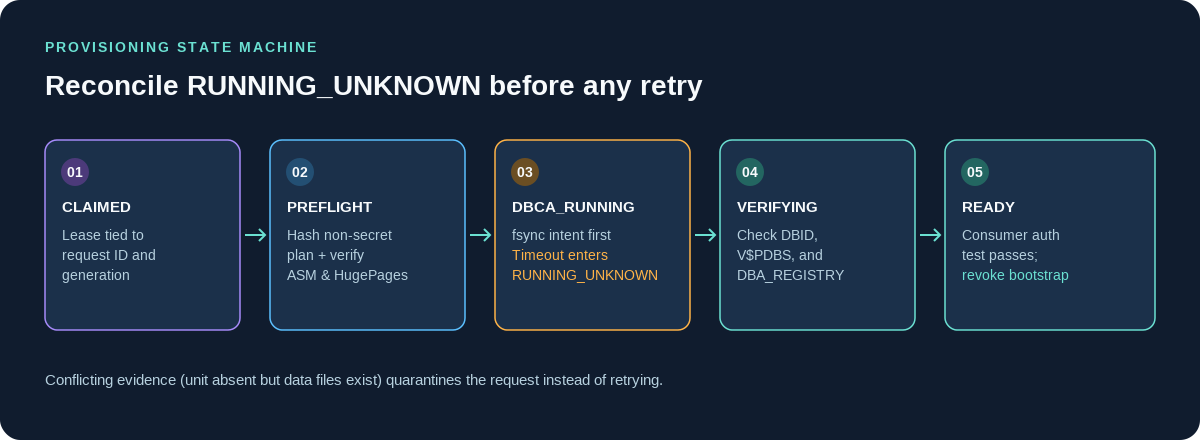
ACCEPTED -> PLACED -> CLAIMED -> PREFLIGHT_PASSED -> DBCA_RUNNING
         -> VERIFYING -> CREDENTIAL_HANDOFF -> READY

Any nonterminal state -> RUNNING_UNKNOWN -> VERIFYING
Any verified failure  -> CLEANUP_REQUIRED -> FAILED or ACCEPTED
RUNNING_UNKNOWN is essential. It expresses an epistemic condition rather than inventing an outcome after a timeout. The reconciler checks, in order, the request ledger, host claim, systemd unit, DBCA log, Oracle inventory, database identity, and storage artifacts. It moves to FAILED only when a terminal failure is observed, and to READY only when all readiness invariants hold.
In Practice
Oracle documents DBCA as the supported assistant for creating and configuring a database, including a silent command interface and response-file mode. Oracle also warns that response files can contain clear-text passwords and should be restricted or removed when not in use. Those two documented facts establish the operational boundary: DBCA performs the local database mutation; a platform control plane must own request identity, policy, credentials, retries, and proof of completion.
The idempotency key must cover the desired database identity, not only an HTTP attempt. Enforce uniqueness for the request ID, target host, DB unique name, SID, and storage namespace. A client retry returns the existing operation. A changed specification creates a new generation and requires the old generation to be terminal; it must not mutate an active request in place.
Separate Preconditions, Execution, and Readiness
The preflight should emit a signed or immutable evidence document that includes the Oracle home version, RU level, service class revision, CPU and memory observations, HugePages and memlock capacity, ASM disk-group state and usable space, listener ownership, filesystem headroom, required OS groups, and selected DBCA syntax. The agent then hashes the exact non-secret plan and stores that digest in the request ledger. This makes later questions—“which policy produced this database?”—answerable without retaining credentials.
Execution evidence is different from readiness evidence. Capture the transient unit name, systemd invocation ID, DBCA start time, exit status, and the relevant $ORACLE_BASE/cfgtoollogs/dbca location. Do not scrape a percentage from human-oriented output and treat it as a transaction boundary. Progress is advisory; observed state is authoritative.
After DBCA exits, use explicit probes such as these, adapted to the topology:
- Verify the expected database resource exists in Oracle Restart or Clusterware where those components own it; otherwise verify the intended instance and configuration files directly.
- Connect locally with controlled administrative authentication and compare
DBID,DB_UNIQUE_NAME, CDB status, database role, and open mode to the request. - Check
V$PDBSfor the requested PDB and desired open mode, and configure saved state deliberately rather than assuming it persisted. - Check
DBA_REGISTRYfor invalid or loading components. A clean process exit does not prove catalog components are valid. - Confirm data files, online redo, control files, and recovery destinations are on the approved storage namespaces; also verify usable capacity after allocation.
- Verify service registration through the listener and perform a connection using the consumer service name. Do not certify readiness through the default administrative service.
- Retrieve the credential through the intended workload identity and perform a minimal authentication test. Revoke bootstrap access only after this succeeds.
These probes form the completion predicate. Store their results and timestamps as structured evidence, while excluding SQL text, connect descriptors, or error payloads that may contain secrets.
Test the Failure Semantics, Not Just the Happy Path
A staging qualification should inject faults at the boundaries where ownership changes. Terminate the API after intent persistence but before its response; restart the host agent immediately before and during DBCA; block control-plane traffic while the unit continues; expire the work lease; make the secret manager unavailable after database creation; fill a dedicated log filesystem; and deliver the same request repeatedly. For every test, assert both safety and liveness:
- Safety: no duplicate DB identity, no credential overwrite, no deletion of an unowned database, and no second DBCA process for one generation.
- Liveness: once dependencies recover, reconciliation either reaches
READYor produces a terminal, operator-actionable state with retained evidence.
Capacity testing should measure the actual shared constraints: ASM allocation and rebalance load, image or template reads, secret-manager quotas, cloud API rate limits, listener registration, controller database contention, and log ingestion. “Fifty concurrent builds” is not a transferable target. Admission control should allocate weighted tokens by service class and failure domain, then reduce concurrency automatically when storage latency, API throttling, or verification time crosses a reviewed threshold.
Where It Breaks
| Operational Scenario / Environmental Edge Case | Failure Mechanism | Architectural Consequence | Mitigation Protocol |
|---|---|---|---|
| CSPRNG unavailable early in boot | An image starts the agent before the kernel random pool is initialized, so credential generation blocks or fails. | The request remains claimed without a credential or DBCA process, and an unsafe retry may create a second secret. | Use the operating-system CSPRNG, surface getrandom failure as a preflight failure, release the claim safely, and fix image or boot ordering; do not substitute a weak userspace generator. |
| ASM access or capacity mismatch | The Oracle software owner lacks the required ASM access, the requested disk group is not mounted, or usable space is below the plan. | DBCA fails before or during file creation and may leave request-owned storage artifacts. | Query ASM state and usable capacity in preflight, validate approved OS-group membership, and record every request-owned artifact for guarded cleanup. |
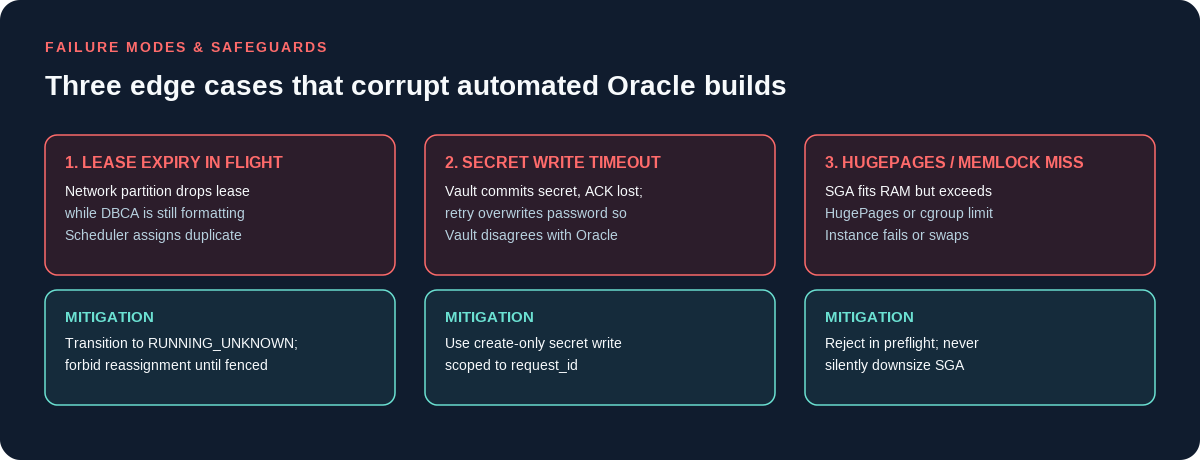
| Partition outlives the work lease | The host continues DBCA while the control plane cannot renew or observe its claim. | A naive scheduler assigns the same identity elsewhere or terminates a host whose outcome is unknown. | Make identity unique globally, move expired claims to RUNNING_UNKNOWN, forbid reassignment while host evidence is unresolved, and require a fenced recovery decision before termination. |
| Cloud identity bootstrap fails | Metadata, instance-principal, DNS, or time synchronization is unavailable during boot. | The agent cannot authenticate to claim work or write the generated credential. | Use the cloud’s authenticated metadata mode, bounded jittered retries, clock-health checks, and a host-local pending state; never fall back to an embedded long-lived credential. |
HugePages, memlock, NUMA, or cgroup limit mismatch | The service-class SGA fits physical RAM but not the effective locked-memory or cgroup envelope. | Instance startup fails or silently uses an unintended memory mode with different performance characteristics. | Validate effective limits and HugePages against the selected Oracle configuration, reserve OS headroom, and reject rather than auto-resize the database. |
| Listener ownership or service collision | A DBCA plan attempts to create or modify a listener already managed by Grid Infrastructure or another Oracle home. | Registration is inconsistent, a port bind fails, or an unrelated service is disrupted. | Discover the listener owner and endpoints, use role-appropriate services, and make network configuration a separately owned reconciled resource. |
| Secret write succeeds but acknowledgement is lost | The secret manager commits a value and the agent times out before receiving the response. | Retrying a normal write can overwrite the credential with a value that no longer matches the database. | Use a request-scoped create-only operation, retain the credential until read-back is proven, and reconcile metadata or version before deciding whether to retry. |
| Log or Oracle-base filesystem fills | DBCA, audit, diagnostic, or journald output consumes a shared filesystem during catalog creation. | Writes fail, evidence is truncated, and colocated Oracle components can be affected. | Isolate and size log destinations, enforce quotas and retention, alert on both bytes and inodes, and stop admission before the reserve needed for diagnosis is consumed. |
September 2026 Update
The architectural boundary still matters even when the provisioning primitive changes:
- PDB clone paths reduce work but add lineage constraints. Oracle supports local and remote PDB clones, refreshable clone PDBs, PDB snapshots, and storage-managed snapshot-copy PDBs subject to version, storage, open-mode, and licensing constraints. A warm CDB pool can therefore avoid building a CDB for every tenant, but the control plane must track source lineage, patch compatibility, storage dependencies, service naming, refresh state, and isolation policy. Provisioning latency must be measured on the chosen storage path; there is no universal seconds-level guarantee.
- An operator is an implementation of reconciliation, not its substitute. Oracle’s Database Operator for Kubernetes exposes documented custom resources for supported database lifecycle operations. Its exact database versions, topology, Kubernetes versions, storage classes, and day-two capabilities must be checked against the release being adopted. A team still owns idempotency, secrets, backup, recovery objectives, observability, upgrades, and the boundary between Kubernetes state and Oracle state.
- Prebuilt images move validation earlier. A patched and tested database-home image can remove installation variance, but it does not validate runtime ASM, HugePages, listener ownership, credentials, or catalog health. Record the image digest and patch inventory as inputs to the service class, then retain the same post-provision completion predicate.
Key Takeaways
- Decouple intent from execution transport: Persist desired state in a fleet catalog and run DBCA inside a uniquely named
systemd-rununit so SSH or API drops never orphan or duplicate builds. - Model uncertainty with
RUNNING_UNKNOWN: On timeout or lease expiry, inspect the systemd unit, DBCA logs, and Oracle inventory before retrying or reassigning. - Validate hardware against policy, not percentages: Reject builds in preflight when RAM, HugePages,
memlock, or ASM disk groups fail the approved service class. - Scope secrets with create-only writes: Generate credentials locally with the OS CSPRNG, isolate any response file on
0600tmpfs, and verify consumer read-back before revoking bootstrap access. - Prove readiness via Oracle views: A zero exit code is insufficient; verify
DBID,V$PDBS,DBA_REGISTRY, and listener service registration before markingREADY.
What to Do Next
- Problem: Inventory every point where a lost response can make the current pipeline confuse “failed” with “still running” or “committed,” including DBCA, storage, identity, and secret writes.
- Solution: Persist an immutable request and generation, execute through a host-local service manager, and reconcile Oracle-observed state against explicit readiness invariants before acknowledging completion.
- Proof: In a non-production failure campaign, kill the API and agent, partition the host, duplicate request delivery, expire credentials, and exhaust log capacity; verify one database identity and a recoverable terminal state after every test.
- Action: Implement
RUNNING_UNKNOWN, create-only secret writes, policy-versioned service classes, admission tokens, and an evidence record before increasing provisioning concurrency.
Sources
- Oracle Database 19c Administrator’s Guide — creating and configuring a database with DBCA
- Oracle Database 19c Linux Installation Guide — running DBCA with response files
- Oracle Database 19c RAC Administration and Deployment Guide — DBCA trace locations
- Oracle Database 19c Multitenant Administrator’s Guide — cloning a PDB
- systemd-run manual — transient service and scope units
- systemd.service manual — service lifetime, restart, and timeout semantics
- Go os/exec package — context cancellation and process execution
- Oracle Database Operator for Kubernetes — official source and documentation
Interactive tools for this topic