
Autonomous Index Lifecycle Management: Safely Deploying Index Changes at Scale
Content reflects the state as of May 2026. AI tooling and model capabilities in this area change frequently.
Adding an index to a production database is not a benign performance optimization; it is a structural alteration of the Cost-Based Optimizer’s search space that can push unrelated, revenue-critical queries into catastrophic execution plan regressions.
TL;DR
- Problem: A
CREATE INDEX ... ONLINEcommand avoids DML locks during build, but exposes the new index globally to the Cost-Based Optimizer (CBO) the instant it completes—frequently flipping unrelated batch or reporting queries from multi-block scans into random single-block I/O storms.- Answer: Decouple physical index construction from optimizer visibility by building with
INVISIBLE ONLINE, validating the full production SQL Tuning Set viaDBMS_SQLPAdual trials (OPTIMIZER_USE_INVISIBLE_INDEXEStoggled viaALTER SESSION), and promoting only after a session-level canary.- Watch out: Invisible indexes still enforce
UNIQUEconstraints on DML, still consume redo/undo and buffer cache during writes, and require multi-day SQL Tuning Sets to avoid bind-peeking blind spots.
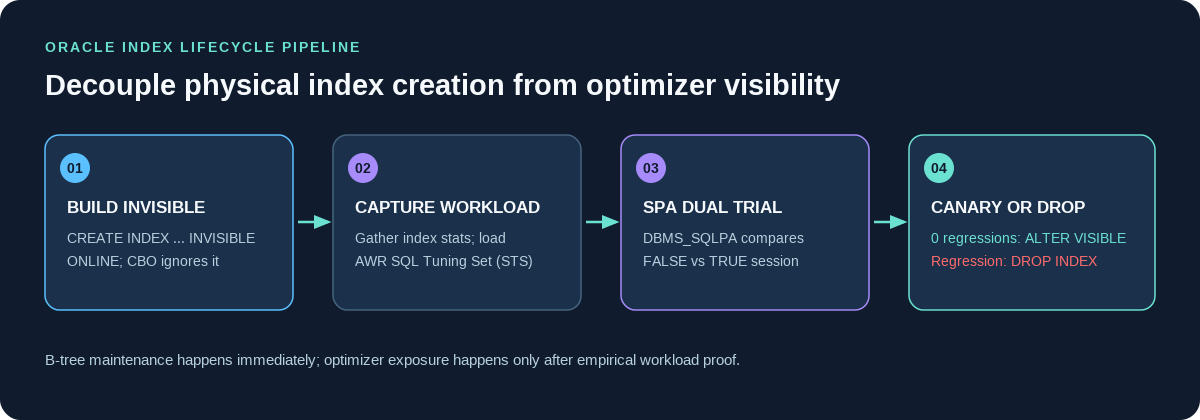
Situation
Enterprise teams running high-throughput relational workloads on Oracle Database 19c—across Exadata, OCI Database Cloud Service, or self-managed bare metal—routinely hit point-lookup bottlenecks on large transactional tables such as ORDERS, TRANSACTIONS, or LEDGER_ENTRIES. Developers identify a slow search endpoint and request a secondary B-tree index on a selective column like customer_email.
To avoid blocking application writes, database engineering teams execute an online index build during a maintenance window:
CREATE INDEX idx_orders_customer_email ON orders(customer_email) ONLINE;
The ONLINE keyword lets concurrent INSERT, UPDATE, and DELETE transactions proceed by buffering changes in a temporary journal table (SYS_JOURNAL_<object_id>) while scanning the base table snapshot. The build finishes without locking the application, and the target lookup query drops from scanning the table to reading a few B-tree blocks.
The failure arrives later under peak concurrency. Because the new index is immediately visible to every session in the instance, the Oracle Cost-Based Optimizer (CBO) re-evaluates execution plans for unrelated queries touching ORDERS. A heavy batch job or reporting query that previously relied on a parallel Full Table Scan—using multi-block I/O or Exadata Smart Scan cell offloading—can suddenly switch to an Index Range Scan if the CBO underestimates row selectivity. Instead of streaming contiguous blocks, the batch job issues millions of single-block random reads (db file sequential read), saturating storage IOPS queues and exhausting application connection pools.
The Problem
Creating a secondary index alters both the physical storage engine and the optimizer’s cost model across four distinct constraints:
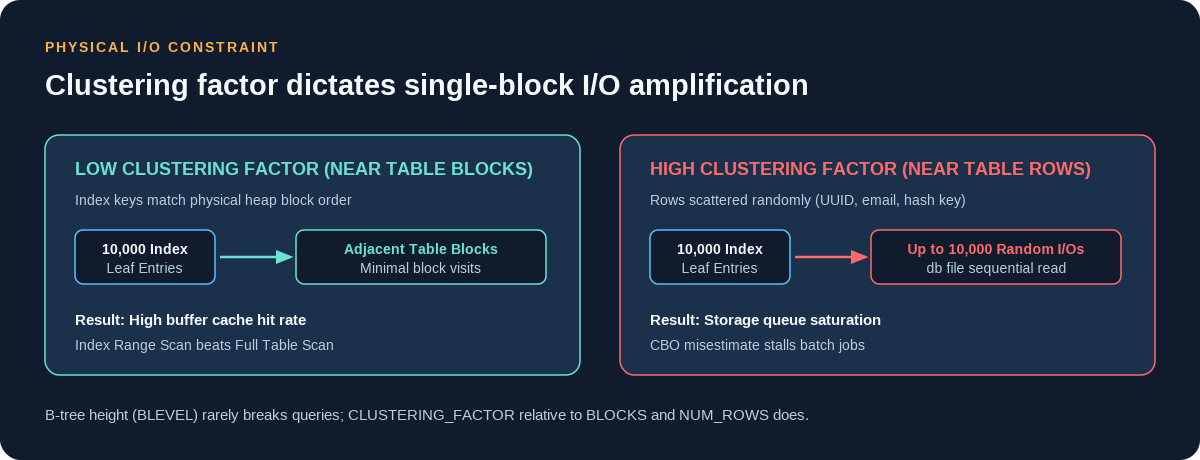
- The Clustering Factor Amplification Constraint: The I/O cost of an Index Range Scan is governed less by B-tree height (
BLEVEL) than byCLUSTERING_FACTORinDBA_INDEXES. During statistics gathering, Oracle walks the index leaf blocks in key order and counts how many times theROWID’s table block address changes from one index entry to the next. That transition count becomesCLUSTERING_FACTOR.- Near-perfect clustering (
CLUSTERING_FACTOR ≈ BLOCKS): When table rows are physically ordered similarly to the index keys (such as a monotonically increasingCREATED_ATor sequence-backed primary key), scanning 10,000 index entries touches a small set of adjacent table blocks. Buffer cache hit rates stay high and physical disk reads stay low. - Pathological clustering (
CLUSTERING_FACTOR ≈ NUM_ROWS): When rows are scattered across heap blocks relative to the index key—common with UUIDs, hashes, orcustomer_emailin an append-mostlyORDERStable—two consecutive index entries almost always point to different table blocks. Scanning 10,000 index entries can force up to 10,000 separate single-block reads across the storage array. If bind peeking or stale histograms cause the CBO to underestimate selectivity, the resulting random I/O storm saturates storage latency. - Controlling sensitivity with
TABLE_CACHED_BLOCKS: Since Oracle 12c,DBMS_STATS.SET_TABLE_PREFSsupportsTABLE_CACHED_BLOCKS(default1, up to255), which letsDBMS_STATSremember recently visited table blocks during the leaf-block walk so a few interleaved rows in an otherwise clustered table do not inflateCLUSTERING_FACTORtowardNUM_ROWS.
- Near-perfect clustering (
- Global Optimizer Visibility Constraint: In standard Oracle DDL, an index becomes globally visible to the CBO the millisecond compilation finishes. Every shared-pool cursor referencing that table is invalidated on its next hard parse or rolling invalidation window, exposing unrelated batch and analytical workloads to unvalidated plan flips.
- Synchronous DML Write Tax: An index is a live write obligation, not a passive read structure. Every
INSERT,DELETE, and indexed-columnUPDATEmust synchronously update B-tree leaf blocks, generate redo and undo, and handle leaf block splits (sequential 90-10 splits versus expensive random 50-50 splits). Adding unvetted indexes to high-ingestion tables increases redo generation and introducesenq: TX - index contentionwaits under concurrent inserts. - Staging Environment Fidelity Constraint: Testing index DDL in QA or staging does not predict production plan stability. Non-production databases rarely replicate production
CLUSTERING_FACTOR, data skew, block fragmentation, or system statistics (AUX_STATS$), so a plan that looks safe in staging can still regress in production.
How can platform architects decouple the physical creation and maintenance of an index from its global visibility to the optimizer, allowing automated validation against live production SQL before exposing application traffic?
Options Considered
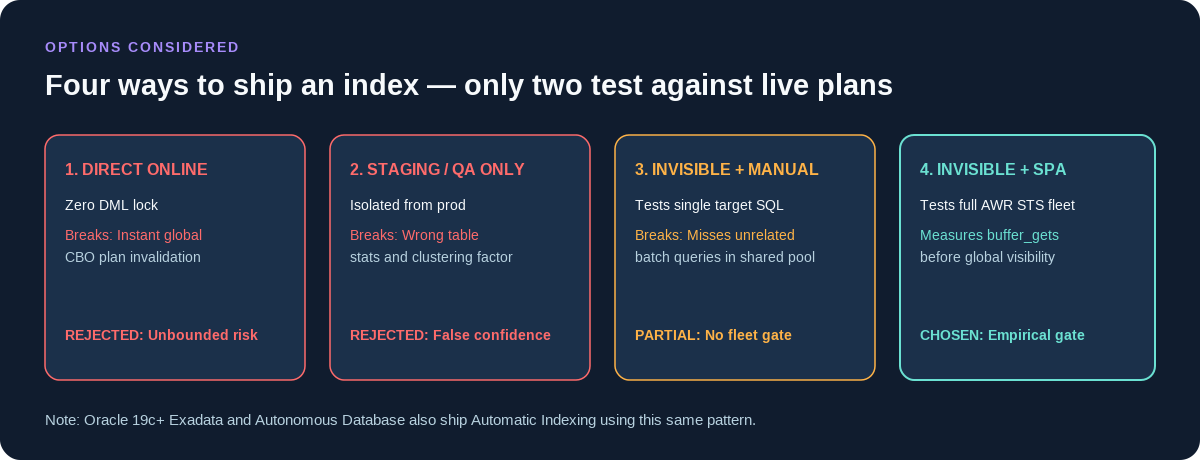
Platform teams typically evaluate four patterns for shipping index changes to production:
| Option | Mechanism | What It Gets Right | Where It Breaks | Verdict |
|---|---|---|---|---|
Direct CREATE INDEX ONLINE | Build index online and expose globally immediately | Zero DML table lock during creation | Exposes every shared-pool query to immediate unvalidated CBO plan flips | Rejected |
| Staging / QA Replay Only | Test index DDL in pre-prod before running in prod | Zero production resource usage during testing | Staging lacks production CLUSTERING_FACTOR, skew, and AUX_STATS$ | Rejected |
INVISIBLE + Manual Session Test | Build INVISIBLE, test target SQL with ALTER SESSION | Confirms target query speeds up safely | Misses unrelated batch and reporting queries in the shared pool | Partial |
INVISIBLE + DBMS_SQLPA Pipeline | Build INVISIBLE, run dual SPA trials on AWR STS | Quantifies both target gain and fleet-wide regressions | Requires Real Application Testing (RAT) license and DML overhead | Chosen |
Direct online builds optimize for DDL availability while ignoring optimizer blast radius. Staging-only validation fails because optimizer cost arithmetic depends on physical table layout and production bind distributions that staging databases do not have. Testing an invisible index manually with ALTER SESSION SET OPTIMIZER_USE_INVISIBLE_INDEXES = TRUE verifies the developer’s query, but tells you nothing about the hundreds of other SQL IDs sharing the same table. Combining INVISIBLE ONLINE with Oracle’s SQL Performance Analyzer (DBMS_SQLPA) closes that gap by testing the entire captured production workload before global visibility changes.
The Index Lifecycle Orchestration Pipeline
The recommended architecture separates physical storage maintenance from optimizer visibility using two native Oracle capabilities: Invisible Indexes and SQL Performance Analyzer (SPA).
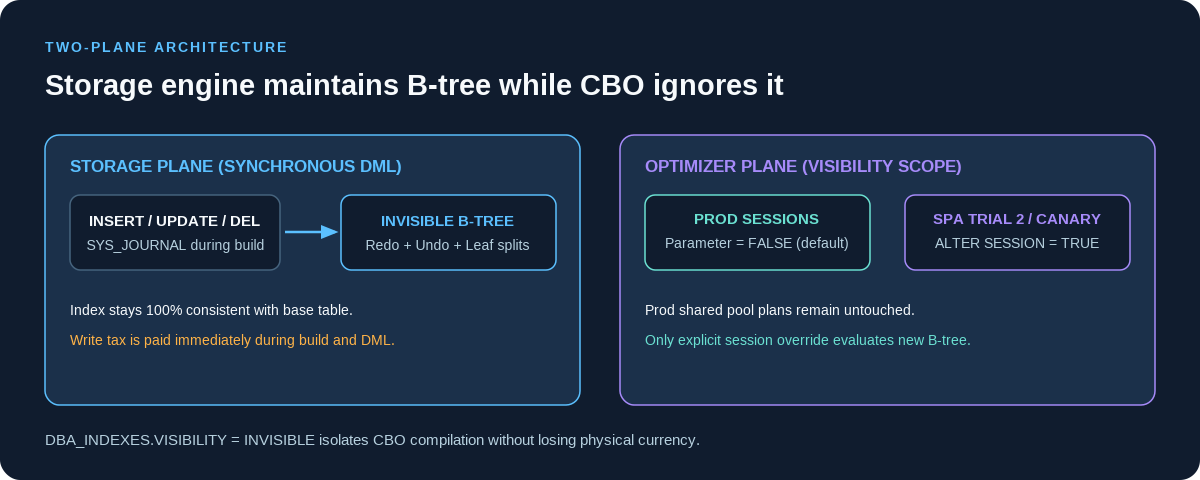
1. Storage Plane vs. Optimizer Plane
Building an index with both INVISIBLE and ONLINE instructs the storage engine to construct and maintain the B-tree in real time while hiding it from the CBO:
CREATE INDEX idx_orders_customer_email
ON orders(customer_email)
TABLESPACE indx_data
INVISIBLE
ONLINE;
- Storage Engine Behavior: Oracle scans the table, builds the B-tree, applies concurrent changes buffered in the online journal table, and keeps leaf blocks synchronized with every subsequent
INSERT,UPDATE, andDELETE. - Optimizer Behavior: The initialization parameter
OPTIMIZER_USE_INVISIBLE_INDEXESdefaults toFALSE. Production sessions compile and execute queries as if the index does not exist, preserving existing execution plans in the shared pool.
2. SQL Performance Analyzer (SPA) Dual-Trial Validation
Once the invisible index is built and its statistics are gathered, the pipeline captures a SQL Tuning Set (STS) from Automatic Workload Repository (AWR) snapshots covering the target table’s active SQL statements. It then invokes DBMS_SQLPA to compare execution metrics with OPTIMIZER_USE_INVISIBLE_INDEXES toggled at the session level between trials:
DECLARE
    v_task_name VARCHAR2(100);
    v_sts_name  VARCHAR2(64) := 'STS_ORDERS_ACTIVE_WORKLOAD';
BEGIN
    v_task_name := DBMS_SQLPA.CREATE_ANALYSIS_TASK(
        sqlset_name => v_sts_name,
        task_name   => 'SPA_VALIDATE_ORDERS_INDEX'
    );

    EXECUTE IMMEDIATE 'ALTER SESSION SET OPTIMIZER_USE_INVISIBLE_INDEXES = FALSE';
    DBMS_SQLPA.EXECUTE_ANALYSIS_TASK(
        task_name      => v_task_name,
        execution_type => 'TEST EXECUTE',
        execution_name => 'TRIAL_1_BASELINE'
    );

    EXECUTE IMMEDIATE 'ALTER SESSION SET OPTIMIZER_USE_INVISIBLE_INDEXES = TRUE';
    DBMS_SQLPA.EXECUTE_ANALYSIS_TASK(
        task_name      => v_task_name,
        execution_type => 'TEST EXECUTE',
        execution_name => 'TRIAL_2_WITH_INDEX'
    );

    EXECUTE IMMEDIATE 'ALTER SESSION SET OPTIMIZER_USE_INVISIBLE_INDEXES = FALSE';
    DBMS_SQLPA.EXECUTE_ANALYSIS_TASK(
        task_name        => v_task_name,
        execution_type   => 'COMPARE PERFORMANCE',
        execution_params => DBMS_ADVISOR.ARGLIST(
            'comparison_metric', 'BUFFER_GETS',
            'execution_name1', 'TRIAL_1_BASELINE',
            'execution_name2', 'TRIAL_2_WITH_INDEX'
        )
    );
END;
/
Note that OPTIMIZER_USE_INVISIBLE_INDEXES is a session/system parameter rather than a DBMS_SQLPA.SET_ANALYSIS_TASK_PARAMETER option, so toggling it via ALTER SESSION between TEST EXECUTE runs ensures Trial 1 measures the baseline and Trial 2 evaluates plans that can see the new index. Comparing on BUFFER_GETS (logical I/O) provides a deterministic signal that is far less noisy than wall-clock elapsed time on shared hosts.
3. Automated Gating Criteria
The pipeline parses DBMS_SQLPA.REPORT_ANALYSIS_TASK and enforces two gates before promotion:
- Target Gain Gate: The motivating SQL ID must show a meaningful reduction in
BUFFER_GETSor CPU time. If the index yields negligible improvement, keeping it only adds DML write overhead, so the pipeline drops it. - Fleet Regression Gate: No other SQL ID in the STS may exceed the configured regression threshold (commonly 5% on
BUFFER_GETSorWORKLOAD_IMPACT_THRESHOLD). Any regression triggers an automatedDROP INDEXand returns the offendingSQL_IDand plan diff to the pull request.
How It Rolls Out
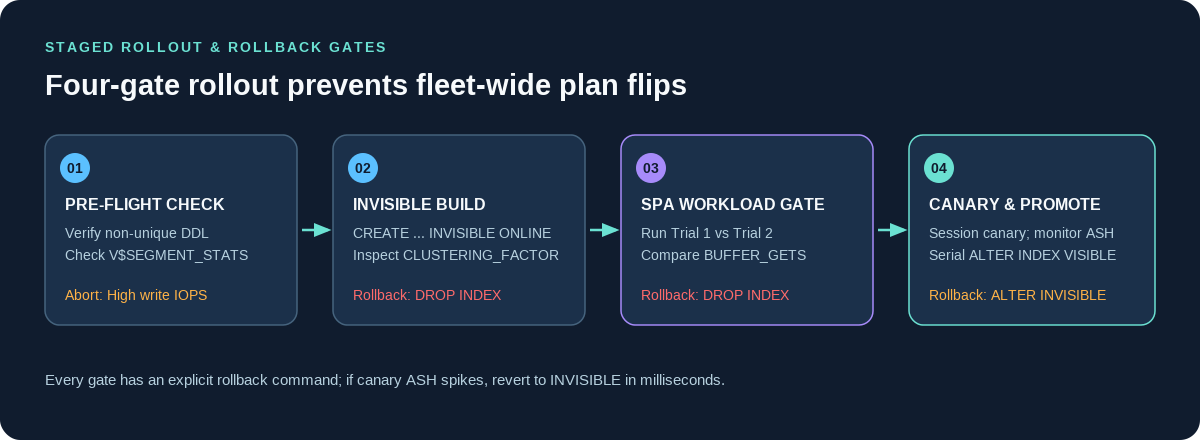
A safe rollout enforces four sequential gates, each with an explicit rollback action:
- Gate 01 — Pre-Flight Safety Check: Reject
UNIQUEindex proposals from automated pipelines, because the storage engine enforces uniqueness even when an index isINVISIBLE. Check table write intensity viaV$SEGMENT_STATISTICSand setDDL_LOCK_TIMEOUTto avoid immediateORA-00054: resource busyfailures during transient locks. Rollback: abort before DDL. - Gate 02 — Invisible Online Build & Physical Inspection: Execute
CREATE INDEX ... INVISIBLE ONLINE, then queryDBA_INDEXESforCLUSTERING_FACTOR,BLEVEL, andLEAF_BLOCKSalongsideDBA_TABLES.BLOCKSandNUM_ROWS. IfCLUSTERING_FACTORapproachesNUM_ROWSon a range-scanned column, flag the index for review before running SPA. Rollback:DROP INDEX. - Gate 03 — SPA Dual-Trial Evaluation: Capture an AWR SQL Tuning Set spanning full batch and OLTP cycles (not just a single off-peak hour) and run the
DBMS_SQLPAbaseline vs. session-enabled comparison. Rollback:DROP INDEX. - Gate 04 — Session Canary & Serialized Promotion: Enable
ALTER SESSION SET OPTIMIZER_USE_INVISIBLE_INDEXES = TRUEon a single canary application pool or service while watching Active Session History (V$ACTIVE_SESSION_HISTORY) fordb file sequential readspikes. For critical batch SQL IDs that must never flip plans even after promotion, pin their existing plans in SQL Plan Management (DBMS_SPM.LOAD_PLANS_FROM_CURSOR_CACHE) before changing index visibility. Once clean, executeALTER INDEX ... VISIBLEserially across Pluggable Databases (PDBs) to avoid concurrent library cache invalidation storms. Rollback:ALTER INDEX ... INVISIBLE(instant, zero data loss).
In Practice
This exact INVISIBLE-build-plus-workload-verification pattern is not merely a custom CI/CD convention; it is the foundational mechanism behind Oracle’s own Automatic Indexing (DBMS_AUTO_INDEX), introduced in Oracle Database 19c on Exadata and Autonomous Database and expanded in Oracle Database 23ai with expression tracking and on-demand APIs.
In Oracle’s documented Automatic Indexing workflow:
- Identification and Invisible Creation: The background task analyzes workload column usage and creates candidate indexes with a
SYS_AI_prefix in theINVISIBLEandUNUSABLEorVISIBLElifecycle states, ensuring production sessions cannot use them prematurely. - SPA Verification: Oracle internally invokes SQL Performance Analyzer verification against captured workload SQL before flipping any
SYS_AI_index toVISIBLE. If a candidate index improves target statements without regressing other SQL statements, it is promoted; otherwise it remains invisible and is eventually purged. - Operational Controls: Administrators can run
DBMS_AUTO_INDEX.CONFIGURE('AUTO_INDEX_MODE', 'REPORT ONLY')to build and test invisible candidates without ever promoting them automatically, or'IMPLEMENT'to allow automated promotion.
For teams running Oracle 19c on non-Exadata infrastructure or without Autonomous Database—where DBMS_AUTO_INDEX is not available—implementing the same INVISIBLE ONLINE + DBMS_SQLPA pipeline in GitOps/CI provides equivalent regression protection using documented, supported database primitives. (Note: DBMS_SQLPA requires the Oracle Real Application Testing option.)
Where It Breaks
| Failure Scenario | Failure Mechanism | Operational Consequence | Mitigation |
|---|---|---|---|
| Invisible Index Sprawl | Failed or abandoned invisible indexes are never dropped | Consumes tablespace storage and slows every INSERT/UPDATE/DELETE | Enforce automated TTL cleanup to drop unpromoted invisible indexes |
| Write-Heavy Table Contention | Multiple indexes on high-DML tables | Leaf block splits, redo overhead, and enq: TX - index contention waits | Gate on V$SEGMENT_STATISTICS write rates before approving new indexes |
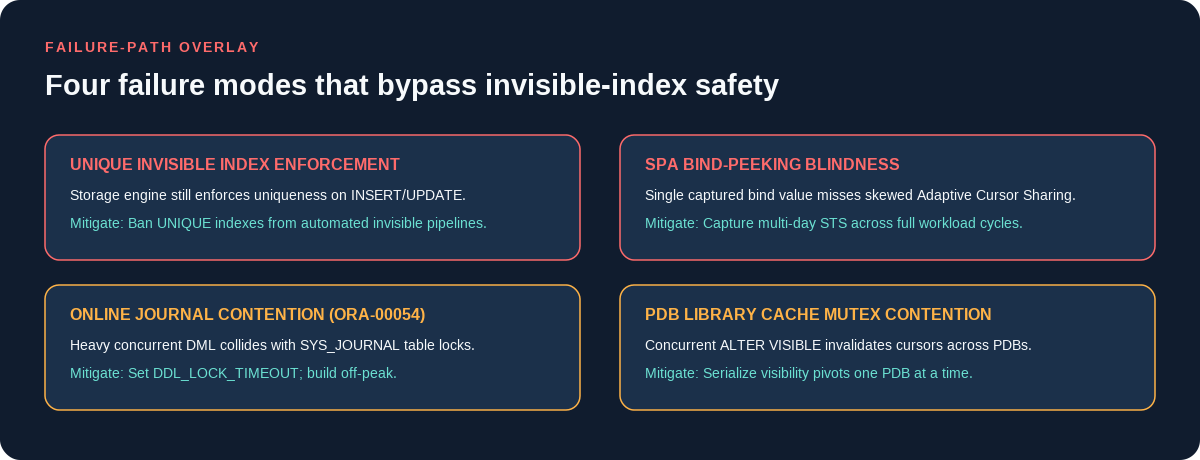
| SPA Bind-Peeking Blindness | STS captures only a narrow window or single bind set | Trial misses skewed predicates handled by Adaptive Cursor Sharing | Capture multi-day STS snapshots covering both OLTP and batch windows |
| Unique Invisible Index Trap | Creating UNIQUE INVISIBLE on a live table | Storage engine enforces uniqueness on DML despite INVISIBLE status | Ban UNIQUE indexes from automated pipelines; require constraint review |
| Exadata Smart Scan Bypass | New index tempts CBO away from Smart Scan | Loses storage cell predicate offload; shifts filtering load to DB host CPU | Calibrate system stats with DBMS_STATS.GATHER_SYSTEM_STATS('EXADATA') |
Online Build Journal Lock (ORA-00054) | Concurrent DML collides with DDL lock acquisition | CREATE INDEX ... ONLINE fails or blocks waiting on SYS_JOURNAL | Schedule builds off-peak and set session DDL_LOCK_TIMEOUT |
| Concurrent PDB Visibility Pivot | Running ALTER INDEX ... VISIBLE across PDBs at once | Simultaneous cursor invalidations trigger library cache: mutex X | Serialize ALTER INDEX ... VISIBLE one PDB at a time |
Key Takeaways
- Visibility is the blast radius, not the build:
CREATE INDEX ... ONLINEprotects DML concurrency during construction, but onlyINVISIBLEprotects the Cost-Based Optimizer from immediate global plan invalidation. CLUSTERING_FACTORdetermines real I/O cost: An index whoseCLUSTERING_FACTORapproachesNUM_ROWSforces random single-block I/O that can make an Index Range Scan orders of magnitude slower than a Full Table Scan.- Toggle
OPTIMIZER_USE_INVISIBLE_INDEXESper session in SPA:DBMS_SQLPAtests invisible indexes by runningTEST EXECUTEtwice—once withFALSEand once afterALTER SESSION SET OPTIMIZER_USE_INVISIBLE_INDEXES = TRUE—comparingBUFFER_GETSacross the full AWR SQL Tuning Set. - Invisible is not free: The storage engine still maintains the B-tree synchronously on every DML statement and still enforces
UNIQUEconstraints even whenVISIBILITY = 'INVISIBLE'. - Oracle 19c+ Automatic Indexing uses the same loop: On Exadata and Autonomous Database,
DBMS_AUTO_INDEXautomates invisible creation, SPA verification, and promotion; CI/CD pipelines bring that same safety gate to standard enterprise deployments.
What to Do Next
- Problem: Production teams still run raw
CREATE INDEX ... ONLINEDDL without testing how the new index alters execution plans for unrelated batch and reporting SQL. - Solution: Mandate
INVISIBLE ONLINEfor all production index builds and gate promotion onDBMS_SQLPAdual-trial comparison (BUFFER_GETS) plus a session-level canary. - Proof: Query
DBA_INDEXESon your highest-churn tables today to compareCLUSTERING_FACTORagainstBLOCKSandNUM_ROWS, and checkV$SQL_PLANfor batch queries doing high-cost index lookups. - Action: Wrap your next non-unique production index request in
CREATE INDEX ... INVISIBLE ONLINE, run a two-trialDBMS_SQLPAcomparison against a 24-hour AWR SQL Tuning Set, and promote withALTER INDEX ... VISIBLEonly after zero fleet regressions.
Sources to Verify
- Oracle Database Administrator’s Guide: Managing Indexes (Invisible Indexes & Automatic Indexing) (
docs.oracle.com/en/database/oracle/oracle-database/19/admin/managing-indexes.html) - Oracle Database PL/SQL Packages and Types Reference: DBMS_SQLPA (
docs.oracle.com/en/database/oracle/oracle-database/19/arpls/DBMS_SQLPA.html) - Oracle Database Performance Tuning Guide: Gathering System Statistics (
EXADATA) (docs.oracle.com) - Oracle Database Reference: DBA_INDEXES (
CLUSTERING_FACTOR,VISIBILITY) (docs.oracle.com)