
Closed-Loop Oracle Remediation: Designing the Human Authorization Mesh for Autonomous Database Agents
Content reflects the state as of November 2026. AI tooling and model capabilities in this area change frequently.
An autonomous LLM agent can diagnose an Oracle lock chain and draft ALTER SYSTEM KILL SESSION in seconds, but giving that agent direct execution authority turns a local performance spike into an unrecoverable business outage.
TL;DR
- Problem: Autonomous remediation agents optimize for their immediate objective (clearing locks) without knowing whether the blocking session is a critical batch job whose rollback will outlast the incident.
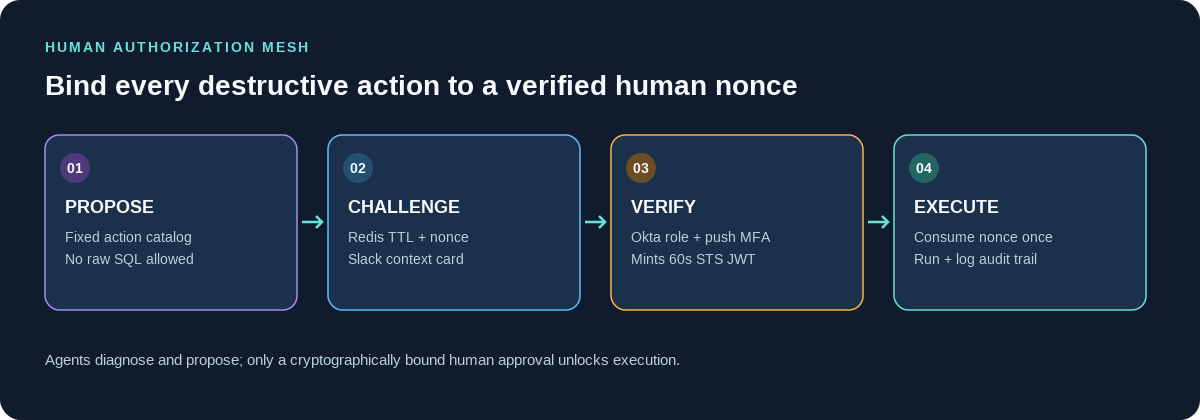
- Answer: Place a stateful approval mesh between the read-only agent and the execution engine—using a fixed action catalog, a Redis-backed cryptographic nonce, Okta MFA verification, and a 60-second RS256 STS token.
- Watch out: Chat-button approvals without MFA, replayable nonces, or string-interpolated
ALTER SYSTEMhandlers recreate the same blast radius behind a UI veneer.
Situation
Autonomous database remediation agents operate across a spectrum from purely advisory (investigate and post recommendations) to fully autonomous (investigate and mutate production state). Where an action belongs on that spectrum depends on two properties: reversibility and blast radius.
| Action Category | Example | Reversibility | Blast Radius | Recommended Approval Mode |
|---|---|---|---|---|
| Read-only diagnostic | AWR report, V$SESSION lock tree | N/A — no state change | None | Autonomous — no approval |
| Reversible maintenance | DBMS_STATS.GATHER_TABLE_STATS | High — prior stats in WRI$_OPTSTAT_TAB_HISTORY | Single table | Autonomous or low-friction review |
| Limited-blast destructive | ALTER SYSTEM KILL SESSION | Partial — rolls back uncommitted work | Single session + undo load | Single-engineer Okta-verified approval |
| High-blast destructive | Kill long-running batch session | Costly — rollback can equal job runtime | Hours of lost compute + locks | Named PE approval + secondary escalation |
| Fleet-wide state change | Data Guard failover, DROP TABLE PURGE | Irreversible or role-changing | Entire service or region | Two-person approval + ITSM record |
The failure mode that motivates an authorization mesh is eager autonomy. When an agent is instructed to resolve row-lock contention (enq: TX - row lock contention), killing the holding session is technically valid from a database lock-graph perspective. What the database views cannot tell the agent is whether that session is a month-end financial close job that has already run for hours—meaning ALTER SYSTEM KILL SESSION will force Oracle to roll back every uncommitted change before the job can even be restarted.
The Problem
Designing a human-in-the-loop approval mechanism for production Oracle operations requires satisfying four competing constraints at the same time:
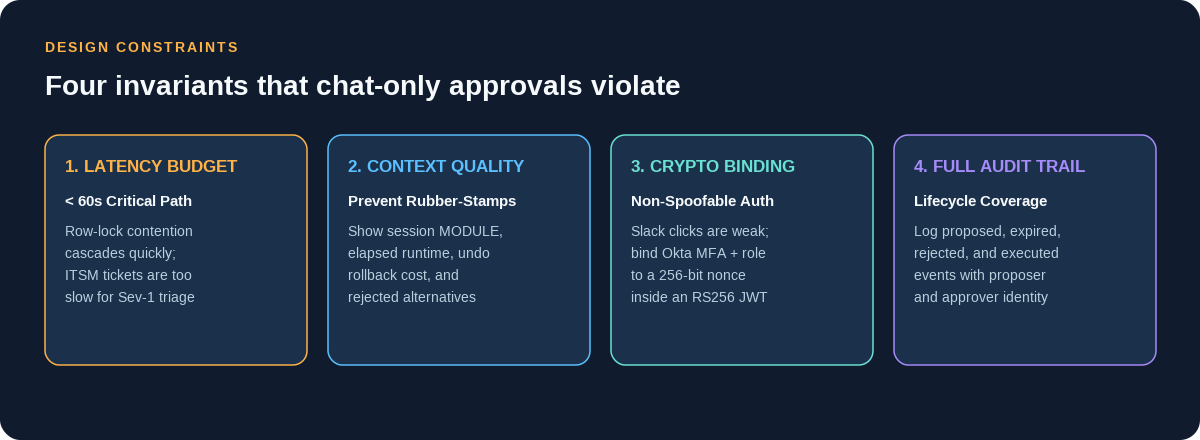
- Incident latency budget (< 60 seconds): During a Severity-1 lock cascade, connection pools back up within one to two minutes. Traditional ITSM change tickets take 5 to 20 minutes to create, route, and approve—far slower than the failure cascade. Breaking down the 60-second budget shows where time actually goes: diagnostic
V$SESSIONandV$TRANSACTIONqueries plus LLM synthesis take roughly 4–6 seconds; Redis persistence and Slack Block Kit delivery take under 1 second; human reading and decision take 15–20 seconds if the card is well-structured; Okta Verify push delivery and biometric approval take 8–12 seconds; and KMS RS256 signing plus Execution Engine dispatch take 1–2 seconds. That leaves a ~20-second margin before the 60-second ceiling—meaning the approval card must be immediately scannable without opening an AWR console. - Context sufficiency to prevent rubber-stamping: A prompt reading “Approve killing session 402?” trains engineers to click Approve blindly. The approval card must surface the session’s
MODULE,ACTION, elapsed runtime, active undo blocks (V$TRANSACTION.USED_UBLK), the exact rollback cost, and the negative-space evidence (what alternatives the agent checked and why it rejected them). - Cryptographic authorization binding: Slack message reactions or
/approveslash commands are weak authorization signals—any member of a channel can click a button without secondary identity verification, and webhook payloads can be replayed if not bound to a single-use nonce. The execution engine must require an asymmetric, short-lived Security Token Service (STS) JWT signed by a Hardware Security Module (HSM) or KMS key and bound to both the approver’s Okta identity and the proposal’s cryptographic nonce. - Complete lifecycle auditability: Regulated environments (PCI DSS, SOX, HIPAA) require an immutable record of every proposed, approved, rejected, expired, and executed state change—including both the proposing agent and the authenticating human principal.
How do you build an approval path that completes in under 60 seconds, surfaces enough operational context to prevent blind clicks, cryptographically binds human identity to a single action, and logs the full lifecycle without forcing DBAs into a console at 2 AM?
Options Considered
Four authorization architectures cover the practical design space for automated database remediation.
| Architecture | Incident Speed | Auth Strength | Raw SQL Risk | Primary Failure Mode |
|---|---|---|---|---|
| Full Agent Autonomy | < 5 seconds | None (self-approved) | High if unconstrained | Terminates critical batch jobs without business context |
| Slack-Only Button | 15–30 seconds | Weak (chat session only) | Medium | Spoofable channel clicks; no MFA or role enforcement |
| Manual ITSM Change Ticket | 5–20 minutes | Strong (SSO + ticket) | Low | Too slow for active Sev-1 lock cascades |
| Stateful Approval Mesh | 20–45 seconds | Strong (Okta MFA + KMS RS256) | None (fixed catalog) | Requires Redis state and KMS availability |
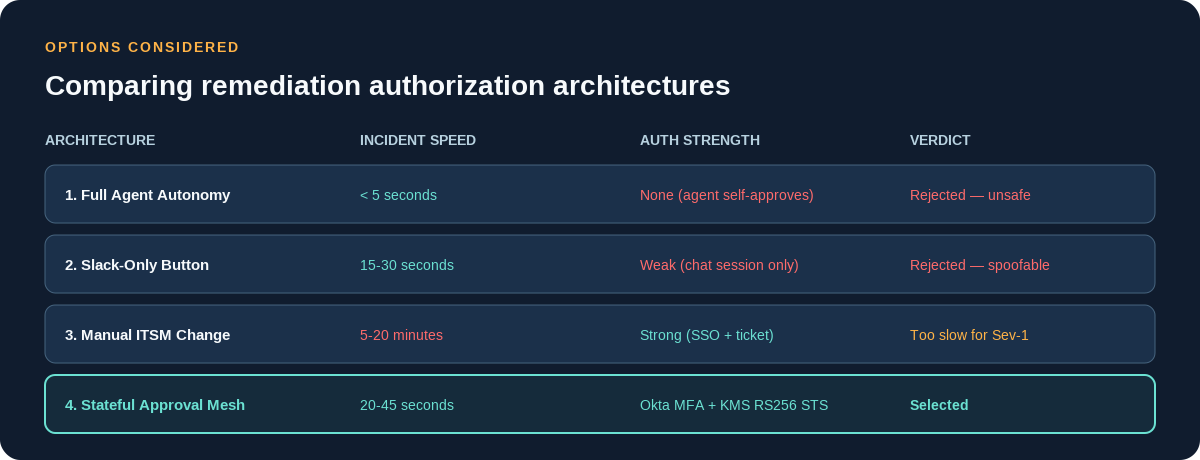
Full agent autonomy achieves sub-5-second remediation but was rejected because database telemetry (V$SESSION, V$LOCK) does not encode business deadlines or downstream batch SLAs. Slack-only buttons meet the speed budget but fail the cryptographic binding constraint: a compromised or unattended laptop with an open Slack session can authorize destructive actions without MFA. Manual ITSM tickets provide strong governance and auditability, so they remain appropriate for planned schema changes and Data Guard failovers, but their multi-minute latency makes them unusable for live lock-cascade triage. The stateful approval mesh combines Slack’s speed with Okta MFA, a fixed action catalog, and KMS-signed STS tokens.
The Stateful Approval Mesh Architecture
The approval mesh enforces strict privilege separation: the diagnostic agent holds read-only Oracle credentials and can only emit structured ActionProposal payloads; only the Execution Engine holds privileged Oracle credentials, and it refuses to act without a valid, unconsumed STS JWT.
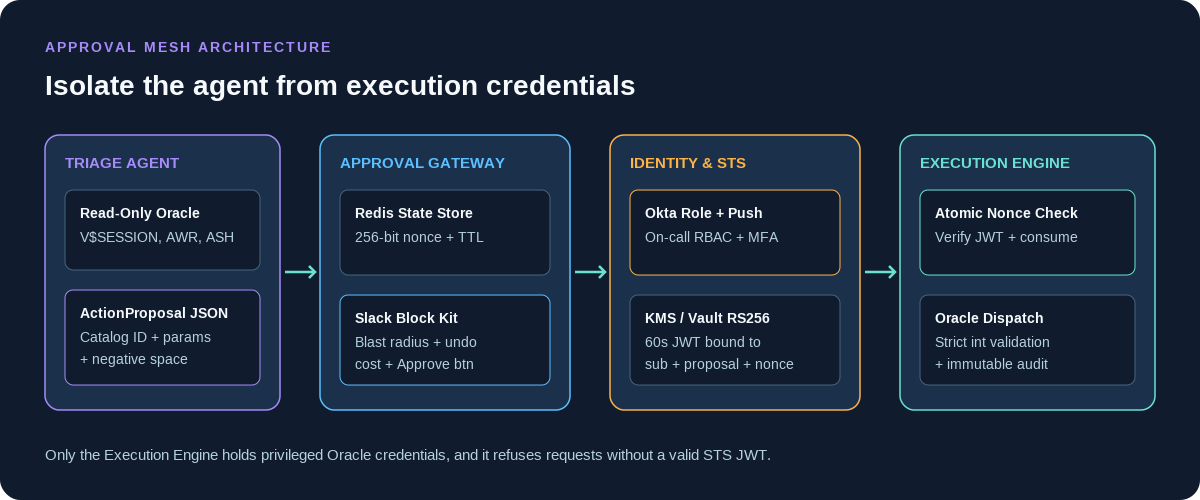
flowchart TD
    A[Read-Only Triage Agent] --> B[ActionProposal JSON — fixed catalog]
    B --> C[Approval Gateway — Redis 256-bit nonce]
    C --> D[Slack Block Kit card — blast radius context]
    D --> E[Engineer clicks Approve]
    E --> F[Okta RBAC + Push MFA]
    F --> G{Approved within TTL?}
    G -->|No — timeout or reject| H[Audit EXPIRED — escalate]
    G -->|Yes| I[Mint 60s RS256 STS JWT]
    I --> J[Execution Engine — atomic nonce CAS]
    J --> K[Validated Oracle API + Audit EXECUTED]
Fixed Action Catalog (No Arbitrary SQL)
The agent never generates raw SQL for execution. It selects an action_id from an allowlisted catalog where each entry defines its risk tier, required Okta group, maximum TTL, reversibility, and blast radius.
from dataclasses import dataclass
from enum import Enum

class RiskLevel(Enum):
    LOW = "LOW"
    HIGH = "HIGH"
    CRITICAL = "CRITICAL"

@dataclass(frozen=True)
class ActionDefinition:
    action_id: str
    display_name: str
    risk_level: RiskLevel
    required_approver_role: str
    max_ttl_seconds: int
    reversibility: str
    blast_radius_description: str

ACTION_CATALOG = {
    "kill_single_session": ActionDefinition(
        action_id="kill_single_session",
        display_name="Kill Oracle Session",
        risk_level=RiskLevel.HIGH,
        required_approver_role="oracle-dba-oncall",
        max_ttl_seconds=90,
        reversibility="PARTIAL — Oracle marks session KILLED and rolls back uncommitted work",
        blast_radius_description="Terminates target session; rollback duration scales with undo blocks used",
    ),
    "gather_table_stats": ActionDefinition(
        action_id="gather_table_stats",
        display_name="Gather Table Statistics",
        risk_level=RiskLevel.LOW,
        required_approver_role="any-engineer",
        max_ttl_seconds=300,
        reversibility="FULL — prior stats restorable via DBMS_STATS.RESTORE_TABLE_STATS",
        blast_radius_description="Refreshes optimizer statistics for one table; may trigger plan re-parses",
    ),
    "make_index_visible": ActionDefinition(
        action_id="make_index_visible",
        display_name="Restore Index Visibility",
        risk_level=RiskLevel.LOW,
        required_approver_role="any-engineer",
        max_ttl_seconds=300,
        reversibility="FULL — index can be toggled back to INVISIBLE",
        blast_radius_description="Exposes existing index to optimizer without rebuilding segments",
    ),
}
Nonce Binding and Okta-Verified STS Issuance
When the gateway receives a proposal, it generates a 256-bit cryptographic nonce (secrets.token_urlsafe(32)), stores the proposal in Redis with SETEX, writes a PROPOSED audit record, and posts a Slack Block Kit card. Clicking Approve verifies the engineer’s Okta group membership and triggers an Okta Verify push challenge before minting a 60-second RS256 JWT signed via KMS or Vault.
import json
import secrets
from datetime import datetime, timedelta, timezone
from jose import jwt

def submit_proposal(redis_client, slack_client, proposal: dict) -> str:
    action_def = ACTION_CATALOG[proposal["action_id"]]
    nonce = secrets.token_urlsafe(32)
    expires_at = datetime.now(timezone.utc) + timedelta(seconds=action_def.max_ttl_seconds)

    record = {
        "proposal": proposal,
        "nonce": nonce,
        "status": "PENDING",
        "required_role": action_def.required_approver_role,
        "expires_at": expires_at.isoformat(),
    }
    redis_client.setex(
        f"approval:{proposal['proposal_id']}",
        action_def.max_ttl_seconds,
        json.dumps(record),
    )
    audit_log("PROPOSED", {"proposal_id": proposal["proposal_id"], "nonce": nonce})
    resp = slack_client.chat_postMessage(**build_slack_card(proposal, action_def, nonce))
    return resp["ts"]

async def issue_sts_after_okta(okta_client, approver_email: str, proposal_id: str, nonce: str, record: dict) -> str | None:
    if not okta_client.user_has_role(approver_email, record["required_role"]):
        return None
    push = await okta_client.send_push_verification(
        user_email=approver_email,
        challenge_context=f"Approve {record['proposal']['action_id']} on {record['proposal']['db_unique_name']}",
    )
    if push.status != "APPROVED":
        return None

    now = datetime.now(timezone.utc)
    claims = {
        "sub": approver_email,
        "proposal_id": proposal_id,
        "nonce": nonce,
        "action_id": record["proposal"]["action_id"],
        "db_unique_name": record["proposal"]["db_unique_name"],
        "iat": int(now.timestamp()),
        "exp": int((now + timedelta(seconds=60)).timestamp()),
    }
    return kms_sign_rs256_jwt(claims)
Atomic Nonce Consumption and Negative-Space Enrichment
Two implementation details separate a production-grade approval mesh from a prototype. First, the Execution Engine must consume the Redis nonce atomically. If two on-call engineers click Approve within milliseconds of each other, a naive GET followed by SET allows both requests to pass the check and execute the Oracle command twice. Using a Redis Lua compare-and-swap (or GETDEL on a single-use key) guarantees that exactly one worker claims PENDING → CONSUMED and all concurrent or replayed tokens fail immediately.
Second, the Slack card must include negative-space evidence gathered deterministically by the gateway—not hallucinated by the LLM. Before posting a kill_single_session card, the gateway queries V$SESSION (logon_time, module, action, sql_id) and V$TRANSACTION (used_ublk, used_urec) directly so the engineer sees the exact undo footprint and session age. Before posting a make_index_visible or index-drop proposal, it attaches the row from DBA_INDEX_USAGE showing TOTAL_ACCESS_COUNT and LAST_USED, and validates schema/object identifiers against DBA_OBJECTS so unverified object names never reach execution.
Safe Oracle Execution (Why ALTER SYSTEM Rejects Binds)
A subtle Oracle trap sits in the execution handler: Oracle does not support bind variables in DDL or ALTER SYSTEM statements. Passing ALTER SYSTEM KILL SESSION :sid, :serial to cursor.execute() raises ORA-00922: missing or invalid option. To prevent parameter injection without relying on unsupported binds, the execution handler must strictly validate sid and serial# as positive integers, verify the target session still exists in V$SESSION (and is not a background process where TYPE != 'USER'), and then format the literal 'sid,serial#' string.
def kill_oracle_session(conn, parameters: dict) -> dict:
    sid = int(parameters["sid"])
    serial = int(parameters["serial"])
    if sid <= 0 or serial <= 0:
        raise ValueError("sid and serial# must be positive integers")

    with conn.cursor() as cur:
        cur.execute(
            "SELECT username, module, status FROM v$session WHERE sid = :sid AND serial# = :serial AND type = 'USER'",
            sid=sid,
            serial=serial,
        )
        row = cur.fetchone()
        if not row:
            return {"status": "SKIPPED", "reason": "Session no longer active or not a USER session"}

        # ALTER SYSTEM does not accept bind variables; sid and serial are verified ints
        cur.execute(f"ALTER SYSTEM KILL SESSION '{sid},{serial}' IMMEDIATE")
        return {"status": "KILLED", "sid": sid, "serial": serial, "module": row[1]}
How It Rolls Out
Every remediation request follows a five-step state machine with explicit rollback and escalation gates.
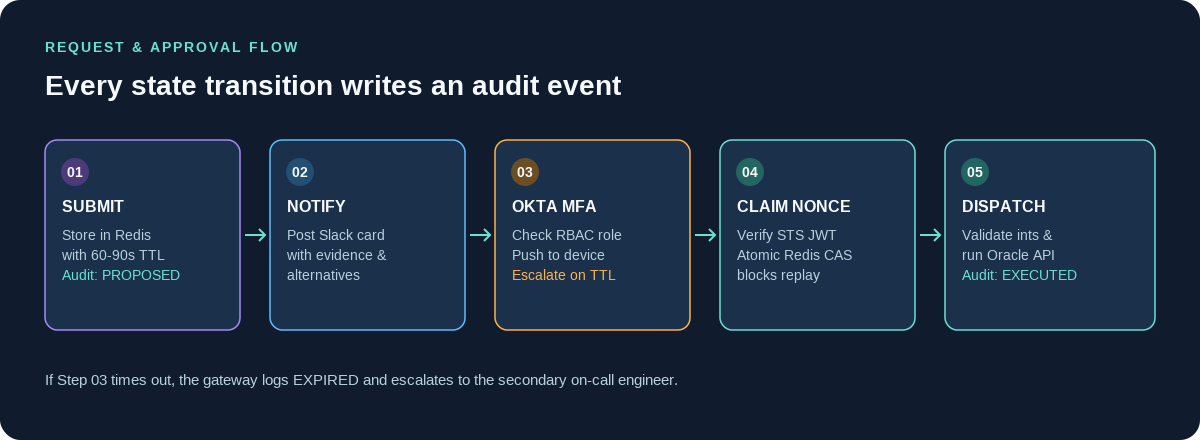
- Step 1 — Submit & Persist: The agent emits an
ActionProposalfromACTION_CATALOG. The gateway writes thePENDINGrecord with a 256-bit nonce to Redis (SETEXwith 60–300s TTL depending on risk tier) and logsPROPOSEDto the immutable audit store. - Step 2 — Context Card Delivery: The gateway posts the Slack Block Kit message containing target database,
MODULE/ACTION, undo rollback cost,agent_justification, andalternatives_considered. - Step 3 — Okta RBAC + MFA Challenge: When an engineer clicks Approve, the gateway checks their Okta group (
oracle-dba-oncallororacle-platform-pe) and sends an Okta Verify push. ForCRITICALactions such as Data Guard failover, the gateway requires two distinct Okta principals (sub_1 != sub_2) plus an active ITSM incident ID before minting the STS token. Escalation gate: If the push times out or is rejected, the gateway logsEXPIREDorREJECTEDand pages the secondary on-call engineer with a shorter TTL (45s secondary, 30s on-call manager). In parallel, the agent posts its read-only diagnostic summary to the incident channel so the escalating engineer does not lose context waiting for another triage cycle. - Step 4 — Atomic Nonce Claim: The Execution Engine validates the RS256 JWT signature against the KMS public key, checks
exp, and performs an atomic Redis compare-and-swap (PENDING→CONSUMED). Any duplicate or replayed token fails immediately. - Step 5 — Parameter-Validated Dispatch & Audit: The handler validates integer bounds and session type (
USER) inV$SESSION, executes the allowlisted Oracle call, and writes theEXECUTEDaudit record linkingproposed_by(agent) andapproved_by(Oktasub).
In Practice
Several concrete Oracle and identity behaviors dictate how this pattern must be implemented:
- Oracle
ALTER SYSTEM KILL SESSIONvs.DISCONNECT SESSION: Per Oracle Database Administrator’s Guide,ALTER SYSTEM KILL SESSIONdoes not skip transaction rollback. It marks the sessionKILLED(V$SESSION.STATUS = 'KILLED') and instructs the session (or PMON/cleanup processes) to roll back all uncommitted changes using undo blocks. AddingIMMEDIATEreturns control to the caller immediately rather than waiting for the session to acknowledge, but the undo rollback still runs—and for a multi-hour batch DML job, rollback can take as long as the original transaction. SurfacingV$TRANSACTION.USED_UBLKandUSED_URECon the Slack approval card gives the engineer the true recovery cost before clicking Approve. When a session is waiting on a dead client TCP socket andKILL SESSIONleaves it stuck inKILLEDstate,ALTER SYSTEM DISCONNECT SESSION '<sid>,<serial#>' IMMEDIATEdestroys the dedicated server process directly after rollback. - Oracle statistics and index verification (
DBA_INDEX_USAGEandDBMS_STATS): When an agent proposesgather_table_stats, Oracle retains prior table statistics inWRI$_OPTSTAT_TAB_HISTORY(31 days by default viaDBMS_STATS.GET_STATS_HISTORY_RETENTION), making statistics refreshes genuinely reversible viaDBMS_STATS.RESTORE_TABLE_STATS. For index visibility or drop proposals, Oracle 12.2+ providesDBA_INDEX_USAGE(which automatically tracksTOTAL_ACCESS_COUNT,TOTAL_EXEC_COUNT, andLAST_USEDwithout manualALTER INDEX ... MONITORING USAGE). Requiring the agent to attachDBA_INDEX_USAGEoutput prevents approving index changes that break infrequent month-end jobs. - KMS/HSM signing boundary: Storing the RS256 private key in application environment variables means a single CI/CD secret leak compromises the entire Oracle fleet. Signing STS tokens via AWS KMS or OCI Vault HSM ensures the private key never leaves the hardware boundary.
Where It Breaks
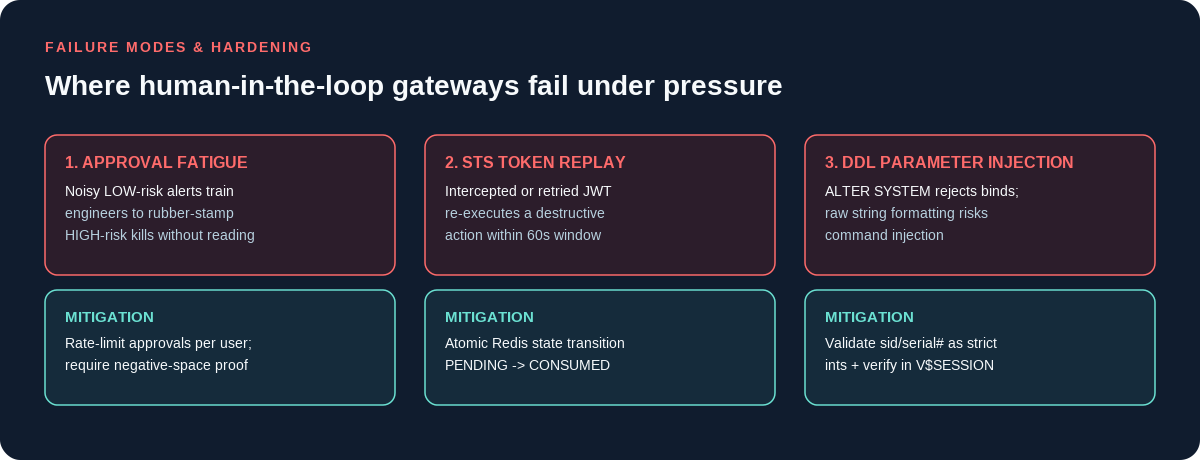
| Condition | Breaks How | Detect | Mitigate |
|---|---|---|---|
| Approval fatigue | High volume of LOW alerts trains engineers to approve HIGH kills blindly | Track per-engineer approval rate and review time (< 3s) | Rate-limit approvals per user; require negative-space evidence in every card |
| STS token replay | Intercepted or retried JWT re-executes a destructive action within 60s | Duplicate proposal_id execution attempts in engine logs | Atomic Redis CAS (PENDING → CONSUMED) before dispatch |
ALTER SYSTEM injection | String-interpolated parameters inject extra SQL clauses | Static analysis + runtime regex check on parameters | Strict int() casting + V$SESSION existence and TYPE = 'USER' check |
| On-call engineer unreachable | 2 AM Okta push times out after 30s; incident stalls | Monitor EXPIRED proposal rate on Sev-1 alerts | Decreasing-TTL escalation chain to secondary on-call and manager |
| Redis expiry erases audit | Proposal expires in Redis (SETEX) leaving no record of agent intent | Compare PROPOSED count against EXECUTED + EXPIRED + REJECTED | Write PROPOSED on submit and EXPIRED via keyspace/timer callback |
| Signing key compromise | Leaked private key lets attacker forge valid STS JWTs | Unexpected sub or missing Okta push correlation ID | Sign and verify via AWS KMS or OCI Vault HSM; never store raw keys |
Key Takeaways
- Separate diagnosis from execution: Keep the LLM agent on read-only Oracle credentials; only the Execution Engine holds privileged credentials and only acts on a signed STS token.
- Replace raw SQL with a fixed action catalog: Constraining proposals to allowlisted
action_identries prevents prompt injection from turning an approval card into arbitrary DDL. - Surface rollback cost, not just lock symptoms:
ALTER SYSTEM KILL SESSIONrolls back uncommitted undo; showingV$TRANSACTION.USED_UBLKand runtime prevents engineers from killing multi-hour batch jobs blindly. - Bind approvals to single-use nonces and MFA: Chat clicks alone are spoofable; pair Slack Block Kit with Okta RBAC + push MFA and an atomic Redis
PENDING→CONSUMEDstate transition. - Validate DDL parameters in code: Because
ALTER SYSTEMrejects bind variables (ORA-00922), enforce strict integer parsing andV$SESSIONverification before formatting the command.
What to Do Next
- Problem: Autonomous Oracle remediation agents optimize for immediate database metrics without understanding business context, risking catastrophic rollbacks when killing long-running batch sessions.
- Solution: Deploy a stateful approval mesh between your diagnostic agent and execution engine using a fixed action catalog, Redis-backed single-use nonces, Okta MFA verification, and KMS-signed 60-second RS256 STS tokens.
- Proof: Oracle’s
ALTER SYSTEM KILL SESSIONmarks a sessionKILLEDand rolls back its uncommitted transaction—meaning an ill-timed kill on a large batch job triggers an undo rollback that can outlast the original incident. - Action: Audit every Slack bot, webhook, and runbook runner in your environment that can mutate Oracle state this week; verify whether it requires MFA-backed cryptographic authorization and whether any
ALTER SYSTEMhandler performs strict integer andV$SESSIONvalidation.
Sources
- Oracle Database Administrator’s Guide 19c — Managing Sessions (
ALTER SYSTEM KILL SESSIONand rollback behavior): https://docs.oracle.com/en/database/oracle/oracle-database/19/admin/managing-sessions.html - Oracle Database SQL Language Reference 19c —
ALTER SYSTEM: https://docs.oracle.com/en/database/oracle/oracle-database/19/sqlrf/ALTER-SYSTEM.html - Oracle Database Reference 19c —
DBA_INDEX_USAGE: https://docs.oracle.com/en/database/oracle/oracle-database/19/refrn/DBA_INDEX_USAGE.html - Okta Authentication & Factors API Documentation: https://developer.okta.com/docs/reference/api/authn/
- RFC 8725 — JSON Web Token Best Current Practices: https://datatracker.ietf.org/doc/html/rfc8725
- Redis
SETEXCommand Reference: https://redis.io/commands/setex/
Interactive tools for this topic