
Autonomous Oracle Vulnerability Management: Integrating Update Advisor with Immutable CI/CD Pipelines
If patching 1,200 Oracle databases for a quarterly Critical Patch Update requires DBAs to read advisories, file change tickets, and run opatch in place on live hosts, the pipeline fails its 14-day CVSS 9.0+ remediation SLA by construction.
TL;DR
- Problem: At 1,200 databases, a 14-day remediation window requires patching
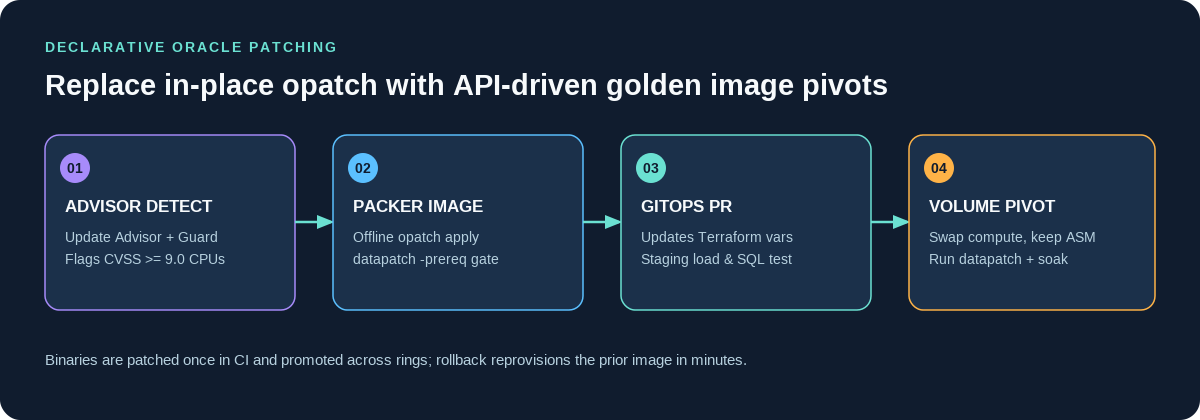
85.7databases per day, while in-placeopatchmutates live$ORACLE_HOMEbinaries across divergent OS library states.- Answer: Ingest patch advisories programmatically via Oracle Update Advisor and OCI Cloud Guard, build patched golden images offline with Packer, open a GitOps Terraform PR, and pivot compute nodes across telemetry-gated rings while keeping ASM data volumes intact.
- Watch out: Retaining prior golden images for only 72 hours leaves no fast pivot rollback if a subtle optimizer regression surfaces in Week 2—keep prior images for 7 days (30 days for emergency CVSS 9.0+ patches).
Situation
Oracle releases quarterly Critical Patch Updates (CPUs) and Release Updates (RUs) every January, April, July, and October. Under regulated frameworks (PCI DSS v4.0 Requirement 6.3, SOC 2, HIPAA), vulnerabilities scored CVSS 9.0 or higher typically carry 14-day remediation SLAs. At small scale, a DBA reads the advisory PDF, downloads the RU from My Oracle Support (MOS), and runs opatch apply during a weekend window.
At fleet scale, two programmatic interfaces replace manual advisory triage. The Oracle Update Advisor (OUA) REST API evaluates registered Oracle Homes and recommends applicable patches (with Oracle recommending batching multiple assets per request to minimize API overhead), while OCI Cloud Guard exposes unpatched database posture findings via CloudGuardClient.list_problems(). Coupling those feeds to an immutable golden-image pipeline removes per-host opatch execution from production entirely.
The Problem
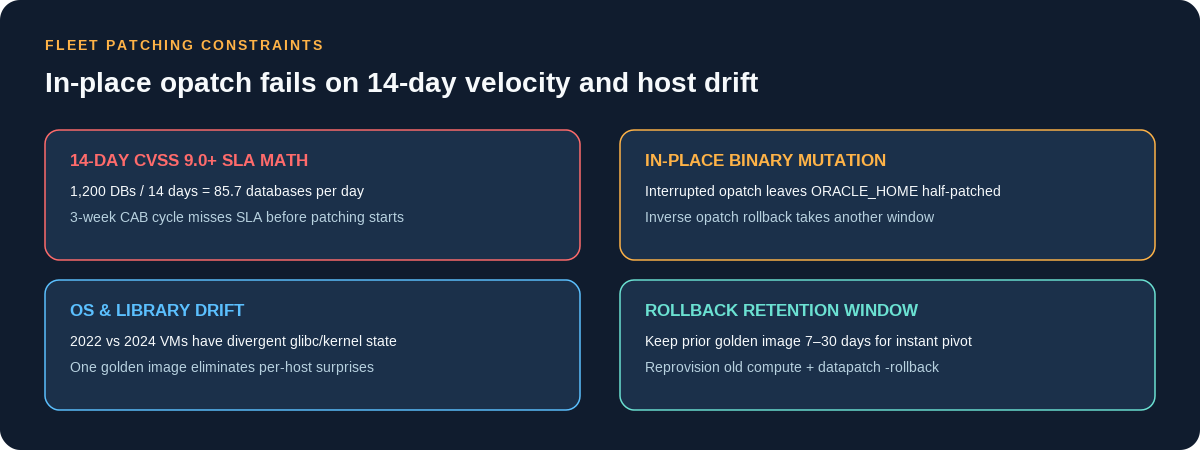
In-place opatch patching across 1,200 self-managed Oracle databases breaks under four concrete operational constraints.
1. 14-day remediation velocity math. Patching 1,200 databases within a 14-day CVSS 9.0+ SLA requires an average throughput of 1,200 / 14 = 85.7 databases per day—every day, including weekends. If a manual advisory review and Change Advisory Board (CAB) cycle consumes 3 weeks (21 days) before the first production opatch runs, the SLA is already breached by 7 days on Day 0 of execution. By the time a 6-to-10-week weekend schedule finishes, the next quarterly CPU arrives and the fleet never reaches 100% compliance.
2. In-place binary state mutation. Running opatch apply on a live host modifies $ORACLE_HOME binaries in place. An interrupted binary copy or inventory lock leaves the home partially patched, requiring manual opatch rollback or home cloning before the database can reopen cleanly.
3. OS and library divergence across host vintages. Servers provisioned in 2022 versus 2024 accumulate different glibc, kernel, and yum/dnf package states. A Release Update that links cleanly on a 2024 VM can fail relinking on a 2022 VM with the identical Oracle version, turning an automated Ansible loop into manual DBA debugging.
4. Multi-hour rollback windows. Reverting a regression after in-place opatch requires scheduling a second outage window to run opatch rollback and datapatch -rollback per host—doubling the blast radius and coordination cost.
How do you patch 1,200 Oracle databases within 14 days of a CPU release without mutating live $ORACLE_HOME binaries, without hitting OS library drift, and with minute-level rollback?
Options Considered
| Architecture | Detection Latency | Velocity at 1,200 DBs | Rollback Mechanism | Why Chosen or Rejected |
|---|---|---|---|---|
Manual advisory + opatch | Days to weeks | Fails (<20 DBs/weekend) | Manual opatch rollback | Rejected — O(N) DBA bottleneck misses 14-day SLA |
Ansible in-place opatch | Minutes via scan | Moderate; stalls on OS drift | Re-run rollback play | Rejected — mutates live homes across divergent OS states |
| Golden image + volume pivot | Minutes via API | High; parallel ring pivots | Reprovision prior image | Chosen — patches once offline; fast image rollback |
| Oracle Autonomous Database | Vendor-managed | Vendor-managed quarterly | Vendor-managed | Rejected for fleet — does not cover self-managed VM/EC2 |
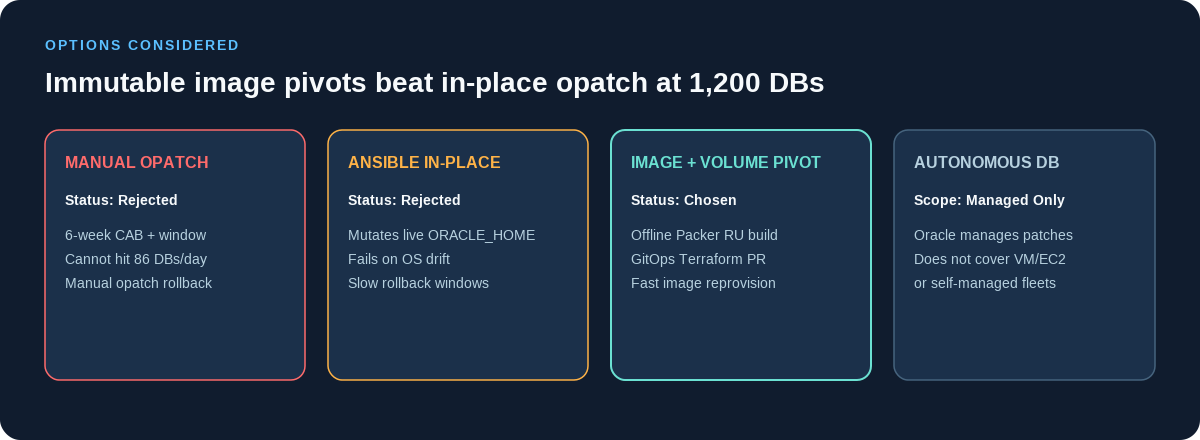
Ansible in-place patching automates SSH execution, but still runs opatch 1,200 separate times against 1,200 mutable filesystems. An immutable golden-image pipeline compiles and validates the patched $ORACLE_HOME once inside an ephemeral Packer build VM, then rolls that verified artifact across rings via compute replacement and block-volume reattachment.
The Declarative Patch Automation Control Plane
The control plane separates vulnerability ingestion, offline image construction, GitOps promotion, and ringed compute pivots into four decoupled stages. No DBA logs into a production host to run opatch.
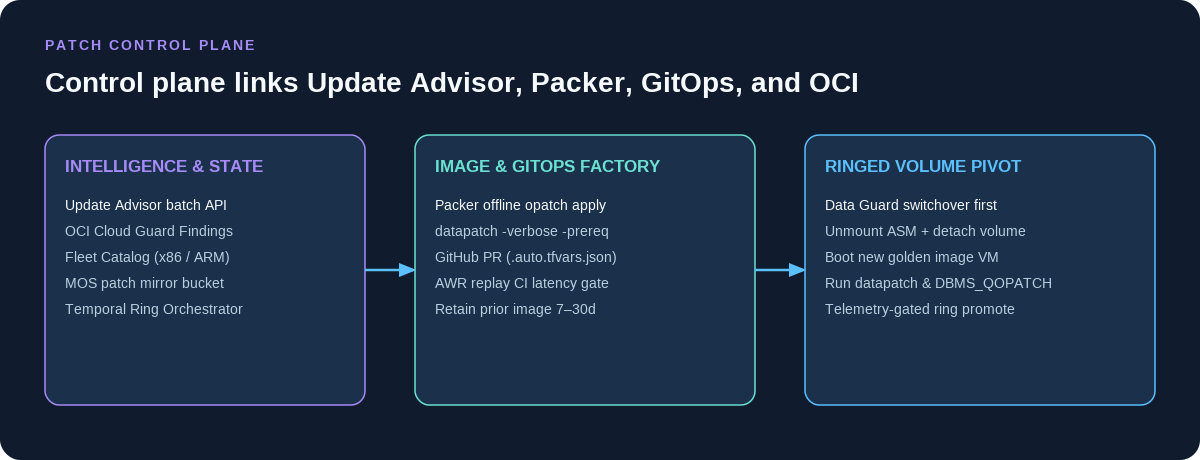
flowchart TD
    A[Update Advisor and Cloud Guard API — new CPU detected] --> B[Temporal Control Plane — query Fleet Catalog]
    B --> C[Packer Image Factory — offline opatch apply from mirror]
    C --> D[Validation Gate — datapatch -verbose -prereq]
    D -->|Fail| E[Halt pipeline and alert platform team]
    D -->|Pass| F[GitOps PR — update golden image_id in tfvars]
    F --> G[Staging CI — AWR replay p99 check]
    G -->|Pass| H[Ring 0 Canary — 48h V$SQL telemetry soak]
    H -->|Pass| I[Ring 1 10pct — 24h soak then Ring 2-N fleet]
Vulnerability ingestion via OCI Cloud Guard and Update Advisor. The control plane polls OCI Cloud Guard’s list_problems() API using Instance Principals (eliminating expiring API keys) and batches asset queries to the Oracle Update Advisor REST API to map CVSS >= 9.0 advisories to affected ORACLE_HOME versions in the Fleet Catalog:
from dataclasses import dataclass
from datetime import datetime
import oci

@dataclass
class PatchRecommendation:
    patch_id: str
    ru_version: str
    cvss_score: float
    detected_at: datetime

def get_open_oracle_findings(compartment_id: str, home_version: str) -> list[PatchRecommendation]:
    signer = oci.auth.signers.InstancePrincipalsSecurityTokenSigner()
    cg = oci.cloud_guard.CloudGuardClient({}, signer=signer)
    items = cg.list_problems(
        compartment_id=compartment_id,
        lifecycle_state="OPEN",
        resource_type="OracleDatabase",
        sort_by="RISKLEVELS",
        sort_order="DESC",
    ).data.items

    recs: list[PatchRecommendation] = []
    for item in items:
        details = item.additional_details or {}
        if home_version in details.get("affected_versions", []):
            recs.append(PatchRecommendation(
                patch_id=details.get("patch_id", ""),
                ru_version=details.get("target_version", ""),
                cvss_score=float(details.get("cvss_score", 0.0)),
                detected_at=item.time_first_detected,
            ))
    return recs
Offline Packer golden image build. Rather than pulling patches directly from MOS inside ephemeral build VMs (where contract or IP allowlist hiccups stall builds), infosec stages the RU zip in an internal OCI Object Storage bucket. Packer downloads the archive, applies it to an offline $ORACLE_HOME using opatch apply -silent (without the deprecated -ocmrf flag removed in modern OPatch), and runs datapatch -verbose -prereq against a freshly cloned scratch database:
#!/usr/bin/env bash
set -euo pipefail

RU_PATCH_ID="${1:?Usage: build_patched_home.sh <RU_PATCH_ID>}"
ORACLE_HOME="/u01/app/oracle/product/19.0.0/dbhome_1"
RU_PATCH_ZIP="/tmp/p${RU_PATCH_ID}_190000_Linux-x86-64.zip"

oci os object get --bucket-name oracle-patches --name "${RU_PATCH_ZIP##*/}" --file "${RU_PATCH_ZIP}"
mkdir -p /tmp/patch_staging
unzip -q "${RU_PATCH_ZIP}" -d /tmp/patch_staging

export ORACLE_HOME
"${ORACLE_HOME}/OPatch/opatch" apply "/tmp/patch_staging/${RU_PATCH_ID}" -silent
"${ORACLE_HOME}/OPatch/opatch" lsinventory | grep -q "${RU_PATCH_ID}"
"${ORACLE_HOME}/OPatch/datapatch" -verbose -prereq 2>&1 | tee /tmp/datapatch_prereq.log
grep -q "No issues found" /tmp/datapatch_prereq.log
GitOps PR generation and DBMS_QOPATCH verification. Once Packer publishes the new image OCID (tagged by compute architecture—x86_64 or aarch64—so Ampere and x86 fleets never cross-apply binaries), the control plane opens a Terraform PR updating oracle_golden_image_id in .auto.tfvars.json. Staging CI runs anonymized AWR SQL replay against the candidate image to catch plan regressions before merge.
During the pivot itself, the control plane never replaces an active primary compute node directly when a Data Guard physical standby is present. Instead, it pivots the standby node first: the host agent stops the standby database cleanly, dismounts all ASM diskgroups (srvctl stop diskgroup -diskgroup DATA,RECO), detaches the OCI block volumes via oci compute volume-attachment detach, provisions the replacement compute instance from the patched golden image OCID, reattaches the exact ASM block-volume OCIDs, mounts ASM, and starts Managed Recovery (MRP0). Once the standby catches up to zero apply lag, Temporal triggers a Data Guard switchover so applications fail over to the patched node in seconds. The retired primary then undergoes the identical volume pivot and runs datapatch across the CDB and all open PDBs (datapatch -verbose)—applying any SQL dictionary changes once per Data Guard pair rather than twice. After datapatch completes, the control plane verifies patch registration from inside SQL using Oracle’s DBMS_QOPATCH package, confirming both binary inventory and SQL registry state match the target RU:
SELECT DBMS_QOPATCH.GET_OPATCH_LSINVENTORY() AS inventory_xml FROM DUAL;
Why GitOps PRs sit between Packer and Temporal. Generating an automated Pull Request rather than mutating Terraform state directly preserves a full audit trail for SOC 2 and PCI DSS auditors: every production binary change maps to a signed commit, an automated AWR staging test run, and an explicit approval record for emergency CVSS 9.0+ promotions. If a Ring 0 regression appears, reverting the GitOps PR and triggering a compute pivot back to the retained prior image OCID restores the exact pre-patch binary and OS state without SSHing into hosts or running opatch rollback.
How It Rolls Out
Ringed promotion gates every wave on live V$SQL telemetry rather than wall-clock timers alone.
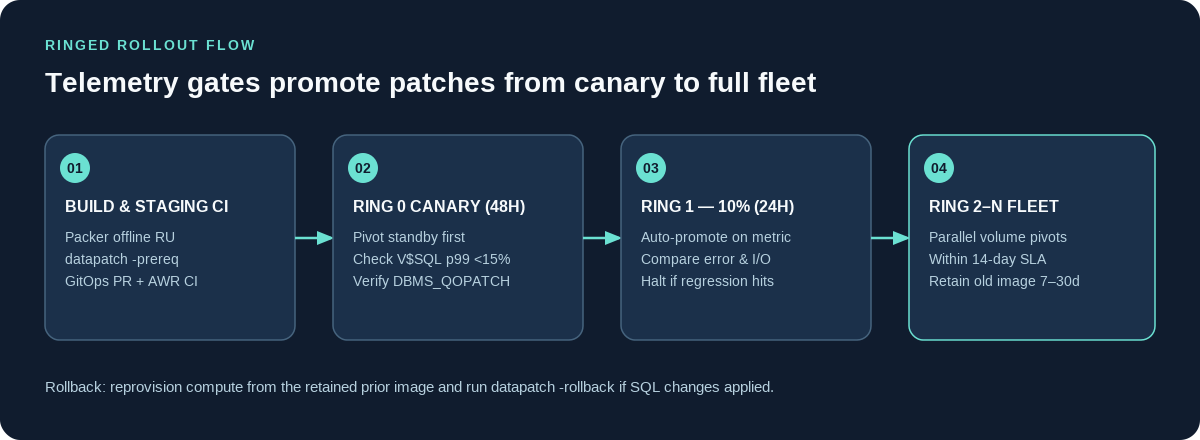
Phase 1: Image Build and Staging AWR Replay. Packer builds the patched golden image offline, validates datapatch -verbose -prereq, and opens the GitOps PR. Staging CI executes a 50-session concurrency replay of anonymized top AWR SQL. Gate: 0 datapatch prereq errors and staging p99 SQL elapsed time within 15% of baseline. Rollback: close the PR without modifying any production Terraform state.
Phase 2: Ring 0 Canary (Standby-First, 48-Hour Soak). Pivot non-production and Data Guard physical standby nodes first, switch over to test primary load, and monitor V$SQL and DBMS_QOPATCH for 48 hours. The telemetry gate compares the post-pivot ELAPSED_TIME / NULLIF(EXECUTIONS, 0) distribution for the top 50 SQL_IDs against the 7-day pre-patch baseline stored in the Fleet Catalog. Gate: DBMS_QOPATCH confirms the target RU is active, DBA_REGISTRY_SQLPATCH shows SUCCESS across all PDBs, and high-frequency V$SQL p99 elapsed time shows <15% regression. Rollback: reprovision compute from the prior golden image OCID and run datapatch -rollback if SQL dictionary changes were applied.
Phase 3: Ring 1 (10% Fleet, 24-Hour Soak). Promote 10% of production databases in parallel batches, executing Data Guard switchover before pivoting the former primary so client downtime stays under a single switchover window. Gate: zero ORA-00600/ORA-07445 alert-log spikes and <15% V$SQL elapsed-time drift. Rollback: halt Ring 2 promotion and revert Ring 1 nodes to the retained prior image.
Phase 4: Ring 2–N Full Fleet Completion. Execute parallel volume pivots across the remaining 90% of databases within the 14-day SLA, throttling concurrent compute replacements per OCI availability domain (max_concurrent_pivots=25) so OCI Block Volume attach/detach API calls never hit tenant rate limits, and retaining the previous golden image for 7 days (or 30 days for emergency CVSS 9.0+ pivots). Each pivot activity records its pre-pivot volume OCIDs, boot image OCID, and DBMS_QOPATCH inventory XML in the Fleet Catalog so auditors have an immutable compliance trail linking every database to the exact CVE patch level and GitOps PR commit. Gate: 100% of targeted Oracle Homes report compliant RU levels in Cloud Guard / Fleet Catalog. Rollback: prior image remains bootable in the registry throughout the retention window.
Handling RAC clusters and single-instance standbys uniformly. On two-node RAC clusters, the same immutable pivot pattern runs rolling one node at a time: drain services on node 1 via srvctl relocate service, stop Grid Infrastructure and ASM on node 1, pivot node 1’s compute VM to the patched golden image, rejoin the cluster, and repeat on node 2 before running datapatch -verbose once for the cluster. Single-instance databases without a Data Guard standby fall back to a brief scheduled maintenance window where ASM dismounts cleanly before the block-volume detach/reattach swap.
In Practice
- Oracle Update Advisor batching guidance (Pattern A): Per Oracle’s Update Advisor REST API documentation, batching multiple Oracle Home assets into a single recommendation request minimizes API round trips across large fleets compared to one-by-one polling.
DBMS_QOPATCHfor SQL-level inventory verification (Pattern A): Per Oracle Database PL/SQL Packages and Types Reference,DBMS_QOPATCH(owned bySYS, requiring anOPENdatabase andJOB_QUEUE_PROCESSES > 0for RAC cross-node queries) exposes OUIopatch lsinventory -xmlmetadata directly inside SQL, giving the control plane a database-side verification gate post-pivot.- Deprecated
-ocmrfanddatapatch -prereq(Pattern A): Per Oracle OPatch documentation, the-ocmrfresponse-file flag is deprecated and unnecessary in modern OPatch releases, whiledatapatch -verbose -prereqvalidates SQL patch prerequisites before committing dictionary changes. - OCI compute volume-attachment detach semantics (Pattern B): In OCI CLI, block-volume detachment uses
oci compute volume-attachment detach --volume-attachment-id <ocid> --force(under thecomputenamespace, notbv). Oracle documentation notes that OS-level unmount and ASM diskgroup dismount must still precede force-detachment to prevent I/O corruption.
Where It Breaks
| Failure Mode | Breaks How | Detect | Mitigate |
|---|---|---|---|
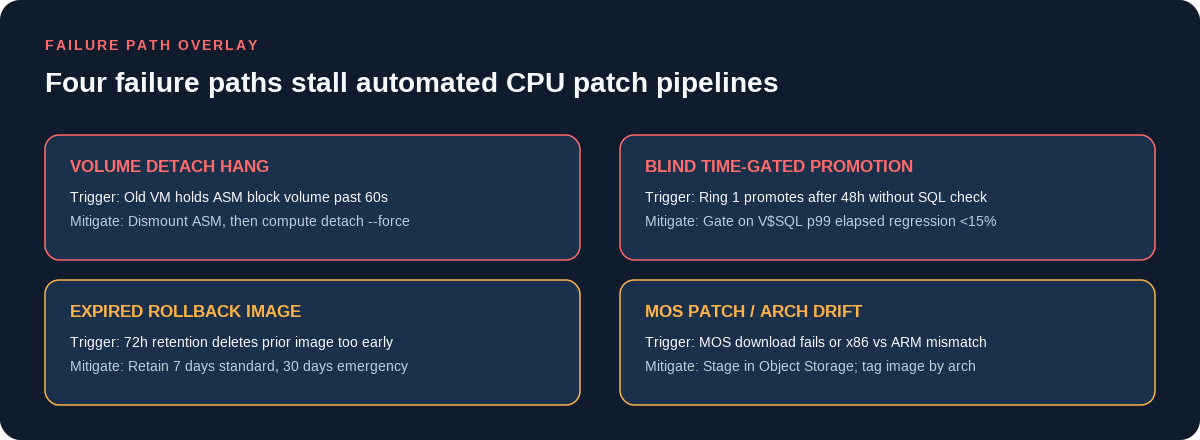
| Hung block-volume detach | Old VM holds ASM volume past 60s graceful unmount | Pivot activity times out waiting for volume DETACHED state | Dismount ASM cleanly, then run oci compute volume-attachment detach --force |
| Blind time-gated ring promotion | Ring 1 promotes after 48h despite subtle V$SQL regression | Post-pivot V$SQL p99 elapsed time climbs >15% | Gate every ring on V$SQL p99 comparison, never a bare sleep timer |
| Expired rollback golden image | 72h image retention deletes prior image before regression found | Reprovision step fails with missing image OCID | Retain prior image 7 days standard, 30 days for CVSS 9.0+ patches |
| MOS download or auth failure | Packer VM blocked by MOS contract lag or IP allowlist | Packer build fails at download step | Infosec mirrors CPUs to internal OCI Object Storage bucket on release day |
| x86 vs. ARM binary mismatch | x86_64 RU applied or deployed onto OCI Ampere aarch64 VM | opatch fails or ORA-00600 on mismatched architecture | Track arch in Fleet Catalog; build separate x86_64 and aarch64 images |
| Update Advisor credential expiry | Static API keys expire silently; new CPUs go undetected | last_successful_poll metric ages past 7 days | Use OCI Instance Principals (no static keys); alert on poll staleness |
Key Takeaways
- Eliminate in-place
opatchfrom production: Build and validate the patched$ORACLE_HOMEonce inside an offline Packer VM, then pivot production compute nodes around untouched ASM data volumes. - Use
DBMS_QOPATCHto verify patch state from SQL: QueryingDBMS_QOPATCHafterdatapatchconfirms the running database’s OUI inventory matches the intended RU without scraping host logs. - Gate ring promotion on
V$SQLtelemetry, not clocks: Block Ring 1 and Ring 2 promotion automatically ifp99elapsed time on high-frequency SQL regresses by more than 15% during the Ring 0 soak. - Mirror MOS patches internally and tag by architecture: Pre-staging CPUs in Object Storage prevents MOS download outages during 14-day sprints, and architecture tagging prevents
x86_64vs.aarch64mismatches. - Retain prior golden images for at least 7 days: Fast image-reprovision rollback only works if the previous golden image OCID is still present in the registry.
What to Do Next
- Problem: Manual and in-place
opatchworkflows fail 14-day CVSS 9.0+ compliance at 1,200-database scale due to O(N) human gates, live binary mutation, and host library drift. - Solution: Connect Oracle Update Advisor and OCI Cloud Guard findings to an offline Packer image factory, GitOps Terraform PRs, and telemetry-gated block-volume compute pivots.
- Proof: Verify
opatch apply -silentanddatapatch -verbose -prereqpass on an offline Packer build, confirmDBMS_QOPATCHreports the new RU post-pivot, and testoci compute volume-attachment detach --forceafter ASM dismount in staging. - Action: Register your OCI Oracle Homes in Cloud Guard and Update Advisor, mirror the latest quarterly RU into a private Object Storage bucket, and build one offline golden image with Packer this week.
Sources
- Oracle Critical Patch Update Advisories — Quarterly Release & CVSS Scoring: https://www.oracle.com/security-alerts/
- OCI Cloud Guard API —
ListProblems: https://docs.oracle.com/en-us/iaas/api/#/en/cloud-guard/20200131/Problem/ListProblems - Oracle Database 23ai/26ai PL/SQL Packages —
DBMS_QOPATCH: https://docs.oracle.com/en/database/oracle/oracle-database/23/arpls/DBMS_QOPATCH.html - Oracle OPatch User’s Guide — Offline Patching & Deprecated
-ocmrf: https://docs.oracle.com/en/database/oracle/oracle-database/19/opunk/ - OCI CLI Command Reference —
oci compute volume-attachment detach: https://docs.oracle.com/en-us/iaas/tools/oci-cli/latest/oci_cli_docs/cmdref/compute/volume-attachment/detach.html - PCI DSS v4.0 Requirement 6.3 — Security Vulnerability Patching: https://www.pcisecuritystandards.org/document_library/
Interactive tools for this topic