
AI-Driven Patch Scheduling: Using Knowledge Graphs and LLM Planners to Calculate Oracle Fleet Blast Radius
Content reflects the state as of September 2026. AI tooling and model capabilities in this area change frequently.
A patch deployment pipeline that upgrades production databases in alphabetical order or inside a single Prod stage will happily patch every replica backing a payment service in the same maintenance window.
TL;DR
- Problem: Environment stages (
Dev/QA/Prod) isolate non-production from production, but they treat production as one undifferentiated ring and cannot prevent correlated outages across co-dependent databases.- Answer: Derive a live application-to-database dependency graph from Oracle
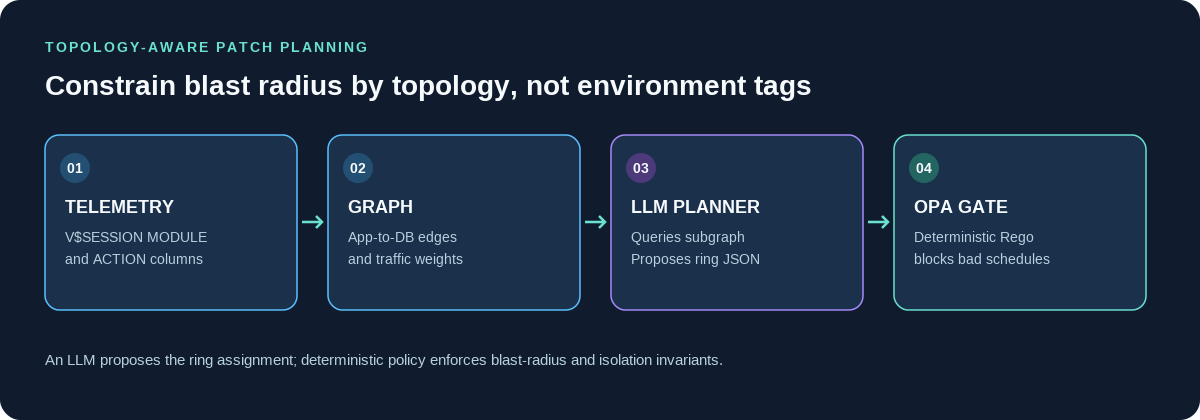
V$SESSIONtelemetry, let an LLM planner propose multi-ring schedules, and gate every schedule through deterministic Open Policy Agent (OPA) Rego rules.- Watch out: An LLM planner without a fail-closed OPA gate or pre-ring graph re-validation will eventually emit a schedule that violates co-dependency or blast-radius limits when topology drifts.
Situation
Database fleets outgrow manual change-management spreadsheets long before they outgrow their patching tools. Platforms running hundreds or thousands of Oracle instances across multiple cloud regions typically group databases by lifecycle environment (Sandbox, Dev, QA, Prod) and by owning team. That taxonomy answers who pays for the instance and whether it holds customer data, but it says nothing about runtime coupling.
Two databases owned by different teams and tagged with different service names frequently sit on the same critical transaction path. A checkout service might read from an order database in one region, write to a ledger database in another, and stream events to a fraud-scoring database managed by an analytics group. When a Quarterly Release Update (RU) introduces an optimizer plan regression that only manifests under production concurrency, synthetic QA tests pass, and the Prod deployment stage hits every database in that transaction path simultaneously.
In the documented pattern for large-fleet operations, configuration management databases (CMDBs) fail to solve this because application teams deploy new microservices and connection strings faster than humans update CMDB tickets. Safe ring scheduling requires topology discovered from live database sessions, paired with a planner that can pack rings under hard business constraints.
The Problem
Designing a multi-ring patch schedule across a large Oracle fleet is a constrained bin-packing problem. Environment labels (Prod vs. Non-Prod) fail because they ignore four operational constraints that govern real blast radius:
- Revenue-weighted blast radius cap: No single patch ring may contain databases whose combined traffic exceeds a fixed ceiling $B_{\max}$ of total platform revenue (for example, $B_{\max} = 5%$). If a fleet serves $100M in monthly gross merchandise value (GMV) across 1,000 production databases, a single ring’s cumulative exposure must stay at or below $5M/month. If a single database handles 12% of GMV, it cannot share a ring with other databases and requires application-level failover (such as Data Guard switchover) before patching.
- Co-dependency isolation: Any two databases queried by the same application
MODULE(or sitting on the same synchronous call chain) must occupy different rings. IfPAY_US_01andPAY_US_02both servecheckout-api, placing both in Ring 1 eliminates the service’s redundancy during that window. - Minimum bake window and cadence math: Each ring requires a bake period $T_{\text{bake}}$ (for example, 24 hours for production rings, 48 hours for Ring 0 canary databases) before the next ring starts. With $N$ rings and $T_{\text{bake}} = 24\text{h}$, total rollout duration is at least $(N - 1) \times 24\text{h}$ plus execution time. A schedule that splits a fleet into 30 rings takes a full month to complete, colliding with the next quarterly RU or violating a 14-day critical CVE SLA. The planner must therefore minimize ring count $N$ while strictly respecting $B_{\max}$ and co-dependency separation.
- Replication and downstream ordering: Where Oracle GoldenGate or CDC pipelines replicate from an upstream primary to downstream reporting or analytics databases, patching downstream consumers after upstream sources have baked prevents schema or redo-parsing incompatibilities from masking each other.
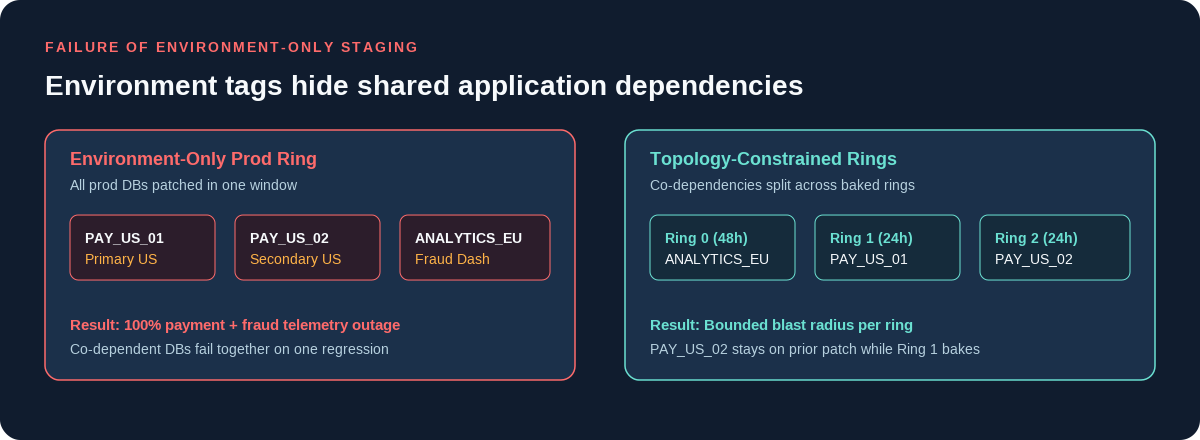
Hand-crafting rings for a few dozen databases is tractable in a spreadsheet. Once a fleet crosses several hundred databases with overlapping microservice dependencies, finding a valid assignment that minimizes ring count without violating co-dependency or revenue caps becomes an NP-hard graph-coloring and bin-packing problem.
How do you automatically generate a minimal-ring Oracle patch schedule that enforces revenue blast-radius caps, geographic separation, and application co-dependency isolation without relying on stale manual CMDBs?
Options Considered
Before settling on a knowledge graph plus LLM planner behind a deterministic policy gate, four scheduling architectures represent the realistic design space.
| Option | Topology Source | Constraint Enforcement | Maintenance Cost | Primary Failure Mode |
|---|---|---|---|---|
Alphabetical / Flat Prod Ring | None | None | Minimal | Correlated outage across co-dependent DBs |
| Manual DBA Ring Assignment | Tribal knowledge / CMDB | Human review | Very high | Stale CMDB misses new service dependencies |
| Ungated LLM Planner | Live telemetry graph | Prompt instructions only | Low | Probabilistic constraint violations under scale |
| Graph + LLM Planner + OPA Gate | Live V$SESSION + billing | Deterministic Rego deny | Low | Requires fail-closed OPA and telemetry gates |
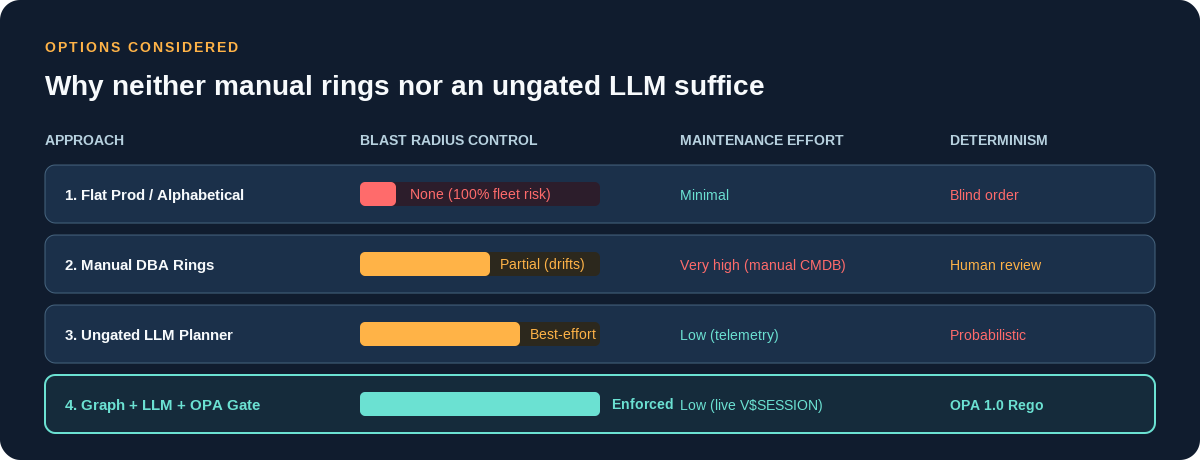
Alphabetical or flat Prod staging is the default in most CI/CD pipelines. It requires zero topology metadata and finishes quickly because all production targets run in parallel or in arbitrary batches. It was rejected because it provides zero protection against correlated failures: a single bad optimizer patch hits primary, secondary, and observability databases in the same window.
Manual DBA ring assignment relies on engineers tagging databases into Ring-0 through Ring-4 based on CMDB records and institutional memory. It works for small, static fleets, but it breaks down in microservice environments where teams add new connection pools weekly. Maintaining the ring map becomes an ongoing operational tax, and stale tags silently re-introduce co-dependencies into the same ring.
An ungated LLM planner solves the manual maintenance problem by querying a live dependency graph and proposing ring assignments in JSON. However, LLMs are probabilistic reasoners. When asked to pack hundreds of databases into rings while tracking multi-hop co-dependencies and summing floating-point revenue percentages, an LLM will occasionally place two co-dependent databases in the same ring or exceed the 5% cap by a fraction of a percent. Prompting alone cannot serve as a production safety invariant.
Knowledge graph + LLM planner + OPA gate separates heuristic search from formal verification. The LLM handles the messy, multi-constraint bin-packing proposal using graph queries, while Open Policy Agent (OPA) evaluates the resulting JSON against deterministic Rego rules and rejects any invalid plan before it touches the deployment pipeline.
The AI Topology Planning Architecture
The architecture divides responsibilities across four layers: telemetry discovery, graph storage, heuristic planning, and deterministic policy validation.
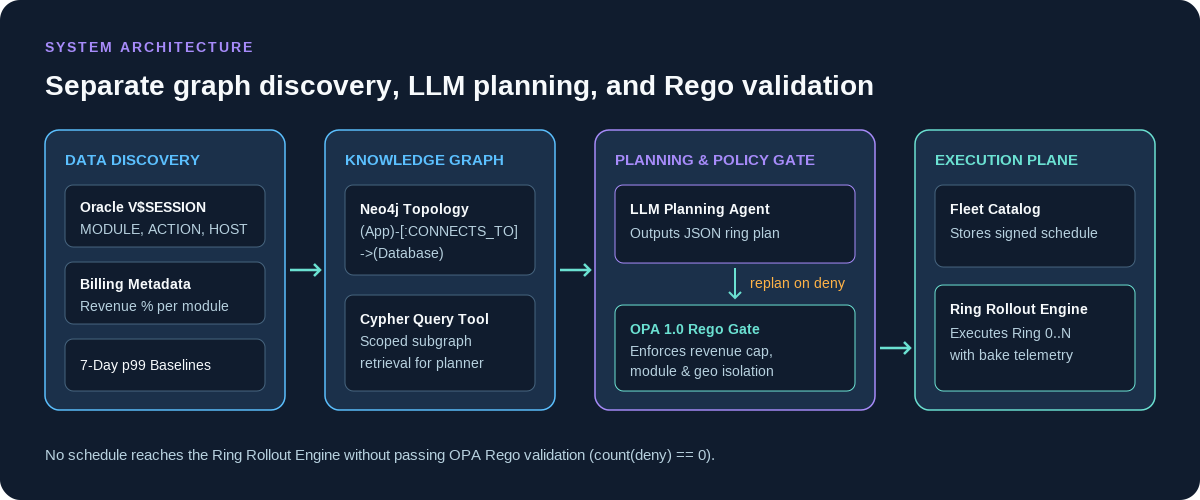
flowchart TD
    A[Oracle V$SESSION telemetry] --> B[Neo4j Knowledge Graph]
    B --> C[LLM Planning Agent — Cypher query tools]
    C --> D[Draft ring schedule JSON]
    D --> E[OPA 1.0 Rego Gate]
    E --> F{count deny == 0?}
    F -->|No — return violations| C
    F -->|Yes — signed schedule| G[Fleet Catalog and Ring Rollout]
Layer 1: Telemetry Discovery Without Manual CMDBs
Oracle’s V$SESSION dynamic performance view records every active and inactive session connected to an instance, including MODULE, ACTION, PROGRAM, MACHINE, and USERNAME (VARCHAR2(64) for MODULE and ACTION in Oracle 19c/23ai). When applications instrument their connection pools using DBMS_APPLICATION_INFO.SET_MODULE or JDBC connection properties (v$session.program / v$session.module), V$SESSION exposes ground-truth application-to-database edges directly from the database engine.
An ingestion worker polls V$SESSION across the fleet on a scheduled interval and pairs each discovered MODULE with business criticality or revenue weights from the billing/catalog store. Unlike V$SQL_MONITOR—which only captures SQL statements that run in parallel or exceed 5 seconds of combined CPU and I/O time—V$SESSION captures every connected client regardless of query duration.
# Neo4j knowledge graph ingestion from Oracle V$SESSION telemetry
from neo4j import GraphDatabase
import oracledb

def ingest_session_topology(db_identifier: str, neo4j_driver):
    """Ingest current Oracle session topology into Neo4j knowledge graph."""
    sql = """
        SELECT DISTINCT
               NVL(s.module, s.program)                    AS app_module,
               s.machine                                   AS app_host,
               s.username                                  AS db_user,
               s.action                                    AS business_action,
               COUNT(*) OVER (PARTITION BY NVL(s.module, s.program)) AS session_count
        FROM   v$session s
        WHERE  s.type = 'USER'
          AND  s.status IN ('ACTIVE', 'INACTIVE')
        FETCH FIRST 500 ROWS ONLY
    """
    with get_conn(db_identifier) as conn:
        sessions = conn.cursor().execute(sql).fetchall()

    with neo4j_driver.session() as neo4j:
        for module, app_host, db_user, action, session_count in sessions:
            neo4j.run("""
                MERGE (db:Database {unique_name: $db_id})
                MERGE (app:Application {module: $module, host: $app_host})
                MERGE (app)-[r:CONNECTS_TO]->(db)
                SET r.session_count = $session_count,
                    r.last_seen = timestamp(),
                    r.business_action = $action
            """, db_id=db_identifier, module=module, app_host=app_host,
                 session_count=session_count, action=action)
Layer 2 & 3: Scoped Graph Queries and LLM Ring Proposal
Serializing an entire fleet’s dependency graph into a single LLM prompt wastes context tokens and degrades reasoning accuracy. Instead, the planning agent is given a Cypher query tool to inspect co-dependency clusters, regional groupings, and revenue weights incrementally.
import anthropic
import json

def generate_ring_schedule(patch_id: str, database_list: list[str]) -> dict:
    """Use an LLM planner to propose a topology-aware ring schedule."""
    client = anthropic.Anthropic()
    graph_summary = query_database_topology_summary(database_list)

    system_prompt = """You are an Oracle fleet patch scheduling agent.
    Generate a ring-based deployment schedule satisfying these HARD CONSTRAINTS:
    1. No ring may contain databases collectively serving >5% of total monthly GMV.
    2. Databases serving the same application module (V$SESSION.MODULE) must never share a ring.
    3. Ring-0 must contain only internal databases with revenue_pct < 0.1%.
    4. At least one primary region database per critical service must remain unpatched per ring.
    5. Each ring requires a minimum 24-hour bake time (48h for Ring-0).
    Output ONLY valid JSON matching the rings schema."""

    response = client.messages.create(
        model="claude-opus-4-5",
        max_tokens=8192,
        system=system_prompt,
        messages=[{
            "role": "user",
            "content": (
                f"Generate a ring schedule for patch {patch_id}.\n"
                f"Topology summary:\n{json.dumps(graph_summary, indent=2)}\n"
                f"Databases: {database_list}"
            ),
        }],
    )
    return json.loads(response.content[0].text)
Layer 4: Deterministic OPA 1.0 Rego Validation
Every candidate schedule passes through Open Policy Agent before entering the Fleet Catalog. OPA 1.0 (released December 2024) enforces Rego v1 by default, requiring explicit if and contains keywords for multi-value deny rules. If count(deny) > 0, the pipeline returns the exact list of violated constraints to the LLM agent for replanning; the deployment runner never accepts an unvalidated schedule.
# opa/oracle_patch_schedule.rego (OPA 1.0 / Rego v1)
package oracle.patch.schedule

import rego.v1

default allow := false

allow if {
    count(deny) == 0
}

# CONSTRAINT 1: No ring may exceed 5% revenue blast radius
deny contains msg if {
    some ring in input.rings
    ring.max_revenue_pct > 5.0
    msg := sprintf("Ring %v exceeds 5%% blast radius: %.1f%%", [ring.ring_id, ring.max_revenue_pct])
}

# CONSTRAINT 2: No two databases serving the same application module in the same ring
deny contains msg if {
    some ring in input.rings
    some db1 in ring.databases
    some db2 in ring.databases
    db1 != db2
    some shared_module in input.topology[db1].modules
    shared_module in input.topology[db2].modules
    msg := sprintf("Ring %v co-locates %v and %v (shared module: %v)", [ring.ring_id, db1, db2, shared_module])
}

# CONSTRAINT 3: Ring-0 must contain only internal databases
deny contains msg if {
    some ring in input.rings
    ring.ring_id == "Ring-0"
    some db in ring.databases
    input.topology[db].revenue_pct >= 0.1
    msg := sprintf("Ring-0 contains revenue-bearing DB %v (%.2f%% GMV)", [db, input.topology[db].revenue_pct])
}
How It Rolls Out
Generating an approved schedule is only half the control loop. Execution must enforce bake windows, verify live telemetry before every promotion, and keep rollback confined to the active ring.
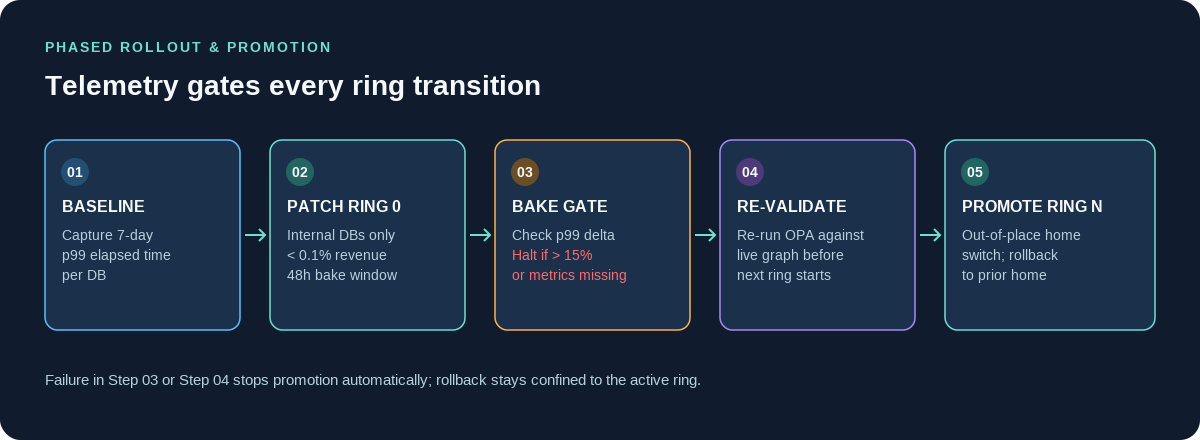
- Phase 1 — Baseline Capture: Before Ring 0 starts, the pipeline snapshots 7-day rolling p99 SQL elapsed time, CPU utilization, and active session counts for every database in the schedule. Gate: Missing baseline metrics block ring start.
- Phase 2 — Ring 0 Canary Execution: Ring 0 patches only internal or non-revenue databases (
revenue_pct < 0.1%) using out-of-place Oracle Home switching. Rollback point: Switch the instance back to the pre-patch Oracle Home and rundatapatch -rollbackif needed. - Phase 3 — Bake Evaluation: After the 48-hour Ring 0 bake window (or 24 hours for subsequent rings), the evaluator compares live p99 elapsed time against the 7-day baseline. If any database regresses beyond the configured threshold (for example, >15%), promotion halts automatically.
async def evaluate_ring_bake_status(ring_id: str, patch_version: str) -> tuple[bool, str]:
    """Evaluate whether a ring's bake period shows acceptable telemetry."""
    ring_dbs = fleet_catalog.get_databases_in_ring(ring_id, patch_version)
    regression_dbs = []

    for db in ring_dbs:
        baseline = await metrics_store.get_p99_elapsed_baseline(db.unique_name, days=7)
        current = await query_current_p99_elapsed_time(db.unique_name)
        if baseline is None or current is None:
            return False, f"Missing telemetry for {db.unique_name} — fail-closed halt"
        if (current - baseline) / baseline > 0.15:
            pct = (current - baseline) / baseline * 100
            regression_dbs.append(f"{db.unique_name} ({pct:.1f}% regression)")

    if regression_dbs:
        return False, f"Regressions detected: {', '.join(regression_dbs)}"
    return True, f"Ring {ring_id} bake complete across {len(ring_dbs)} databases"
- Phase 4 — Pre-Ring Live Graph Re-Validation: Because application deployments happen continuously during a multi-day rollout, the pipeline re-runs the OPA Rego check against the current Neo4j graph immediately before Ring $N+1$ begins. If a newly deployed microservice created a new co-dependency edge between an already-patched Ring 0 database and a Ring 2 database, OPA rejects the stale schedule and triggers a partial replan for the remaining unpatched rings.
- Phase 5 — Ring $N$ Promotion: Only after both the bake gate and the live OPA re-validation pass does the pipeline advance to the next ring.
In Practice
Several concrete behaviors in the underlying systems shape how this pattern works in production:
- Oracle
V$SESSIONinstrumentation behavior: By default, uninstrumented JDBC or Python clients populateV$SESSION.PROGRAM(for example,JDBC Thin Clientorpython@app-host) while leavingMODULEandACTIONnull. Without enforcingDBMS_APPLICATION_INFO.SET_MODULEor connection-string properties (v$session.program/oracle.jdbc.v$session.osuser), the knowledge graph collapses distinct microservices into a single genericJDBC Thin Clientnode, creating false co-dependency edges. Enforcing non-emptyMODULEvalues at connection pool startup is a prerequisite for accurate graph edges. - OPA 1.0 evaluation model: Because OPA evaluates Rego policies in memory against a JSON input document (
input.ringsandinput.topology), policy verification is deterministic and sub-second once the subgraph is assembled. The architectural boundary is strict: the LLM never receives write credentials to the deployment pipeline, and the deployment pipeline only accepts schedules accompanied by a signed OPA pass result (allow == true). - AWS Cell-Based Architecture alignment: The ring model applies the same blast-radius containment principle documented in AWS Well-Architected cell-based architectures: partition production into bounded cells (rings) with independent failure domains, and require health signals from an early cell before exposing subsequent cells to the same change.
- OCI Update Advisor integration: For fleets running on Oracle Cloud Infrastructure, OCI Fleet Patching and Provisioning (FPP) and Update Advisor APIs provide the execution and patch-recommendation primitives, while the graph + OPA layer supplies the cross-service topology awareness that standard maintenance windows lack.
Where It Breaks
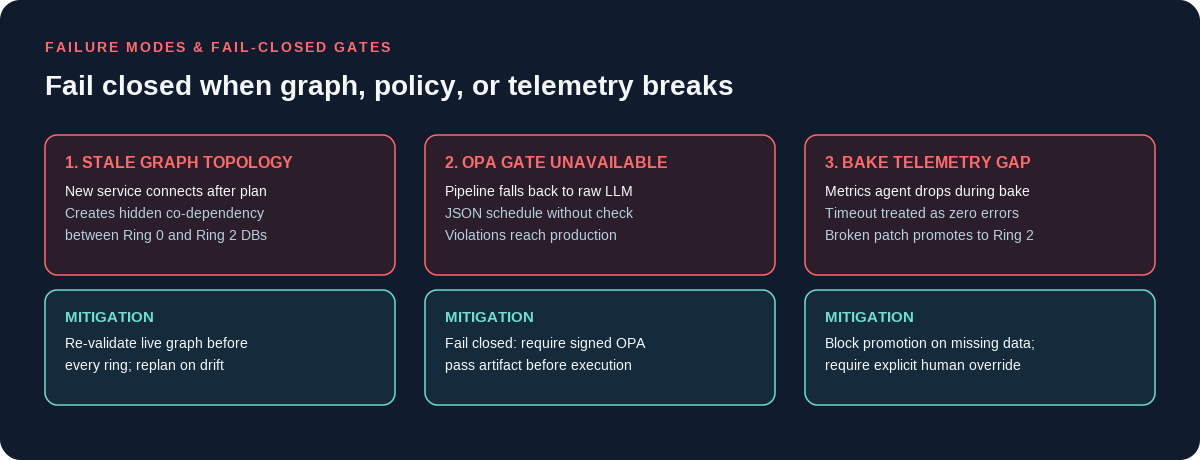
Every control-plane layer introduces its own failure mode. The system must fail closed when telemetry, policy evaluation, or topology freshness degrades.
| Condition | Breaks How | Detect | Mitigate |
|---|---|---|---|
| Stale knowledge graph | New microservice connects to a DB after schedule generation, creating an unmodeled co-dependency | Diff V$SESSION edges against the snapshot used at plan time | Re-run OPA validation against live Neo4j graph before every ring promotion |
Generic MODULE names | Uninstrumented apps all report JDBC Thin Client, causing false co-dependency explosions | Alert when V$SESSION.MODULE IS NULL exceeds 5% of user sessions | Fall back to (PROGRAM, MACHINE) tuple; require MODULE in pool config |
| OPA gate unavailable | Pipeline skips policy check on timeout and executes raw LLM JSON | Monitor OPA HTTP 5xx and require signed policy-pass artifact | Fail closed: halt rollout if OPA is unreachable; never bypass validation |
| Bake telemetry gap | Metrics agent drops during bake window; timeout treated as zero errors | Explicitly check current is None in bake evaluator | Block ring promotion on missing metrics; require human override to proceed |
| Over-constrained ring explosion | Strict 5% cap + dense co-dependencies forces too many rings, breaching CVE SLA | Compare (ring_count * bake_hours) against patch SLA deadline | Parameterize cap and bake by CVSS severity (e.g., shorter bake for critical CVEs) |
| LLM context truncation | Serializing thousands of DBs into one prompt drops tail dependencies | Check JSON completeness and OPA unmatched-DB rule | Give the LLM Cypher query tools instead of dumping the full graph |
Key Takeaways
- Environment stages do not bound production blast radius: Separating
QAfromProdleaves all production databases in one correlated failure domain unless production itself is partitioned into topology-aware rings. - Derive dependencies from
V$SESSION, not manual CMDBs:V$SESSION.MODULE,ACTION, andMACHINEreflect actual runtime connections; manual CMDBs drift as soon as a new microservice ships. - Never trust an ungated LLM with production invariants: Use the LLM for heuristic bin-packing across complex graph constraints, and enforce every hard rule deterministically in OPA 1.0 Rego v1 (
count(deny) == 0). - Re-validate topology before every ring transition: A schedule that was valid on Monday can become invalid by Wednesday if a newly deployed service bridges two rings.
- Fail closed on missing telemetry or policy outages: Missing bake metrics or an unreachable OPA server must halt promotion, never auto-promote.
What to Do Next
- Problem: Environment-based deployment stages (
Dev/QA/Prod) cannot prevent a patch regression from simultaneously hitting all databases backing a critical service because they have no awareness of runtime application co-dependencies. - Solution: Build a topology-aware patch planner that ingests
V$SESSIONconnection telemetry into a knowledge graph, uses an LLM agent to propose minimal-ring schedules, and gates every schedule through OPA 1.0 Rego rules and telemetry-gated ring promotion. - Proof: Querying
V$SESSIONimmediately reveals which application modules and hosts share databases—exposing hidden coupling that flatProdrings miss. - Action: Run
SELECT NVL(module, program) AS app, machine, COUNT(*) FROM v$session WHERE type = 'USER' GROUP BY NVL(module, program), machine ORDER BY 3 DESC;on your primary Oracle databases this week to audit whether your current patch rings separate co-dependent applications.
Sources
- Oracle Database Reference —
V$SESSION(MODULE,ACTION,MACHINE,PROGRAM): https://docs.oracle.com/en/database/oracle/oracle-database/19/refrn/V-SESSION.html - Oracle Database Reference —
V$SQL_MONITOR(ACTIONcolumn and 5-second/parallel threshold): https://docs.oracle.com/en/database/oracle/oracle-database/19/refrn/V-SQL_MONITOR.html - Open Policy Agent — OPA 1.0 & Rego v1 Policy Language: https://www.openpolicyagent.org/docs/latest/policy-language/
- Neo4j Cypher Manual: https://neo4j.com/docs/cypher-manual/current/
- AWS Well-Architected — Reducing Scope of Impact with Cell-Based Architecture: https://docs.aws.amazon.com/wellarchitected/latest/reducing-scope-of-impact-with-cell-based-architecture/
- Anthropic Claude Tool Use Documentation: https://docs.anthropic.com/en/docs/tool-use
Interactive tools for this topic