
Immutable Infrastructure Patching for Oracle Fleets: Beyond FPP at Hyper-Scale
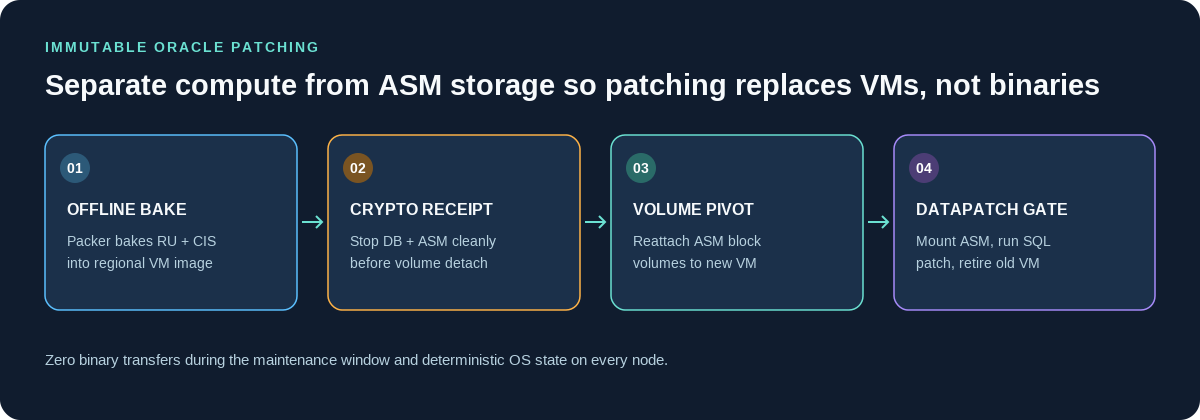
Patching a cloud database by mutating binaries on a long-lived VM treats disposable compute as permanent hardware; separating ASM block storage from compute lets you patch by swapping golden images instead of pushing gigabytes of Oracle Homes during the maintenance window.
TL;DR
- Problem: Hub-and-spoke patching with Oracle FPP (
rhpserver) saturates central network uplinks when provisioning working copies at scale and leaves multi-year Linux OS and RPM drift untouched on long-lived VMs.- Answer: Bake Oracle Grid Infrastructure, Release Updates, and CIS Level 1 OS hardening offline via Packer into regional VM images, then pivot databases during maintenance windows by cleanly stopping ASM, verifying a signed shutdown receipt, reattaching ASM block volumes to a fresh VM, and running
datapatch.- Watch out: Never detach block volumes without confirming zero mounted ASM disk groups; poll
udev/asmcmd lsdskbefore mounting on the new VM; and if you roll back afterdatapatchhas updatedDBA_REGISTRY_SQLPATCH, you must rundatapatchfrom the old Oracle Home to revert the data dictionary.
Situation
Oracle Fleet Patching and Provisioning (FPP) is Oracle’s native tool for centralized software lifecycle management. Using a central Grid Infrastructure cluster running rhpserver and the rhpctl CLI, FPP maintains a repository of gold images and performs out-of-place patching by provisioning a new working copy (rhpctl add workingcopy), validating readiness (rhpctl move database -eval), switching the database over (rhpctl move database), and running datapatch.
For fleets of dozens of databases in a single region, FPP’s out-of-place model is a major improvement over in-place opatch apply. At thousands of instances spread across multiple cloud regions, however, even out-of-place binary provisioning runs into the limits of mutating long-lived virtual machines from a central hub: rhpserver must serialize oraInventory locks on multi-tenant hosts, push multi-gigabyte working copies across WAN/VPC boundaries, and tolerate OS-level package drift that accumulated since the VM was first provisioned.
Cloud-native database platforms decouple two things that on-premises servers fused together: the compute layer (Linux kernel, glibc, Grid Infrastructure, and RDBMS binaries) and the data layer (persistent block volumes holding Oracle ASM disk groups for DATA, FRA, and OCR/SPFILEs). When storage outlives the VM, patching no longer requires copying binaries onto old hosts.
The Problem
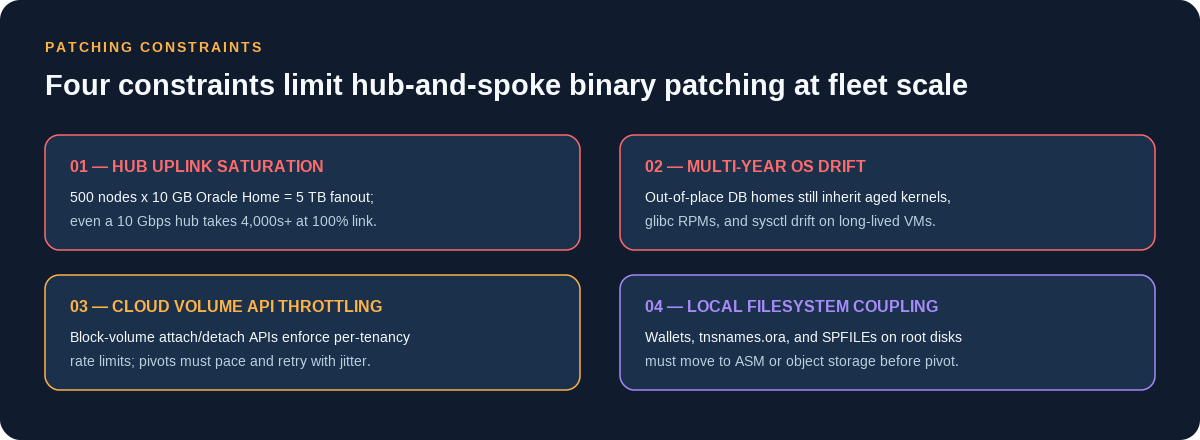
Centralized hub-and-spoke patching hits four concrete constraints at fleet scale:
- Hub uplink saturation during parallel working-copy fanout (derived math): An Oracle Grid Infrastructure plus RDBMS home is roughly 10 GB of binaries. Staging working copies concurrently to 500 target VMs from a central
rhpservertransfers500 * 10 GB = 5,000 GB(40,000 Gb). Even if a central hub sustains a full 10 Gbps (1.25 GB/s) uplink with zero packet loss, pushing 5 TB takes40,000 Gb / 10 Gbps = 4,000 seconds(66.7 minutes) of continuous saturation—long enough to trigger corporate DLP/IDS anomaly alerts or starve co-located management traffic. - Multi-year OS configuration drift: Out-of-place DB home patching replaces
$ORACLE_HOME, not the underlying Oracle Linux OS. A VM provisioned three years ago accumulates hundreds ofyum updateruns, kernel updates,sysctledits, and agent upgrades. A Release Update that passesopatchprerequisites on Node A fails on Node B because of a divergentglibcorlibaiopackage introduced months earlier. - Cloud block-volume API rate limits: Moving to VM replacement trades network bandwidth limits for cloud control-plane API quotas. Cloud providers throttle
AttachVolumeandDetachVolumecalls per tenancy (limits differ by provider, region and account, so read the current quota for your own tenancy before sizing the pivot batch). Unthrottled parallel pivots trigger HTTP 429 responses mid-cutover. - Local filesystem state coupling: Any database storing auto-login wallets,
tnsnames.ora,sqlnet.ora, or custom monitoring configs on the VM’s root disk cannot survive a compute swap cleanly unless those artifacts live on ASM/ACFS, object storage, or an external configuration service.
How do you roll out quarterly Oracle Release Updates across thousands of cloud nodes in parallel—with zero binary push during the maintenance window, zero accumulated OS drift, and deterministic rollback?
Options Considered
| Patching Model | Binary Delivery | OS Drift Reset? | Rollback Mechanism | Why Chosen / Rejected |
|---|---|---|---|---|
In-Place opatch apply | Local copy / NFS | No | opatch rollback while DB is down | Rejected: Long binary-mutation downtime and brittle rollback if opatch fails mid-apply. |
Oracle FPP (rhpctl) | rhpserver working copies | No (mutates existing VM) | rhpctl move database back to old working copy | Partial Fit: Clean out-of-place DB home switch, but leaves Linux OS drift and central hub fanout intact. |
| Ansible + Artifactory RPMs | Regional repo pull | Partial (RPMs only) | Downgrade RPMs | Rejected: Reduces hub bottleneck via regional repos, but still mutates stateful hosts into snowflakes. |
| Immutable Packer Image + Volume Pivot | Pre-baked regional VM image | Yes (fresh OL8 + RU every cycle) | Boot old image + reattach + datapatch rollback if needed | Chosen: Eliminates maintenance-window binary transfers and resets OS and DB binaries together. |
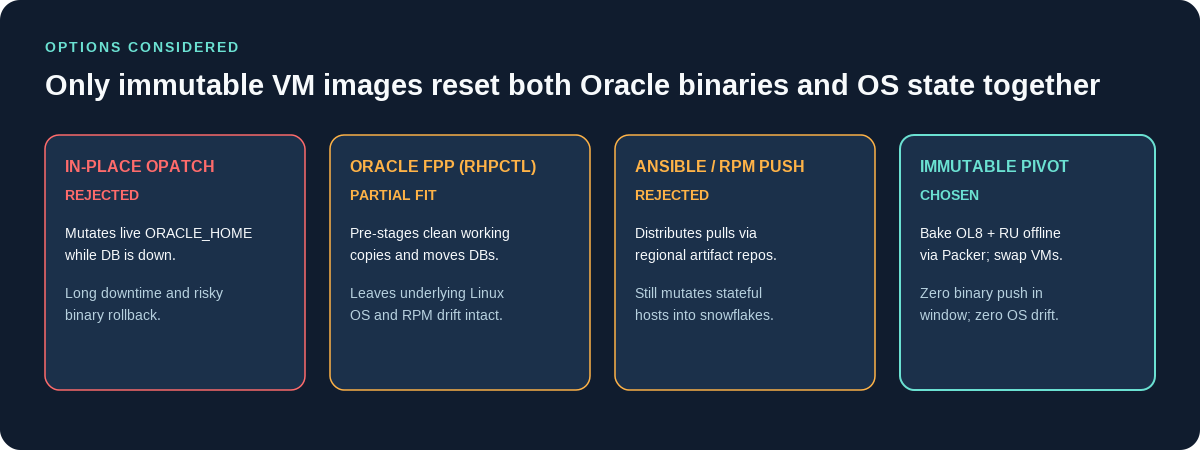
Oracle FPP (rhpctl) remains the right choice on bare-metal Exadata or on-premises clusters where compute nodes cannot be replaced via cloud APIs. On cloud VMs backed by detachable block storage (OCI Block Volumes or AWS EBS), immutable image pivoting goes one step further: it treats the entire Linux OS + Grid Infrastructure + RDBMS stack as a single versioned, read-only artifact.
The Immutable Oracle Compute Image Pipeline
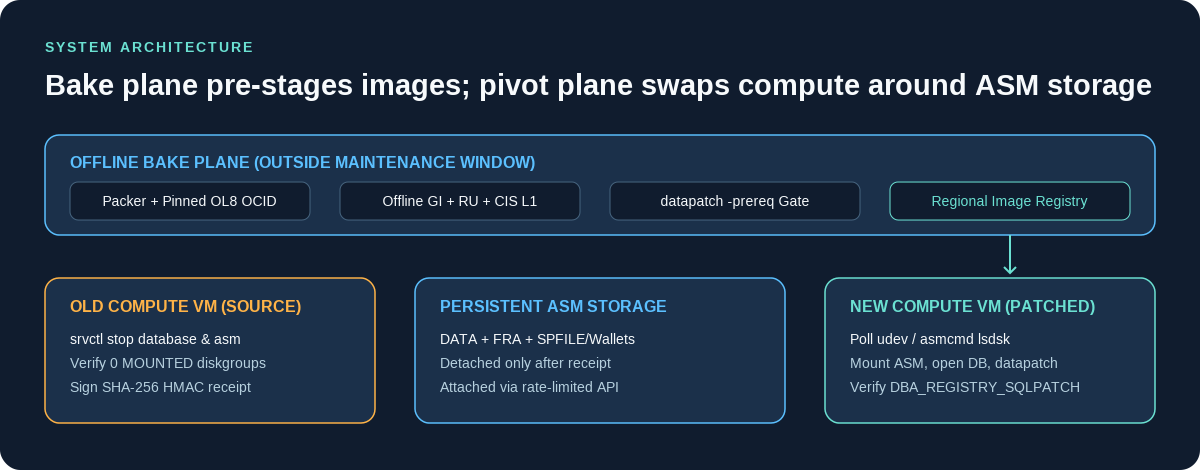
The architecture splits patching into two decoupled planes separated in time: an Offline Bake Plane triggered whenever Oracle publishes a quarterly Release Update, and a Production Pivot Plane that swaps compute around persistent ASM storage during maintenance windows.
Bake Phase: Golden Image Construction
HashiCorp Packer builds the patched image offline from a pinned Oracle Linux 8 base OCID/AMI (never floating latest tags, so base kernel parameters like vm.hugetlbpages and kernel.shmmax never change unexpectedly). The pipeline installs Grid Infrastructure and the target Oracle 19c/23ai Release Update, applies CIS Level 1 OS hardening, validates datapatch -prereq against a representative test database, and seals the image before replicating it to regional registries.
# oracle-db-19c-ru.pkr.hcl
build {
  source "oci-instance" "oracle-linux-8" {
    base_image_ocid  = var.pinned_ol8_ocid
    shape            = "VM.Standard.E5.Flex"
    ocpus            = 4
    memory_in_gbs    = 32
    compartment_ocid = var.build_compartment_ocid
  }

  provisioner "shell" {
    scripts = [
      "scripts/01-install-grid-infrastructure.sh",
      "scripts/02-apply-oracle-release-update.sh",
      "scripts/03-harden-cis-level1.sh",
      "scripts/04-install-monitoring-agents.sh",
      "scripts/05-seal-image.sh",
    ]
    environment_vars = [
      "ORACLE_VERSION=19.25.0.0",
      "RU_PATCH_ID=37082825",
    ]
  }
}
Pivot Phase: Cryptographic Shutdown Gate and ASM Dismount
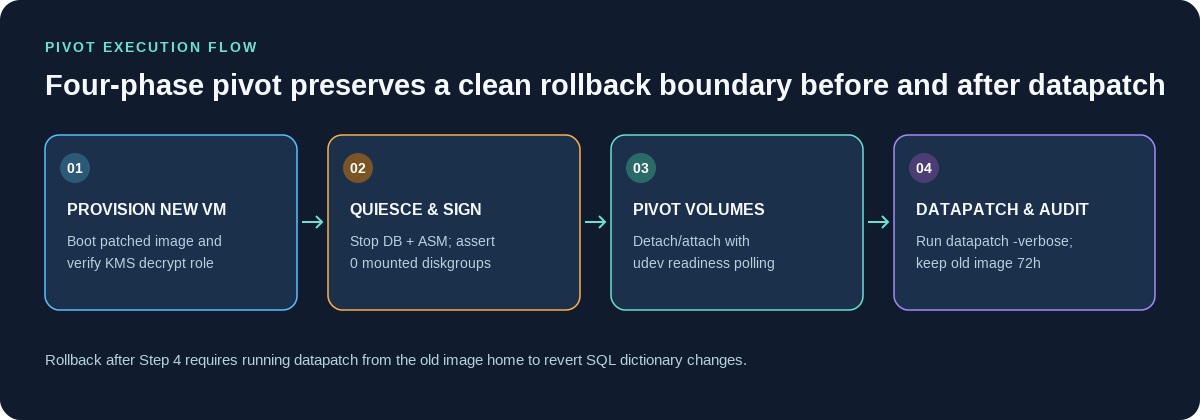
Before detaching any block volume from the old VM, the local agent must cleanly shut down the database and Oracle ASM, verify zero mounted disk groups, and return a SHA-256 HMAC shutdown receipt. Detaching a volume while ASM still holds disk groups mounted risks corrupting ASM disk headers and leaving the new VM unable to mount storage without kfed/kfod intervention.
Equally important is Oracle Restart (HAS) and /etc/oratab re-registration on the new VM. Because the golden image is built offline without knowing any specific database’s DB_UNIQUE_NAME or SPFILE path, the new VM boots with a clean Grid Infrastructure / Oracle Restart home and an empty /etc/oratab. Once the block volumes attach and udev rules bind the ASM disk devices under /dev/oracleasm/disks/* (or AFD labels), the local agent starts ohasd, discovers the ASM disk groups via asmcmd, and registers the database resource in Oracle Restart (srvctl add database pointing to the SPFILE stored on +DATA) before calling srvctl start database. Keeping the SPFILE, password file (orapw), and auto-login wallet on +DATA rather than $ORACLE_HOME/dbs is what makes the new VM completely stateless until attach time.
For Data Guard topologies, the pivot orchestrator applies the same standby-first order used in traditional patching: pivot all physical standbys to the new golden image first (without running datapatch, since standbys stay in MOUNT / READ ONLY managed recovery), verify redo transport and apply catch-up, execute a planned dgmgrl SWITCHOVER if minimizing primary outage, and then pivot the former primary and run datapatch once on the active primary so redo propagates the dictionary changes downstream.
#!/usr/bin/env bash
set -euo pipefail
DB_UNIQUE_NAME="${1}"

srvctl stop database -db "${DB_UNIQUE_NAME}" -stopoption immediate -force
srvctl stop asm -force

for _ in $(seq 1 12); do
  OFFLINE=$(crsctl stat res ora.asm -t 2>/dev/null | grep -c "OFFLINE" || true)
  [[ "${OFFLINE}" -gt 0 ]] && break
  sleep 5
done

MOUNTED=$(asmcmd lsdg 2>/dev/null | grep -v "^State" | grep -c "MOUNTED" || true)
[[ "${MOUNTED}" -gt 0 ]] && { echo "ERROR: ASM disk groups still mounted"; exit 1; }

echo -n "${DB_UNIQUE_NAME}:$(date -u +%s):OFFLINE" \
  | openssl dgst -sha256 -hmac "${FLEET_HMAC_SECRET}" -binary | base64 > /tmp/shutdown_receipt.b64
On the control-plane side (Temporal workflow), volume detach and attach calls are paced with exponential backoff and jitter, and the new VM polls asmcmd lsdsk for up to 60 seconds after the cloud API reports ATTACHED to wait for udev device nodes before mounting ASM and running datapatch.
def pivot_oracle_compute(db_id: str, new_image_id: str) -> bool:
    db = fleet_catalog.get(db_id)
    new_vm = cloud_api.provision_vm(image_id=new_image_id, shape=db.shape, subnet=db.subnet_id)

    # Gate: require valid KMS role on new_vm and signed ASM-offline receipt from old_vm
    assert cloud_api.verify_kms_decrypt(new_vm.id, db.kms_key_id), "New VM missing KMS access"
    receipt = agent.shutdown_db_and_unmount_asm(db.unique_name, timeout_seconds=300)
    assert receipt.signature_valid, "Unverified shutdown — aborting before volume detach"

    for vol in db.block_volumes:
        cloud_api.detach_volume_with_backoff(vol.id, db.vm_id)
    for vol in db.block_volumes:
        cloud_api.attach_volume_with_backoff(vol.id, new_vm.id)

    agent.wait_for_asm_disks(new_vm.id, timeout_seconds=60)
    agent.mount_asm_and_open_db(new_vm.id, db.unique_name)
    agent.run_datapatch(new_vm.id, db.unique_name)

    if agent.verify_sqlpatch_registry(new_vm.id, expected_version="19.25.0.0"):
        cloud_api.terminate_instance(db.vm_id)
        return True
    return False
At 20 concurrent regional pivots averaging 3 minutes per pivot (excluding long-running datapatch tails on multi-PDB CDBs), a 2,000-database fleet finishes in (2,000 / 20) * 3 min = 300 minutes (5 hours) with zero binary push across the network during the window. Just as importantly, if a single database’s datapatch stalls on an invalid object or a udev timeout, only that database’s Temporal workflow pauses; the remaining 19 parallel slots continue advancing without a central rhpserver bottleneck or shared SSH runner queue blocking the wave.
To keep cloud volume API retries deterministic under regional load, the Temporal activity separates provisioning (provision_vm + verify_kms_decrypt, which can run ahead of the maintenance window) from the cutover critical path (shutdown_db -> detach -> attach -> mount -> datapatch). Pre-booting the replacement VM 10 minutes before the database stops removes OS boot and cloud-init latency from the database downtime budget entirely, leaving only ASM dismount, block-volume reattachment, and instance startup inside the outage window.
How It Rolls Out
- Phase 1 — Externalize Root-Disk State. Move auto-login wallets,
SPFILEs,tnsnames.ora, andsqlnet.oraonto ASM/ACFS or object storage/config management so the root volume holds zero unique database state. Validation gate: Destroy and recreate a non-production VM from the current golden image and open the database without copying files from the old root disk. Rollback: Restore root-disk config from backup. - Phase 2 — Bake and Pre-Validate Golden Images. Build the Packer image with pinned OS base OCID/AMI, CIS Level 1 hardening, and the target RU, then run
datapatch -prereqagainst a cloned test database. Validation gate: Zeroopatchconflicts and cleandatapatch -prereqqueue. Rollback: Reject image promotion in the regional registry. - Phase 3 — Canary Pivots with Old-VM Retention. Pivot non-production and canary databases using the HMAC shutdown receipt and
udevpolling, keeping the old image ID in the fleet catalog for 72 hours. Validation gate:DBA_REGISTRY_SQLPATCHreportsSUCCESSfor the new RU,opatch lsinventorymatches the golden image manifest, and application smoke tests pass. Rollback: Beforedatapatchruns, reattach volumes to a VM booted from the old image directly; afterdatapatchruns, boot a VM from the old image, start inSTARTUP UPGRADEif core components changed, and executedatapatch -verbosefrom the old Oracle Home so Oracle applies the rollback archives stored inSYSTEM. Make sureORACLE_HOME/sqlpatchon the old image remains intact sodatapatchcan read every rollback descriptor. - Phase 4 — Fleet Wave Execution. Scale paced regional waves within cloud block-volume API rate limits, persisting pivot checkpoints to durable external storage so any control-plane restart resumes cleanly.
In Practice
- Oracle
datapatchrollback behavior (Oracle Database Utilities Guide): A common misconception is that swapping back to an old VM image requires nodatapatchwork. In reality, oncedatapatchcompletes on the new image,DBA_REGISTRY_SQLPATCHrecords the new Release Update in the database dictionary. Rolling back to the previous Oracle Home requires runningdatapatch -verbosefrom that older home (often afterSTARTUP UPGRADE) so Oracle executes the rollback scripts archived inside theSYSTEMtablespace. - Oracle FPP vs. immutable images (Oracle FPP Administrator’s Guide): Oracle FPP (
rhpctl add workingcopyandrhpctl move database) solves binary isolation inside an existing OS, which is essential on bare-metal Exadata where VMs are not swapped. On cloud VMs, Packer + block-volume pivoting eliminates both binary push during the window and multi-year Linux package drift. - Oracle AI Database 26ai
datapatchand snapshot behavior (Oracle 26ai Documentation): Oracle 26ai added a built-in blocking-session kill-switch indatapatchto terminate sessions holding dictionary locks that previously stalled maintenance windows. For storage/block-volume snapshots taken while a database is running, Oracle 26ai explicitly desupportedRECOVER...SNAPSHOT TIMEand recommends bracketing snapshots withALTER DATABASE BEGIN BACKUP/END BACKUPand recovering viaRECOVER...UNTIL TIME.
Where It Breaks
| Condition | Breaks How | Detect | Mitigate |
|---|---|---|---|
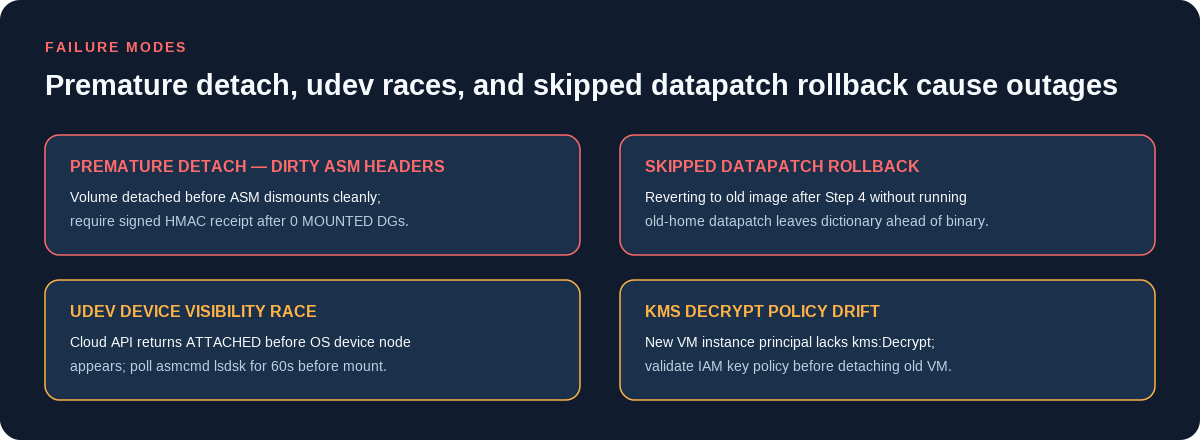
| Volume detached before ASM dismounts | ASM disk headers remain dirty; new VM fails to mount disk groups | crsctl / asmcmd lsdg mount errors (ORA-15032) | Enforce signed HMAC shutdown receipt after 0 MOUNTED disk groups before detach API |
Post-datapatch rollback skips old-home datapatch | Database dictionary stays at newer RU than old VM binaries; ORA-600 / invalid registry | DBA_REGISTRY_SQLPATCH version mismatch vs. opatch lsinventory | Run datapatch -prereq then datapatch -verbose from old image home (with STARTUP UPGRADE if required) |
| Cloud volume API HTTP 429 throttling | Parallel detach/attach calls fail mid-pivot, leaving volumes detached | Cloud API 429 TooManyRequests in Temporal activity logs | Cap concurrent pivots per region and use jittered exponential backoff |
Cloud ATTACHED vs. Linux udev race | Cloud API reports volume attached before /dev/oracleasm/disks/* appears | asmcmd lsdsk returns missing disks immediately after boot | Poll asmcmd lsdsk for up to 60s before starting ASM |
KMS kms:Decrypt drift on new VM | New VM attaches encrypted volumes, then fails ASM I/O on decrypt | Kernel / ASM I/O errors immediately on mount | Validate new VM instance-principal KMS permissions before detaching old VM |
| Unpinned base OS image in Packer | Floating OS tag pulls new kernel/RPMs, shifting hugetlbpages or shmmax | Kernel/sysctl diff in image manifest | Pin exact base OS OCID/AMI ID and gate OS upgrades separately from DB RUs |
Key Takeaways
- Separate compute lifecycle from ASM storage: Baking Oracle Homes and OS hardening offline via Packer removes multi-terabyte binary transfers from the production maintenance window.
- Never detach a block volume on trust: Gate every
DetachVolumeAPI call on a cryptographic HMAC receipt provingsrvctl stop asmcompleted andasmcmd lsdgreports zero mounted disk groups. - Poll
udevafter cloudATTACHED: Cloud control-plane APIs report attachment before Linux device nodes settle; wait onasmcmd lsdskbefore attempting ASM startup. - Post-
datapatchrollback still requiresdatapatch: Reverting to an older Oracle Home image after dictionary patching succeeds requires runningdatapatch -verbosefrom the old home to apply stored rollback archives. - Externalize all local state first: Wallets,
SPFILEs, andtnsnames.oramust live on ASM/ACFS or external config stores before compute VMs can be treated as disposable.
What to Do Next
- Problem: Hub-and-spoke binary patching saturates central network uplinks at scale and leaves multi-year Linux OS drift intact across long-lived database VMs.
- Solution: Adopt an offline Packer golden-image pipeline paired with an HMAC-gated block-volume pivot workflow that swaps compute VMs around persistent ASM storage.
- Proof: Verify in a non-production canary pivot that
DBA_REGISTRY_SQLPATCHreflects the new Release Update with zero files copied from the old VM’s root disk. - Action: Audit your Oracle cloud VMs this week for root-disk dependencies—local wallets,
tnsnames.ora, andSPFILEs—and migrate them to ASM or external secret/config storage as your prerequisite for immutable patching.
Interactive tools for this topic