
Fleet Evacuation Engineering: Exiting Deprecated Managed Oracle Services at Scale
Exiting a deprecated managed database service cannot rely on detaching EBS volumes when the cloud provider owns the storage perimeter; fleet-scale evacuation requires streaming data out through Oracle’s own redo and RMAN active duplication channels while the source remains online.
TL;DR
- Problem: AWS has announced End of Support for Amazon RDS Custom for Oracle effective March 31, 2027, leaving fleets locked inside an AWS-owned EBS perimeter where modifying
/rdsdbdataor managed files flips instances toUnsupported configuration.- Answer: Run a Temporal-orchestrated Data Plane Evacuation Engine that uses SSM Run Command to execute
RMAN DUPLICATE ... FOR STANDBY FROM ACTIVE DATABASE(reading from Oracle’s SGA, not EBS), syncs via Data Guard Broker, switches over through an Envoy proxy layer, and deletes the source RDS instance after a 7-day stability timer.- Watch out: Never write inside
/rdsdbdataor unapproved OS paths on RDS Custom; migrate TDE keystores before seeding; setAPPLIED ON ALL STANDBYarchivelog deletion policy; and cap JDBC poolmaxLifetimeMsso stale connections do not hit the demoted standby (ORA-01033/ORA-16000).
Situation
Amazon RDS Custom for Oracle sits between standard Amazon RDS for Oracle and self-managed Oracle on Amazon EC2. Unlike standard RDS, RDS Custom grants SYSDBA privileges and OS access (via AWS Systems Manager) so teams can install custom backup/monitoring agents, Database Vault, or legacy packaged-application dependencies while AWS automates backups, Multi-AZ orchestration, and underlying EBS storage.
AWS has announced the deprecation and End of Support (EOS) for Amazon RDS Custom for Oracle effective March 31, 2027. After that date, access to the RDS Custom for Oracle console, database instances, snapshots, and Custom Engine Versions (CEVs) is discontinued.
| Deployment Model | OS & SYSDBA Access | EBS / Storage Owner | Oracle Binary Owner | Primary Exit Mechanism |
|---|---|---|---|---|
| RDS Standard for Oracle | None | AWS | AWS-managed | Data Pump / AWS DMS |
| RDS Custom for Oracle | SSM + SYSDBA | AWS (RDS-managed) | Customer CEV | RMAN Active Dup / Data Guard |
| Self-Managed EC2 | Full root + SYSDBA | Customer | Customer | Storage / RMAN / Data Guard |
| Oracle Database@AWS | Exadata VM + SYSDBA | Oracle (ODB Network) | Oracle-managed | Target platform (RAC + DG) |
The architectural catch is storage ownership. Even though RDS Custom exposes OS access, AWS owns the EBS volume lifecycle and snapshot metadata. You cannot detach an RDS Custom EBS volume and mount it onto a standard EC2 instance or an Exadata VM Cluster. Any fleet exit must move data over an Oracle-native replication channel while staying inside the RDS Custom support perimeter.
The Problem
Evacuating hundreds of multi-terabyte Oracle databases ahead of the March 31, 2027 deadline hits four concrete constraints:
- EBS storage entanglement: RDS Custom EBS volumes and snapshots carry RDS-internal KMS and storage orchestration bindings tied to the RDS instance identifier. Standard EC2 instances cannot mount cloned RDS snapshots directly.
- Support perimeter lockout (
Unsupported configuration): RDS Custom continuously monitors/rdsdbdata, managedlistener.orapaths, and OS packages. If an ad-hoc migration script writes temp files inside/rdsdbdataor alters managed components without pausing automation (aws rds modify-db-instance --automation-mode all-paused), AWS shifts the instance toUnsupported configurationand suspends automated backups and monitoring. - Fleet DBA concurrency math: Migrating 500 databases manually at 2.5 DBA-hours per instance requires
500 * 2.5 = 1,250engineering hours of bespoke execution—excluding incident recovery and post-cutover cleanup. Without durable workflow orchestration, a small DBA team cannot clear the backlog before EOS while running daily production operations. - Hard March 31, 2027 cutoff and double-billing risk: Leaving migrated RDS Custom instances running “for safety” doubles monthly compute and licensing spend and leaves unretired infrastructure approaching the EOS cliff.
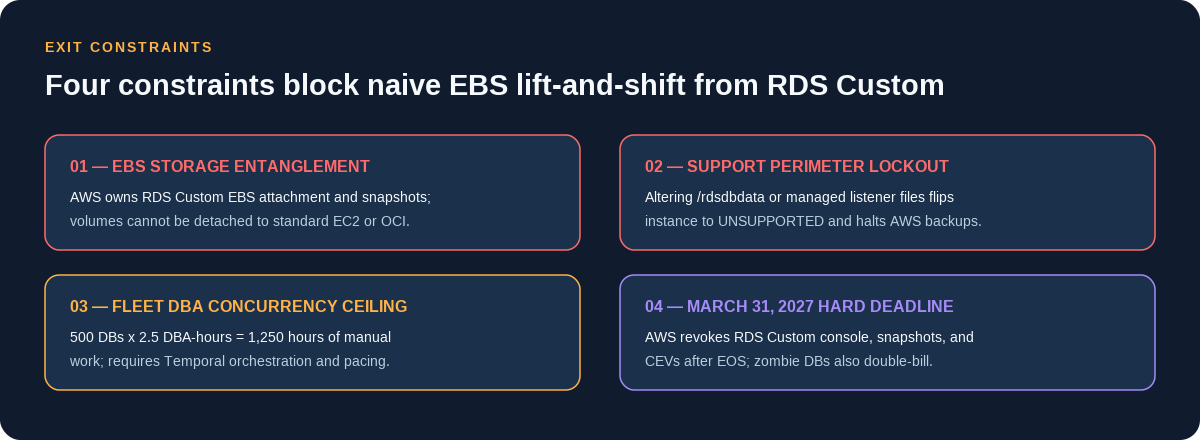
How do you evacuate hundreds of RDS Custom for Oracle databases before March 31, 2027 without violating the AWS support perimeter, taking multi-hour logical export outages, or scaling DBA headcount linearly?
Options Considered
| Exit Strategy | Downtime Profile | Physical Block Fidelity | Perimeter Safe? | Why Chosen / Rejected |
|---|---|---|---|---|
Data Pump (expdp / impdp) | Multi-hour write freeze | Logical (rebuilds indexes/stats) | Yes | Rejected: Unacceptable outage windows on multi-terabyte OLTP databases and heavy post-import validation. |
| AWS DMS (Logical CDC) | Low cutover | Logical (requires supplemental logging) | Yes | Rejected: Struggles with complex Oracle UDTs, LOB edge cases, and sequence/trigger parity across legacy schemas. |
| Self-Managed EC2 Target | Seconds (with Data Guard) | Physical | Yes | Fallback Target: Supports RMAN active duplication, but shifts OS patching, kernel tuning, and HA fencing back onto DBAs. |
| RMAN Active Dup + Data Guard to Oracle Database@AWS | Seconds (dgmgrl SWITCHOVER) | Physical (exact block copy) | Yes (via SSM + SGA) | Chosen: Streams directly from Oracle SGA over port 1521, preserves physical fidelity, and lands on managed Exadata HA. |
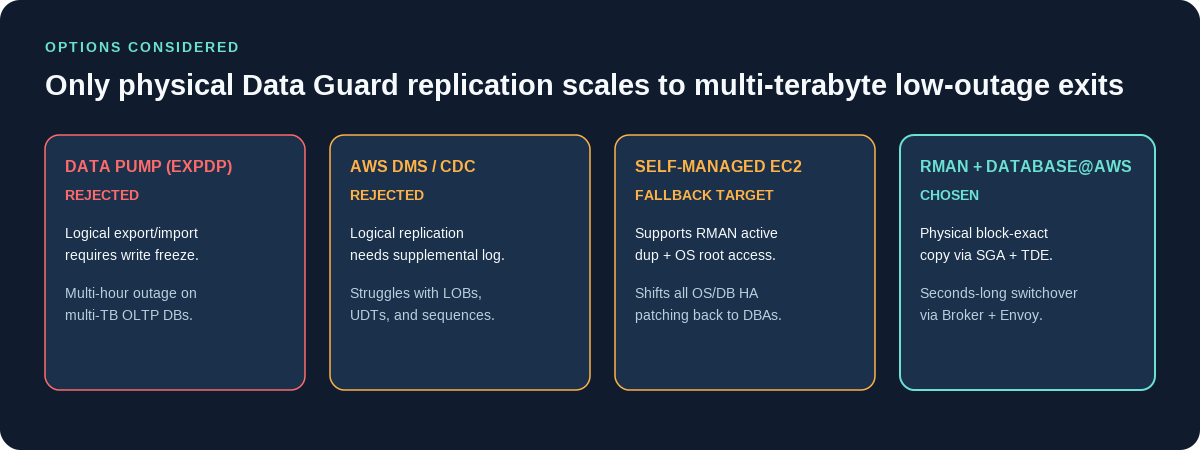
Using Self-Managed EC2 as the destination works with the exact same RMAN active duplication engine if a workload requires custom kernel modules or unsupported legacy Oracle versions that do not fit Oracle Database@AWS or standard RDS for Oracle. For enterprise OLTP workloads that need RAC, Data Guard automation, and Exadata I/O without inheriting Linux/hypervisor patching toil, Oracle Database@AWS (or standard Amazon RDS for Oracle when SYSDBA/OS access is no longer needed) is the cleaner landing zone.
The Data Plane Evacuation Engine
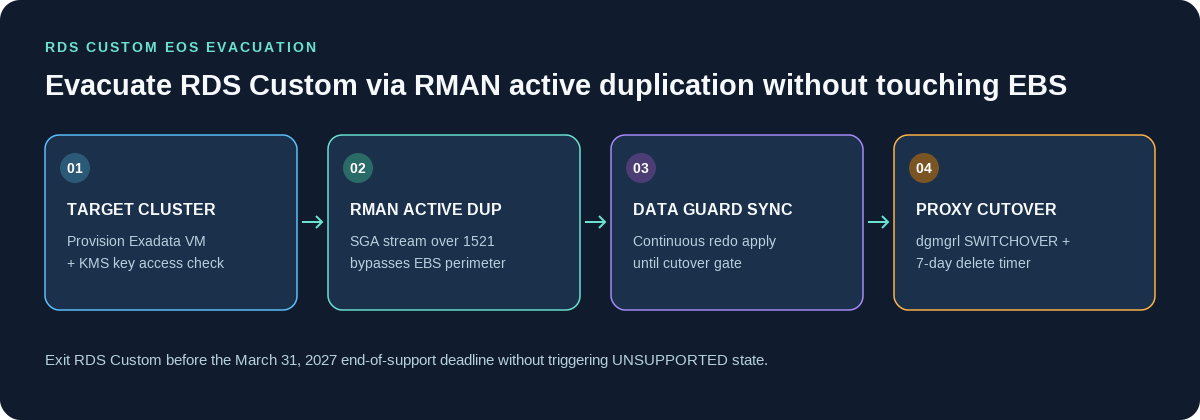
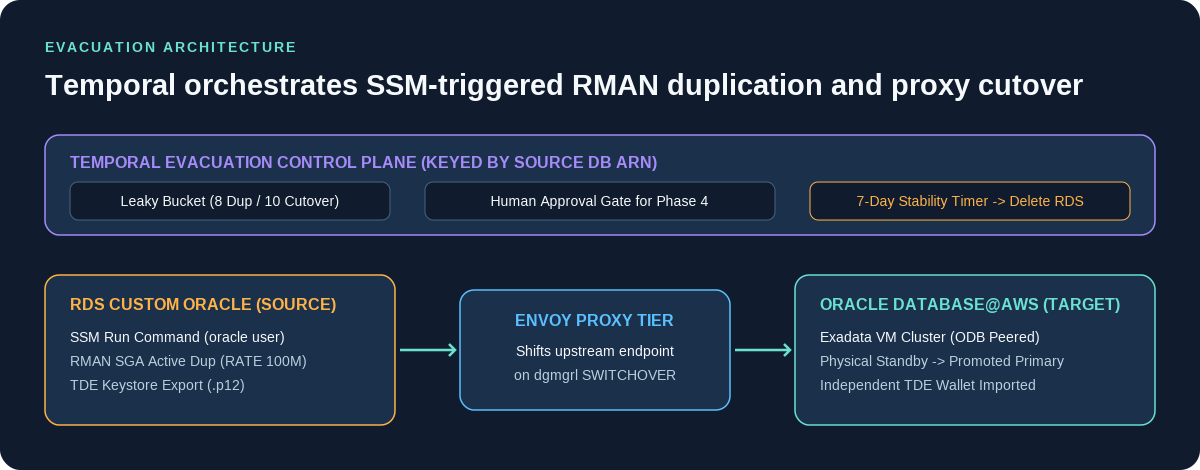
The Evacuation Engine treats every migration as a temporary physical Data Guard standby orchestrated by a durable Temporal workflow keyed by the source RDS Custom ARN. Because RMAN DUPLICATE ... FOR STANDBY FROM ACTIVE DATABASE reads blocks from Oracle’s SGA buffer cache via DBMS_BACKUP_RESTORE and streams them over SQL*Net (TCP 1521/2484), it never touches EBS volumes or /rdsdbdata layout directly.
Phase 1: Target Provisioning and TDE Keystore Migration
The workflow provisions the target Exadata VM Cluster (or CDB) idempotently, validates VPC/ODB peering connectivity on port 1521/2484, and checks that target IAM/KMS permissions are healthy. Before seeding any standby, the pre-flight activity verifies two Oracle Data Guard prerequisites on the RDS Custom source: Force Logging (SELECT force_logging FROM v$database must return YES so NOLOGGING direct-path loads do not corrupt standby blocks) and Standby Redo Logs (SRLs) sized identically to the online redo logs on the target (>= (online_groups_per_thread + 1) groups) so Data Guard Broker can receive redo immediately upon role reversal.
If a source database requires a parameter or tnsnames.ora adjustment that touches managed directories before duplication begins, operators must pause RDS Custom automation explicitly (aws rds modify-db-instance --automation-mode all-paused), apply the change, and resume --automation-mode full afterward rather than editing /rdsdbdata while the perimeter monitor is active.
For TDE-encrypted databases, the workflow exports the source TDE master encryption keys before seeding the standby—because RDS Custom’s EBS KMS key is independent of Oracle’s TDE wallet:
ADMINISTER KEY MANAGEMENT EXPORT ENCRYPTION KEYS
  WITH SECRET "migration_passphrase"
  TO '/tmp/wallet_export.p12'
  FORCE KEYSTORE IDENTIFIED BY "<keystore_password>";
The exported .p12 bundle is transferred securely to the target and imported into the target keystore prior to RMAN DUPLICATE.
Phase 2: RMAN Active Duplication via SSM Run Command
The workflow invokes the extraction script on the RDS Custom host via AWS Systems Manager (SSM) Run Command (running as the oracle OS user, which is an explicitly supported management channel inside the RDS Custom perimeter):
RMAN> DUPLICATE TARGET DATABASE
  FOR STANDBY
  FROM ACTIVE DATABASE
  DORECOVER
  SPFILE
    SET "db_unique_name"     = "TARGET_DB_UNIQUE"
    SET "log_archive_dest_2" = "SERVICE=target_tns ASYNC
                                VALID_FOR=(ONLINE_LOGFILES,PRIMARY_ROLE)
                                DB_UNIQUE_NAME=TARGET_DB_UNIQUE"
  SECTION SIZE 4G
  USING COMPRESSED BACKUPSET;
-- Parallelism comes from the channels allocated before DUPLICATE
-- (ALLOCATE CHANNEL / ALLOCATE AUXILIARY CHANNEL), not from a DUPLICATE clause.
Using SECTION SIZE 4G splits large datafiles across all 8 parallel RMAN channels rather than serializing one channel per datafile. At a capped RATE 100M per channel (8 * 100 MB/s = 800 MB/s raw, or roughly 2.88 TB/hour before compression), an 8 TB database seeds in roughly 8 TB / 2.88 TB/hr ≈ 2.8 hours without saturating a 10 Gbps VPC link when paced across concurrent workflows.
Phase 3 & Phase 4: Data Guard Sync, Proxy Cutover, and Cleanup
Once duplication finishes, the workflow registers both databases in Data Guard Broker (CREATE CONFIGURATION / ADD DATABASE target_db ... MAINTAINED AS PHYSICAL), sets LogXptMode = 'ASYNC' on target_db, and configures RMAN on the source so archived logs are not purged before the standby applies them:
dgmgrl sys/<password>@source_tns <<EOF
CREATE CONFIGURATION evac_dg AS PRIMARY DATABASE IS source_db
  CONNECT IDENTIFIER IS source_tns;
ADD DATABASE target_db AS CONNECT IDENTIFIER IS target_tns
  MAINTAINED AS PHYSICAL;
ENABLE CONFIGURATION;
EDIT DATABASE target_db SET PROPERTY LogXptMode='ASYNC';
EOF
In Temporal, a leaky bucket caps concurrent Phase 2 duplications (for example, 8 concurrent streams per 10 Gbps subnet) and concurrent Phase 4 cutovers (for example, 10 per wave). After a human approval signal in Temporal, Phase 4 executes DGMGRL> SWITCHOVER TO target_db; and updates the Envoy proxy upstream route.
To keep the cutover window bounded to seconds rather than hanging on stale TCP sockets, two client-side controls are mandatory alongside Envoy’s routing update:
- Bounded JDBC pool lifetimes: Every application connection pool must enforce
maxLifetimeMs <= 1800000(30 minutes) and fast connection validation (SELECT 1 FROM DUAL), preventing long-lived connections from staying pinned to the demoted RDS Custom instance after Envoy shifts new connections to Exadata. - Idempotent retry on standby errors: During the 5–15 second Envoy xDS propagation window across Availability Zones, in-flight writes that still land on the demoted RDS Custom instance receive
ORA-01033(duringMOUNTtransition) orORA-16000(if opened read-only). Configuring Envoy upstream timeouts and application-tier retries on transient connection/read-only errors absorbs the brief propagation window without user-visible failures.
Post-cutover, a mandatory 7-day Temporal timer monitors V$DATAGUARD_STATS and application error rates. Only after 7 clean days does the workflow delete the source RDS Custom instance to prevent double-billing:
aws rds delete-db-instance \
  --db-instance-identifier "${SOURCE_DB_ID}" \
  --skip-final-snapshot \
  --delete-automated-backups
How It Rolls Out
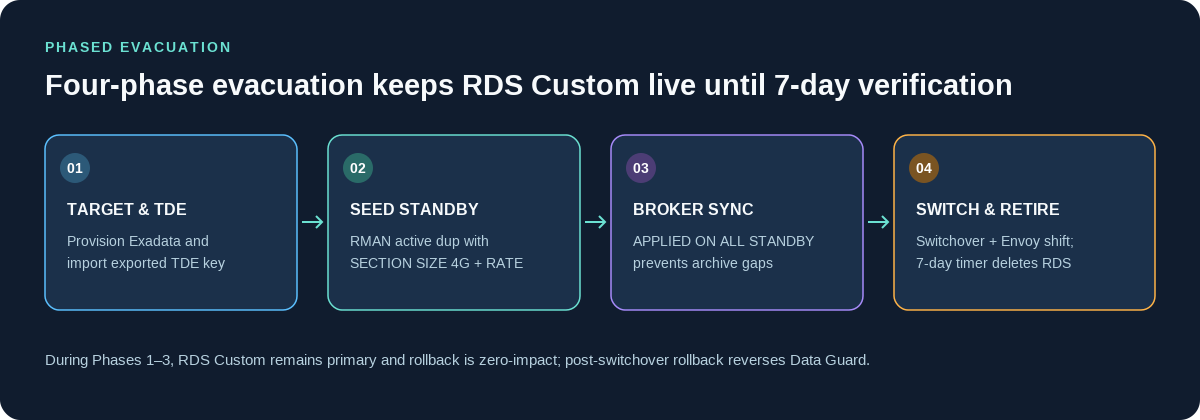
- Phase 1 — Pilot Inventory and Perimeter Audit. Classify all RDS Custom instances by Oracle version, TDE status, size, and target landing zone (Oracle Database@AWS, standard RDS, or EC2). Run a non-production dry run to confirm SSM Run Command scripts never touch
/rdsdbdata. Validation gate: ZeroUnsupported configurationevents in AWS RDS event logs. Rollback: Abort workflow before RMAN starts. - Phase 2 — Non-Production Standby Seeding. Execute
RMAN DUPLICATE ... FROM ACTIVE DATABASEwithRATEthrottling andAPPLIED ON ALL STANDBYarchivelog deletion policy. Validation gate: Target standby opens inMOUNT/READ ONLYwith0apply lag inV$DATAGUARD_STATS. Rollback: Drop the target standby and removeevac_dgbroker config; source RDS Custom is untouched. - Phase 3 — Production Cutover Waves. Enforce JDBC connection pool
maxLifetimeMs <= 1800000(30 minutes) and Envoy upstream retries before triggeringDGMGRL> SWITCHOVER TO target_db;. Validation gate: Zero elevated HTTP 5xx rates and clean write commits on Exadata. Rollback: ExecuteDGMGRL> SWITCHOVER TO source_db;and revert Envoy upstream routing. - Phase 4 — 7-Day Stability Timer and Decommission. Hold the demoted RDS Custom instance for 7 days as an emergency failback target, then run
aws rds delete-db-instanceautomatically and alert on any source instance still running > 30 days post-cutover.
In Practice
- RDS Custom support perimeter behavior (AWS RDS Custom User Guide): AWS monitors
/rdsdbdataand core OS/listener configurations continuously; unauthorized edits flip the instance toUnsupported configurationand halt automated backups. Running RMAN active duplication via SSM Run Command as theoracleuser reads from SGA memory and avoids modifying/rdsdbdatafiles directly. - RMAN active duplication and TDE independence (Oracle Backup & Recovery Reference): Because
DUPLICATE ... FOR STANDBY FROM ACTIVE DATABASEstreams blocks throughDBMS_BACKUP_RESTOREover Oracle Net, RDS Custom’s EBS KMS key never needs to be shared with the target environment; only Oracle’s TDE software keystore (ADMINISTER KEY MANAGEMENT EXPORT ENCRYPTION KEYS; see Oracle’s Advanced Security TDE documentation for the exact export and import procedure) must be migrated. - Oracle Database@AWS as a landing zone (AWS & Oracle Documentation): Oracle Database@AWS gives DBAs
SYSDBAand Exadata VM cluster control while Oracle manages the underlying Exadata storage cells and hypervisors—preserving the operational control that originally drove teams to RDS Custom without inheriting self-managed EC2 hardware/firmware toil. Exadata VM Clusters also support online OCPU and memory scaling, allowing teams to land initial migrations on right-sized compute shapes and scale dynamically after cutover based on observed AWR telemetry rather than over-provisioning up front. - Temporal leaky-bucket pacing and
V$ARCHIVE_GAPmonitoring: Capping concurrent Phase 2 duplications prevents 20 parallel RMAN streams from saturating a 10 Gbps subnet, while pollingV$ARCHIVE_GAPevery 15 minutes during Phase 3 catches missing archive sequences early—beforeAPPLIED ON ALL STANDBYretention pressure forces a full RMAN re-seed. Storing workflow state in Temporal by source ARN also ensures an orchestrator restart resumes mid-migration cleanly.
Where It Breaks
| Condition | Breaks How | Detect | Mitigate |
|---|---|---|---|
| RMAN channels saturate VPC subnet | Concurrent duplications exhaust 10 Gbps link and drop RMAN channels | RMAN ORA-19502 / network retransmit spikes | Cap concurrent Phase 2 runs via Temporal leaky bucket and set RMAN RATE 100M per channel |
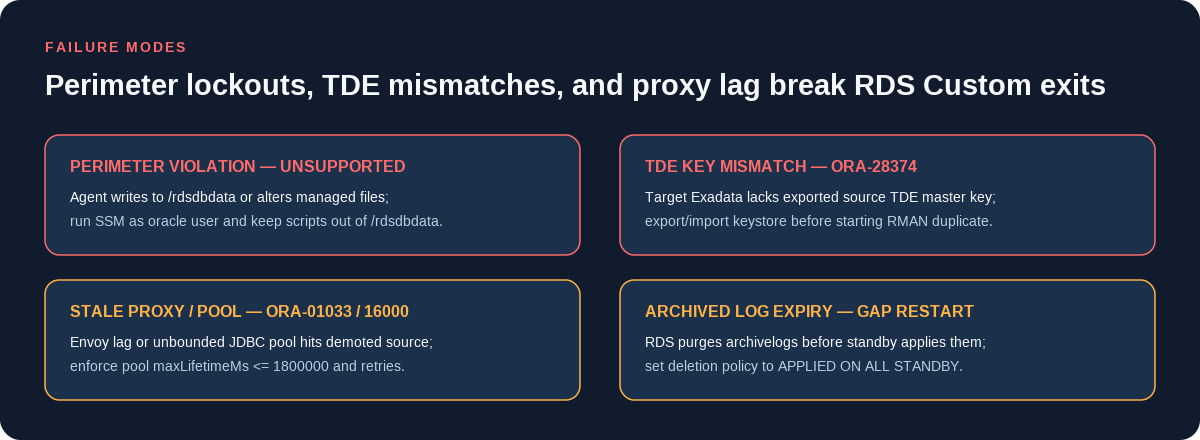
SSM script writes inside /rdsdbdata | RDS Custom perimeter triggers Unsupported configuration and suspends backups | RDS event RDS-EVENT-0200 / status Unsupported configuration | Execute as oracle user; ban writes to /rdsdbdata (or pause automation explicitly if unavoidable) |
| Missing TDE master key on target | Target Exadata cannot decrypt TDE tablespaces (ORA-28374) | ORA-28374: typed master key not found in wallet on standby open | Export/import .p12 TDE keystore in Phase 1 and verify wallet open before Phase 2 |
| Envoy propagation or unbounded JDBC pool | Stale writes hit demoted standby in MOUNT / read-only state | ORA-01033 / ORA-16000 (not ORA-16014, which is an archiver error) | Set JDBC maxLifetimeMs <= 1800000, configure Envoy retries, and hold source briefly |
| Source purges archivelogs before apply | Extended Phase 3 sync hits missing archive sequence; standby stalls | V$ARCHIVE_GAP non-empty or MRP stopped | Set RMAN CONFIGURE ARCHIVELOG DELETION POLICY TO APPLIED ON ALL STANDBY |
| Zombie RDS Custom instances post-cutover | Old instances left running past cutover double cloud spend before EOS | Cost anomaly or RDS inventory > 30 days post-cutover | Enforce Temporal’s 7-day stability timer + automated aws rds delete-db-instance |
Key Takeaways
- March 31, 2027 is a hard operational cutoff: AWS discontinues the RDS Custom for Oracle console, instances, snapshots, and CEVs after EOS, so manual per-database migrations will not clear a multi-hundred-database fleet in time.
- Stream out of the SGA, not the EBS layer:
RMAN DUPLICATE ... FOR STANDBY FROM ACTIVE DATABASEbypasses RDS Custom’s EBS ownership lock and leaves/rdsdbdatauntouched inside the support perimeter. - TDE wallets are independent of EBS KMS keys: Export and import Oracle’s TDE encryption keys explicitly (
ADMINISTER KEY MANAGEMENT EXPORT ENCRYPTION KEYS) before seeding the standby to avoidORA-28374. - Know the right standby error codes during cutover: Stale connections hitting a demoted standby throw
ORA-01033orORA-16000(whereasORA-16014indicates an archiver destination failure); cap JDBCmaxLifetimeMsand configure Envoy retries. - Automate decommission on a 7-day timer: A Temporal stability timer that deletes the source RDS Custom instance after 7 clean days prevents double-billing and zombie instances.
What to Do Next
- Problem: AWS RDS Custom for Oracle reaches End of Support on March 31, 2027, and AWS-owned EBS volume lifecycles block storage-level lift-and-shift.
- Solution: Build a Temporal-orchestrated evacuation pipeline using SSM Run Command,
RMAN DUPLICATE ... FOR STANDBY FROM ACTIVE DATABASE, Data Guard Broker, and Envoy proxy cutover to Oracle Database@AWS (or EC2/standard RDS where appropriate). - Proof: Run a single non-production RDS Custom pilot confirming zero
Unsupported configurationperimeter events during RMAN duplication and sub-minutedgmgrl SWITCHOVER. - Action: Inventory your RDS Custom for Oracle instances this week by size, TDE status, and CEV version, and verify SSM Run Command + port 1521/2484 connectivity to your target VPC or ODB network.
Interactive tools for this topic