
Continuous Chaos: Automating Cross-Region DR Switchovers for 10,000 Databases
Testing disaster recovery once a year during a frozen maintenance window does not prove regional resilience; it only proves that a static snapshot of your topology worked before the next day’s code and firewall changes introduced drift.
TL;DR
- Problem: Annual DR drills leave up to 364 days for hardcoded primary IPs, asymmetric DR firewall rules, undersized standby VMs, and stale JVM DNS caches to break failover silently.
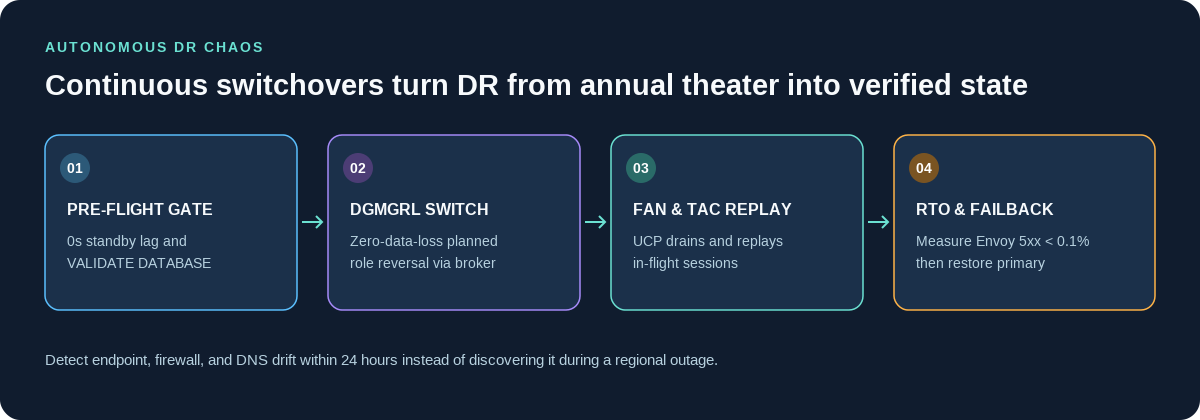
- Answer: Run an autonomous Temporal Chaos Control Plane during normal business hours that validates zero standby lag (
V$DATAGUARD_STATS+DGMGRL> VALIDATE DATABASE), executes planneddgmgrl SWITCHOVERacross small resilience rings, and measures application-tier Envoy 5xx recovery against your RTO budget.- Watch out:
V$DATAGUARD_STATSreturns rows only on the standby (zero rows on the primary), JVM DNS caching (networkaddress.cache.ttl) defaults to 30s or infinite (-1under a SecurityManager), and cross-region cell splits will turn a successful DB switchover into a latency outage unless app cells fail over in lockstep.
Situation
Organizations operating tier-1 transactional databases under frameworks such as SOC 2 Type II, ISO 27001, PCI-DSS, and DORA are required to demonstrate both zero-data-loss Recovery Point Objectives (RPO = 0) and sub-minute Recovery Time Objectives (RTO). In Oracle estates, that architecture typically pairs a primary database in one cloud region (for example, us-east-1 or OCI Ashburn) with a synchronous or near-synchronous physical standby in a secondary region (us-west-2 or OCI Phoenix) managed by Oracle Data Guard Broker.
Historically, teams validate that topology through an Annual DR Exercise: weeks of spreadsheet runbook preparation, a multi-day or multi-week deployment freeze, an off-hours maintenance window where engineers manually adjust DNS or global load balancers and run dgmgrl switchover commands, and a signed compliance report.
The flaw in that operating model is temporal. A database platform does not sit in amber between annual tests. Application teams merge connection-string changes, network teams edit security groups, and infrastructure teams resize standby compute shapes every week. Every unverified change between annual exercises widens the gap between documented RTO and actual failover behavior.
The Problem
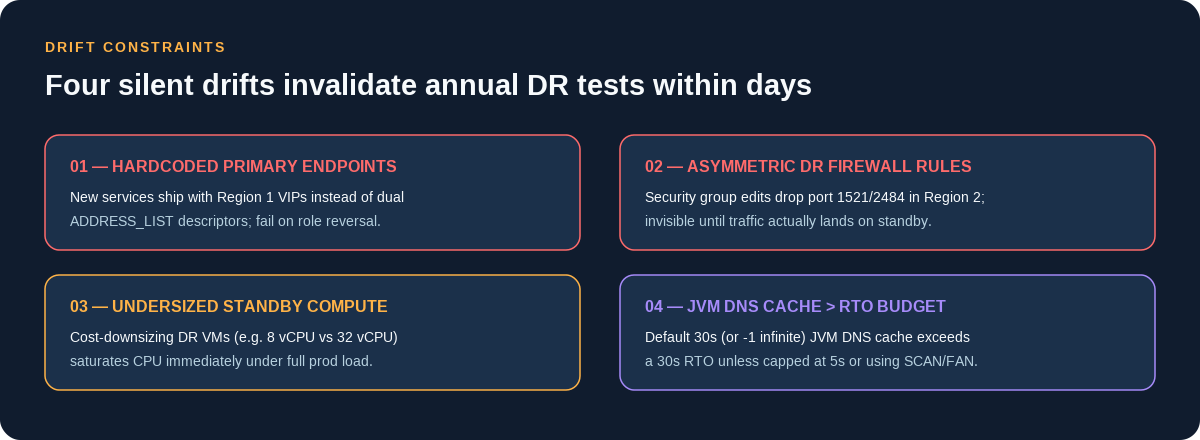
Disaster recovery readiness decays at the velocity of application and infrastructure changes, driven by four concrete constraints:
- RTO budget arithmetic leaves zero margin for DNS or redo-lag surprises: Suppose a service carries a 30-second RTO SLA. Even a clean
dgmgrl SWITCHOVERspends time draining connections, reversing redo transport, opening the promoted primary, and notifying client pools via Fast Application Notification (FAN). If the standby holds 15 seconds of unapplied redo (apply lag) and the JVM caches DNS for its default 30 seconds (or indefinitely whennetworkaddress.cache.ttl = -1under a SecurityManager),15s + 30s = 45salready blows past a 30-second RTO before the first post-failover query executes. - Hardcoded primary endpoints bypass service discovery: A microservice deployed with a single-region VIP or private IP instead of a dual-region
ADDRESS_LISTconnect descriptor works normally against Region 1—and fails completely the momentdgmgrlreverses roles to Region 2. - Asymmetric DR firewall and NSG drift: Security group or Network Security Group edits applied only to the active primary region leave port
1521or2484blocked from application subnets in the DR region. Because steady-state traffic never touches the standby listener, the block remains invisible until failover. - Undersized standby compute shapes: Downsizing standby VMs to reduce idle DR spend (for example, running 8 vCPUs on standby versus 32 vCPUs on primary) passes
dgmgrlrole transition checks, then collapses under CPU saturation the second production traffic lands on the promoted primary.
How do you verify continuously across a multi-thousand-database fleet that every standby, network path, connection pool, and application tier can complete a zero-data-loss switchover within its RTO SLA—without relying on annual freezes or fragile human runbooks?
Options Considered
| Operating Model | Drift Detection Window | Live App Path Verified? | Blast Radius Control | Why Chosen / Rejected |
|---|---|---|---|---|
| Annual Manual DR Exercise | Up to 364 days | Only under code freeze | All-or-nothing regional cutover | Rejected: Expensive theater; misses daily CI/CD endpoint, firewall, and DNS regressions. |
| Quarterly Scripted Game Day | Up to 90 days | Off-hours synthetic load | Subsystem-wide | Rejected: Cuts drift to 90 days, but off-hours traffic hides real connection-pool and sizing bottlenecks. |
| Snapshot Standby Drill | Continuous or weekly | No (synthetic SQL only) | Standby only | Rejected: Proves the DR database can open read-write, but never exercises live FAN/TAC replay or app-to-DR routing. |
| Autonomous Chaos Control Plane | < 24 hours (daily slice) | Yes (real Envoy 5xx & latency) | Ring-fenced 1% daily canary | Chosen: Proves true end-to-end RTO during business hours with automated pre-flight abort and failback. |
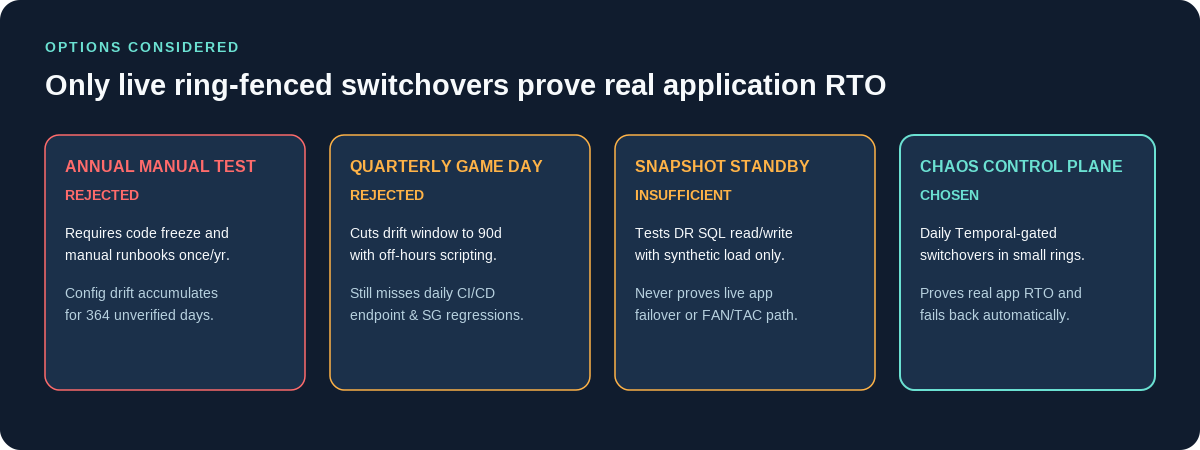
In practice, Oracle Snapshot Standby (ALTER DATABASE CONVERT TO SNAPSHOT STANDBY) is useful for testing schema migrations or isolated read-write workloads, but it cannot replace live switchover verification because production application pools never drain, reconnect, or replay transactions against the DR region during a snapshot test. Worse, converting a physical standby to a snapshot standby temporarily halts redo apply (even though redo continues to ship and queue), which increases the redo-apply backlog that would have to be drained if a real disaster struck during the test window. Only a controlled planned switchover (SWITCHOVER TO)—protected by strict pre-flight lag gates and ring-fenced blast radius—proves that the full stack from Envoy and UCP down to Data Guard Broker behaves as designed without degrading RPO.
Another common alternative is DNS-only or GSLB-only failover testing against a read-only Active Data Guard standby. While that verifies network reachability to the DR region, read-only queries do not exercise redo role reversal, ALTER SYSTEM / write-path locks, standby redo log sizing on the demoted primary, or UCP transaction replay under TAC. Continuous dgmgrl SWITCHOVER in small daily rings is the only mechanism that validates bidirectional role symmetry—proving both that Region 2 can run production writes and that Region 1 can cleanly re-synchronize as a standby afterward.
The Chaos Control Plane Architecture
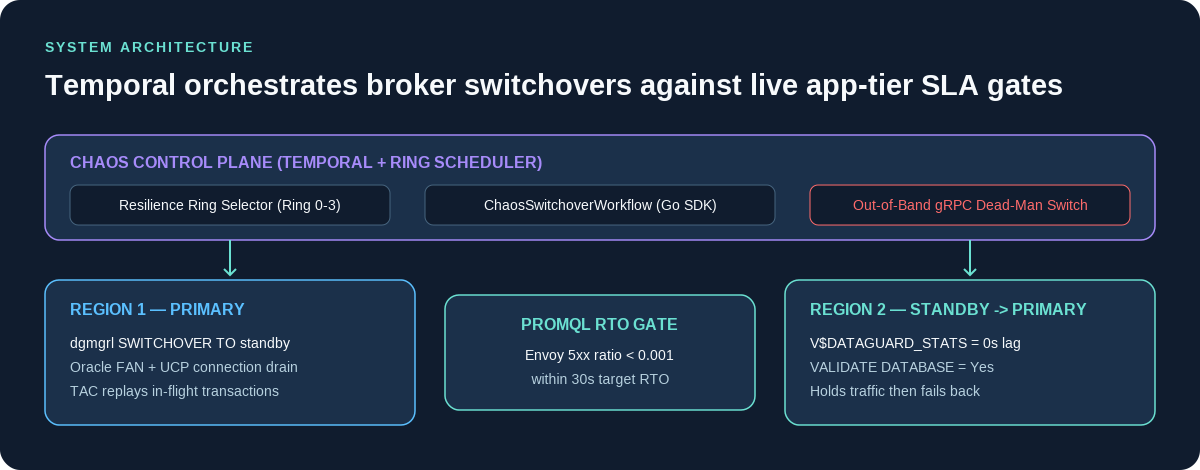
The target architecture embeds DR verification into normal operations via a Temporal-backed Chaos Control Plane that selects a small daily slice of databases inside graduated resilience rings, validates zero lag, executes a Data Guard Broker switchover, verifies application-tier recovery metrics, and fails back cleanly.
Core Architectural Subsystems
- Resilience Rings for Blast Radius Caging: Databases are tagged into four rings—Ring 0 (internal/canary), Ring 1 (non-customer tooling), Ring 2 (standard services), and Ring 3 (tier-1 transactional ledgers). Chaos workflows target Ring 0 and Ring 1 first and halt promotion to Ring 3 whenever global error budgets burn below threshold.
- Standby-Side Lag and Broker Readiness Gates:
V$DATAGUARD_STATSreturns rows only on the standby database (it returns zero rows when queried on the primary). Before touching any role, the pre-flight activity queriesV$DATAGUARD_STATSon the target standby fortransport lagandapply lag, then runsDGMGRL> VALIDATE DATABASE <standby_db>;to confirmReady for Switchover: Yes. - FAN and Transparent Application Continuity (TAC): Planned switchover (
SWITCHOVER TO) preserves zero data loss. Oracle Data Guard Broker coordinates the role reversal while Fast Application Notification (FAN) signals Universal Connection Pool (UCP) clients out-of-band over Oracle Notification Service (ONS) to abort idle connections and drain active ones at request boundaries. Transparent Application Continuity (TAC) then replays eligible in-flight transactions against the newly promoted primary without surfacingORA-connection errors to the caller, provided the JDBC connect string uses anADDRESS_LISTcontaining both regional SCAN endpoints withFAILOVER=ON,LOAD_BALANCE=OFF, and boundedCONNECT_TIMEOUT/TRANSPORT_CONNECT_TIMEOUTvalues so sockets never block on a dead TCP half-open. - Application-Tier RTO Verification: Database
OPEN READ WRITEstatus is necessary but not sufficient. The control plane polls Envoy / API Gateway Prometheus metrics (envoy_cluster_upstream_rq_xx) to confirm that HTTP 5xx error rates settle back below0.1%within the target RTO window. Alongside HTTP 5xx ratios, the activity checks p99 upstream latency and active DB session counts so a silent connection-pool stall—where zero requests arrive because pods are stuck waiting on a stale socket—cannot masquerade as a healthy0%error rate. - Out-of-Band Emergency Dead-Man Switch: An operator abort signal travels over a direct gRPC / Temporal Signal path rather than behind an asynchronous message queue, ensuring any in-flight experiment halts or fails back immediately. In addition, the Temporal workflow checks a global error-budget gate immediately before
ExecuteBrokerSwitchoverand again beforeHoldDurationcompletes; if an unrelated regional incident consumes the service’s error budget mid-experiment, the workflow skips the hold window and triggers failback right away.
1. Temporal Chaos State Machine (Go SDK)
package chaos

import (
	"fmt"
	"time"

	"go.temporal.io/sdk/temporal"
	"go.temporal.io/sdk/workflow"
)

type ChaosSwitchoverRequest struct {
	DatabaseName     string        `json:"databaseName"`
	PrimaryRegion    string        `json:"primaryRegion"`
	StandbyRegion    string        `json:"standbyRegion"`
	TargetRtoSeconds int           `json:"targetRtoSeconds"`
	HoldDuration     time.Duration `json:"holdDuration"`
}

func ChaosSwitchoverWorkflow(ctx workflow.Context, req ChaosSwitchoverRequest) error {
	ao := workflow.ActivityOptions{
		StartToCloseTimeout: 5 * time.Minute,
		RetryPolicy:         &temporal.RetryPolicy{MaximumAttempts: 1},
	}
	ctx = workflow.WithActivityOptions(ctx, ao)
	logger := workflow.GetLogger(ctx)

	var isReady bool
	if err := workflow.ExecuteActivity(ctx, AssertPreFlightSafety, req).Get(ctx, &isReady); err != nil || !isReady {
		logger.Warn("Pre-flight gate failed; aborting with zero blast radius", "error", err)
		return nil
	}

	var switchoverDuration time.Duration
	if err := workflow.ExecuteActivity(ctx, ExecuteBrokerSwitchover, req.DatabaseName, req.StandbyRegion).Get(ctx, &switchoverDuration); err != nil {
		_ = workflow.ExecuteActivity(ctx, EmergencyFailback, req.DatabaseName, req.PrimaryRegion).Get(ctx, nil)
		return err
	}

	var appRecovered bool
	if err := workflow.ExecuteActivity(ctx, AssertApplicationRecoverySLA, req.DatabaseName, req.TargetRtoSeconds).Get(ctx, &appRecovered); err != nil || !appRecovered {
		_ = workflow.ExecuteActivity(ctx, EmergencyFailback, req.DatabaseName, req.PrimaryRegion).Get(ctx, nil)
		return fmt.Errorf("RTO breach: application did not recover within %ds", req.TargetRtoSeconds)
	}

	workflow.Sleep(ctx, req.HoldDuration)

	if err := workflow.ExecuteActivity(ctx, ExecuteBrokerSwitchover, req.DatabaseName, req.PrimaryRegion).Get(ctx, nil); err != nil {
		return err
	}
	return workflow.ExecuteActivity(ctx, PublishComplianceCertificate, req, switchoverDuration).Get(ctx, nil)
}
2. Standby Pre-Flight SQL and Broker Switchover
Query V$DATAGUARD_STATS on the standby before running VALIDATE DATABASE and SWITCHOVER TO in dgmgrl:
-- Run on the physical standby (returns 0 rows on primary)
SELECT name, value, unit, time_computed
FROM   v$dataguard_stats
WHERE  name IN ('transport lag', 'apply lag', 'apply finish time');
#!/usr/bin/env bash
set -euo pipefail
TARGET_ALIAS="${1}"
TARGET_STANDBY="${2}"

OUTPUT=$(dgmgrl /@"${TARGET_ALIAS}" <<EOF
VALIDATE DATABASE "${TARGET_STANDBY}";
SWITCHOVER TO "${TARGET_STANDBY}";
EXIT;
EOF
)
echo "${OUTPUT}"
echo "${OUTPUT}" | grep -q "Switchover succeeded, new primary is \"${TARGET_STANDBY}\""
3. Application RTO Assertion (PromQL)
(
  sum(rate(envoy_cluster_upstream_rq_xx{envoy_cluster_name="payments_service", response_code_class="5"}[30s]))
  /
  sum(rate(envoy_cluster_upstream_rq_xx{envoy_cluster_name="payments_service"}[30s]))
) < 0.001
How It Rolls Out
Autonomous production switchovers should never start on Day 1 against tier-1 databases. Roll out in four gated phases:
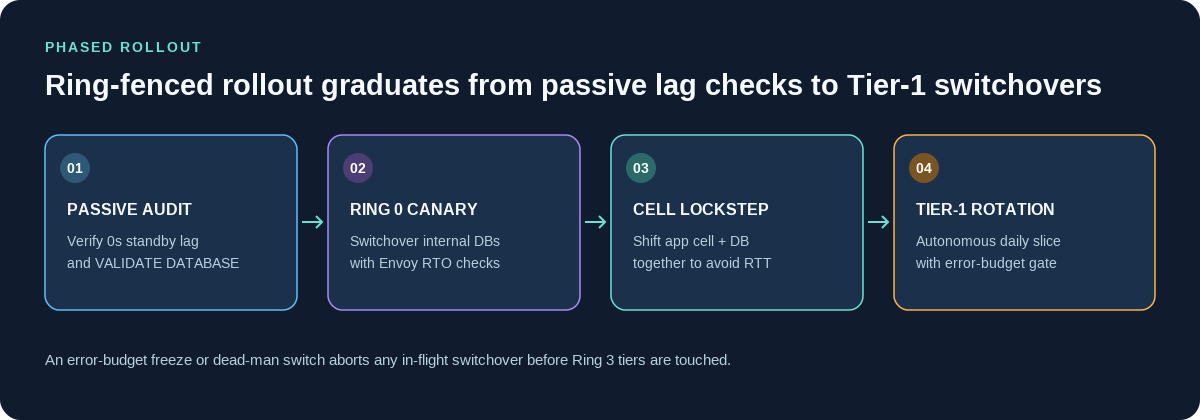
- Phase 1 — Passive Lag and Broker Validation. Run continuous read-only checks (
V$DATAGUARD_STATSon standbys andDGMGRL> VALIDATE DATABASE) across the fleet to catch asymmetric firewall blocks, stale broker metadata, and chronic redo lag. Validation gate: ZeroVALIDATE DATABASEerrors and zero unplanned lag spikes across 30 consecutive days. Rollback: Disable the passive validation cron. - Phase 2 — Ring 0 Canary Switchovers. Enable
ChaosSwitchoverWorkflowfor internal non-customer databases (Ring 0) during business hours with short hold durations (for example, 10 minutes). Validation gate: Application Envoy 5xx ratio returns below0.1%within the target RTO and failback succeeds automatically. Rollback: Trigger the Temporal dead-man switch signal or flip the Ring 0 feature flag off. - Phase 3 — Application Cell Lockstep. Pair database switchovers with regional application-cell traffic shifting so upstream services never make cross-region calls to a promoted standby while pods stay pinned in Region 1. Validation gate: End-to-end p99 request latency remains within regional baseline after switchover. Rollback: Fail back both app cell routing and Data Guard primary together.
- Phase 4 — Tier-1 Daily Rotation. Expand daily randomized selection (for example, 1% of eligible instances per day) to Ring 2 and Ring 3 services, gated by a global error-budget check that freezes all chaos runs during real incidents.
In Practice
- Continuous fault injection precedent (Netflix TechBlog): Netflix’s Chaos Engineering evolution (from Chaos Monkey to ChAP / Failure Injection Testing) demonstrated that testing failure modes continuously in production during business hours catches configuration and routing drift that annual or off-hours drills miss—provided blast radius is tightly bounded and automated abort gates watch live business metrics.
- Oracle Data Guard Broker
SWITCHOVER TObehavior (Oracle Data Guard Broker Documentation): Unlike a forced failover (FAILOVER TO),SWITCHOVER TOin Oracle 19c and 23ai performs automated pre-switchover validation, preserves redo continuity, and transitions the former primary into a synchronized physical standby without needing an RMAN rebuild. That symmetry also exposes missing Standby Redo Logs (SRLs) or mismatchedDB_FILE_NAME_CONVERT/LOG_FILE_NAME_CONVERTparameters on the original primary the first time it flips to standby—catching asymmetric storage configuration long before a real disaster. - Oracle Database 23ai resiliency vs. external fault injection (Oracle HA Overview): Oracle Database 23ai does not expose a SQL-level chaos-injection API to simulate corruption or packet drops; instead, Oracle 23ai provides Raft-based replication for Globally Distributed Database and MAA Application Continuity for session replay, while teams inject network latency or packet loss externally via Linux
tc, Chaos Mesh, or VCN route/security rules. - JVM DNS TTL behavior (Java
InetAddressspecification): Because the JVM caches resolved hostnames for 30 seconds by default (or forever whennetworkaddress.cache.ttl = -1under a SecurityManager), applications using DNS aliases rather than SCAN/ONS addresses must explicitly set-Dsun.net.inetaddr.ttl=5(ornetworkaddress.cache.ttl=5) so connections re-resolve within a 30-second RTO budget.
Where It Breaks
| Condition | Breaks How | Detect | Mitigate |
|---|---|---|---|
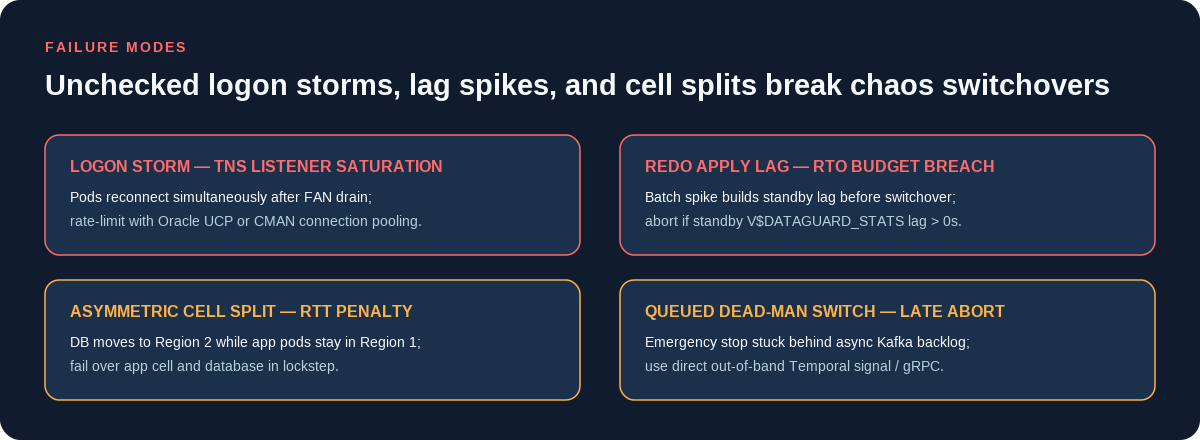
| Logon storm on promoted primary | Application pods drop connections simultaneously after FAN drain and flood the new primary listener | TNS-12518 / listener CPU saturation during switchover | Enforce Oracle UCP connection rate limiting or route through Oracle Connection Manager (CMAN) |
| Redo apply lag spikes before trigger | Heavy batch load builds standby apply backlog; switchover stalls waiting for redo catch-up | V$DATAGUARD_STATS on standby shows apply lag > 0 | Abort pre-flight immediately if standby transport lag or apply lag is non-zero |
| Asymmetric app-to-DB region split | Database moves to Region 2 while microservices stay in Region 1, adding cross-region RTT to every query | Sudden p99 query latency jump despite healthy DB CPU | Execute chaos switchovers at the Application Cell boundary in lockstep |
| Stale JVM DNS cache | App threads keep dialing Region 1 IP after role reversal until JVM cache expires | Connection timeouts / ORA-12514 on Region 1 after switchover | Set networkaddress.cache.ttl=5 in base container images and use dual-region ADDRESS_LIST + FAN |
| Dead-man switch queued behind backlog | Emergency abort message sits behind congested Kafka partitions while workflow continues | Abort command latency > 5 seconds | Send dead-man abort via direct out-of-band Temporal Signal / gRPC |
| Standby tablespace / ASM space mismatch | Primary extends a datafile that fails on standby due to smaller storage quota; MRP halts | Alert log ORA-01119 / MRP stopped in DGMGRL | Audit standby ASM diskgroup / filesystem free headroom in pre-flight checks |
Key Takeaways
- Annual DR drills measure a past snapshot, not today’s fleet: Endpoint, firewall, and compute-shape drift accumulate within days of normal CI/CD releases.
- Query
V$DATAGUARD_STATSon the standby, never the primary: The view returns zero rows on the primary; pair standby lag checks withDGMGRL> VALIDATE DATABASEbefore every automated switchover. - Database
OPEN READ WRITEis not application RTO: Always gate chaos success on downstream Envoy/API Gateway 5xx recovery and latency, backed by an out-of-band Temporal dead-man switch. - Fail over application cells and databases together: Moving a database cross-region while leaving pods behind turns a clean
dgmgrl SWITCHOVERinto a cross-region latency outage. - Control DNS caching and logon storms explicitly: Cap JVM
networkaddress.cache.ttlat 5 seconds and use Oracle UCP + FAN/TAC so connection pools drain and replay without saturating the promoted listener.
What to Do Next
- Problem: Annual DR exercises create a false sense of resilience while daily application, firewall, and DNS changes silently break cross-region failover readiness.
- Solution: Replace annual theater with a Temporal-backed Chaos Control Plane that runs continuous, ring-fenced
dgmgrl SWITCHOVERexperiments gated by standby lag invariants and live Envoy 5xx RTO assertions. - Proof: Confirm 30 consecutive days of zero
VALIDATE DATABASEerrors and0sstandby apply lag across your fleet before authorizing automated Ring 0 canary switchovers. - Action: Deploy a read-only
V$DATAGUARD_STATSandDGMGRL> VALIDATE DATABASEcheck across your Data Guard standbys this week to surface hidden DR drift before your next failover test.
Interactive tools for this topic