
Building a Database-as-a-Service Control Plane for 10,000 Oracle Databases Across 100 Regions
Push-based automation collapses past 500 Oracle databases on WAN binary distribution, Terraform state lock contention, and unbounded blast radius; operating 10,000 databases across 100 regions requires inverting to a three-tier pull control plane with fail-static host agents.
TL;DR
- Problem: Pushing
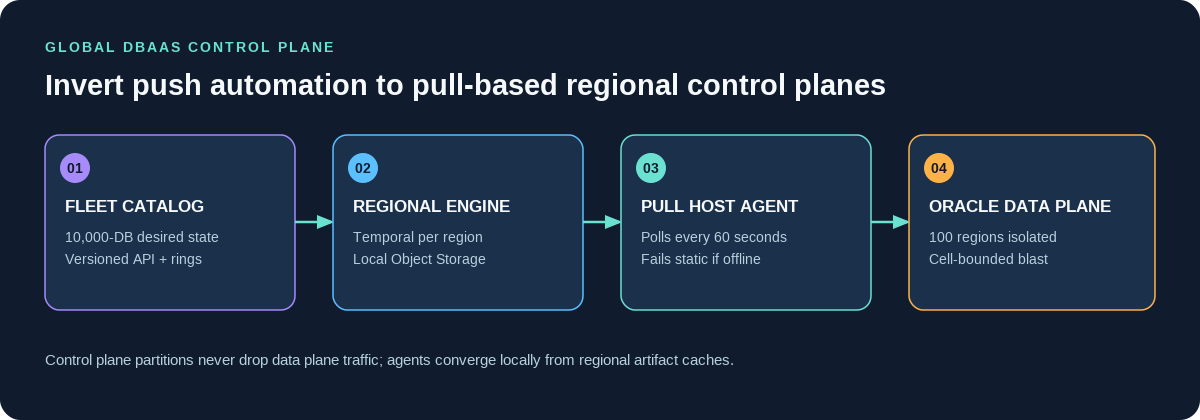
10 GBOracle binaries to10,000databases (100 TBaggregate WAN traffic) or runningterraform applyacross10,000workspaces saturates transoceanic links, triggers daily state-lock collisions, and propagates bugs globally in seconds.- Answer: Split control into three tiers: a strongly consistent Global Fleet Catalog (desired state), autonomous Regional Temporal Engines paired with local Object Storage mirrors, and pull-based Go host agents that poll every 60 seconds and fail static when disconnected.
- Watch out: A regional cache that outlives a global patch freeze lets partitioned cells keep rolling out updates—cap regional desired-state cache TTL at 2 hours before halting new mutations.
Situation
Global database platforms span dozens of commercial, sovereign, and dedicated cloud regions to satisfy sub-50ms application latency and data-residency mandates, with 50 to 150 Oracle databases per region ranging from multi-tenant PDBs to multi-terabyte RAC clusters with Active Data Guard standbys.
At 100 to 500 databases, standard push tooling works: Terraform provisions compute and block volumes, Ansible pushes configuration changes over SSH, and a centralized Oracle Fleet Patching and Provisioning (FPP) server distributes golden homes. For OCI-native estates, Oracle provides OCI Fleet Application Management for compliance policies across Base and Exadata Database Services, Exadata Fleet Update for scale-out Exadata/GI maintenance, and OCI Database Management for observability. Yet when a multi-cloud or self-managed fleet grows from 500 toward 10,000 databases across 100 regions, push-based orchestration hits structural limits.
The Problem
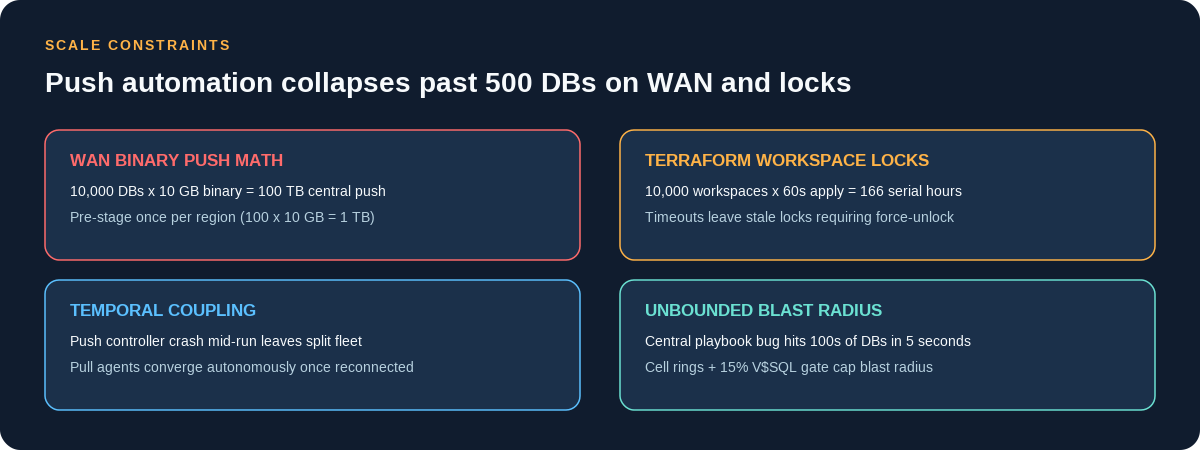
Centralized push automation breaks between 500 and 10,000 databases under four concrete engineering constraints.
1. WAN binary distribution math. Pushing a 10 GB Oracle golden home or Release Update from a central FPP hub or Ansible controller to 10,000 hosts transfers 10,000 * 10 GB = 100 TB across inter-region WAN links. Even at 10 Gbps (1.25 GB/s theoretical), transferring 100 TB serially takes 80,000 seconds (22.2 hours) of sustained line-rate traffic—and concurrent bursts drop TCP connections, leaving half-copied binaries. Pre-staging the 10 GB artifact once per region (100 * 10 GB = 1 TB total inter-region transfer) cuts WAN egress by 100x and lets hosts pull locally over regional Object Storage.
2. Terraform workspace state contention. Managing 10,000 independent Terraform workspaces in Object Storage turns a routine global parameter change into 10,000 sequential or batched plan/apply runs. At 60 seconds per workspace, serial execution takes 600,000 seconds (166.7 hours, or nearly 7 days). Parallelizing runs collides on state locks whenever a network blip aborts an apply, forcing manual terraform force-unlock cleanup.
3. Temporal coupling between orchestrator and data plane. Push controllers require live network reachability to every target VM at execution time. If the central controller crashes or a transoceanic link drops mid-play, the fleet splits into partially updated and un-updated nodes with no local convergence loop.
4. Unbounded global blast radius. A bad Ansible task or Terraform module pushed concurrently from one global controller can corrupt hundreds of databases within a 5-second detection window before an operator cancels the run.
How do you provision, patch, and govern 10,000 Oracle databases across 100 regions without WAN binary saturation, workspace lock collisions, or orchestrator-coupled outages?
Options Considered
| Architecture | Viable Fleet Ceiling | Failure Mode at Scale | Blast Radius | Why Chosen or Rejected |
|---|---|---|---|---|
| Ansible push playbooks | ~500 databases | SSH fan-out exhaustion; WAN saturation | Global controller reach | Rejected — temporal coupling and partial split states |
| Per-DB Terraform workspaces | ~1,000 databases | 166h serial apply; stale state locks | Per-module blast | Rejected — slow global convergence and lock recovery |
| Centralized FPP server | ~500 databases | Hub binary push SPOF; limited non-Oracle scope | Hub reachability | Rejected — central transfer bottleneck across 100 regions |
| Three-tier pull control plane | 10,000+ databases | Isolated per-region/per-agent failures | Cell ring + 15% gate | Chosen — regional autonomy and fail-static agents |
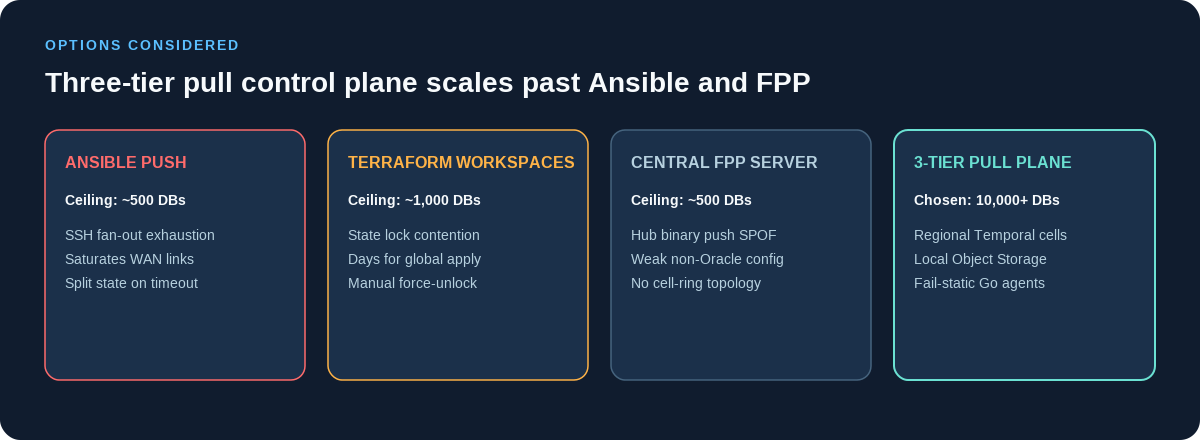
FPP, OCI Fleet Application Management, and Exadata Fleet Update are strong fits for homogeneous Oracle-managed or under-1,000-database estates. Above that threshold across 100 regions—where lifecycle operations also span monitoring agents, TLS certificate rotation, and custom backup catalogs—a three-tier pull architecture isolates regional network partitions and caps blast radius by cell.
The Distributed DBaaS Control Plane Architecture
The design inverts control from centralized push to a three-tier pull hierarchy: a Global Fleet Catalog, Regional Temporal Control Planes, and Pull-Based Go Host Agents.
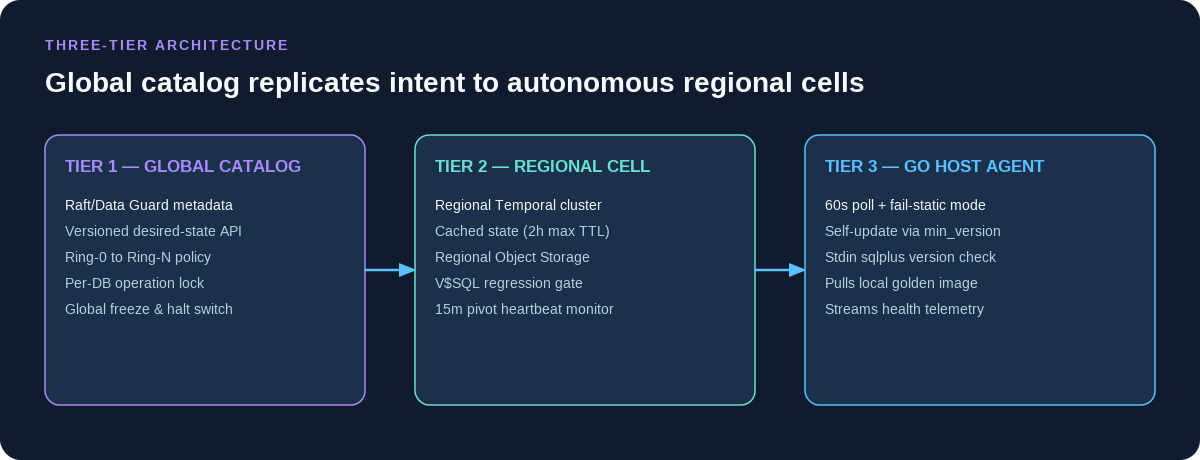
flowchart TD
    A[Global Fleet Catalog — Raft or Data Guard metadata] -->|Replicate desired state| B[Regional Control Plane — Temporal cluster]
    B -->|2h max cache TTL| C[Regional Object Storage — 10 GB golden images]
    D[Go Host Agent — systemd on DB VM] -->|Poll every 60s| B
    D -->|Pull local image| C
    D -->|Fail static if unreachable| E[Oracle Database Engine]
    B -->|Check V$SQL p99 below 15pct| F[Ring Promotion Gate]
    F -->|Halt on regression| A
Tier 1 — Global Fleet Catalog. A strongly consistent metadata store (using Raft consensus or Active Data Guard-replicated Autonomous Database) holds the declarative specification for all 10,000 databases: target Oracle version, golden image OCID, patch ring, replication topology, and an in_progress operation lock per database. It never SSHs into database hosts.
Tier 2 — Regional Control Planes (Temporal Workflow Engines). Each of the 100 regions runs an independent Temporal cluster paired with a regional Object Storage mirror holding pre-staged golden images. If transoceanic fiber disconnects a region from the Global Catalog, the regional Temporal cluster continues executing health checks and in-flight workflows using its local desired-state cache—capped at a 2-hour TTL so a partitioned region cannot ignore a global patch freeze indefinitely.
Tier 3 — Pull-Based Go Host Agents. A single Go binary runs as a systemd service on every database VM, polling its Regional Control Plane every 60 seconds. Notice how getCurrentOracleVersion() passes SQL via cmd.Stdin (never shell-only <<< syntax inside exec.Command, which fails without a shell) and how pollDesiredState() enforces the fail-static rule:
package main

import (
	"encoding/json"
	"fmt"
	"net/http"
	"os/exec"
	"strings"
	"time"
)

type DesiredState struct {
	OracleVersion   string `json:"oracle_version"`
	GoldenImageID   string `json:"golden_image_id"`
	MinAgentVersion string `json:"min_agent_version"`
	PatchRing       string `json:"patch_ring"`
}

func getCurrentOracleVersion() (string, error) {
	cmd := exec.Command("sqlplus", "-S", "/ as sysdba")
	cmd.Stdin = strings.NewReader("SET HEADING OFF FEEDBACK OFF\nSELECT version FROM v$instance;\nEXIT;\n")
	out, err := cmd.Output()
	if err != nil {
		return "", fmt.Errorf("sqlplus version query failed: %w", err)
	}
	return strings.TrimSpace(string(out)), nil
}

func pollDesiredState(dbUniqueName, regionalURL string) (*DesiredState, error) {
	client := &http.Client{Timeout: 10 * time.Second}
	req, err := http.NewRequest("GET", fmt.Sprintf("%s/v2/databases/%s/desired-state", regionalURL, dbUniqueName), nil)
	if err != nil {
		return nil, err
	}
	req.Header.Set("Accept", "application/vnd.fleet.v2+json")
	resp, err := client.Do(req)
	if err != nil {
		return nil, fmt.Errorf("control plane unreachable — fail static: %w", err)
	}
	defer resp.Body.Close()

	var state DesiredState
	if err := json.NewDecoder(resp.Body).Decode(&state); err != nil {
		return nil, fmt.Errorf("invalid desired state — fail static: %w", err)
	}
	return &state, nil
}
Cell-based rings and telemetry-gated promotion. The Global Fleet Catalog assigns every database to a ring (Ring-0 internal test with 48-hour soak, Ring-1 through Ring-3 regional production waves with 24-hour soaks, and Ring-N Tier-0 critical databases with 72-hour soak). Before promoting a ring, the Regional Control Plane compares V$SQL p99 elapsed time across the active ring against pre-patch baselines and halts promotion automatically if any database regresses by more than 15%:
async def validate_ring_health(ring: str, patch_version: str, catalog, metrics) -> bool:
    for db in catalog.query(ring=ring, oracle_version=patch_version):
        baseline_p99 = metrics.get_baseline_p99(db.unique_name)
        current_p99 = await metrics.query_current_p99(db.unique_name)
        if baseline_p99 > 0 and ((current_p99 - baseline_p99) / baseline_p99) * 100.0 > 15.0:
            await metrics.alert_halt(db.unique_name, ring, patch_version)
            return False
    return True
Agent self-update and per-database operation locking. Before executing any lifecycle change, the Go agent compares its compiled binary version against DesiredState.MinAgentVersion. If an upcoming Oracle 26ai datapatch or volume-pivot change requires agent 2.0, older agents pull the signed 2.0 binary from regional Object Storage, verify its SHA-256 checksum, and restart cleanly via systemd before touching Oracle. Simultaneously, the Global Fleet Catalog enforces a single in_progress mutex per db_unique_name so two overlapping ring promotions can never trigger concurrent compute pivots on the same database.
Heartbeat timeouts and regional cache TTLs. When a Go agent begins a destructive or stateful lifecycle step such as a block-volume compute pivot, it acquires a Temporal activity lease and emits heartbeats every 60 seconds. If the agent crashes after stopping the old VM and never provisions the replacement compute node, the Regional Temporal cluster detects the missed heartbeat within 15 minutes, aborts the pivot workflow, issues a cloud API reboot on the original VM so Oracle restarts on its prior golden image, and pages the on-call engineer. Conversely, if a transoceanic fiber cut isolates a Regional Control Plane from the Global Fleet Catalog, the regional cell continues serving cached desired state for up to 2 hours. Once the cache age crosses 2 hours, the regional cell transitions to read-only health monitoring and refuses new lifecycle mutations until global connectivity—and any pending global patch freeze—is confirmed.
API versioning across 10,000 heterogeneous hosts. Rolling out a new Fleet Catalog field across 10,000 agents cannot be atomic. Every Go agent sends Accept: application/vnd.fleet.v2+json on its 60-second poll, and Regional Control Planes maintain backward compatibility for both N and N-1 schema versions. Agents receiving an unrecognized schema or HTTP 4xx/5xx response fall back to fail-static mode rather than guessing defaults, ensuring schema migrations never trigger unintended database restarts.
Worker pool sizing and global wave throttling. Even with regional Temporal clusters, launching 10,000 patch workflows simultaneously would overwhelm a static 100-slot worker pool, queueing 9,900 executions for days. Each regional cluster sizes its Temporal worker pool at expected peak concurrency plus 50% headroom, autoscales workers via Kubernetes HPA on temporal_workflow_execution_count, and enforces a global wave ceiling of 1,000 concurrent active workflows so compliance windows remain predictable.
How It Rolls Out
Migrating from push scripts to a 100-region pull control plane rolls out in four gated phases.
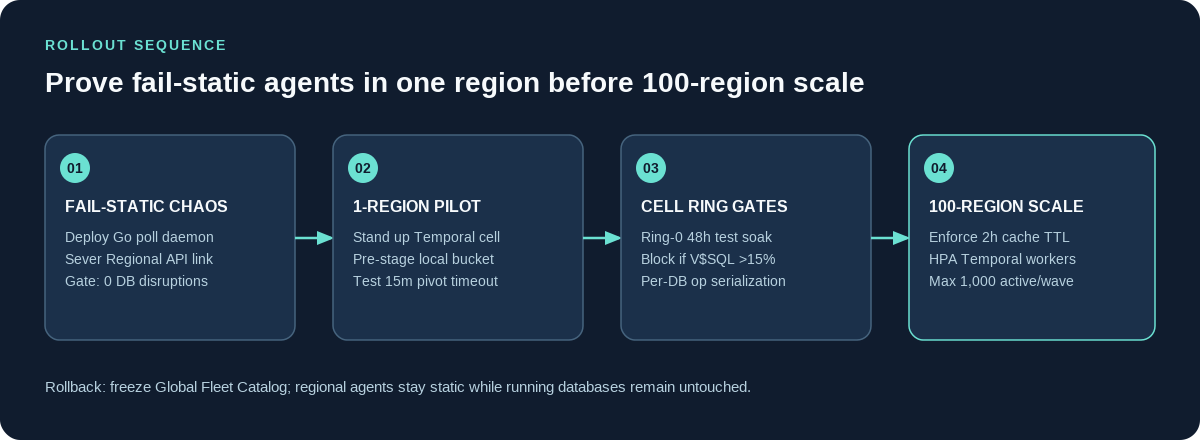
Phase 1: Fail-Static Agent Chaos Pilot. Deploy the Go polling agent in read-only shadow mode on 20 non-production VMs, then sever network access to the Regional API endpoint. Gate: 0 database disruptions and 100% clean fail-static log entries over 72 hours. Rollback: stop the systemd unit (systemctl stop dbaas-agent).
Phase 2: Single-Region Temporal Cell and Local Mirror. Stand up one Regional Temporal cluster, replicate golden images to that region’s Object Storage bucket (plus two neighboring fallback regions), and validate the 15-minute pivot heartbeat timeout. Gate: simulated mid-pivot agent crash triggers automatic old-VM reboot within 15 minutes. Rollback: revert the Fleet Catalog desired state to current version.
Phase 3: Telemetry-Gated Ring Promotion. Enable Ring-0 (48-hour soak) and Ring-1 (24-hour soak) in the pilot region with the >15% V$SQL regression gate and API versioning (Accept: application/vnd.fleet.v2+json). Gate: 0 unapproved ring promotions and verified per-DB in_progress lock rejection on concurrent test triggers. Rollback: set global freeze flag in Fleet Catalog.
Phase 4: 100-Region Federation. Roll out Regional Temporal cells across all remaining regions with the 2-hour regional cache TTL, HPA-autoscaled Temporal workers, and a global concurrency cap of 1,000 active workflows per wave. Gate: full fleet convergence within compliance SLA with <1% manual interventions. Rollback: halt new waves at the Global Catalog; running databases remain unaffected.
In Practice
- Pull-model fail-static semantics (Pattern A): As documented in Google’s Borg paper and “Borg, Omega, and Kubernetes” (ACM Queue, Vol. 14, No. 1, 2016), decoupling control-plane availability from data-plane execution ensures that control-plane partitions or restarts never drop active workloads; agents hold their last known good state until connectivity returns.
- Temporal multi-region autonomy (Pattern A): Per Temporal’s multi-region architecture documentation, running region-local Temporal clusters keeps workflow execution, activity heartbeats, and retry timers local to each region so transoceanic latency never stalls local database operations.
- OCI Object Storage replication for artifact locality (Pattern A): Pre-staging golden images into regional Object Storage buckets (with cross-region replication to two neighbor regions) removes
100 TBcentral WAN pushes and eliminates single-bucket availability stalls. - Oracle managed fleet tooling scope (Pattern B): For OCI-native estates under 1,000 databases, OCI Fleet Application Management, Exadata Fleet Update, and Oracle FPP provide built-in compliance and patching runbooks; the custom three-tier Temporal plane is warranted when fleets span multiple clouds, 100+ regions, or non-Oracle host lifecycle tasks.
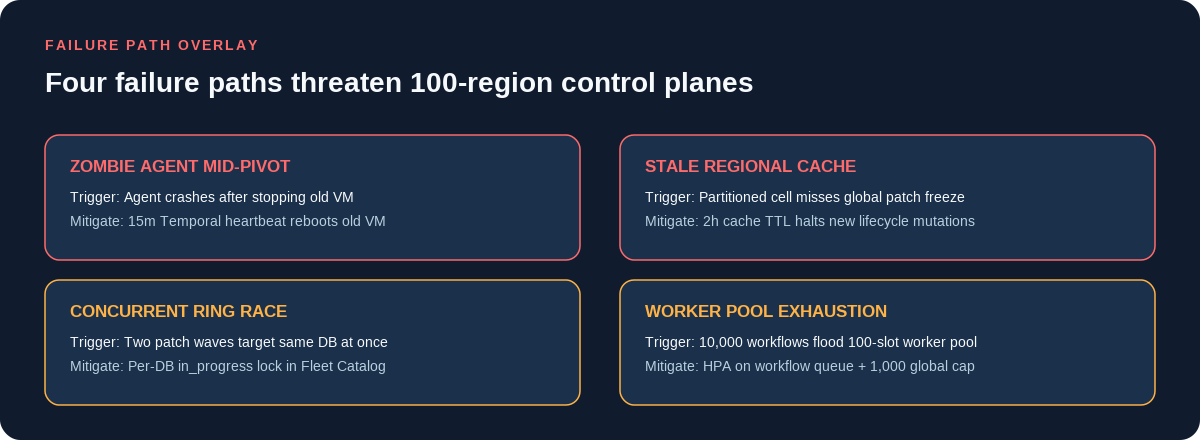
Where It Breaks
| Failure Mode | Breaks How | Detect | Mitigate |
|---|---|---|---|
| Zombie agent mid-pivot | Agent stops old VM, then crashes before new VM boots | Temporal 15-minute activity heartbeat times out | Workflow reboots old VM via cloud API and pages on-call |
| Stale regional cache | Partitioned region misses global freeze and keeps patching | Regional sync age metric exceeds 2 hours | Enforce 2-hour cache TTL; halt new mutations after expiry |
| Concurrent ring promotion race | Two patch waves target the same DB simultaneously | Catalog lock conflict on db_unique_name | Enforce single in_progress mutex per DB in Fleet Catalog |
| Temporal worker pool exhaustion | 10,000 workflows flood a 100-slot worker pool | temporal_workflow_execution_count queue depth spikes | HPA-scale workers + cap global wave at 1,000 active |
| Agent version drift | Agent 1.9 runs outdated datapatch syntax on 26ai | CurrentAgentVersion < MinAgentVersion in poll | Self-update agent binary from regional bucket before pivot |
| Catalog schema breaks old cells | Unversioned JSON field breaks older regional parsers | 4xx/decode errors spike on desired-state poll | Version media types (vnd.fleet.v2+json); support N and N-1 |
Key Takeaways
- Invert binary distribution from central push to regional pull: Pre-staging a
10 GBgolden image once per region (1 TBacross 100 regions) eliminates the100 TBWAN bottleneck of pushing from a central controller to 10,000 hosts. - Enforce fail-static behavior on every host agent: If the Regional Control Plane is unreachable or returns malformed JSON, the agent must take zero action so control-plane outages never become database outages.
- Bound regional cache autonomy with a 2-hour TTL: Regional Temporal cells should survive brief WAN partitions, but must halt new lifecycle mutations if disconnected from the Global Catalog past 2 hours to honor global freezes.
- Serialize operations per database and version the agent API: A per-database
in_progressmutex prevents concurrent ring races, andmin_agent_versionself-updates prevent binary/schema drift across 10,000 VMs. - Gate every ring on
V$SQLtelemetry, not timers: Automated promotion must verifyp99SQL elapsed time has not regressed by>15%before advancing fromRing-0to global waves.
What to Do Next
- Problem: Push-based tools (Ansible, per-DB Terraform workspaces, centralized FPP) collapse past 500–1,000 Oracle databases due to WAN binary saturation, state-lock contention, and unbounded blast radius.
- Solution: Deploy a three-tier pull control plane—Global Fleet Catalog, Regional Temporal clusters with local Object Storage mirrors, and fail-static Go host agents—to govern 10,000 databases across 100 regions.
- Proof: Verify the Go agent’s
sqlplusstdin version check and fail-static behavior under simulated Regional API outage, and confirm a 15-minute Temporal heartbeat timeout recovers a simulated mid-pivot agent crash. - Action: Deploy a read-only 60-second polling daemon on one staging Oracle VM that compares
SELECT version FROM v$instanceagainst a central JSON endpoint and logs drift without mutating state.
Sources
- Google Research — Large-scale cluster management at Google with Borg (EuroSys 2015): https://research.google/pubs/large-scale-cluster-management-at-google-with-borg/
- Burns et al. — Borg, Omega, and Kubernetes (ACM Queue, Vol. 14, No. 1, 2016): https://queue.acm.org/detail.cfm?id=2898444
- Temporal Documentation — Multi-Region / Multi-Cluster Architecture: https://docs.temporal.io/cloud/multi-region
- OCI Fleet Application Management Documentation: https://docs.oracle.com/en-us/iaas/fleet-application-management/index.html
- Oracle Fleet Patching and Provisioning (FPP) Guide: https://docs.oracle.com/en/database/oracle/oracle-database/19/cwadd/oraclet-fleet-patching-and-provisioning.html
- OCI Object Storage — Cross-Region Replication: https://docs.oracle.com/en-us/iaas/Content/Object/Tasks/usingreplication.htm
Interactive tools for this topic