
Tiering High Availability by Blast Radius: The Composite RAC, Data Guard, and GoldenGate Architecture
Treating high availability as a monolithic requirement guarantees architectural failure because node crashes, storage corruption, regional network blackouts, and destructive SQL belong to separate failure domains that no single replication primitive can isolate.
TL;DR
- Problem: Stretching Oracle RAC across sites multiplies Cache Fusion lock latency and leaves shared ASM storage as a single point of failure, while unpartitioned active-active GoldenGate collapses under WAN write conflicts.
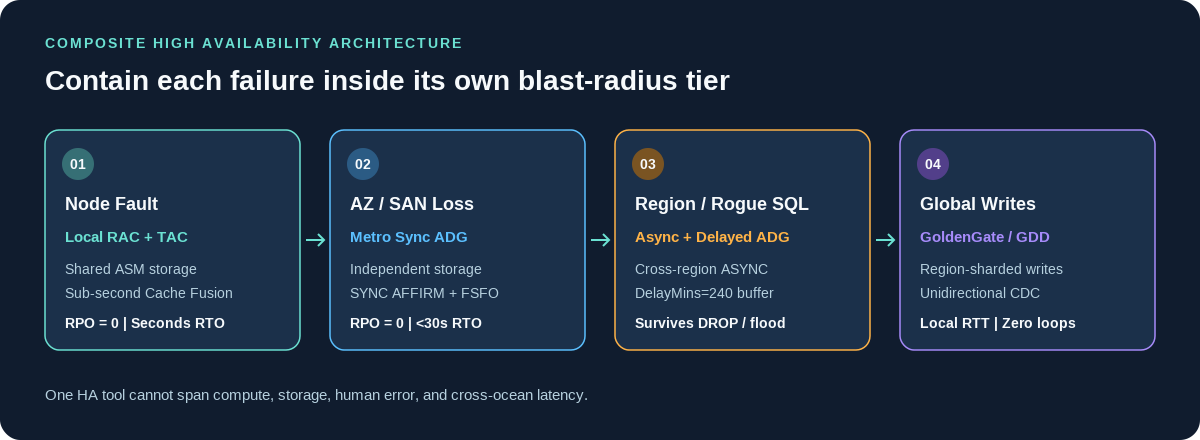
- Answer: Layer four Oracle Maximum Availability Architecture (MAA) tiers by blast radius—local RAC with TAC for compute faults, synchronous Active Data Guard for metro AZ loss, asynchronous plus delayed standby for regional and logical recovery, and region-sharded GoldenGate or 23ai Raft for global writes.
- Watch out: Synchronous
MaxAvailabilitystalls primarylog file synccommits during metro network jitter unlessNetTimeoutis bounded, and delayed standbys silently lose logical protection if redo spikes exhaust the Fast Recovery Area.
Situation
Transactional systems that process payments, reservations, or inventory ledgers typically operate under four-nines to five-nines availability targets, zero-data-loss recovery point objectives (RPO = 0) for local and metro faults, and recovery time objectives (RTO) measured in seconds. In the Oracle ecosystem, architects evaluate three distinct availability primitives to satisfy those mandates:
- Oracle Real Application Clusters (RAC): A shared-everything compute topology where multiple database instances on separate hosts mount a common Oracle Automatic Storage Management (ASM) disk group. Cache Fusion coordinates data blocks and global enqueues between instance buffer caches over a private RDMA or Gigabit interconnect.
- Oracle Active Data Guard (ADG): A shared-nothing physical replication topology where the primary database ships redo records to one or more independent standby databases. The Managed Recovery Process (MRP) applies redo blocks continuously, keeping the standby physically identical while open for read-only queries and Fast-Start Failover (FSFO).
- Oracle GoldenGate (OGG): A decoupled logical replication engine that captures committed changes from redo logs, writes platform-independent trail files, and applies SQL DML and DDL on target databases through Replicat processes.
The recurring operational mistake is treating these three primitives as mutually exclusive alternatives rather than complementary layers. Selecting a single tool forces it across failure boundaries it was never built to survive.
The Problem
Stretching any single availability primitive past its physical failure domain breaks either latency, isolation, or data integrity. Four explicit constraints govern multi-tier database availability:
- Constraint 1 — Interconnect Speed-of-Light Tax (RAC Cache Fusion): Inside a single datacenter over InfiniBand or RoCE, Cache Fusion block transfers complete in sub-millisecond memory-to-network round trips. Stretching RAC across two datacenters 30 to 50 kilometers apart introduces 2 to 5 milliseconds of round-trip fiber latency. Under OLTP concurrency, every global cache read (
gc cr block 2-way) or busy buffer handoff (gc current block busy) pays that cross-site RTT. Consider a transaction executing 40 sequential index and table block gets where 25% require cross-node Cache Fusion coordination: at 0.2 ms local RTT, interconnect overhead is10 * 0.2 ms = 2 msper transaction; at 3 ms cross-AZ RTT, interconnect overhead jumps to10 * 3 ms = 30 ms, adding 28 ms of pure lock wait before disk or network I/O is even counted. - Constraint 2 — Shared Storage Blast Radius: Every RAC node mounts the same ASM diskgroups. A storage array firmware defect, SAN fabric misconfiguration, or administrative
DROP DISKGROUPerror hits every RAC node simultaneously. Shared-everything compute provides zero isolation against storage corruption or human error. - Constraint 3 — Synchronous Commit Latency Budget: Synchronous Data Guard (
SYNC AFFIRM) holds the primaryLGWRcommit until the metro standby confirms redo write to its standby redo logs. When metro RTT is under 1 ms, commit overhead is negligible. Beyond 5 to 10 ms RTT, synchronouslog file syncwaits throttle primary write throughput directly. - Constraint 4 — WAN Write-Collision Rate: Transatlantic RTT between US East and Europe West sits around 70 to 120 ms. Running unpartitioned active-active GoldenGate across that link leaves a wide asynchronous window where concurrent updates to the same row collide, shifting database capacity from application transactions to Conflict Detection and Resolution (CDR) exception queues.
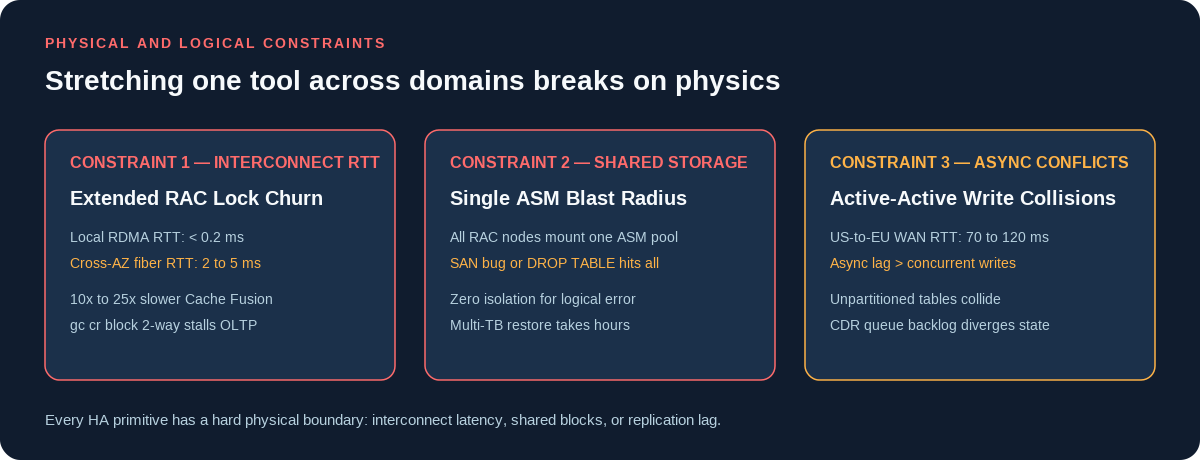
How do platform architects layer RAC, Active Data Guard, and GoldenGate so compute faults, SAN failures, regional outages, rogue SQL, and cross-ocean latency are each absorbed inside their own boundary?
Options Considered
Before settling on a layered topology, teams typically evaluate three single-technology shortcuts. Each fails at least two of the four constraints above.
| Architecture Option | Compute Fault (RTO / RPO) | Storage / AZ Loss | Logical Error (DROP TABLE) | Global Multi-Region Writes | Why Rejected |
|---|---|---|---|---|---|
| Extended (Stretched) RAC | Seconds / RPO = 0 | Fails — shared ASM | Fails — instant propagation | Fails — Cache Fusion stalls | Cross-AZ RTT degrades OLTP; shared ASM is a single point of failure. |
| Single-Region Active Data Guard | 15–30s FSFO / RPO = 0 | Survives via independent ASM | Fails unless delayed target added | Fails — single primary writer | Full cluster failover for a single host crash; no local compute pooling. |
| Unpartitioned Active-Active GoldenGate | Seconds / Async RPO > 0 | Survives on independent DB | Fails — DML/DDL replicates | Collides under concurrent writes | Cannot guarantee RPO = 0; conflict queues risk ledger divergence. |
| Composite MAA Topology (Chosen) | Seconds (RAC + TAC) / RPO = 0 | Survives via Metro Sync ADG | Survives via DelayMins=240 | Survives via sharded writes | Contains every failure inside its matched layer without cross-domain coupling. |
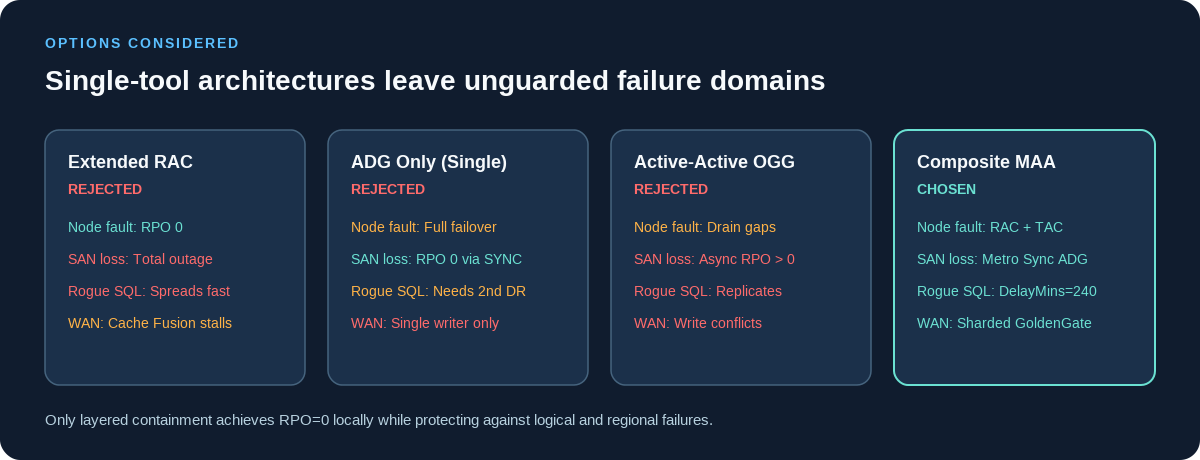
Extended RAC was rejected because dark fiber does not eliminate shared ASM corruption or rogue DDL propagation. Single-region ADG alone forces a database-wide role transition just to survive a single server motherboard fault. Bidirectional GoldenGate without strict write ownership trades zero data loss for asynchronous conflict resolution. Only the composite design satisfies all four failure domains without violating physics.
The Composite Blast-Radius Architecture
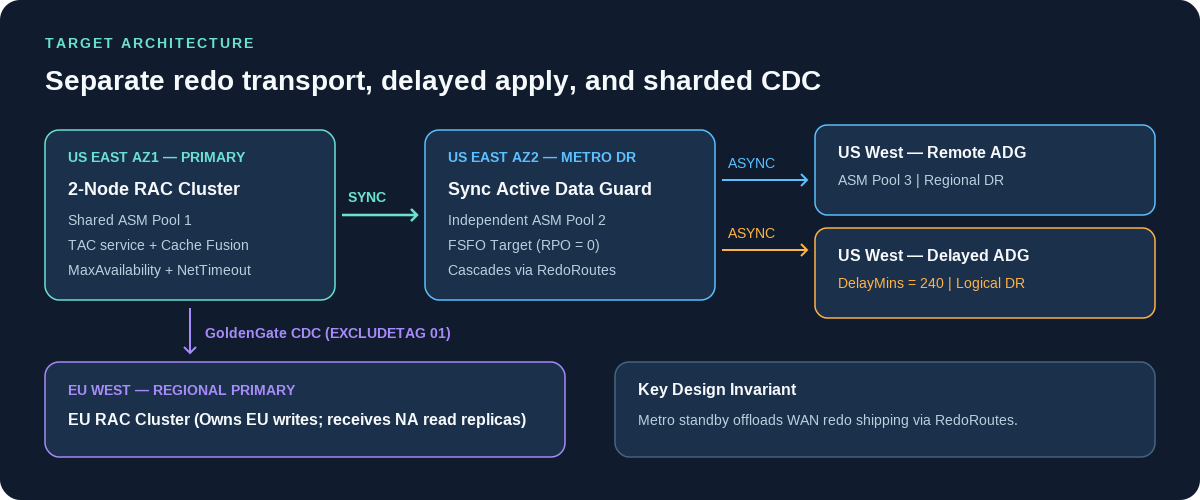
The production-grade pattern assigns one dedicated primitive to each failure domain: compute, metro storage, continental geography, logical corruption, and cross-region write routing.
Layered Component Design
- Compute Layer (Local RAC + TAC): Within the primary availability zone, a 2-node or 4-node RAC cluster shares local ASM storage over a redundant private interconnect. If one compute instance fails, Clusterware evicts it and surviving instances recover uncommitted locks from shared redo. Transparent Application Continuity (TAC) combined with Fast Application Notification (FAN) and Transaction Guard intercepts in-flight SQL calls and replays uncommitted sessions on a surviving node without surfacing disconnects to the application.
- Metro Storage Layer (Synchronous Active Data Guard): Within the same metropolitan region where RTT stays below 1 ms, the primary replicates to a local standby running in
MaxAvailabilityprotection mode (LogXptMode = 'SYNC'). Because the metro standby owns completely independent ASM storage, a SAN failure or AZ power loss triggers Fast-Start Failover (FSFO) with RPO = 0. - Continental Layer (Cascaded Async Data Guard): To protect the primary from shipping redo directly across three WAN targets, Data Guard
RedoRoutesoffloads continental shipping to the metro standby. The metro standby forwards redo asynchronously (ASYNC) to a remote-region disaster recovery standby, shielding primary commit latency from cross-country network jitter. - Logical Error Layer (Delayed Apply Standby): A second remote standby receives redo asynchronously in real time, so committed transactions are durable off-site, but its Managed Recovery Process enforces
DelayMins = 240. If an engineer drops a table or runs an unguardedUPDATE, operations halts MRP before the bad SCN is applied, flashes back or queries the delayed standby prior to the error, and extracts the clean rows. - Global Write Layer (Region-Sharded GoldenGate): When users operate across North America and Europe, applications partition write ownership by region: North American accounts write only to the US primary, and European accounts write only to the EU primary. GoldenGate replicates read-only reference tables and cross-region read replicas unidirectionally with transaction tagging, avoiding active-active write collisions.
Production Configuration Snippets
On the primary RAC cluster, create the application service with TAC enabled. Note that TAC (-failovertype AUTO) uses -failover_restore AUTO for automatic session state tracking, alongside -commit_outcome TRUE to record Transaction Guard outcomes:
srvctl add service -db PRODDB \
  -service srv_payments_oltp \
  -preferred PRODDB1,PRODDB2 \
  -failovertype AUTO \
  -failover_restore AUTO \
  -commit_outcome TRUE \
  -replay_init_time 600 \
  -retention 86400 \
  -notification TRUE \
  -drain_timeout 300 \
  -clbgoal SHORT \
  -rlbgoal THROUGHPUT

srvctl start service -db PRODDB -service srv_payments_oltp
In Data Guard Broker (dgmgrl), bind the metro synchronous target, cascade the remote and delayed standbys through RedoRoutes, and cap synchronous stall exposure with NetTimeout:
CONNECT sys/"<broker_credential>"@PROD_PRIMARY;

ADD DATABASE prod_metro AS CONNECT IDENTIFIER IS PROD_METRO;
EDIT DATABASE prod_metro SET PROPERTY LogXptMode = 'SYNC';
EDIT DATABASE prod_metro SET PROPERTY NetTimeout = 15;
EDIT DATABASE prod_metro SET PROPERTY RedoRoutes = '(LOCAL : (prod_remote ASYNC, prod_delayed ASYNC))';

ADD DATABASE prod_remote AS CONNECT IDENTIFIER IS PROD_REMOTE;
EDIT DATABASE prod_remote SET PROPERTY LogXptMode = 'ASYNC';

ADD DATABASE prod_delayed AS CONNECT IDENTIFIER IS PROD_DELAYED;
EDIT DATABASE prod_delayed SET PROPERTY LogXptMode = 'ASYNC';
EDIT DATABASE prod_delayed SET PROPERTY DelayMins = 240;

EDIT CONFIGURATION SET PROTECTION MODE AS MaxAvailability;
ENABLE CONFIGURATION;
SHOW CONFIGURATION;
For cross-region GoldenGate replication, tag Replicat writes and configure Extract to exclude that tag so replicated rows never bounce back in an echo loop:
-- GoldenGate Microservices Extract: EX_US_TXNS
EXTRACT ex_us_txns
USERIDALIAS ogg_admin DOMAIN OGG_SECURITY
EXTTRAIL /u02/goldengate/dirdat/et, MEGABYTES 500
TRANLOGOPTIONS EXCLUDETAG 01
TABLE payments.accounts, WHERE (region_code = 'NA');
TABLE payments.transactions, WHERE (origin_region = 'NA');

-- GoldenGate Replicat on EU Cluster: REP_EU_SYNC
REPLICAT rep_eu_sync
USERIDALIAS ogg_admin DOMAIN OGG_SECURITY
DBOPTIONS SUPPRESSTRIGGERS
DBOPTIONS SETTAG 01
MAP payments.accounts, TARGET payments.accounts_us_replica;
MAP payments.transactions, TARGET payments.transactions_us_replica;
How It Rolls Out
Deploying all four layers at once creates tangled failure diagnostics. Roll out each blast-radius tier behind an explicit validation gate and rollback boundary before admitting production writes.
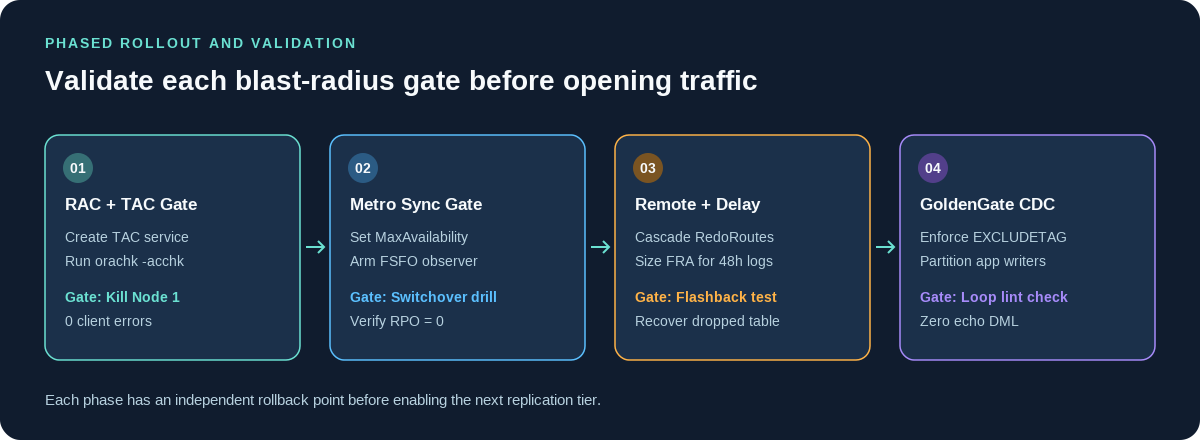
- Phase 1 — RAC Cluster and TAC Coverage Gate: Provision the 2-node primary RAC cluster and create the TAC database service. Run
orachk -acchk(part of Oracle Autonomous Health Framework) and the database’s built-in Application Continuity Protection Check (available in Oracle 19.10+) to flag non-replayable JDBC concrete types or mid-transaction DDL. Validation gate: Kill instance 1 under synthetic load and confirm zero application errors. Rollback: Revert connection strings to a standard non-TAC service while fixing unsupported client calls. - Phase 2 — Metro Synchronous ADG and FSFO Gate: Provision the AZ2 standby on independent ASM storage, enable
MaxAvailability, and start the FSFO observer on a third fault domain. Validation gate: Measurelog file syncp99 latency under peak write load, then execute a plannedSWITCHOVER TO prod_metroand an unplanned primary kill drill to verify RPO = 0. Rollback: Drop protection mode toMaxPerformance(ASYNC) if metro RTT exceeds the commit latency budget. - Phase 3 — Cascaded Remote and Delayed Standbys: Attach
prod_remoteandprod_delayed(DelayMins = 240) viaRedoRoutesfromprod_metro, sizing the delayed standby’s Fast Recovery Area (FRA) to hold at least 48 hours of peak redo. Validation gate: Simulate aDROP TABLEon a staging clone and verify row extraction from the delayed standby via Flashback. Rollback: Remove the delayed standby fromRedoRouteswithout impacting primary or metro availability. - Phase 4 — Partitioned GoldenGate CDC: Enable Extract and Replicat with
DBOPTIONS SETTAG 01andTRANLOGOPTIONS EXCLUDETAG 01after verifying region-sharded write routing in the application tier. Validation gate: Insert test rows in NA and verify zero echo captures in EU Extract trail statistics. Rollback: Stop Extract/Replicat; regional primaries continue operating independently while read replicas freeze.
In Practice
This layered design maps directly to Oracle Maximum Availability Architecture (MAA) Platinum reference behavior, where RAC provides local instance resilience, Active Data Guard provides zero-data-loss physical standby failover, and GoldenGate or sharding decouples multi-region active writes.
- Deterministic Conflict Handling vs. Write Partitioning: In Oracle GoldenGate 23ai, multi-master conflict handling relies on deterministic Automatic Conflict Detection and Resolution (ACDR) using hidden timestamp columns or explicit
COMPARECOLSandRESOLVECONFLICTrules—not autonomous guesswork. While GoldenGate 23ai adds vector replication for AI retrieval pipelines and CDC streaming into Oracle Machine Learning (OML) and ONNX scoring workflows, active-active SQL conflicts still require strict relational rules or application write partitioning to avoid silent ledger overwrites. - Native Raft Consensus in Oracle 23ai: For greenfield globally distributed schemas that can adopt horizontal sharding, Oracle Globally Distributed Database (GDD) in 23ai introduces native Raft consensus replication across Replication Units (groups of table partition chunks, typically replicated with a factor of 3). Raft automates leader election and majority-quorum commits inside the database engine, reducing external Data Guard and GoldenGate orchestration overhead for sharded workloads—though legacy monolithic schemas still require the composite RAC + ADG + GoldenGate topology.
Where It Breaks
Every added layer introduces its own operational failure mode. Monitor transport lag, FRA headroom, and replay eligibility continuously so a dormant safeguard does not fail silently during an incident.
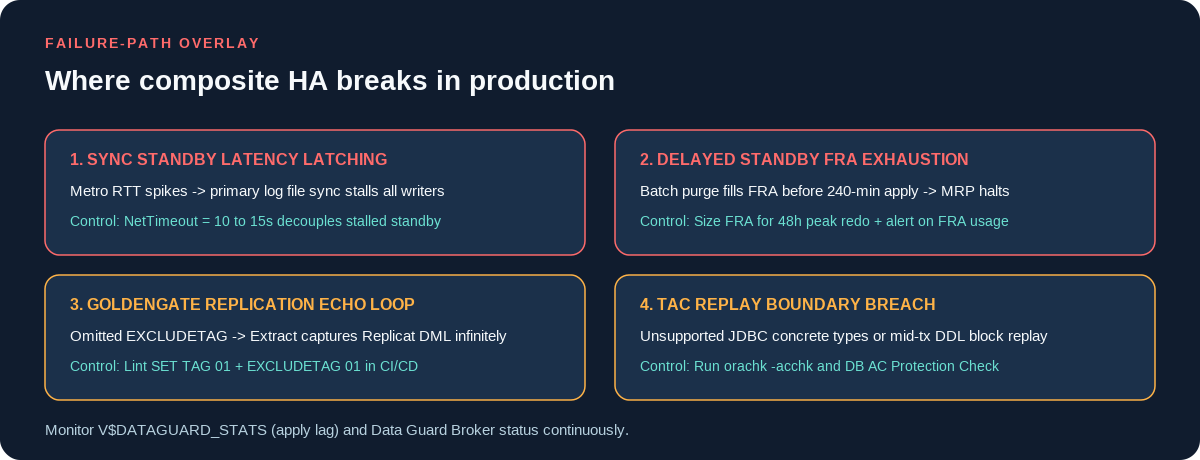
| Failure Condition | Breaks How | How to Detect | Mitigation |
|---|---|---|---|
| Metro WAN RTT spike | SYNC AFFIRM blocks primary log file sync commits across all RAC nodes until timeout. | Monitor log file sync p99 wait time and Data Guard transport lag. | Set NetTimeout = 10 to 15 seconds so LGWR decouples a stalled standby instead of hanging writes. |
| Delayed standby FRA exhaustion | Heavy batch loads or purges fill the FRA before the 240-minute apply window clears; MRP halts. | Alert on V$RECOVERY_FILE_DEST space used > 75% and V$DATAGUARD_STATS (NAME = 'apply lag'). | Size delayed standby FRA for 48+ hours of peak redo generation; enforce retention policies. |
| Missing GoldenGate tag exclusion | Replicat DML is recaptured by local Extract, creating an infinite bidirectional echo storm. | Sudden spike in Extract trail bytes and duplicate key errors in Replicat discard files. | Mandate DBOPTIONS SET TAG and TRANLOGOPTIONS EXCLUDETAG in CI/CD parameter linters. |
| RAC interconnect packet loss | CSS heartbeat misses trigger node eviction and brief cluster reconfiguration stalls. | Alert on CSS misscount warnings and gc cr block lost interconnect counters. | Use redundant bonded NICs on isolated, non-routed private interconnect switches. |
| Standby archive gap or MRP crash | Standby falls behind primary; FSFO observer blocks automatic failover to prevent data loss. | Query V$DATAGUARD_STATS WHERE name = 'apply lag' and SHOW CONFIGURATION in dgmgrl. | Alert when apply lag exceeds 60 seconds; automate missing archive fetch diagnostics. |
| Replication schema drift | ALTER TABLE executed on primary without updating GoldenGate definitions aborts Replicat (OGG-00551). | GoldenGate Microservices health endpoint reports ABENDED Replicat status. | Couple schema migrations with GoldenGate DDL replication or coordinated CI/CD rollout steps. |
| Non-replayable TAC session state | Mid-transaction DDL, autonomous transactions, or deprecated JDBC concrete classes disable replay. | Run orachk -acchk or query database AC Protection Check views. | Audit application SQL and JDBC drivers in staging before enabling TAC in production. |
Key Takeaways
- Match the primitive to the failure domain: RAC protects against compute host faults, synchronous Active Data Guard protects against storage and AZ loss, a delayed standby protects against human SQL errors, and partitioned GoldenGate protects against cross-continent write latency.
- Never stretch Cache Fusion across WAN links: Milliseconds of inter-site fiber latency multiply across every global cache wait and cannot fix shared ASM storage vulnerability.
- Bound synchronous stall risk with
NetTimeout:MaxAvailabilityprotects RPO = 0 under normal metro RTT, but without a tightNetTimeout, network jitter turns a standby problem into a primary write outage. - Offload WAN redo shipping via
RedoRoutes: Let the metro standby forward asynchronous redo to remote and delayed standbys so the primaryLGWRnever manages multiple cross-country TCP streams. - Partition writes before enabling GoldenGate: Tag-based loop exclusion (
SET TAG/EXCLUDETAG) prevents echo storms, and region-sharded write ownership eliminates active-active conflict queues.
What to Do Next
- Problem: Relying on a single HA technology leaves critical databases exposed to out-of-scope failures—such as shared-storage corruption in RAC or multi-hour restore times after a rogue
DROP TABLE. - Solution: Implement a tiered MAA topology: local RAC with TAC for node faults, metro synchronous Active Data Guard for zero-RPO AZ failover, cascaded async plus 240-minute delayed standbys for regional and logical recovery, and region-sharded GoldenGate (or 23ai GDD Raft for sharded schemas) for global writes.
- Proof: Validate each tier independently—confirm zero client errors during a staging RAC node kill with
orachk -acchkclean, verify RPO = 0 in a metrodgmgrlswitchover drill, and prove point-in-time table recovery from the delayed standby. - Action: Audit your primary production databases this week: check whether your disaster recovery standby shares storage with the primary, verify
NetTimeoutand FRA headroom on every Data Guard target, and confirm whether a delayed-apply standby exists to absorb destructive DDL.
Interactive tools for this topic