
Ephemeral Data Environments: Zero-Cost Database Cloning for CI/CD via Storage Snapshots
Testing database migrations against synthetic or truncated datasets hides table-rewrite locks and index bloat; validating schema changes safely requires running CI checks against Copy-on-Write storage clones of full-scale, masked production data.
TL;DR
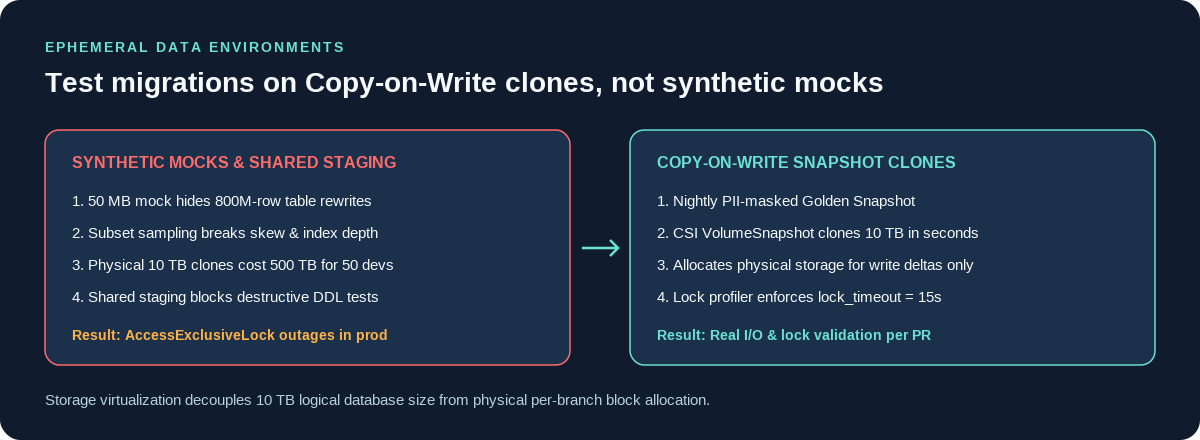
- Problem: A 50 MB synthetic test database passes DDL in milliseconds, while the same
ALTER TABLEwith a volatile default or type change rewrites a 10 TB production table underAccessExclusiveLock.- Answer: Build a nightly PII-masked Golden Snapshot and clone it per pull request via Kubernetes CSI
VolumeSnapshotCopy-on-Write storage, gated bylock_timeoutprofiling and strict TTL reapers.- Watch out: Standard EBS snapshots lazy-load blocks from S3 on first read, while EBS Fast Snapshot Restore (FSR) bills
$0.75/hourper snapshot per Availability Zone continuously.
Situation
Engineering teams validate application code on every pull request using ephemeral containers and automated integration suites. Database schema migrations, by contrast, are still commonly tested against one of three compromised environments:
- Synthetic or Mock Datasets: A local container seeded with a few thousand rows validates SQL syntax, but hides B-tree index depth, dead-tuple bloat, and query optimizer cardinality transitions.
- Static Shared Staging: Multiple teams share a single long-lived staging database. Because dropping tables or running destructive rollbacks disrupts neighboring squads, teams avoid testing failure paths, and staging data drifts weeks behind production.
- Truncated Subset Clones: An ETL job copies a 1% or 5% sample of production rows. Sampling breaks foreign-key distributions, misses Pareto-skewed tenant hotspots, and understates the runtime of full-table rewrites.
When an ALTER TABLE statement passes in 120 milliseconds against a 50 MB synthetic container, the pull request merges—pushing an untested lock and I/O bomb straight toward production.
The Problem
Running unverified migrations against a 10-terabyte production table exposes three hard operational and financial constraints:
- Physical Clone Storage Math: Giving 50 developers dedicated physical 10 TB copies via
pg_restore, MySQL physical backup, or Oracle RMAN duplicate requires provisioning 500 TB (512,000 GB) of block storage. At AWS EBSgp3base pricing ($0.08/GB-month), raw disk alone costs$40,960/monthbefore counting IOPS, compute, or the hours spent streaming terabytes over the network. By contrast, a Copy-on-Write clone consuming 20 GB of write deltas adds$1.60/monthin storage per active branch. - PostgreSQL
AccessExclusiveLockQueue Cascade: EveryALTER TABLEacquires anAccessExclusiveLock, blocking all concurrentSELECT,INSERT,UPDATE, andDELETEqueries on that table. Even a fast metadata-onlyALTER TABLEcreates an outage if it queues behind a single long-running reportingSELECT: onceALTER TABLEwaits in the lock queue, every subsequentSELECTandINSERTqueues behindALTER TABLE, exhausting application connection pools within seconds. Worse, while PostgreSQL 11+ executesADD COLUMNwith a constant non-volatile default as a fast metadata-only catalog update, adding a column with a volatile default (such asnow(),random(), orclock_timestamp()), changing a column data type, or rewriting a constraint forces PostgreSQL to rewrite every physical heap page and secondary index on disk while holdingAccessExclusiveLock. - EBS Lazy Loading vs. Fast Snapshot Restore (FSR) Economics: Standard AWS EBS snapshots restore a volume immediately at zero extra hourly fee, but stream blocks lazily from Amazon S3 on first read—distorting migration duration benchmarks. Enabling EBS Fast Snapshot Restore (FSR) pre-warms blocks for full IOPS immediately, but bills
$0.75 per DSU-hour(1 snapshot × 1 AZ × 1 hour, 1-hour minimum) continuously from enablement until disabled ($547.50/monthper AZ, or$1,642.50/monthacross three AZs).
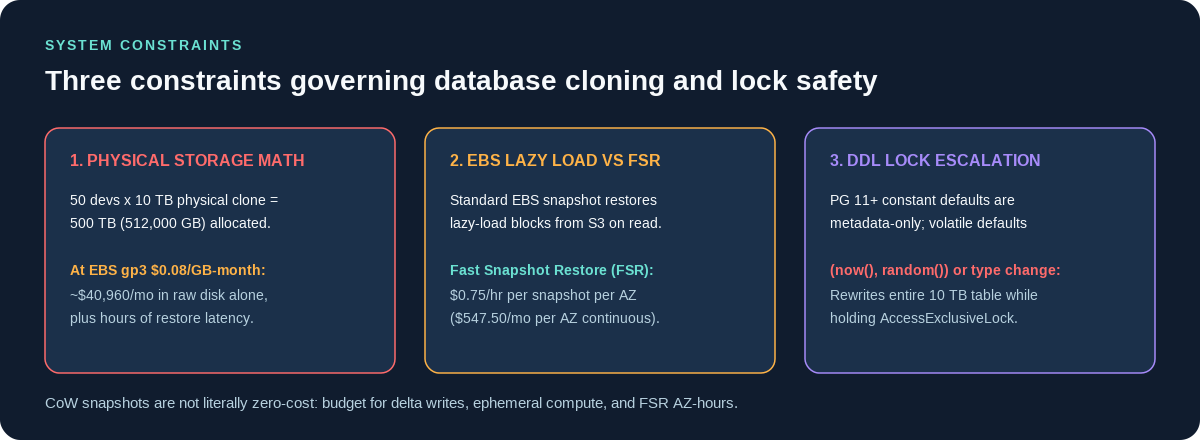
How can platform teams give every pull request an isolated, full-scale production-equivalent database in seconds without paying for 50x physical storage or exposing unmasked PII?
Options Considered
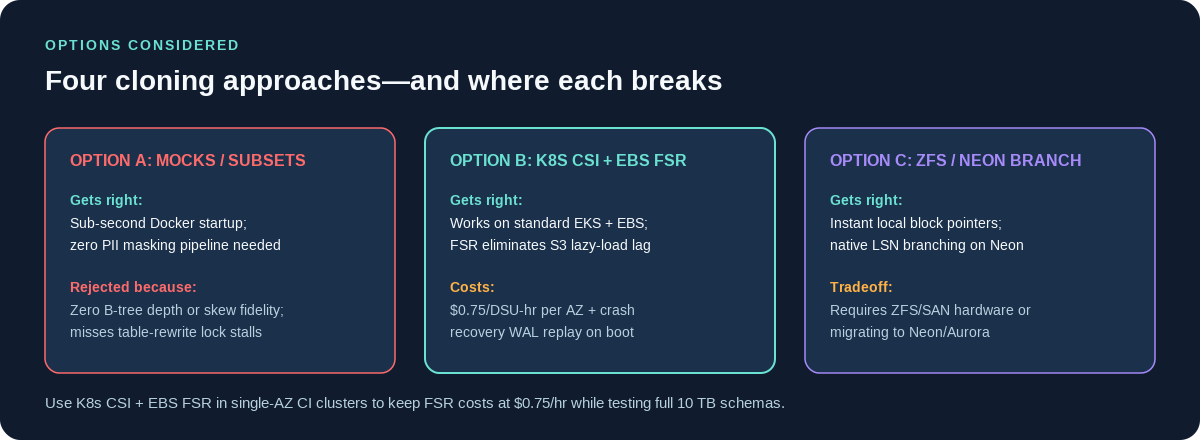
Teams building pre-merge database verification choose among four approaches, each trading off fidelity, I/O latency, and infrastructure cost.
| Approach | Provisioning Latency | Storage Footprint | Where It Breaks | Decision |
|---|---|---|---|---|
| Synthetic Mocks / Subsets | Seconds | Megabytes | Zero B-tree depth or skew fidelity; misses AccessExclusiveLock rewrites | Rejected for DDL gating |
Physical Restore (pg_restore / RMAN) | Hours | 1.0x per developer (500 TB for 50 devs) | Prohibitive storage bill and restore time | Rejected for per-PR CI |
| K8s CSI + EBS Snapshot (with single-AZ FSR) | Seconds | Delta blocks only | $0.75/hr per AZ for FSR; requires WAL crash recovery on boot | Selected for AWS EKS fleets |
| ZFS/SAN CoW or Neon/Aurora Branching | Sub-second to seconds | Delta blocks only | Requires ZFS/SAN hardware or serverless branching engine | Selected where storage/engine supports it |
Synthetic mocks are rejected as the sole migration gate because they cannot reproduce lock queues or multi-hour table rewrites. Physical restores are rejected because 50x storage multiplication and multi-hour restore windows break CI feedback loops. Copy-on-Write (CoW) cloning via Kubernetes CSI VolumeSnapshot—pinned to a single Availability Zone when using EBS FSR—delivers full 10 TB physical fidelity while allocating block storage only for modified pages.
The Ephemeral Storage Clone Architecture
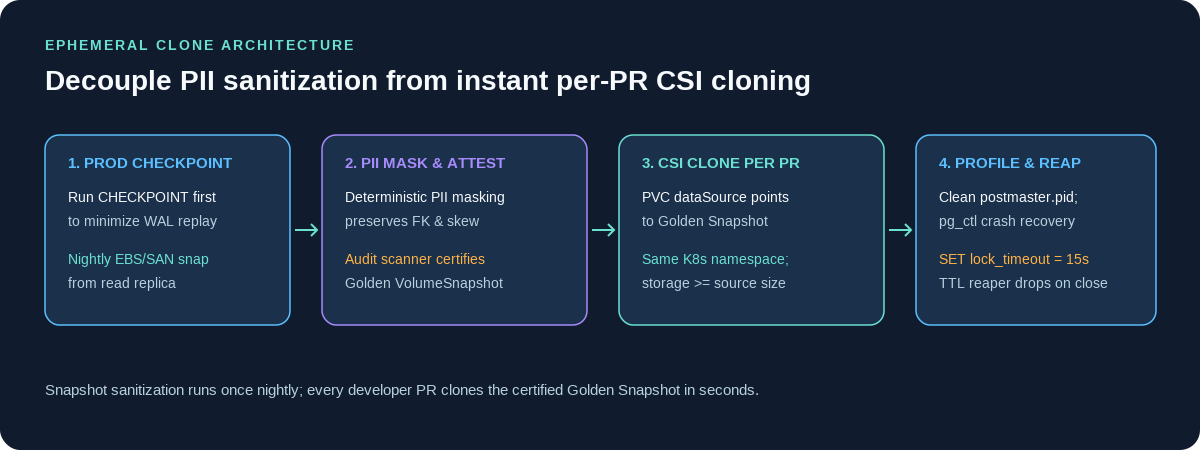
The ephemeral data platform separates nightly PII sanitization from instant per-PR Copy-on-Write cloning.
1. Nightly Sanitization and Golden Snapshot Pipeline
Production data cannot be mounted directly into developer CI namespaces under GDPR, HIPAA, or PCI-DSS. Each night, a scheduled job issues CHECKPOINT on a production read replica to flush dirty buffers and minimize WAL replay time, takes a block snapshot, and attaches it to an isolated sanitization worker. The worker runs deterministic PII masking—using keyed HMAC-SHA256 hashes or format-preserving tokenization for joinable keys like email and account_id so foreign-key integrity, cardinality, NULL ratios, and row-count skew stay intact—and then runs ANALYZE so pg_statistic histograms match production query plans. Finally, an automated PII-scanner attestation gate inspects sampled columns before publishing an immutable read-only Golden VolumeSnapshot protected by DoNotDelete IAM Service Control Policies.
2. Kubernetes CSI Copy-on-Write Cloning
When a developer opens a pull request, an Ephemeral Data Operator creates a PersistentVolumeClaim referencing the Golden VolumeSnapshot via the stable snapshot.storage.k8s.io/v1 API. Under Kubernetes CSI rules, both the VolumeSnapshot and the cloned PersistentVolumeClaim must reside in the same namespace, and the requested resources.requests.storage must be equal to or greater than the source snapshot size. Because EBS ReadWriteOnce volumes can only attach to one EC2 node at a time, the operator also sets short CSI volume-attachment timeouts so a rescheduled pod is not stuck in Multi-Attach if an underlying spot node terminates abruptly:
apiVersion: v1
kind: PersistentVolumeClaim
metadata:
  name: data-clone-pr-1402
  namespace: database-ephemeral-ci
spec:
  accessModes: ["ReadWriteOnce"]
  storageClassName: ebs-gp3-sc
  resources:
    requests:
      storage: 10Ti
  dataSource:
    apiGroup: snapshot.storage.k8s.io
    kind: VolumeSnapshot
    name: snap-golden-masked-prod
At creation time, the clone shares read pointers with the Golden Snapshot and consumes zero private data blocks until the migration writes deltas. Under the hood, local NVMe arrays (such as ZFS or Pure Storage FlashArray) resolve those pointers directly on local flash at wire speed, whereas cloud block snapshots (such as AWS EBS) store base blocks in S3 and fetch them lazily on first read unless Fast Snapshot Restore (FSR) pre-warms the volume.
To prevent runaway delta allocation when a developer tests an unindexed full-table UPDATE, the operator pairs the PersistentVolumeClaim with a Kubernetes ResourceQuota in database-ephemeral-ci and monitors kubelet_volume_stats_used_bytes. If delta writes exceed a configured ceiling—such as 150 GB on a 10 TB virtual volume—the CI job aborts before generating an unexpected storage bill.
3. Crash-Consistent Startup and Lock Profiling
Because a live block snapshot captures the database in a crash-consistent state, the container entrypoint removes stale postmaster.pid and socket files and lets PostgreSQL replay uncommitted WAL records before opening connections:
#!/bin/bash
set -euo pipefail
DATA_DIR="/var/lib/postgresql/data"
rm -f "${DATA_DIR}/postmaster.pid" "${DATA_DIR}/.s.PGSQL.*"
/usr/lib/postgresql/15/bin/pg_ctl -D "${DATA_DIR}" -w start
psql -U postgres -d enterprise_db -c "CREATE EXTENSION IF NOT EXISTS pg_stat_statements; SELECT pg_stat_statements_reset();"
Once PostgreSQL accepts connections, the CI runner executes the migration inside a transaction with SET LOCAL lock_timeout = '15s'; and fails the build if the migration either exceeds the lock timeout or runs longer than a table-rewrite threshold. To catch lock-order deadlocks that never appear in single-session tests, the runner optionally spawns a lightweight background read/write load generator against the cloned database while the DDL executes:
import psycopg2, sys, time

def profile_migration(uri: str, sql_path: str) -> None:
    conn = psycopg2.connect(uri)
    conn.autocommit = True
    cur = conn.cursor()
    with open(sql_path) as f:
        sql = f.read()
    t0 = time.time()
    try:
        cur.execute("BEGIN;")
        cur.execute("SET LOCAL lock_timeout = '15s';")
        cur.execute(sql)
        cur.execute("COMMIT;")
        if time.time() - t0 > 180.0:
            sys.exit(1)  # Suspected table rewrite on 10 TB dataset
    except psycopg2.errors.LockNotAvailable:
        sys.exit(2)
    finally:
        conn.close()
When profile_migration.py rejects a blocking DDL statement, developers refactor the change into a four-step non-blocking sequence: add the column as nullable without a default (metadata-only), backfill rows in bounded batches, set the DEFAULT for future writes, and add CHECK or NOT NULL constraints using NOT VALID followed by VALIDATE CONSTRAINT (which holds a weaker ShareUpdateExclusiveLock instead of AccessExclusiveLock).
4. Aggressive TTL Reaper and Serverless Branching
Every ephemeral pod and PVC carries a strict Time-to-Live (2 to 4 hours) and a PR-close webhook trigger. An automated reaper deletes expired pods and PVCs so weekend compute and delta-block charges never accumulate. In addition to DDL lock profiling, CI runners query pg_stat_statements and EXPLAIN (ANALYZE, BUFFERS) against the cloned dataset to catch query plan regressions—such as a dropped or altered index flipping an index scan into a multi-terabyte sequential scan—before the pull request merges. For teams already running serverless engines such as Neon or Aurora Serverless v2, native LSN-based branching provides the same CoW isolation without managing CSI snapshot classes directly.
How It Rolls Out
Deploying ephemeral snapshot cloning safely requires validating boot time and PII sanitization before gating developer merges.
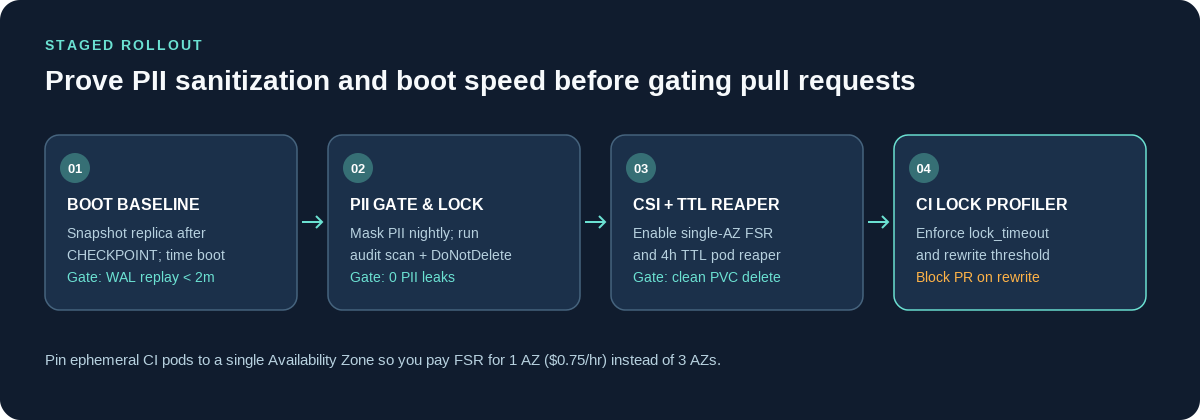
- Phase 1 — Snapshot Boot Baseline: Take a manual snapshot of a staging replica immediately after
CHECKPOINT, clone it to a single-AZ volume, and measurepg_ctl startWAL recovery time. - Phase 2 — Automated PII Masking and Attestation: Build the nightly sanitization worker, attach an automated PII-detection scan as a mandatory publish gate, and lock the Golden Snapshot with
DoNotDeletepolicies. - Phase 3 — Single-AZ CSI + FSR and TTL Reaper: Pin ephemeral CI pods to one Availability Zone so EBS Fast Snapshot Restore costs
$0.75/hour(1 AZ) instead of$2.25/hour(3 AZs), and verify the 4-hour TTL reaper cleanly deletes PVCs. - Phase 4 — CI Lock Profiler Gate: Wire
profile_migration.pyinto pull requests to flag volatile-default table rewrites andlock_timeoutviolations before merge.
In Practice
Documented storage and database engine behaviors explain why CoW snapshot platforms succeed—and where operators must guard their budgets:
- AWS EBS Lazy Loading vs. FSR Billing: AWS documentation confirms that volumes restored from standard EBS snapshots lazy-load blocks from S3 on first read, introducing unpredictable I/O latency during schema benchmarks. Enabling EBS Fast Snapshot Restore removes that penalty at
$0.75 per DSU-hourper AZ—meaning pinning CI runners to a single AZ cuts FSR spend by two-thirds compared to multi-AZ enablement. - Kubernetes CSI
VolumeSnapshotConstraints: Undersnapshot.storage.k8s.io/v1, a cloned PVC must reside in the same namespace as theVolumeSnapshotand request at least as much storage as the source snapshot. Teams organizing CI per-PR namespaces must either run all ephemeral DBs in a shareddatabase-ephemeral-cinamespace with network policies or replicate snapshot metadata per namespace. - PostgreSQL 11+ Metadata-Only vs. Table-Rewrite DDL: PostgreSQL’s
ALTER TABLEdocumentation establishes that constant defaults are metadata-only since PostgreSQL 11, whereas volatile defaults (now(),random()) and column type changes rewrite the entire table underAccessExclusiveLock. Testing against a real 10 TB CoW clone catches the difference immediately before production deployment. - CSI Block Clones vs. Serverless Page-Store Branching: When teams run self-managed PostgreSQL on Kubernetes or EC2, CSI
VolumeSnapshotclones are the standard CoW primitive. Teams already running serverless storage engines such as Neon or Aurora Serverless v2 can instead branch directly at a specific LSN via API without managingVolumeSnapshotCRDs, EBS FSR hours, orpg_ctlcrash recovery on container boot. - Pattern Acknowledgment: I have not personally operated a 50-developer EBS FSR fleet across 10 TB databases, but the documented storage-virtualization pattern across Kubernetes CSI, AWS EBS, and PostgreSQL internals is consistent: separate nightly PII masking from per-PR CoW clones, pin FSR to one AZ, and enforce hard TTLs.
Where It Breaks
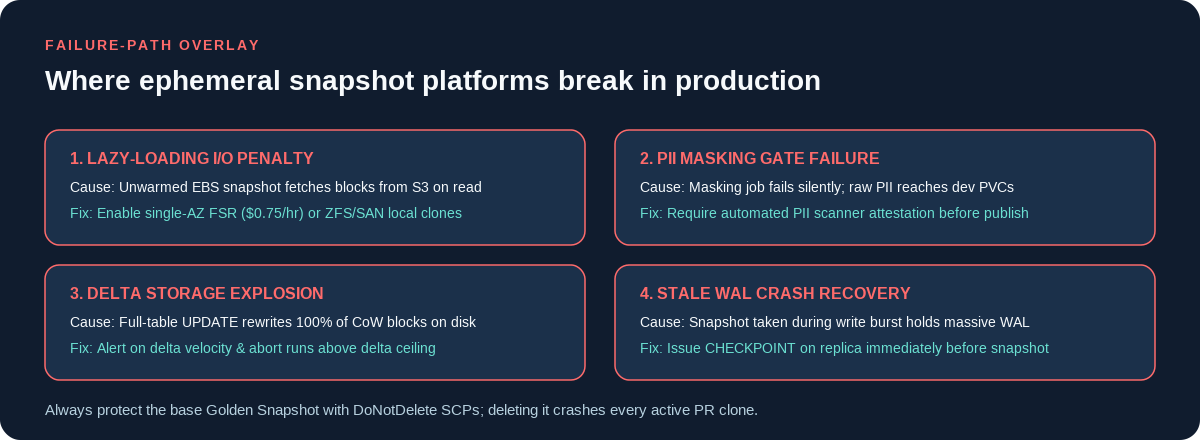
Storage virtualization eliminates 50x physical copies, but introduces distinct operational failure modes.
| Failure Mode | Breaks How | Detect | Mitigate |
|---|---|---|---|
| EBS lazy-loading I/O stall | Standard EBS snapshot streams blocks from S3 on first read, skewing CI timings | High iowait and read latency spikes on initial table scan | Enable single-AZ EBS FSR ($0.75/hr) or use ZFS/SAN local CoW clones |
| PII masking gate failure | Masking script fails silently; unmasked customer data lands in dev PVCs | Automated PII regex/entropy scanner flags unmasked columns | Block Golden Snapshot promotion unless scanner exits clean |
| Delta storage explosion | Unindexed full-table UPDATE rewrites 100% of CoW blocks on disk | Rapid PVC delta growth alerts during CI run | Abort ephemeral job and fail PR if delta write bytes exceed threshold |
| Weekend compute sprawl | Developers leave ephemeral pods running after PRs stall or close | Orphaned pods older than 4 hours in database-ephemeral-ci | Enforce 2–4h TTL reaper cron and PR-close webhook teardown |
| Stale WAL crash recovery | Snapshot captured during write burst holds gigabytes of unflushed WAL | pg_ctl start exceeds CI startup timeout replaying WAL | Run CHECKPOINT on replica immediately before taking snapshot |
| CSI volume latch on node loss | Node crashes leaving RWO EBS volume attached to dead instance | Rescheduled pod stuck in ContainerCreating (Multi-Attach) | Configure CSI volume attachment timeouts and force-detach recovery |
| Base Golden Snapshot deletion | Operator deletes Golden Snapshot while PR clones are mounted | Active clones fail immediately with physical read I/O errors | Protect Golden Snapshots with DoNotDelete tags and AWS IAM SCPs |
Key Takeaways
- Synthetic mocks cannot catch
AccessExclusiveLockrewrites: Only a full-scale clone exposes multi-hour table rewrites triggered by volatile defaults or column type changes. - CoW snapshots eliminate 50x storage duplication, not all cost: Budget for write deltas, ephemeral pod compute, and single-AZ EBS Fast Snapshot Restore (
$0.75/DSU-hour). - Pin CI clones to one Availability Zone and one namespace: Single-AZ placement cuts FSR costs by 3x, and same-namespace placement satisfies Kubernetes
VolumeSnapshotdataSourcerules. - Gate Golden Snapshots on
CHECKPOINTand PII attestation: Flushing dirty pages keeps pod startup fast, while an automated PII scanner prevents unmasked production data from reaching dev clusters.
What to Do Next
- Problem: Schema migrations that pass in milliseconds against 50 MB synthetic test databases trigger
AccessExclusiveLockoutages and full table rewrites on multi-terabyte production tables. - Solution: Build a nightly PII-masked Golden Snapshot pipeline and provision isolated per-PR Copy-on-Write clones via Kubernetes CSI
VolumeSnapshotwithlock_timeoutprofiling and strict TTL reapers. - Proof: Run a baseline test by issuing
CHECKPOINTon a staging replica, taking an EBS snapshot, restoring a volume in a single AZ, and measuringpg_ctl startWAL recovery time. - Action: Wire
profile_migration.pywithSET LOCAL lock_timeout = '15s'into one high-churn repository this week, and pin your firstVolumeSnapshotclone in a single-AZ namespace to measure real DDL runtime before production rollout.
Interactive tools for this topic