
Multi-Tenant AWS RDS Provisioning: Designing Cell-Based Isolation Architectures
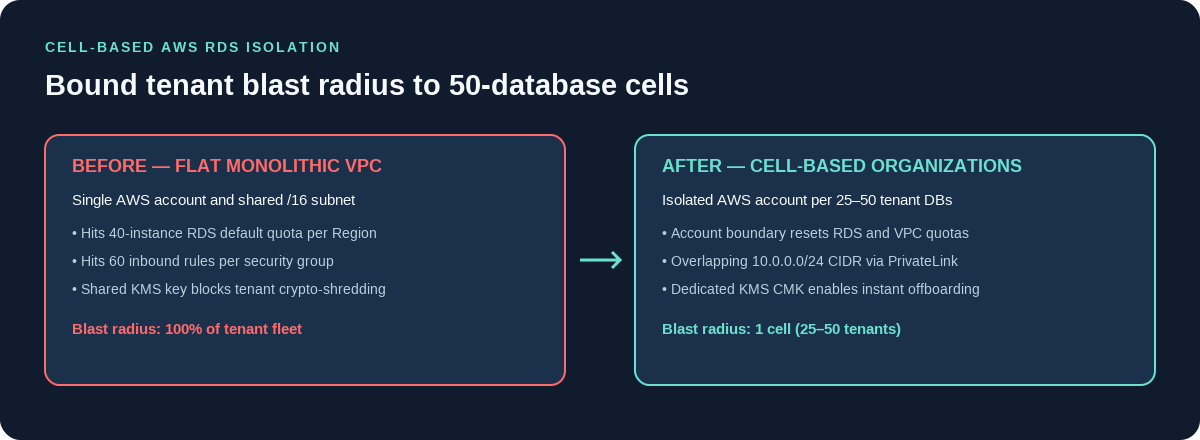
Attempting to host hundreds or thousands of enterprise tenant databases inside a single flat AWS VPC guarantees service quota exhaustion, lateral network exposure, and an account-wide blast radius during operational incidents.
TL;DR
- Problem: A single AWS account and VPC hits hard quotas (40 default RDS instances per Region, 60 inbound rules per security group, 500 default routes per route table) and blocks per-tenant cryptographic offboarding when keys are shared.
- Answer: Partition the fleet into bounded cells of 25 to 50 RDS Oracle instances per AWS Organizations account, exposed to the application tier over AWS PrivateLink with overlapping
10.0.0.0/24CIDRs and one KMS Customer Managed Key per tenant.- Watch out: Amazon RDS Proxy does not support Oracle, and Network Load Balancer IP targets go stale on Multi-AZ failover unless an RDS Event-driven Lambda refreshes the target group; AWS Organizations also does not provide a delegated administrator for RDS lifecycle operations.
Situation
Enterprise SaaS providers in regulated sectors—core banking, healthcare revenue cycle management, and defense logistics—frequently operate under customer data sovereignty clauses. Frameworks such as SOC 2 Type II, PCI-DSS, HIPAA, and FedRAMP often prohibit logical multi-tenancy where tenants share tables separated only by a tenant_id column. Contracts instead mandate hard isolation: each enterprise customer receives a dedicated database instance with independent storage encryption.
To deliver dedicated Oracle databases on AWS without managing operating systems, storage volumes, or binary patching directly, platform teams adopt Amazon RDS for Oracle. In early deployments, the provisioning pipeline follows a centralized pattern: one primary production VPC in a single AWS account, Multi-AZ private subnets behind a Transit Gateway, and a Terraform or OpenTofu module that creates an aws_db_instance per tenant inside that shared database subnet.
That pattern works for the first few dozen customers. Once tenant count grows past a single account’s default service quotas and subnet isolation boundaries, onboarding stalls and every network or IAM change carries fleet-wide risk.
The Problem
A flat, centralized RDS deployment breaks along four documented AWS service limits and isolation constraints:
- RDS Regional Instance Quota (40 Default): AWS enforces a default aggregate quota of 40 DB instances per account per Region across Amazon RDS, Aurora, Neptune, and DocumentDB (with additional engine-specific or license-included sub-limits). Reaching 1,000 or 5,000 tenant databases in one account requires repeated quota escalations and concentrates the entire customer base under a single IAM and API rate-limit domain.
- Security Group Rule Cap (60 Inbound Rules): By default, a VPC security group allows 60 inbound IPv4 rules and 60 outbound IPv4 rules, and the product of security groups per network interface multiplied by rules per security group cannot exceed 1,000. When hundreds of tenant RDS instances share a
/16database subnet, an application container compromised via remote code execution can scan Oracle listener ports (1521or2484) across neighboring tenants unless granular per-tenant rules exist—which the 60-rule cap prevents at scale. - Route Table Scaling Ceiling (500 Default / 1,000 Max): Isolating each tenant into its own VPC and interconnecting those VPCs through a central Transit Gateway or peering mesh collides with both RFC 1918 IPv4 address exhaustion and VPC route table quotas. Each VPC route table defaults to 500 non-propagated routes and is adjustable only up to 1,000 routes, where AWS notes that network performance may degrade.
- KMS Key Co-Mingling on Offboarding: Encrypting multiple tenant databases under one shared AWS KMS key prevents clean cryptographic erasure. When a customer terminates their contract and requires verified data destruction, deleting a shared KMS key renders active tenants’ databases and EBS snapshots permanently unreadable.
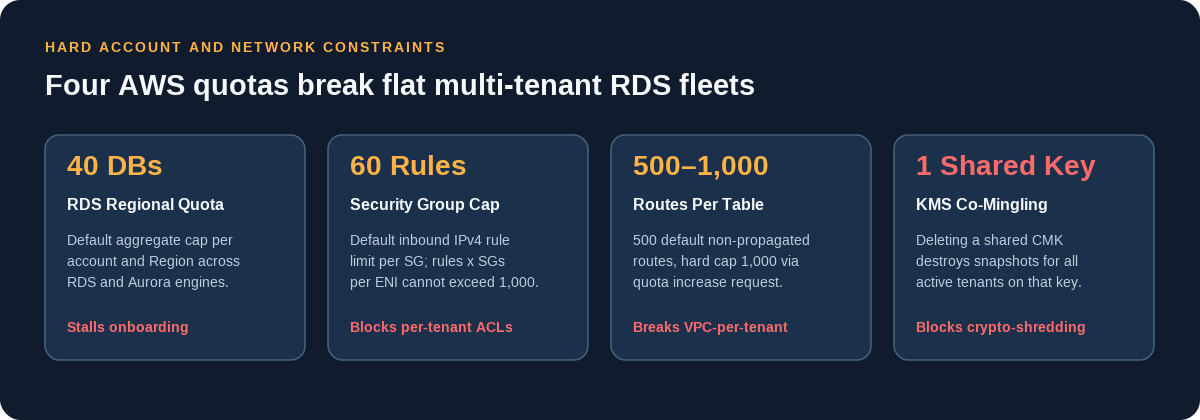
Consider the arithmetic of a 2,500-tenant fleet. At 50 RDS instances per cell, the platform runs 50 isolated cell accounts; an account-level misconfiguration or Regional RDS quota ceiling inside one cell affects at most 2% of the fleet (50 tenants) rather than 100%.
How do platform teams automate provisioning for thousands of isolated RDS Oracle instances with non-overlapping application connectivity, bounded blast radius, and clean per-tenant cryptographic erasure without hitting AWS account and VPC quotas?
Options Considered
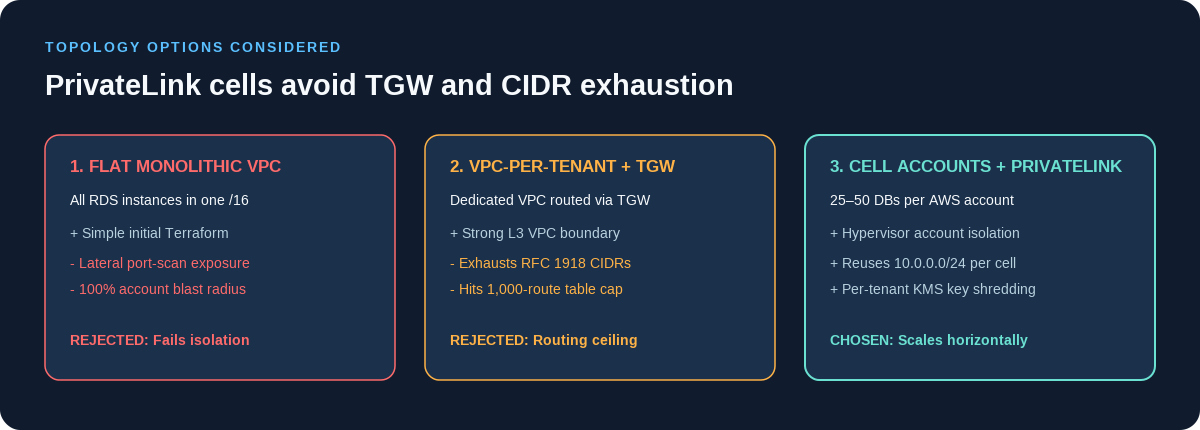
Platform teams evaluating multi-tenant RDS isolation typically compare three network and account topologies before committing to Terraform modules.
| Topology | Isolation Boundary | Routing Mechanism | Where It Breaks | Decision |
|---|---|---|---|---|
| Flat Monolithic VPC | Shared subnet + security groups | Direct VPC routing | Hits 40-instance default RDS quota, 60-rule SG cap, and 100% account blast radius | Rejected |
| VPC-Per-Tenant + TGW | Dedicated VPC per DB | AWS Transit Gateway | Exhausts RFC 1918 CIDRs and hits 500–1,000 routes per route table | Rejected |
| Cell Accounts + PrivateLink | Dedicated AWS account per 25–50 DBs | AWS PrivateLink + Internal NLB | Requires cross-account orchestration and NLB target IP sync on failover | Chosen |
The Flat Monolithic VPC minimizes initial Terraform boilerplate, because every tenant shares one aws_db_subnet_group and one Transit Gateway attachment. It fails as soon as compliance audits require lateral movement prevention between tenants or when a single account’s RDS API and instance quotas become a deployment bottleneck.
The VPC-Per-Tenant + Transit Gateway design establishes a clean Layer 3 network boundary per customer, but it transfers the scaling bottleneck to IPv4 address planning and route propagation. Even with /26 subnets, thousands of routed VPCs consume large blocks of 10.0.0.0/8 space and force central hub route tables toward the 1,000-route ceiling.
Cell-Based AWS Organizations Accounts with PrivateLink resolves both limits. The AWS account acts as a hard IAM, billing, and quota boundary, while PrivateLink decouples routing so every cell VPC reuses the exact same 10.0.0.0/24 CIDR block.
The Cell-Based AWS Organizations Architecture
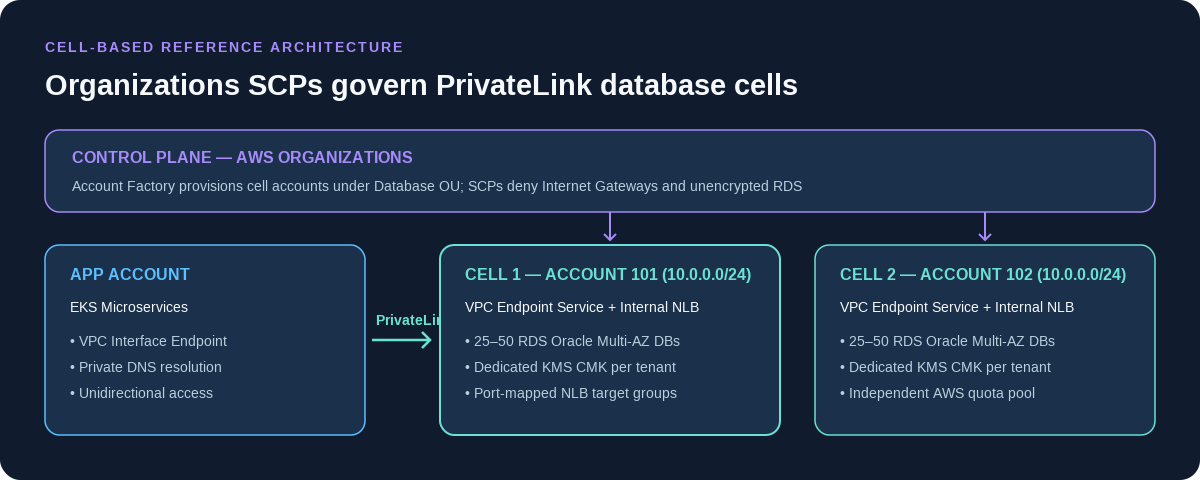
The target architecture partitions the database fleet into standardized administrative units called Cells. Each cell is an independent AWS account provisioned under a dedicated Organizational Unit (OU) in AWS Organizations and sized to hold 25 to 50 RDS Oracle instances—staying comfortably near or slightly above the 40-instance default quota (with a single predictable quota bump to 60 if needed) while keeping the per-cell blast radius small.
Control Plane: AWS Organizations and Guardrail SCPs
The management plane creates each cell account via aws_organizations_account and places it under a Database OU governed by Service Control Policies (SCPs). SCPs enforce baseline invariants that individual cell Terraform runs cannot override: denying ec2:CreateInternetGateway and ec2:AttachInternetGateway so no database subnet can ever be routed to the public internet, and denying rds:CreateDBInstance when rds:StorageEncrypted is false.
# cell_account_factory.tf
resource "aws_organizations_account" "database_cell" {
  name                       = "prod-db-cell-${var.cell_id}"
  email                      = "aws-db-cell-${var.cell_id}@enterprise.com"
  parent_id                  = aws_organizations_organizational_unit.database_ou.id
  iam_user_access_to_billing = "DENY"
  close_on_deletion          = false
}

resource "aws_organizations_policy" "cell_guardrail" {
  name        = "DB-Cell-Strict-Guardrail"
  description = "Deny internet gateways and unencrypted RDS instances"
  content = jsonencode({
    Version = "2012-10-17"
    Statement = [
      {
        Sid      = "DenyInternetGateways"
        Effect   = "Deny"
        Action   = ["ec2:CreateInternetGateway", "ec2:AttachInternetGateway"]
        Resource = "*"
      },
      {
        Sid      = "EnforceEncryptedStorage"
        Effect   = "Deny"
        Action   = "rds:CreateDBInstance"
        Resource = "*"
        Condition = {
          Bool = { "rds:StorageEncrypted" = "false" }
        }
      }
    ]
  })
}
Network Plane: Overlapping CIDRs over PrivateLink
Inside each cell account, Terraform provisions a standardized 10.0.0.0/24 VPC split across Availability Zones (10.0.0.0/26 and 10.0.0.64/26). An internal Network Load Balancer (NLB) sits in front of the cell’s RDS instances and attaches to an aws_vpc_endpoint_service restricted to the application account’s ARN via allowed_principals.
Because AWS PrivateLink proxies TCP connections at the Hyperplane layer between the application VPC’s Interface Endpoint and the cell’s NLB, the application VPC and the cell VPC never exchange IP routes. Every cell reuses 10.0.0.0/24, eliminating IPv4 CIDR exhaustion across thousands of databases.
# cell_network_privatelink.tf
resource "aws_vpc" "cell_vpc" {
  cidr_block           = "10.0.0.0/24"
  enable_dns_hostnames = true
  enable_dns_support   = true
}

resource "aws_lb" "cell_nlb" {
  name               = "nlb-cell-${var.cell_id}"
  internal           = true
  load_balancer_type = "network"
  subnets            = [aws_subnet.db_subnet_a.id, aws_subnet.db_subnet_b.id]
}

resource "aws_vpc_endpoint_service" "cell_endpoint_service" {
  acceptance_required        = false
  network_load_balancer_arns = [aws_lb.cell_nlb.arn]
  allowed_principals         = [var.application_account_arn]
}
To avoid exhausting Elastic Network Interfaces (ENIs) and subnet IPs in the application VPC, do not create one PrivateLink endpoint service per tenant database. Instead, multiplex all 25 to 50 tenant databases inside a cell through the cell’s shared NLB using distinct listener ports mapped to each tenant’s IP target group.
Data Plane: Per-Tenant KMS CMKs and Multi-AZ RDS Oracle
Each tenant database is provisioned with its own dedicated aws_kms_key (deletion_window_in_days between 7 and 30 days) and a Multi-AZ aws_db_instance running Oracle 19c (engine = "oracle-ee", engine_version = "19.0.0.0.ru-2024-04.rur-2024-04.r1"). When a customer offboards, revoking grants and scheduling deletion of that tenant’s CMK cryptographically shreds the active volume and all associated automated EBS snapshots without touching any other tenant in the cell.
# tenant_database_instance.tf
resource "aws_kms_key" "tenant_cmek" {
  description             = "Dedicated encryption key for Tenant ${var.tenant_id}"
  deletion_window_in_days = 7
  enable_key_rotation     = true
}

resource "aws_db_instance" "tenant_oracle_db" {
  identifier                 = "tenant-${var.tenant_id}-oracle"
  engine                     = "oracle-ee"
  engine_version             = "19.0.0.0.ru-2024-04.rur-2024-04.r1"
  instance_class             = "db.r6i.xlarge"
  allocated_storage          = 200
  max_allocated_storage      = 1000
  storage_type               = "gp3"
  multi_az                   = true
  publicly_accessible        = false
  db_subnet_group_name       = aws_db_subnet_group.cell_db_subnets.name
  kms_key_id                 = aws_kms_key.tenant_cmek.arn
  storage_encrypted          = true
  auto_minor_version_upgrade = false
  backup_retention_period    = 35
  deletion_protection        = true
  skip_final_snapshot        = false
  final_snapshot_identifier  = "final-snap-tenant-${var.tenant_id}"
}
How It Rolls Out
Cell provisioning and tenant onboarding execute in four ordered stages, each with a clear validation gate and rollback point.
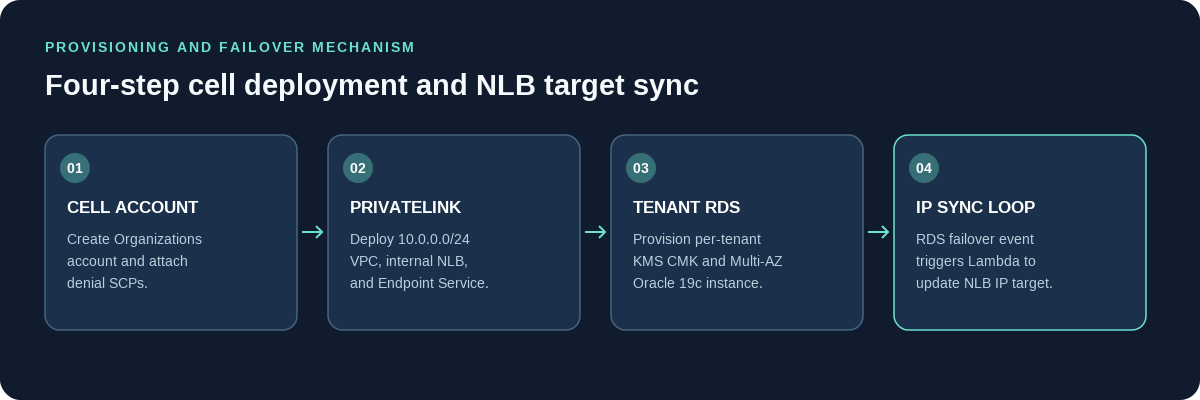
- Cell Account Creation and SCP Attachment: The Account Factory pipeline creates the AWS Organizations account in the Database OU and verifies that the guardrail SCPs are active. Validation gate: attempt a dry-run unencrypted
CreateDBInstanceorCreateInternetGatewaycall and confirm IAM denies it. Rollback: move the empty account to a quarantine OU before any tenant data exists. - Cell Network and PrivateLink Bootstrap: Terraform deploys the
10.0.0.0/24VPC, Multi-AZ subnets, internal NLB, andaws_vpc_endpoint_service, and creates the matching Interface Endpoint in the application account. Validation gate: verify endpoint state transitions toavailableand DNS resolves from the application EKS cluster. Rollback: destroy the network module in the empty cell. - Tenant KMS and RDS Oracle Provisioning: For each tenant assigned to the cell, the pipeline creates
aws_kms_key.tenant_cmek, provisions the Multi-AZ RDS Oracle instance, resolves the primary instance’s private IP, and registers it in the NLB target group on the tenant’s assigned listener port. Validation gate: NLB target health check passes on the Oracle listener port (1521internal target) and an encrypted SQL*Net handshake succeeds from the application tier. Rollback: before customer data loads, destroy the tenant stack and cancel key deletion if needed. - Failover IP Synchronization Loop: Because Amazon RDS Proxy does not support Oracle, an NLB pointing to static RDS IP targets will drop connections after a Multi-AZ failover when RDS promotes the standby and updates its internal DNS to a new IP. To prevent this, deploy an Amazon RDS Event Subscription listening for failover events (such as
RDS-EVENT-0005/ primary switchover notifications) routed through SNS to an AWS Lambda function. The Lambda resolves the RDS endpoint DNS name, deregisters the stale IP from the NLB target group, and registers the new primary IP. Validation gate: execute a manual Multi-AZ reboot with failover in staging and confirm the NLB target updates automatically.
Note on fleet management: AWS Organizations does not provide a native delegated administrator role for Amazon RDS lifecycle operations (unlike GuardDuty, AWS Config, or CloudFormation StackSets). Cross-account RDS patching, parameter group enforcement, and snapshot audits must be driven by a central CI/CD runner or CloudFormation StackSets assuming scoped IAM execution roles in each cell account, rather than relying on a non-existent RDS delegated admin feature.
In Practice
Several parts of this design come directly from documented AWS service behavior and published guidance:
- AWS Well-Architected Reliability Pillar (Cell-Based Architectures): AWS documents partitioning workloads into independent cells with a fixed maximum capacity so that failures, bad deployments, and noisy neighbors remain bounded to a single cell rather than cascading across the entire fleet.
- AWS PrivateLink + RDS IP Target Synchronization: AWS Architecture guidance explicitly documents that NLB IP target groups in front of RDS do not track DNS IP changes during Multi-AZ failovers, requiring either RDS Proxy (unavailable for Oracle) or an RDS Event + SNS + Lambda synchronization loop.
- KMS Key Deletion Behavior: AWS KMS documentation specifies a mandatory 7-to-30-day waiting period (
deletion_window_in_days) before a scheduled CMK is permanently destroyed, providing a built-in safety buffer against accidental offboarding webhooks.
I have not operated a 5,000-instance RDS Oracle fleet personally; the sizing target of 25 to 50 databases per cell is a documented architectural pattern derived from balancing AWS’s 40-instance default Regional RDS quota against blast-radius containment and cross-account CI/CD overhead.
Where It Breaks
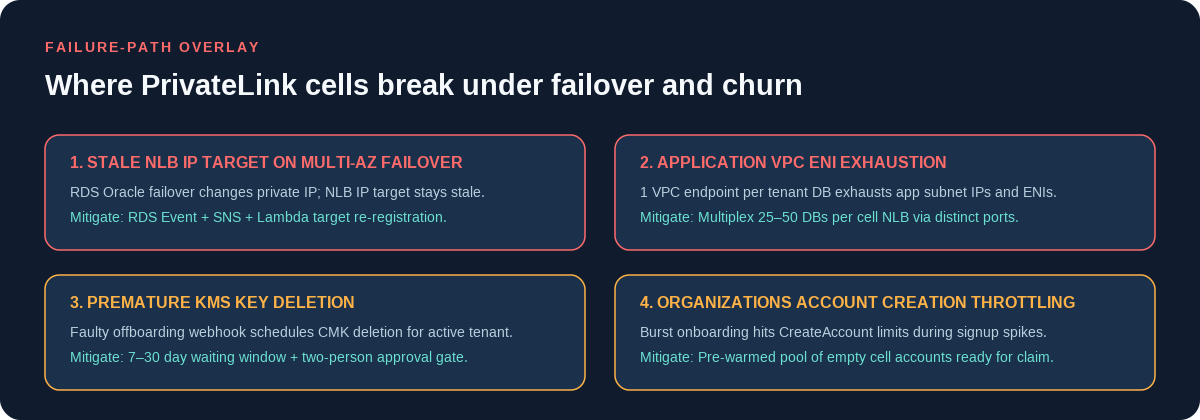
Cell-based isolation eliminates single-account quota ceilings, but it introduces cross-account operational failure modes that must be engineered explicitly.
| Condition | Breaks How | Detect | Mitigate |
|---|---|---|---|
| Multi-AZ RDS Oracle failover | Primary IP changes; NLB IP target group points to old standby IP and drops traffic. | NLB UnHealthyHostCount > 0 and application ORA-12541 / timeout errors. | Subscribe RDS failover events to SNS + Lambda to re-register the resolved RDS DNS IP. |
| 1 VPC endpoint per tenant DB | Application VPC exhausts subnet IPv4s and ENI quotas across hundreds of endpoints. | InsufficientAddressSpace or ENI limit errors in application account. | Multiplex 25–50 tenant DBs per cell behind one NLB using distinct listener ports. |
| Premature CMK deletion webhook | Faulty offboarding triggers ScheduleKeyDeletion on an active tenant’s KMS key. | CloudTrail alert on kms:ScheduleKeyDeletion / kms:DisableKey. | Enforce 7–30 day deletion_window_in_days and require two-person approval in the control plane. |
Burst onboarding hits CreateAccount | Rapid customer signups exceed AWS Organizations CreateAccount concurrency/rate limits. | TooManyRequestsException or ConcurrentModificationException in Account Factory. | Maintain a pre-warmed pool of empty, SCP-hardened cell accounts ready for assignment. |
| Cross-account CI/CD STS storms | Central runner assumes IAM roles across dozens of cells simultaneously, hitting STS limits. | Terraform provider throttling errors during fleet-wide parameter updates. | Stagger rollouts by cell cohort with exponential backoff and per-cell worker queues. |
| Option Group / patch drift | Oracle timezone or RU patches applied inconsistently across cell accounts. | AWS Config custom rules flagging mismatched engine_version or option groups. | Publish versioned golden Terraform modules / CloudFormation StackSets from one central repo. |
Key Takeaways
- Account boundaries are the only hard AWS quota reset: Splitting fleets into 25–50 database cells per AWS Organizations account isolates RDS instance quotas, IAM blast radius, and API rate limits simultaneously.
- PrivateLink eliminates CIDR and route-table scaling limits: Exposing cell NLBs through
aws_vpc_endpoint_servicelets every cell reuse10.0.0.0/24, avoiding Transit Gateway route caps (500 default / 1,000 max) and RFC 1918 exhaustion. - Oracle on PrivateLink requires automated NLB IP sync: Because RDS Proxy does not support Oracle, an RDS Event + SNS + Lambda loop is mandatory to update NLB IP targets whenever Multi-AZ failover changes the primary IP.
- One KMS CMK per tenant makes offboarding deterministic: Dedicated customer-managed keys with a 7–30 day deletion window allow verifiable cryptographic shredding of a single tenant’s data and snapshots without affecting cell neighbors.
- Do not rely on RDS delegated administration: AWS Organizations does not support a delegated administrator for RDS lifecycle operations; fleet-wide patching and compliance checks require StackSets or CI/CD runners with scoped cross-account IAM roles.
What to Do Next
- Problem: Hosting dedicated enterprise RDS Oracle instances in one flat VPC hits AWS’s 40-instance default Regional quota, 60-rule security group cap, and shared KMS offboarding lock-in.
- Solution: Group 25 to 50 tenant databases per AWS Organizations cell account behind a PrivateLink-backed internal NLB, with one KMS CMK per tenant and an Event-driven Lambda keeping NLB IP targets current across Multi-AZ failovers.
- Proof: In a staging cell, trigger a Multi-AZ RDS reboot with failover and verify that the Lambda updates the NLB target group IP and restores application connectivity before health checks expire.
- Action: Audit your primary production account’s
DescribeDBInstancescount and KMS key sharing today; if more than 25 regulated tenants share a single VPC or KMS key, stand up your first SCP-guarded cell account and PrivateLink NLB module this week.