
Azure Constrained-Core Optimization: Designing Licensing-Aware Infrastructure Code
Cloud compute infrastructure is billed by the hour, but enterprise database software is licensed by exposed hypervisor vCPUs; deploying standard Azure virtual machines to unlock storage IOPS can trigger millions of dollars in unbudgeted Oracle liabilities from a single Terraform pull request.
TL;DR
- Problem: Azure couples uncached storage IOPS and throughput to VM vCPU count, so sizing for 51,200 IOPS on standard
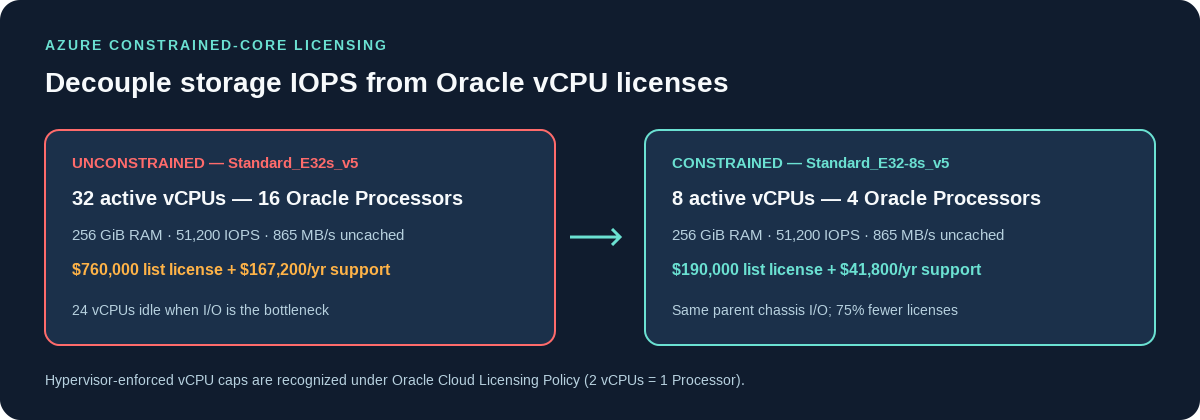
Standard_E32s_v5exposes 32 vCPUs (16 Oracle Processors) even when the database needs only 8 vCPUs.- Answer: Use Azure constrained-core SKUs (
Standard_E32-8s_v5) paired with Premium SSD v2 (PremiumV2_LRS) and enforce SKU selection at three layers: a declarative Terraform module, an OPA Conftest CI gate, and an Azure Policydenyassignment.- Watch out: Constrained-core shapes create a 32:1 GiB-per-vCPU memory ratio that can trigger
latch: cache buffers chainsspinlocks and interrupt skew if SGA sizing, parallel query caps, andirqbalanceare not tuned.
Situation
Enterprise technology organizations migrating mission-critical Oracle Database workloads from on-premises SAN architectures to Microsoft Azure face a structural mismatch between how cloud hypervisors allocate I/O and how Oracle prices software. On-premises, storage arrays deliver IOPS and bandwidth over Fibre Channel fabrics independently of how many CPU sockets are populated in the database host. In Azure, that independence disappears at the VM hypervisor boundary.
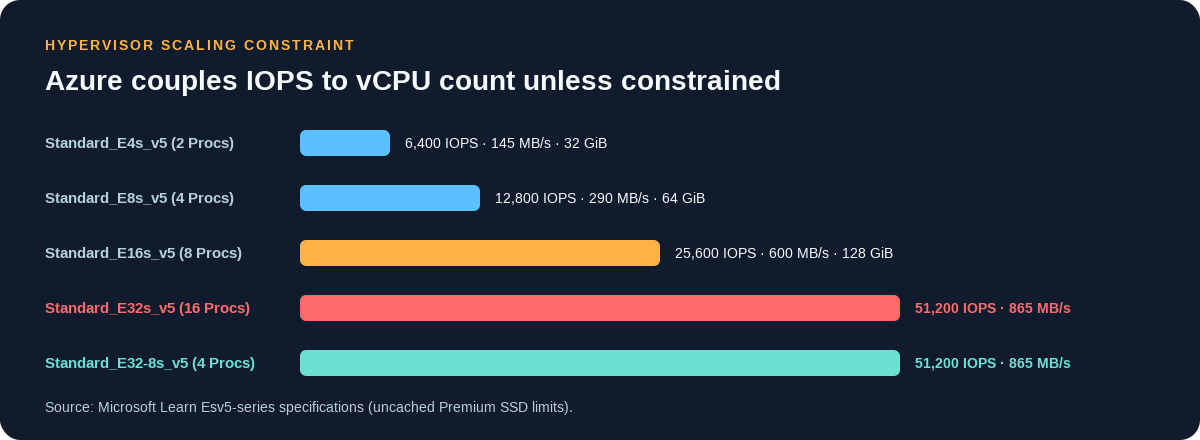
In an Online Transaction Processing (OLTP) deployment, database workloads often require 40,000 to 50,000 Input/Output Operations Per Second (IOPS) and roughly 800 MB/s of uncached storage bandwidth to sustain redo log flushes (log file sync), DBWR dirty-block writes, and random index lookups (db file sequential read). When platform engineers consult the Azure Esv5-series specification, they discover that uncached Premium SSD storage throughput and IOPS scale linearly with vCPU count:
Standard_E4s_v5exposes 4 vCPUs and 32 GiB RAM, but caps uncached remote storage at 6,400 IOPS and 145 MB/s.Standard_E8s_v5exposes 8 vCPUs and 64 GiB RAM, capping uncached remote storage at 12,800 IOPS and 290 MB/s.Standard_E16s_v5exposes 16 vCPUs and 128 GiB RAM, capping uncached remote storage at 25,600 IOPS and 600 MB/s.Standard_E32s_v5exposes 32 vCPUs and 256 GiB RAM, unlocking 51,200 IOPS and 865 MB/s of uncached storage throughput.
Because an 8-vCPU Standard_E8s_v5 stalls at 12,800 IOPS, engineers routinely select Standard_E32s_v5 in Terraform solely to acquire the parent chassis’s storage controller ceiling. Once that pull request merges, every node exposes 32 vCPUs to the Linux kernel regardless of actual CPU demand.
The Problem
The financial failure surfaces during an Oracle License Management Services (LMS) review. Under Oracle’s Licensing Oracle Software in the Cloud Computing Environment policy for Authorized Cloud Environments (which includes Microsoft Azure and AWS), Oracle’s standard on-premises Core Factor Table does not apply. Instead, when multi-threading (hyper-threading) is enabled, two available vCPUs equal one Oracle Processor license; if multi-threading is disabled, one vCPU equals one Processor license.
Consider the arithmetic on published Oracle Technology Global Price List figures ($47,500 perpetual list price per Enterprise Edition Processor license plus $10,450 per year in Software Update License & Support, or 22% of list):
- Constraint 1 — Linear I/O-to-vCPU Coupling: Reaching 51,200 uncached IOPS on standard
Esv5shapes requiresStandard_E32s_v5(32 vCPUs = 16 Oracle Processors per node). Across a 20-host fleet, that equals 640 vCPUs, or 320 Oracle Processor licenses: $15,200,000 in upfront list licenses plus $3,344,000 in recurring annual support—excluding optional packs such as Partitioning, Diagnostics, or Real Application Clusters. - Constraint 2 — Guest OS Masking Invalidity: Administrators sometimes attempt to cap CPU exposure inside Linux by executing
echo 0 > /sys/devices/system/cpu/cpu*/onlineor settingmaxcpus=8in GRUB. Oracle LMS audits reject guest-OS CPU masking because the policy counts vCPUs made available to the VM by the cloud hypervisor, not cores left online by the guest kernel. - Constraint 3 — Standard Edition 2 (SE2) Hard Cap: For workloads licensed under Oracle Database Standard Edition 2, Oracle’s cloud policy caps instance size at a maximum of 8 vCPUs (mapped at 4 vCPUs per socket, so 8 vCPUs = 2 sockets). Provisioning a
Standard_E16s_v5orStandard_E32s_v5immediately breaks SE2 compliance. - Constraint 4 — Asymmetric Compute-to-I/O Utilization: When I/O—not SQL execution—is the bottleneck, upgrading from
Standard_E8s_v5toStandard_E32s_v5leaves 24 vCPUs largely idle while quadrupling software entitlement exposure.
How can platform engineering teams automate Azure infrastructure provisioning so Oracle databases receive 51,200+ IOPS and 256 GiB of memory while exposing only the exact vCPU count required by the workload?
Options Considered
Platform teams evaluating Oracle on Azure IaaS face four distinct sizing and governance patterns. Only one satisfies both the storage throughput ceiling and Oracle’s hypervisor-level vCPU counting rules.
| Option | Active vCPUs | Uncached IOPS | Oracle EE List / Node | Why Chosen or Rejected |
|---|---|---|---|---|
Unconstrained Standard_E32s_v5 | 32 vCPUs | 51,200 IOPS | $760,000 (16 Procs) | Rejected: 4x license overspend for unused compute cores. |
Guest OS CPU Offlining (maxcpus=8) | 8 visible (32 allocated) | 51,200 IOPS | $760,000 (16 Procs) | Rejected: Oracle LMS counts hypervisor-available vCPUs, not Linux online CPUs. |
Downsize to Standard_E8s_v5 | 8 vCPUs | 12,800 IOPS | $190,000 (4 Procs) | Rejected: Capped at 12,800 IOPS and 290 MB/s; starves OLTP redo and data reads. |
Constrained Standard_E32-8s_v5 + Policy Gates | 8 active vCPUs | 51,200 IOPS | $190,000 (4 Procs) | Chosen: Preserves parent I/O and 256 GiB RAM while cutting vCPUs by 75%. |
Unconstrained Standard_E32s_v5 is operationally simple because it requires no special SKU governance, but it turns every Terraform scale-up into a six-figure licensing event. Guest OS masking is worse: it gives engineers a false sense of compliance while leaving the organization exposed to back-dated audit true-ups. Downsizing to Standard_E8s_v5 solves the licensing math but cuts uncached IOPS by 75% (from 51,200 to 12,800) and uncached throughput by 66% (from 865 MB/s to 290 MB/s), causing I/O queues to back up under OLTP commit bursts.
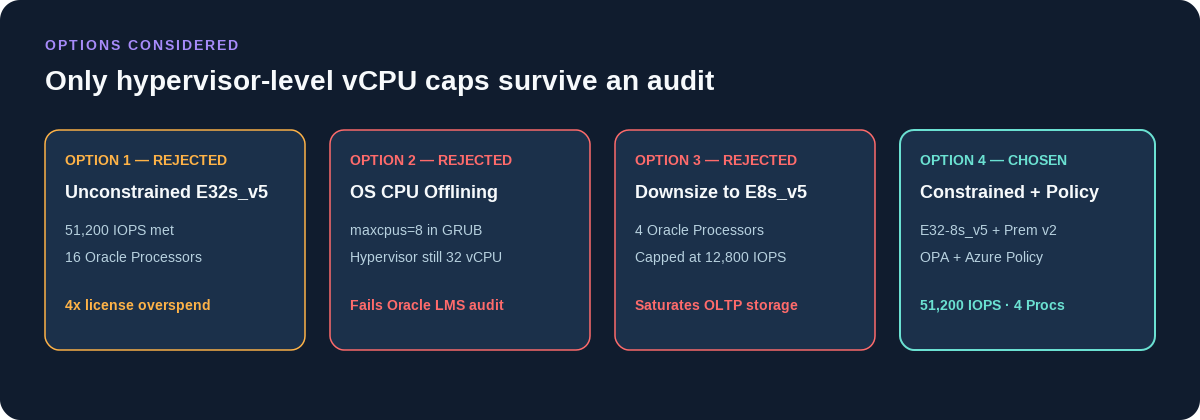
Constrained-core VMs paired with policy-as-code gates win because Microsoft enforces the vCPU reduction at the Azure hypervisor launch boundary. A Standard_E32-8s_v5 exposes only 8 active vCPUs to the guest OS while retaining the 256 GiB RAM, 32 max data disks, 51,200 IOPS, and 865 MB/s uncached throughput of the Standard_E32s_v5 parent chassis.
The Constrained-Core Policy Architecture
Relying on wiki checklists to remind engineers to pick -8s_v5 instead of s_v5 fails the first time an on-call engineer resizes a VM in the Azure Portal during an incident. The architecture therefore removes raw VM SKU selection from human operators and enforces constrained-core shapes across three layers:
- Declarative Capacity Abstraction (Terraform Module): Application and database teams declare workload intent—target IOPS, target MB/s, and required memory—rather than raw Azure VM strings. The module maps those inputs deterministically to approved constrained-core SKUs (
Standard_E8-2s_v5,Standard_E16-4s_v5,Standard_E32-8s_v5, orStandard_E64-16s_v5). - Pre-Merge CI/CD Gate (OPA Conftest): Every pull request runs
terraform plan -out=tfplan.binary, converts the plan to JSON, and evaluates it with Open Policy Agent (OPA). Anyazurerm_linux_virtual_machinetaggedWorkload = "Oracle"whosesizedoes not match the constrained-core hyphenated pattern fails CI before merge. - Runtime Control-Plane Perimeter (Azure Policy): At the Azure Management Group level, an Azure Policy evaluates every
Microsoft.Compute/virtualMachineswrite operation. Iftags['Workload'] == 'Oracle'and the SKU name does not match the constrained pattern, the Azure Resource Manager (ARM) API returns a harddeny, blocking manual portal resizes, ad-hoc CLI commands, and secondary deployment scripts.
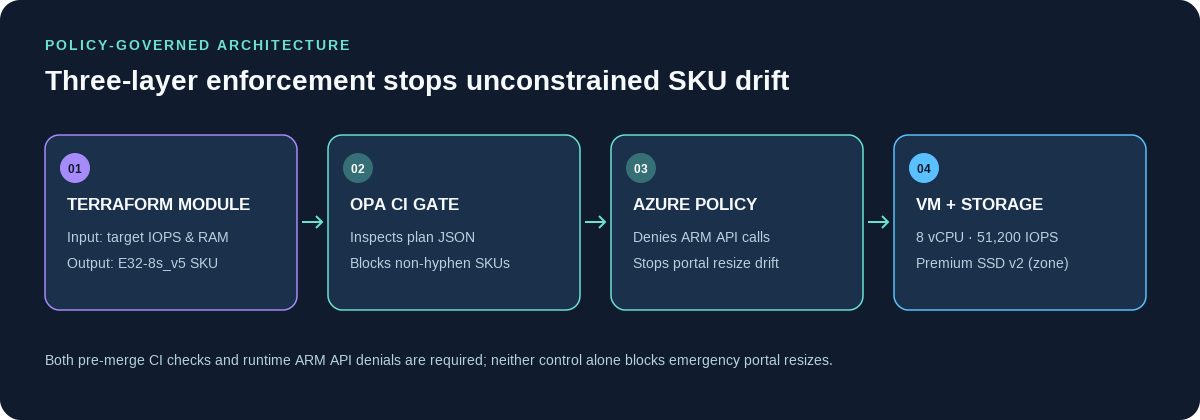
For storage, the architecture pairs constrained-core VMs with Azure Premium SSD v2 (PremiumV2_LRS). Unlike Premium SSD v1, where IOPS and throughput are tied to disk capacity (forcing teams to over-allocate terabytes of empty storage just to buy IOPS), Premium SSD v2 includes a baseline of 3,000 IOPS and 125 MB/s per disk and lets Terraform dial disk_iops_read_write (up to 80,000 IOPS per disk) and disk_mbps_read_write independently of disk_size_gb. Two Azure constraints must be respected in the module: PremiumV2_LRS disks require a zone specification in zonal regions, and host-level disk caching (ReadOnly or ReadWrite) is unsupported on Premium SSD v2 data disks, so caching on azurerm_virtual_machine_data_disk_attachment must be set to "None".
How It Rolls Out
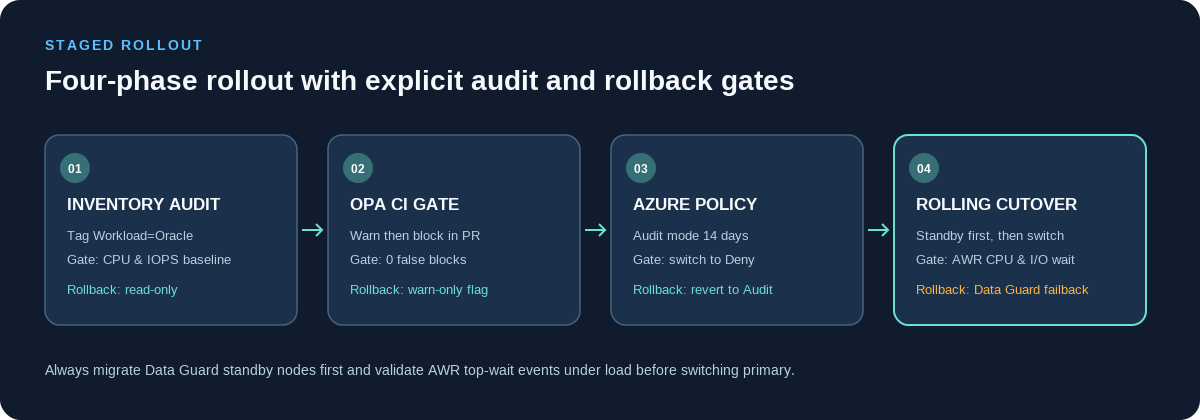
Migrating an existing Oracle estate onto constrained-core shapes and policy guardrails requires a phased rollout so enforcement never breaks live recovery workflows.
- Phase 1 — Inventory and Telemetry Audit: Query Azure Resource Graph for all VMs running Oracle binaries, verify
Workload = "Oracle"tagging, and collect 30 days of CPU utilization,nproc, and Azure Monitor uncached disk IOPS/MBps metrics. Validation gate: 100% of Oracle VMs tagged and mapped to target constrained SKUs. Rollback: Read-only phase; no production changes. - Phase 2 — OPA Gate in Warning Mode, Then Blocking: Add the Rego policy to CI pipelines in warn-only mode for one sprint to catch legacy module exceptions, then flip to blocking (
deny) on pull requests. Validation gate: Zero false-positive blocks on approved constrained-core templates. Rollback: Revert CI step to warn-only. - Phase 3 — Azure Policy in Audit Mode, Then Deny: Deploy the Management Group policy with
effect = "audit"for 14 days to detect portal or CLI drift. Once compliant or exempted for non-Oracle hosts, switcheffectto"deny". Validation gate: Zero unauthorized ARMvirtualMachines/writeevents in Activity Logs. Rollback: Patch policy parameter back to"audit". - Phase 4 — Rolling Standby-First Cutover: Resize Data Guard physical standby VMs first to the target constrained SKU (e.g.,
Standard_E32-8s_v5) and attachPremiumV2_LRSvolumes. Run syntheticSLOBor replay workloads, inspect AWR top timed events forlatch: cache buffers chainsandlog file sync, then perform a planned Data Guard switchover before resizing the former primary. Validation gate: AWR wait profile and redo apply lag remain within SLA under peak load. Rollback: Switch back to the original primary via Data Guard.
In Practice
I have not published internal client telemetry from this architecture, but the documented implementation pattern combines three verifiable artifacts: a Terraform sizing module, an OPA Rego policy, and an Azure Policy deny rule.
1. Declarative Sizing Module (modules/oracle_vm/main.tf)
locals {
  selected_vm_size = (
    var.target_iops > 50000 ? "Standard_E64-16s_v5" :
    var.target_iops > 25000 ? "Standard_E32-8s_v5"  :
    var.target_iops > 12000 ? "Standard_E16-4s_v5"  :
    "Standard_E8-2s_v5"
  )
}

resource "azurerm_linux_virtual_machine" "oracle_node" {
  name                = "vm-${var.database_name}-01"
  resource_group_name = var.resource_group_name
  location            = var.location
  zone                = var.availability_zone
  size                = local.selected_vm_size
  admin_username      = "oracle_admin"

  network_interface_ids = [azurerm_network_interface.oracle_nic.id]

  os_disk {
    caching              = "ReadWrite"
    storage_account_type = "Premium_LRS"
  }

  tags = {
    Workload        = "Oracle"
    DatabaseName    = var.database_name
    ConstrainedCore = "Enforced"
  }
}

resource "azurerm_managed_disk" "asm_data_disk" {
  name                 = "disk-${var.database_name}-data-01"
  location             = var.location
  resource_group_name  = var.resource_group_name
  zone                 = var.availability_zone
  storage_account_type = "PremiumV2_LRS"
  create_option        = "Empty"
  disk_size_gb         = 500
  disk_iops_read_write = var.target_iops
  disk_mbps_read_write = var.target_mbps
  tags                 = { Workload = "Oracle" }
}
2. OPA CI/CD Guardrail (licensing_guardrail.rego)
package terraform.azure.licensing

import future.keywords.in

is_constrained_sku(sku) {
    regex.match("^Standard_[A-Za-z]+[0-9]+-[0-9]+.*$", sku)
}

deny[msg] {
    some resource in input.resource_changes
    resource.type == "azurerm_linux_virtual_machine"
    tags := resource.change.after.tags
    tags["Workload"] == "Oracle"
    vm_size := resource.change.after.size
    not is_constrained_sku(vm_size)

    msg := sprintf(
        "LICENSING VIOLATION: '%v' requests unconstrained SKU '%v' for Oracle.",
        [resource.address, vm_size]
    )
}
3. Azure Policy Definition at Management Group Level
{
  "properties": {
    "displayName": "Enforce Azure Constrained-Core SKUs for Oracle Workloads",
    "mode": "Indexed",
    "policyRule": {
      "if": {
        "allOf": [
          { "field": "type", "equals": "Microsoft.Compute/virtualMachines" },
          { "field": "tags['Workload']", "equals": "Oracle" },
          {
            "field": "Microsoft.Compute/virtualMachines/sku.name",
            "notLike": "Standard_E*-*s_v*"
          }
        ]
      },
      "then": { "effect": "deny" }
    }
  }
}
Note also two documented ecosystem behaviors when evaluating this pattern. First, for workloads that need Exadata-class IOPS or RAC without managing Azure VM storage limits, Oracle Database@Azure runs OCI Exadata infrastructure inside Azure data centers with low-latency VNet integration. Second, while constrained-core SKUs reduce Oracle processor licenses, Azure still bills the VM compute rate of the parent chassis (Standard_E32-8s_v5 carries the same Azure VM compute charge as Standard_E32s_v5), so the savings come from Oracle software licensing rather than Azure IaaS compute.
Where It Breaks
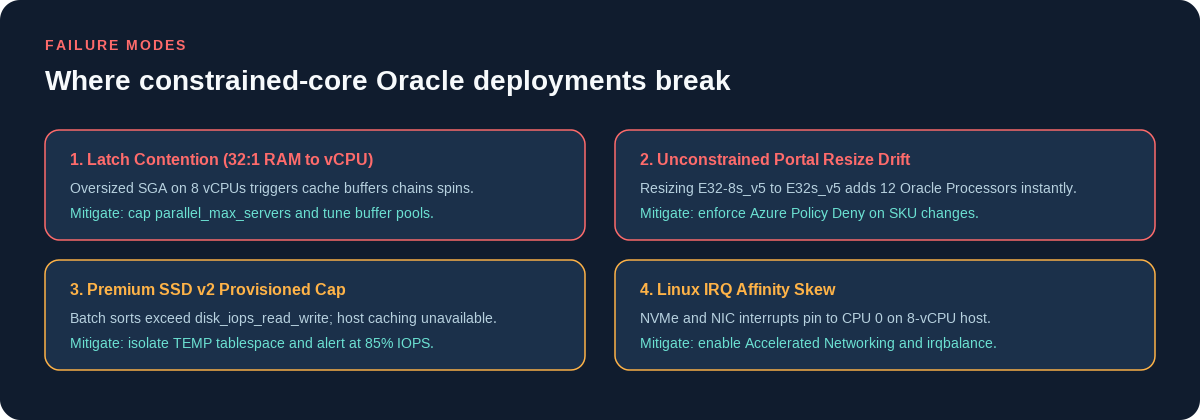
Constrained-core architectures reduce software licensing exposure, but compressing 256 GiB of RAM and 51,200 IOPS onto 8 active vCPUs shifts bottlenecks toward CPU scheduling, latch contention, and audit governance.
| Condition | Breaks How | Detect | Mitigate |
|---|---|---|---|
| Batch or unindexed SQL spike | 8 active vCPUs hit 100% CPU; OLTP sessions queue on resmgr:cpu quantum or listener spawns stall. | Azure Monitor Percentage CPU > 90%; AWR CPU time and OS CPU wait spikes. | Enable Oracle Database Resource Manager (DBRM); cap parallel_max_servers and per-consumer-group CPU shares. |
| Oversized SGA on 32:1 RAM/vCPU | Hundreds of gigabytes of buffer cache scanned by only 8 vCPUs amplifies latch: cache buffers chains spins. | AWR Top 10 Timed Events showing latch: cache buffers chains or latch free. | Size db_cache_size to active working set rather than all 256 GiB; segregate hot objects into KEEP pools. |
| Oracle sales “chassis” challenge | Account reps sometimes argue the parent 32-vCPU hardware chassis should be licensed instead of 8 active vCPUs. | Audit inquiry citing parent VM family (E32) rather than active SKU (E32-8s_v5). | Cite the “available vCPUs” wording in Oracle’s Cloud Licensing Policy; log nproc output and Azure SKU metadata; escalate to LMS. |
| Premium SSD v2 provisioned cap | Bulk loads or sort spills exceed disk_iops_read_write or disk_mbps_read_write; host caching is disabled. | Azure Monitor Data Disk IOPS Consumed Percentage > 85%; direct path read temp waits. | Isolate TEMP onto a dedicated PremiumV2_LRS disk; alert at 85% IOPS and remember Azure caps performance changes per 24h window. |
| Portal resize drift | Engineer resizes Standard_E32-8s_v5 to Standard_E32s_v5 during an incident, instantly adding 12 Oracle Processors. | Azure Activity Log virtualMachines/write with unconstrained SKU; FinOps tag/SKU scanner. | Enforce Azure Policy deny at Management Group scope so portal and CLI resizes fail at the ARM API layer. |
| Linux IRQ affinity skew | Storage NVMe and NIC interrupts pin to CPU 0–1 on an 8-vCPU guest, saturating %soft while cores 2–7 sit idle. | mpstat -P ALL 1 showing imbalanced %irq / %soft on CPU 0. | Enable Azure Accelerated Networking (SR-IOV) on NICs and run irqbalance across all active vCPUs. |
Key Takeaways
- Azure
Esv5VMs bind uncached IOPS and throughput to vCPU count (Standard_E8s_v5caps at 12,800 IOPS / 290 MB/s;Standard_E32s_v5reaches 51,200 IOPS / 865 MB/s), making standard SKU selection an expensive way to buy storage. - Under Oracle’s Authorized Cloud Environments policy, 2 available vCPUs with hyper-threading equal 1 Oracle Processor license ($47,500 list + $10,450/yr support), and guest-OS CPU masking (
maxcpus) is rejected in audits. - Constrained-core SKUs (
Standard_E32-8s_v5) expose 8 active vCPUs at the hypervisor boundary while preserving the parent chassis’s 256 GiB RAM and 51,200 IOPS, cutting Oracle Processor exposure by 75%. - Policy enforcement must span both pre-merge CI (OPA Conftest on
terraform planJSON) and runtime control plane (Azure Policydenyon ARMvirtualMachines/write) to prevent incident-time portal drift. - Constrained-core VMs still bill at the parent Azure compute rate and introduce a 32:1 RAM-to-vCPU ratio, requiring DBRM CPU caps, conservative SGA sizing,
irqbalance, andzone-pinnedPremiumV2_LRSdisks withcaching = "None".
What to Do Next
- Problem: Sizing standard Azure VMs for Oracle storage IOPS exposes 2x to 4x more vCPUs than the database needs, creating multi-million-dollar Oracle licensing liabilities.
- Solution: Standardize on Azure Constrained-Core VMs (
Standard_E32-8s_v5orStandard_E64-16s_v5) paired withPremiumV2_LRSdisks, governed by Terraform intent modules, OPA CI checks, and Azure Policydenyrules. - Proof: Compare
nprocand Azure SKU metadata against 30-day CPU and uncached IOPS telemetry; aStandard_E32-8s_v5retains the full 51,200 IOPS and 865 MB/s ceiling while reporting 8 active vCPUs (4 Oracle Processors) to the guest kernel. - Action: Query your Azure subscriptions today for all VMs tagged or running Oracle, compare active vCPU counts against average CPU and peak disk IOPS, and schedule a Data Guard standby-first migration for any high-core, I/O-bound host.
Sources to Verify
- Oracle Corporation: Licensing Oracle Software in the Cloud Computing Environment (Authorized Cloud Environments policy: 2 vCPUs = 1 Processor with multi-threading; SE2 8-vCPU limit).
- Oracle Corporation: Oracle Technology Global Price List (Enterprise Edition Processor $47,500 list, $10,450 annual support).
- Microsoft Corporation: Esv5-series virtual machine specifications and Constrained vCPU capable VM sizes (Microsoft Learn).
- Microsoft Corporation: Azure Premium SSD v2 and HashiCorp
azurerm_managed_diskdocumentation (PremiumV2_LRSbaseline 3,000 IOPS / 125 MB/s,zonerequirement,caching = "None").
Interactive tools for this topic