
RAG for Fleet Operations: Injecting 10,000 Runbooks into Agentic Control Planes
Content reflects the state as of July 2026. AI tooling and model capabilities in this area change frequently.
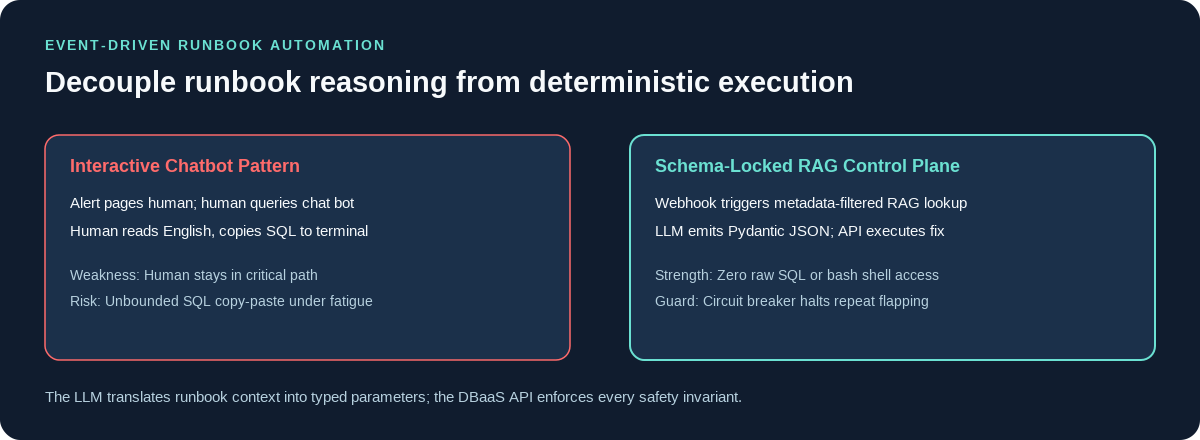
Treating generative artificial intelligence as an interactive chatbot for database operations is an architectural underutilization; at cloud scale, enterprises do not need a faster way for humans to read operational manuals, they need an autonomous agent that reads the manual, verifies the constraints, and executes the fix under deterministic guardrails.
TL;DR
- Problem: Interactive DBA chatbots still leave a fatigued human in the critical path to copy SQL into production, while raw-shell LLM agents expose databases to hallucinated DDL.
- Answer: Pair an event-driven RAG pipeline (GitOps Markdown runbooks + strict
error_codeandtenant_idmetadata filters in Qdrant) with schema-locked Pydantic tool calls dispatched through a bounded DBaaS API.- Watch out: Without a
last_verifiedfreshness gate, exact tenant filtering, ingress idempotency, and per-database circuit breakers, an autonomous agent can apply stale runbooks or loop on runaway workloads.
Situation
Organizations operating large Oracle fleets—spanning multi-tenant Software-as-a-Service (SaaS) databases, financial transaction engines, and analytical warehouses—accumulate thousands of Markdown runbooks, post-mortem notes, and customer-specific operational procedures in Git repositories and internal wikis.
These runbooks capture contextual rules that generic monitoring thresholds cannot express:
- “If Tenant Alpha triggers
ORA-01653(unable to extend table) onORDERS, verify their contractual storage tier in the CRM; if Tier 1, execute an online datafile resize within their cap; if Tier 2, escalate rather than auto-extending.” - “If Tenant Beta hits a library cache lock during their overnight batch window, do not terminate the session; invoke the draining procedure
pkg_tenant_batch.drain_queueand notify the account owner.”
| Remediation Phase | Human On-Call Process | Autonomous Control Plane |
|---|---|---|
| Alert Intake | PagerDuty wake-up and VPN login | Monitoring webhook to ingress endpoint |
| Context Retrieval | Manual search across Git and wikis | Metadata-filtered Qdrant vector query |
| Tenant Contract Check | Manual CMDB / CRM lookup | Structured runbook metadata and API check |
| Command Synthesis | Draft and syntax-check SQL by hand | LLM emits Pydantic-validated JSON args |
| Execution & Audit | Run via CLI; write post-mortem notes | DBaaS API executes and logs to S3/Kafka |
In most overnight incidents, the database command itself takes seconds to execute. The bulk of Mean Time to Recover (MTTR) is spent on human cognitive latency: authenticating through bastions, locating the current runbook, checking tenant exceptions, and verifying syntax before running a command. Because the on-call engineer must also cross-check whether a tablespace sits on ASM or filesystem storage and whether the tenant is within its contractual storage quota, even routine alerts consume significant engineering time and interrupt sleep. Automating the lookup and translation path while keeping the execution surface strictly bounded removes that cognitive tax without sacrificing production safety.
The Problem
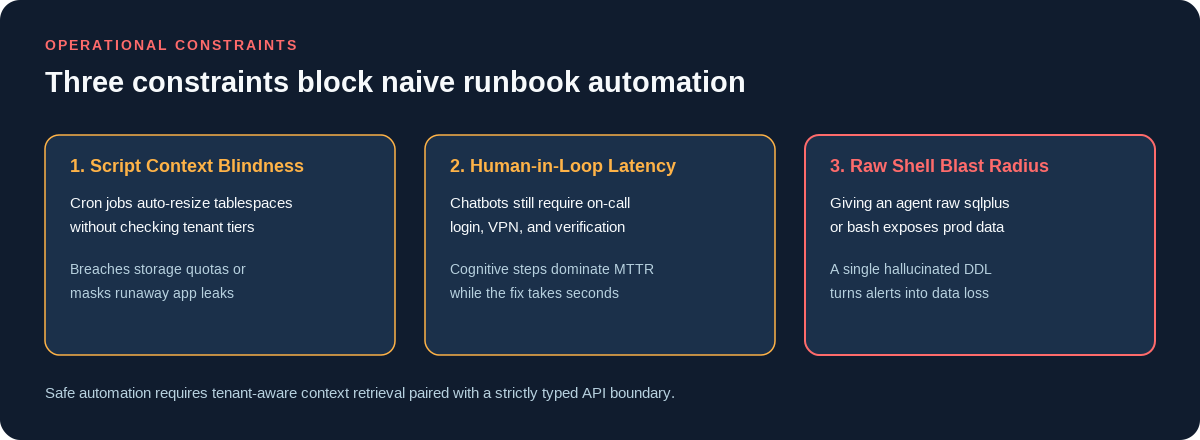
Static cron scripts (such as polling DBA_TABLESPACE_USAGE_METRICS and blindly running ALTER DATABASE DATAFILE ... RESIZE) break down in multi-tenant fleets because remediation depends on business context, maintenance windows, and contractual quotas. Three architectural constraints block naive automation.
Constraint 1: Context Blindness of Static Scripts. Hardcoded remediation scripts cannot interpret natural-language exceptions in Markdown runbooks. Blindly adding datafiles to a tablespace experiencing an application insert loop violates cloud budget caps and masks the underlying defect.
Constraint 2: Human-in-the-Loop Latency of Chatbots. Deploying a Slack RAG chatbot helps an engineer find the right wiki page faster, but leaves the human in the execution path. Under sleep deprivation, an engineer copying generated SQL into a production SQL*Plus session remains both a latency bottleneck and a typo hazard.
Constraint 3: Unacceptable Blast Radius of Raw-Shell Agents. Giving an LLM direct access to sqlplus or bash tools turns prompt injection, retrieval noise, or model hallucination into destructive DDL (DROP TABLE, ALTER SYSTEM, or rm -rf). Furthermore, embedding models cannot reliably distinguish two nearly identical tenant runbooks by cosine similarity alone; if two tenants share 95% of the same ORA-01653 boilerplate and differ only in a single contractual cap, dense vector distance will frequently rank the wrong tenant first. Relying on post-filtering (fetching top-k vectors and then discarding non-matching tenants) also fails when all top-k candidates belong to other tenants, returning zero results even though a valid runbook exists. Safe retrieval requires pre-filtering inside the vector index traversal using indexed keyword metadata.
How can platform teams build an event-driven control plane that retrieves tenant-specific runbooks via RAG and executes deterministic remediations without exposing production databases to raw SQL generation or human-in-the-loop delays?
Options Considered
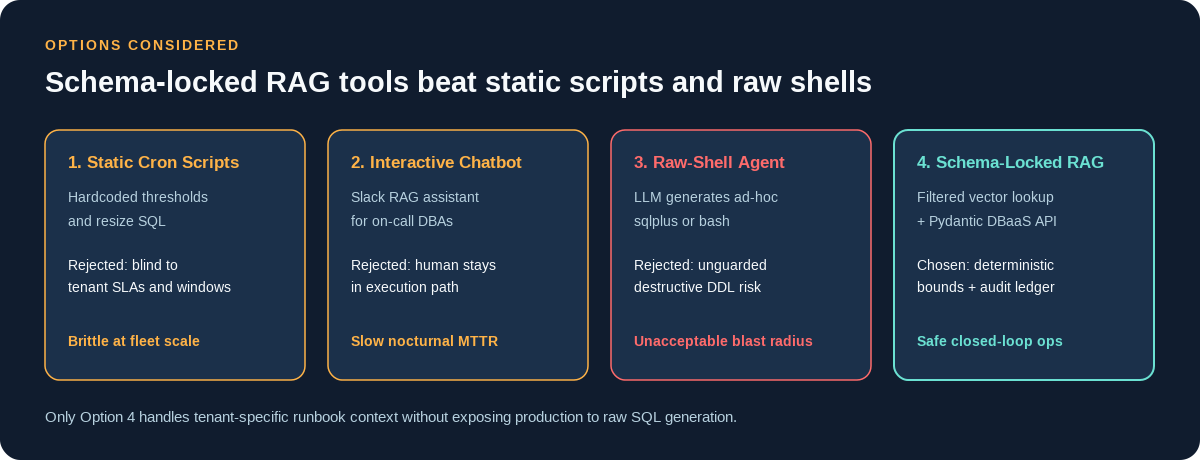
Platform teams typically evaluate four operating models when automating fleet runbook execution.
| Option | Context Awareness | Execution Safety | MTTR Impact | Verdict |
|---|---|---|---|---|
| 1. Static Cron Scripts | None (hardcoded rules) | High (fixed SQL) | Fast for simple cases | Rejected: blind to tenant SLAs and exceptions |
| 2. Interactive DBA Chatbot | High (RAG search) | Medium (human reviews SQL) | Moderate (human in loop) | Rejected: leaves human in nocturnal path |
| 3. Raw-Shell LLM Agent | High (RAG + reasoning) | Unacceptable (arbitrary SQL) | Fast | Rejected: hallucination risks destructive DDL |
| 4. Schema-Locked RAG Control Plane | High (filtered RAG) | High (Pydantic + DBaaS API) | Automated webhook flow | Chosen for closed-loop fleet ops |
Option 1 (Static Cron Scripts) is deterministic and easy to audit, but every tenant exception requires custom Python or PL/SQL branching. Over time, the script fleet becomes harder to maintain than the runbooks themselves.
Option 2 (Interactive DBA Chatbot) improves documentation discovery during daytime debugging, but fails to eliminate nocturnal toil because an engineer must still wake up, read the bot’s output, and execute commands manually.
Option 3 (Raw-Shell LLM Agent) removes the human from the loop by handing the model a generic database connection or shell tool. Any retrieval error or model hallucination can execute arbitrary SQL against production schemas.
Option 4 (Schema-Locked RAG Control Plane) separates reasoning from execution: the LLM reads the retrieved runbook and fills a strictly typed Pydantic schema, while a deterministic DBaaS API holds the credentials and executes pre-approved operations.
The Agentic RAG Control Plane Architecture
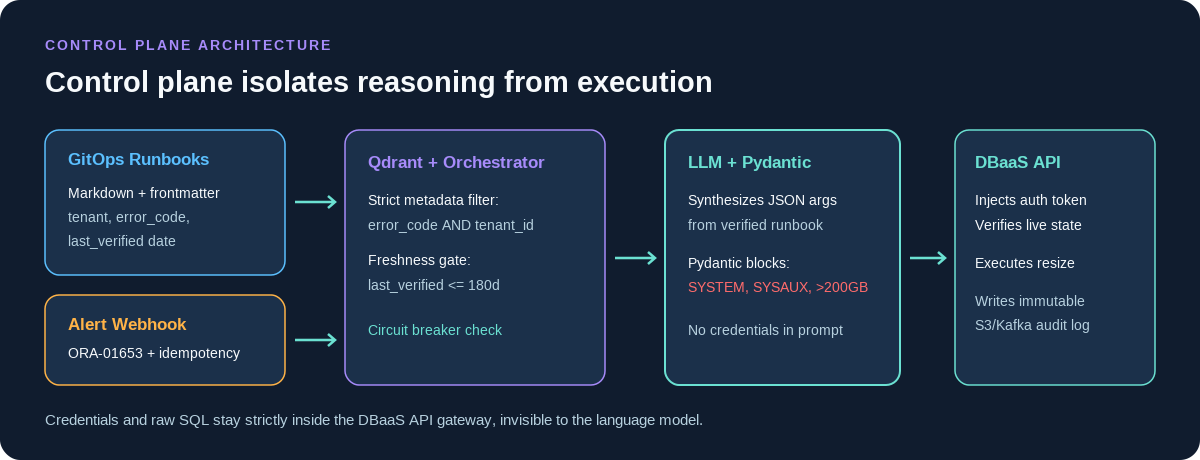
The recommended architecture replaces chat interfaces and raw shells with an Event-Driven Agentic Remediation Control Plane. Monitoring systems (Prometheus Alertmanager, Oracle Enterprise Manager, or PagerDuty) push alert webhooks into a stateful orchestrator (such as Temporal or LangGraph), which coordinates four isolated layers.
flowchart TD
    subgraph Observability Fabric
        A[Monitoring Alert: ORA-01653 on Tenant Alpha] --> B[Alert Webhook Receiver]
    end

    subgraph Agentic Orchestrator — Temporal State Machine
        B --> C[Alert Normalizer and Context Builder]
        C --> D[Vector DB — Filtered Search: Qdrant]
        E[(GitOps Runbook Knowledge Base)] -->|CI/CD Markdown Embedding| D
        D -.->|Returns Authoritative Tenant Runbook| C
    end

    subgraph LLM Reasoning Engine
        C -->|Structured Prompt: Alert + Verified Runbook| F[LLM Agent Core — Structured Tool Call]
        F -.->|Emits Typed JSON Tool Call| G{Pydantic Schema Validator}
    end

    subgraph Deterministic Infrastructure Gate
        G -->|Validates Bounds and Tablespace Rules| H[Control Plane API — storage expand]
        G -->|Rejects Unsanctioned Parameters| I[Safety Circuit Breaker — Page Human]
    end

    subgraph Stateful Database Fleet
        H --> J[(Tenant Database Instance)]
        J --> K[Post-Remediation Telemetry Verification]
        K --> L[Audit Trail — Immutable S3 and Kafka Ledger]
    end
Core Architectural Principles
-
Continuous GitOps Runbook Embedding Pipeline: Runbooks live in Git as Markdown files with structured YAML frontmatter (
tenant,error_code,last_verified). On merge tomain, CI/CD splits each document along Markdown heading boundaries viaMarkdownHeaderTextSplitter(preserving parameter tables and code blocks) and applies a secondaryRecursiveCharacterTextSplitterpass only when an individual section exceeds the embedding model’s optimal chunk window, keeping header metadata attached to every chunk. The pipeline upserts chunks into Qdrant and maintainsKEYWORDpayload indexes onerror_codeandtenantso filtered queries execute during HNSW graph traversal rather than as slow post-filters. -
Strict Metadata Filtering and Freshness Gates: Vector similarity alone is never trusted to select a tenant policy. Every
query_pointscall enforces a QdrantFilterrequiring an exacterror_codematch and matchingtenant(orGLOBAL_DEFAULTwhen no tenant override exists). A post-retrieval gate rejects any runbook whoselast_verifieddate is older than 180 days, routing the alert to a human engineer instead. In CI, a branch-protection check verifies that updates tolast_verifiedcome from an approved DBA pull request rather than automated bots, preventing stale procedures from being silently re-stamped. -
Post-Remediation Verification and Immutable Audit: After the DBaaS API executes an expansion or plan quarantine, the orchestrator runs a read-only verification query (for example, checking
DBA_TABLESPACE_USAGE_METRICSandV$ASM_DISKGROUPfree MB) to confirm the alert condition actually cleared. Both the retrieved runbook Git SHA, the validated Pydantic payload, and the post-check result are written synchronously to an append-only S3 or Kafka audit stream before the webhook returns HTTP 200. If Slack or PagerDuty notifications fail transiently, Temporal retries notification delivery asynchronously without blocking or losing the compliance record. -
Zero Raw Shells or LLM-Supplied Credentials: The model never receives a
sqlplustool, bash shell, or database password. Even authorization tokens are excluded from the Pydantic tool schema so the model cannot fabricate or leak them; the DBaaS API gateway injects short-lived service credentials only after schema validation succeeds. Where teams adopt the Model Context Protocol (MCP) for diagnostic reads, the MCP server is strictly separated into read-only inspection tools and write-bounded remediation endpoints. -
Pydantic Schema Bounds: Every tool parameter carries explicit validators—for example, blocking
SYSTEM,SYSAUX,TEMP, andUNDOTBS1from autonomous tablespace expansion and capping single increments between 10 GB and 200 GB. For SQL plan regressions,QuarantineSqlPlanToolmaps exclusively to Oracle SQL Plan Management (DBMS_SPM) baselines rather than permitting arbitraryALTER SYSTEMstatements. -
Durable Orchestration, Circuit Breakers, and Idempotency: Running the pipeline inside a durable workflow engine (such as Temporal) guarantees that each alert webhook is processed with an ingress deduplication key (
hash(instance_id + error_code + time_bucket)), collapsing flapping alerts into a single workflow. Temporal activity retries handle transient vector-DB or API timeouts without re-running the LLM reasoning step, while a per-database counter halts automation after two expansions in 24 hours.
| Operating Dimension | Manual Human On-Call | Interactive Chatbot | Autonomous RAG Control Plane |
|---|---|---|---|
| Activation | PagerDuty wakes human | Human queries chat bot | Alert webhook triggers workflow |
| Context Lookup | Manual wiki search | Fuzzy semantic search | Filtered Qdrant error_code + tenant |
| Execution Surface | Unrestricted CLI / SQL | Human copies SQL | Pydantic-validated DBaaS API |
| Credential Exposure | Human DBA credentials | Human DBA credentials | Gateway-injected service tokens |
| Audit Trail | Manual ticket notes | Fragmented chat logs | Synchronous S3 / Kafka event log |
How It Rolls Out
Moving from human-driven runbooks to autonomous execution requires four sequential gates so retrieval accuracy and schema safety are proven before any production database is mutated.
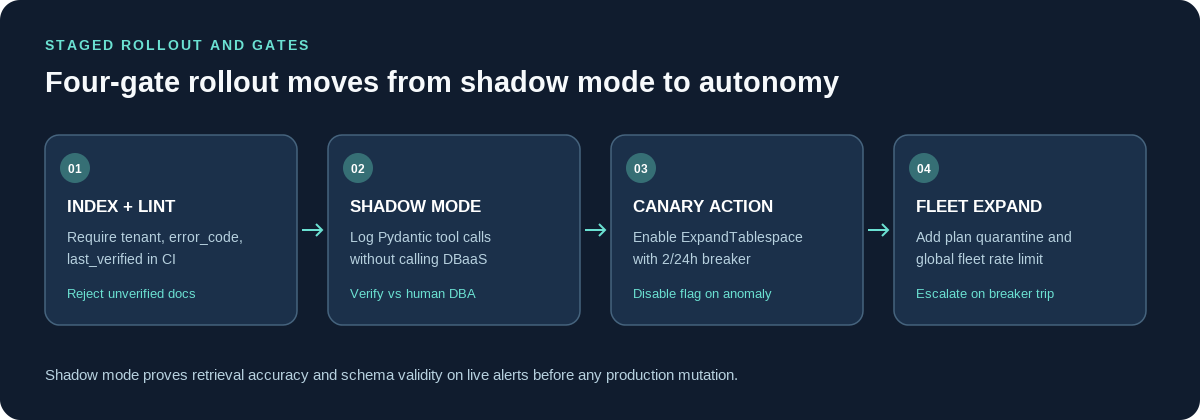
- Gate 1 — GitOps Frontmatter Linting & Indexing: CI rejects any runbook lacking
tenant,error_code, or a validlast_verifiedtimestamp, creates QdrantKEYWORDpayload indexes, and verifies retrieval precision against a curated golden-alert test set (confirming that every test alert resolves to its exact tenant runbook). Rollback: revert the Git commit and re-run the indexer. - Gate 2 — Shadow Mode Validation: Live alert webhooks trigger the full Qdrant retrieval and LLM tool-synthesis pipeline, logging the proposed Pydantic JSON payload without calling the DBaaS API. Engineers audit shadow logs against human DBA actions, checking both schema-validation rejection rates and false-positive escalations. Rollback: zero production impact; disable the webhook listener.
- Gate 3 — Single-Action Canary with Circuit Breakers: Enable execution for one low-risk, reversible action (
ExpandTablespaceToolon non-system tablespaces) on a canary tier with a strict 2-actions-per-24-hours per-database breaker. Verify that post-remediation telemetry confirms free space increased and that stale (>180day) runbooks still escalate cleanly. Rollback: flip the feature flag to fall back to immediate PagerDuty escalation. - Gate 4 — Fleet Expansion & Global Rate Limiting: Onboard additional bounded tools (
QuarantineSqlPlanToolviaDBMS_SPM) behind a global fleet rate limiter (capping autonomous mutations per hour across all tenants) so a systemic application bug—such as a broken deployment flooding every tenant’s tablespace simultaneously—trips the global breaker and pages human leads instead of exhausting cloud storage quotas.
In Practice
Based on Qdrant’s query_points filtering model, LangChain’s MarkdownHeaderTextSplitter, and Pydantic v2 JSON Schema generation, the control plane splits implementation across three small modules. Before indexing chunks, ensure Qdrant has KEYWORD payload indexes on error_code and tenant (client.create_payload_index) so HNSW graph traversal filters candidates without scanning the full collection.
1. Strongly Typed Tool Definitions (remediation_tools.py)
Notice that authorization_token is omitted from the model-facing schema; the API gateway attaches credentials after validation.
# remediation_tools.py
from pydantic import BaseModel, Field, field_validator

class ExpandTablespaceTool(BaseModel):
    """Expands a non-system Oracle tablespace within bounded limits."""
    instance_id: str = Field(..., description="Target database instance ID")
    tenant_id: str = Field(..., description="Tenant identifier")
    tablespace_name: str = Field(..., description="Target tablespace name")
    increment_size_gb: int = Field(..., ge=10, le=200, description="Increment in GB (10-200)")

    @field_validator("tablespace_name")
    @classmethod
    def block_system_tablespaces(cls, v: str) -> str:
        if v.upper() in {"SYSTEM", "SYSAUX", "TEMP", "UNDOTBS1"}:
            raise ValueError(f"Autonomous resize of {v} is prohibited")
        return v.upper()
2. GitOps Ingestion Pipeline (index_runbooks.py)
# index_runbooks.py
import os
import frontmatter
from langchain_text_splitters import MarkdownHeaderTextSplitter
from qdrant_client import QdrantClient
from qdrant_client.models import PointStruct
import openai

openai_client = openai.OpenAI()
qdrant = QdrantClient(url=os.getenv("QDRANT_URL"), api_key=os.getenv("QDRANT_API_KEY"))

def index_runbooks(repo_path: str, collection: str = "oracle_fleet_runbooks"):
    splitter = MarkdownHeaderTextSplitter(
        headers_to_split_on=[("#", "H1"), ("##", "H2"), ("###", "H3")]
    )
    points, point_id = [], 1
    for root, _, files in os.walk(repo_path):
        for file in files:
            if not file.endswith(".md"):
                continue
            post = frontmatter.load(os.path.join(root, file))
            for split in splitter.split_text(post.content):
                emb = openai_client.embeddings.create(
                    input=split.page_content, model="text-embedding-3-large"
                ).data[0].embedding
                points.append(PointStruct(
                    id=point_id,
                    vector=emb,
                    payload={
                        "text": split.page_content,
                        "tenant": post.metadata.get("tenant", "GLOBAL_DEFAULT"),
                        "error_code": post.metadata.get("error_code", "GENERIC"),
                        "last_verified": str(post.metadata.get("last_verified", "1970-01-01")),
                        "source_file": file,
                    },
                ))
                point_id += 1
    qdrant.upsert(collection_name=collection, points=points)
3. Filtered Retrieval and Schema-Locked Execution (agent_remediator.py)
Using qdrant.query_points with a Filter on both error_code and tenant prevents cross-tenant semantic drift, and checking last_verified blocks stale runbooks before the LLM sees them.
# agent_remediator.py
import json, os
from datetime import date, timedelta
import openai
from qdrant_client import QdrantClient
from qdrant_client.models import Filter, FieldCondition, MatchValue, MatchAny
from remediation_tools import ExpandTablespaceTool

openai_client = openai.OpenAI()
qdrant = QdrantClient(url=os.getenv("QDRANT_URL"), api_key=os.getenv("QDRANT_API_KEY"))

def handle_alert(alert: dict) -> bool:
    query_vec = openai_client.embeddings.create(
        input=f"{alert['error_code']} {alert['tablespace_name']} {alert['tenant_id']}",
        model="text-embedding-3-large",
    ).data[0].embedding

    results = qdrant.query_points(
        collection_name="oracle_fleet_runbooks",
        query=query_vec,
        query_filter=Filter(must=[
            FieldCondition(key="error_code", match=MatchValue(value=alert["error_code"])),
            FieldCondition(key="tenant", match=MatchAny(any=[alert["tenant_id"], "GLOBAL_DEFAULT"])),
        ]),
        limit=2,
        with_payload=True,
    )
    if not results.points:
        return False

    payload = results.points[0].payload
    verified_on = date.fromisoformat(payload["last_verified"])
    if date.today() - verified_on > timedelta(days=180):
        return False  # Escalate stale runbook to human on-call

    tools = [{
        "type": "function",
        "function": {
            "name": "ExpandTablespaceTool",
            "description": "Expand a non-system Oracle tablespace",
            "parameters": ExpandTablespaceTool.model_json_schema(),
        },
    }]
    resp = openai_client.chat.completions.create(
        model="gpt-4o",
        messages=[
            {"role": "system", "content": "Translate the runbook into ExpandTablespaceTool args only."},
            {"role": "user", "content": f"Alert: {json.dumps(alert)}\nRunbook:\n{payload['text']}"},
        ],
        tools=tools,
        tool_choice={"type": "function", "function": {"name": "ExpandTablespaceTool"}},
    )
    args = json.loads(resp.choices[0].message.tool_calls[0].function.arguments)
    validated = ExpandTablespaceTool(**args)
    # Dispatch `validated` to authenticated DBaaS API gateway
    return True
Where It Breaks
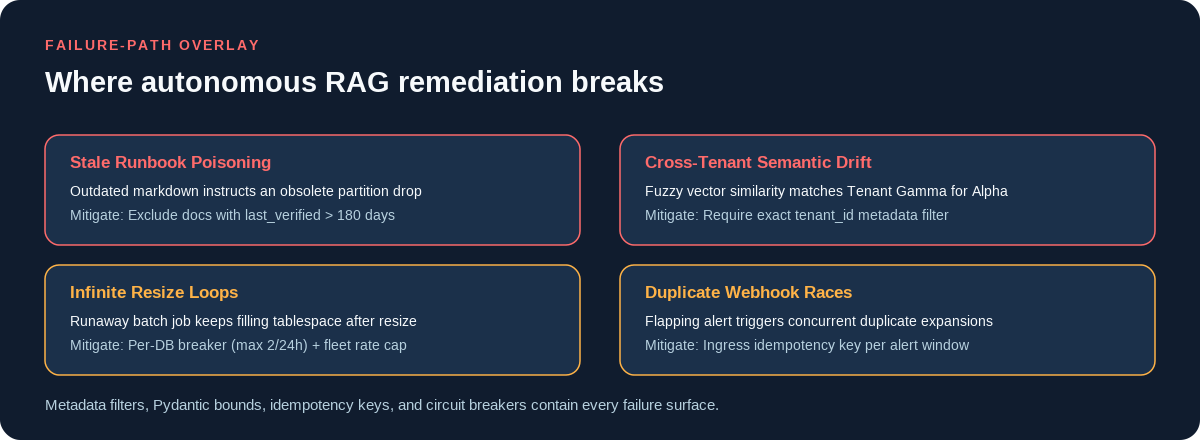
Autonomous remediation introduces distinct failure surfaces at the retrieval, reasoning, and orchestration layers. Most production incidents in RAG control planes trace back to either retrieval boundary leaks (returning the wrong tenant’s policy or an expired procedure) or missing rate limits when an upstream application bug triggers a storm of identical alerts across multiple databases. Even when the LLM produces valid JSON, the orchestrator must still verify live target state against the cloud provider and database catalog before executing a mutation, because CMDB records frequently lag behind account migrations or tablespace drops.
| Failure Mode | Breaks How | Detect | Mitigate |
|---|---|---|---|
| Stale Runbook Poisoning | Outdated Markdown instructs an obsolete command or deprecated tablespace path. | last_verified older than 180 days; CI freshness check fails. | Exclude uncertified docs in code; escalate stale alerts to human. |
| Cross-Tenant Semantic Drift | Fuzzy vector similarity retrieves Tenant Gamma’s runbook for Tenant Alpha. | Retrieved payload["tenant"] mismatches alert tenant_id. | Enforce Qdrant Filter on tenant and error_code via payload index. |
| Infinite Resize Loops | Runaway application insert fills tablespace repeatedly; agent keeps expanding. | Per-DB remediation counter hits threshold within 24 hours. | Trip per-DB circuit breaker (max 2/24h) and global fleet rate cap. |
| Duplicate Webhook Races | Flapping alert delivers concurrent webhooks, triggering parallel expansions. | Multiple workflow IDs created for same instance_id and error_code. | Deduplicate at ingress with hash(instance_id + error_code + bucket). |
| CMDB Inventory Drift | Database migrated to a new cloud account while CMDB still holds old ID. | DBaaS API returns 404 or mismatched resource state before resize. | Query live cloud control plane state immediately prior to mutation. |
| Audit Log Drop | Agent mutates database but fails to log because downstream Slack/HTTP fails. | Missing compliance event in immutable ledger for API mutation. | Write audit record synchronously to Kafka/S3 before returning 200. |
In addition to immutable audit logging, validate that every runbook ingestion job rejects Markdown files missing tenant, error_code, or ISO-8601 last_verified metadata at CI time. Enforcing schema completeness during Git pull requests prevents unindexed or untagged runbooks from silently falling back to unfiltered vector search in production.
Key Takeaways
- Decouple LLM reasoning from infrastructure execution: the model translates runbooks into Pydantic-validated JSON parameters, while a deterministic DBaaS API holds credentials and executes bounded actions.
- Never rely on cosine similarity alone for multi-tenant runbooks; enforce exact payload filtering on
error_codeandtenantin Qdrant before the text reaches the prompt. - Gate every retrieved runbook on a
last_verifiedfreshness timestamp so stale operational docs escalate to humans instead of driving autonomous mutations. - Exclude credentials and raw SQL/bash tools from the agent’s toolset; enforce tablespace allowlists and increment caps inside Pydantic validators.
- Protect the fleet with ingress webhook idempotency keys, per-database circuit breakers, and global fleet rate limits, and roll out through shadow mode first.
What to Do Next
- Problem: Interactive DBA chatbots leave humans in the nocturnal execution path, while unconstrained LLM shell agents risk destructive DDL hallucinations.
- Solution: Build an event-driven RAG control plane that indexes GitOps Markdown runbooks into Qdrant with strict
error_codeandtenantfilters, validates LLM outputs against Pydantic schemas, and executes mutations through a bounded DBaaS API. - Proof: Run the pipeline in shadow mode on live alert webhooks and verify that proposed Pydantic payloads match human DBA decisions while rejecting stale (
>180days) or cross-tenant documents. - Action: Pick your top three repetitive database alerts this week, add
tenant,error_code, andlast_verifiedYAML frontmatter to their Markdown runbooks in Git, and testExpandTablespaceToolschema validation in shadow mode.