
Hub-and-Spoke Network Topology for Oracle Database@Azure: Isolating Exadata in a Zero-Trust VNet Architecture
Deploying physical Exadata hardware inside a Microsoft Azure data center solves cross-cloud latency, but connecting dozens of application VNets to that cluster without creating an un-inspectable flat mesh reduces the entire problem to symmetric hub-and-spoke network design.
TL;DR
- Problem: Oracle Database@Azure projects Exadata vNICs into an Azure Delegated Subnet (
Oracle.Database/networkAttachments), where direct spoke-to-database peering bypasses central firewalls and missing return User Defined Routes (UDRs) break stateful inspection.- Answer: Isolate the delegated subnet in a dedicated Database VNet peered only to a Hub VNet (or Azure Virtual WAN with Routing Intent), enforcing symmetric exact-CIDR UDRs through Azure Firewall Premium.
- Watch out: Delegated client subnets require at least a
/27CIDR (13 reserved IPs + 3 SCAN IPs + 4 IPs per VM) and cannot be resized in place; allocate a/24up front and specify exact subnet prefixes in UDRs.
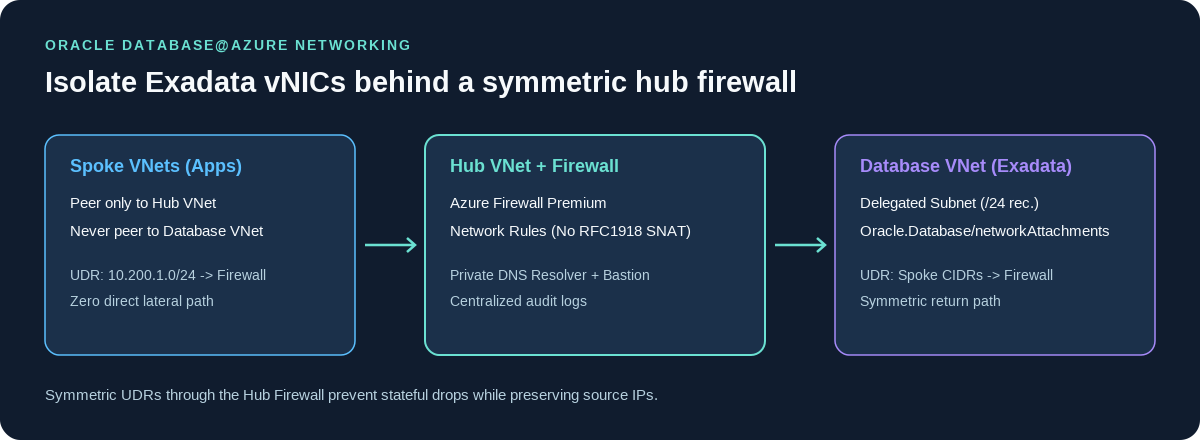
Situation
Oracle Database@Azure provisions OCI-managed Exadata infrastructure physically inside Microsoft Azure data centers using Azure’s Delegated Subnet model. OCI projects virtual Network Interface Cards (vNICs) directly into an empty, dedicated Azure subnet delegated to Oracle.Database/networkAttachments. Because that subnet lives inside an Azure Virtual Network (VNet) in your subscription, application compute reaches Exadata over the local Azure region backbone rather than traversing public internet or cross-cloud VPN links.
At small scale—one application VNet and one Exadata cluster—teams often co-locate workloads in a single VNet or wire direct VNet peering. At enterprise scale, microservices typically span dozens of spoke VNets across multiple Azure subscriptions with strict regulatory segmentation between payment, identity, and analytics tiers. Attempting to peer every spoke VNet directly to the Database VNet hits Azure’s operational routing limits and violates zero-trust East-West inspection requirements: any compromised workload in any spoke gains a direct L3 path to the Exadata client subnet without passing through a central firewall.
| Network Architecture | VNet Complexity | Security Posture | Routing Manageability | East-West Inspection |
|---|---|---|---|---|
| Flat single VNet | Minimal | Poor: no lateral boundary | Simple single-VNet routing | None |
| Direct N:1 spoke-to-DB peering | High N:1 mesh | Poor: unfiltered path to Exadata | Breaks down past ~30 VNets | None: bypasses hub firewall |
| Hub-and-spoke + Azure Firewall | Moderate: central hub | Strong: central L4/L7 policy | Centralized hub route tables | Full symmetric inspection |
| Azure Virtual WAN + Routing Intent | Low UDR overhead | Strong: automated policy routing | Automated across 50+ spokes | Full integrated inspection |
The Problem
The delegated subnet model imposes three concrete network constraints that break ad-hoc peering architectures.
Constraint 1: Delegated Subnet IP Math and Immutability. Oracle Database@Azure reserves a fixed pool of addresses inside the delegated client subnet: 13 reserved networking IPs, 3 Single Client Access Name (SCAN) listener IPs, and 4 IPs per Exadata VM node. A minimal 2-VM cluster therefore consumes 13 + 3 + (4 × 2) = 24 IPs before any scale-out. Because Azure also reserves 5 IPs per subnet, a /28 block (16 total IPs) fails validation immediately, making /27 (32 IPs) the strict minimum for a client subnet and /28 the minimum for a backup subnet. Crucially, a delegated subnet’s CIDR cannot be expanded after creation without destroying and re-provisioning the cluster, so production deployments allocate /24 (256 IPs). Each VNet is also limited by default to one Oracle Database@Azure delegated subnet.
Constraint 2: Non-Transitive Peering and Route Sprawl. Azure VNet peering is non-transitive: peering Spoke A and Spoke B to a Hub VNet does not automatically route packets between Spoke A and the Database VNet without explicit forwarding and User Defined Routes (UDRs). Conversely, peering 50 spokes directly to the Database VNet (even within Azure’s 500-peering-per-VNet hard limit) forces teams to maintain 50 separate return routes and Network Security Group (NSG) exceptions, and NSGs alone lack centralized TLS inspection and audit logging.
Constraint 3: Asymmetric Routing and Summary-Route Blackholes. When traffic flows from a spoke through a Hub Azure Firewall to the Exadata delegated subnet, return traffic from the Exadata vNIC must traverse the exact same firewall in reverse. If the Database VNet lacks a return UDR pointing spoke CIDRs back to VirtualAppliance (the firewall’s private IP), Azure’s default system route sends return packets directly over the peering link or drops them, causing stateful TCP handshakes to hang. Furthermore, generic /16 summary UDRs can fail for bare-metal delegated subnets; Azure and Oracle documentation require exact delegated subnet prefixes (for example, 10.200.1.0/24) in UDRs and Virtual WAN Private Traffic Prefixes.
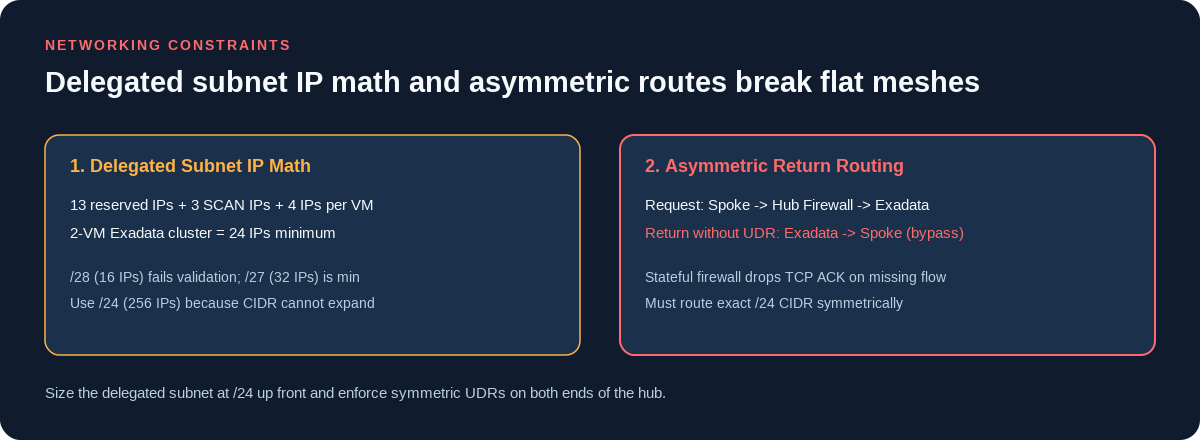
How do platform teams connect dozens of spoke VNets across multiple subscriptions to Oracle Database@Azure with symmetric East-West inspection, preserved client source IPs, and zero-downtime growth headroom?
Options Considered
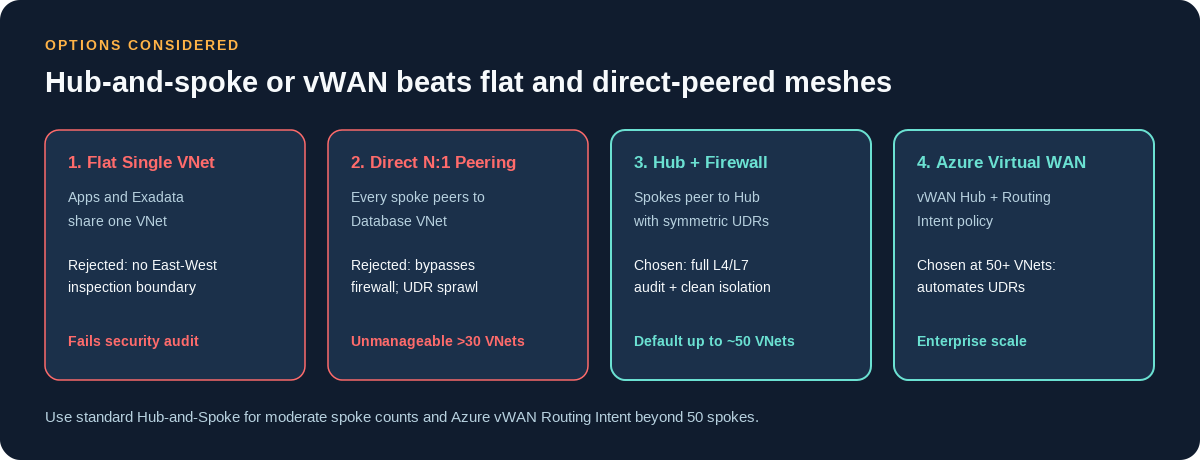
Platform teams evaluate four network topologies before deploying Oracle Database@Azure into production.
| Option | Isolation & Audit | Route Management | Scale Ceiling | Verdict |
|---|---|---|---|---|
| 1. Flat Single VNet | None (shared L3 domain) | Trivial | Single VNet CIDR | Rejected: fails PCI/SOC 2 segmentation |
| 2. Direct Spoke-to-DB Peering | NSG-only; no L7/TLS logs | Manual UDRs on every spoke | Unmanageable >30 spokes | Rejected: bypasses central firewall |
| 3. Hub-and-Spoke + Azure Firewall | Full central L4/L7 inspection | Terraform-managed symmetric UDRs | Clean up to ~50 spokes | Chosen for standard enterprise hubs |
| 4. Azure Virtual WAN + Routing Intent | Full central inspection | Automated by vWAN route manager | 50+ spokes and multi-region | Chosen for large multi-hub estates |
Option 1 (Flat Single VNet) places application VMs and the Oracle delegated subnet in the same VNet. While simple, any lateral movement inside the VNet reaches the Exadata SCAN listeners without passing through a firewall.
Option 2 (Direct N:1 Peering) peers every spoke VNet straight to the Database VNet. It eliminates the hub hop but strips out centralized East-West inspection and forces every subnet change on the Database VNet to be replicated across dozens of spoke route tables.
Option 3 (Hub-and-Spoke with Azure Firewall Premium) isolates the Database VNet behind a central Hub VNet. Spokes peer only to the hub, and symmetric UDRs force all SQL*Net traffic (1521 / 2484) through the firewall’s Network Rules. Because Azure Firewall Network Rules do not SNAT RFC 1918 private destinations by default, the Exadata listener sees each microservice’s true private IP for auditing and ACLs.
Option 4 (Azure Virtual WAN with Routing Intent) replaces manual per-spoke UDRs with vWAN Routing Intent policies when an organization operates 50 or more spokes across multiple regions. Enabling PrivateTraffic Routing Intent in a secured vWAN hub automatically programs routes across every connected VNet to steer RFC 1918 traffic through the vWAN hub’s Azure Firewall—eliminating the risk of a newly onboarded spoke forgetting its return route, provided the exact delegated subnet prefix (such as 10.200.1.0/24) is included in the vWAN Private Traffic Prefixes.
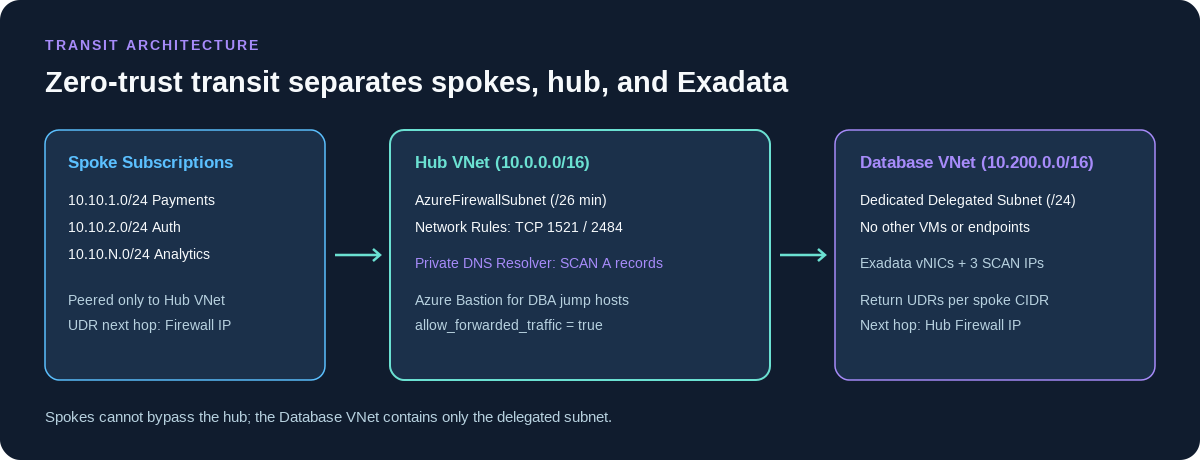
The Hub-and-Spoke Transit Architecture for Oracle Database@Azure
The recommended topology treats the Database VNet as an isolated landing zone: it peers only with the Hub VNet (allow_forwarded_traffic = true), never with application spokes, and contains no other VMs or shared services besides the delegated subnet.
flowchart TD
    A[Spoke VNet 1 — Payment Services — 10.10.1.0/24] -->|VNet Peering to Hub| D
    B[Spoke VNet 2 — User Auth — 10.10.2.0/24] -->|VNet Peering to Hub| D
    C[Spoke VNet N — Analytics — 10.10.N.0/24] -->|VNet Peering to Hub| D

    D[Hub VNet — 10.0.0.0/16] --> E[Azure Firewall Premium — East-West Inspection]
    E --> F[Exact UDR — 10.200.1.0/24 via Firewall]
    F --> G[Database VNet — 10.200.0.0/16]

    G --> H[Delegated Subnet — 10.200.1.0/24 — Oracle.Database/networkAttachments]
    H --> I[Exadata VM Cluster — vNICs and SCAN Listeners]

    D --> J[Azure Bastion — Admin Jump Access]
    D --> K[Private DNS Resolver — oracle.corp-azure.internal]
    K -->|SCAN Resolution| I
Key Architectural Controls
- Symmetric Exact-CIDR Routing: Every spoke subnet attaches a route table sending
10.200.1.0/24(the exact delegated subnet CIDR) toVirtualAppliance(<firewall-private-ip>). Symmetrically, the Database VNet’s delegated subnet route table—where supported, or the peering/hub transit table—returns every spoke CIDR to the same firewall private IP. Note that when deploying Exadata clusters, verify whether UDRs are bound directly to the delegated subnet or enforced via hub/vWAN Routing Intent according to current Azure/OCI delegated-subnet constraints. - Network Rules vs. Application Rules for SQL*Net: Configure SQL*Net (
1521cleartext,2484TCPS/TLS) exclusively in Azure Firewall Network Rules. Azure Firewall Network Rules preserve original RFC 1918 source IPs without SNAT, whereas Application Rules act as a transparent proxy and always apply SNAT. Note also that Azure Firewall Premium’s TLS inspection targets HTTP/S application traffic rather than Oracle’s native TCPS protocol; end-to-end encryption for database sessions is enforced by Oracle Net Services (TCP.VALIDNODE_CHECKINGand Oracle Wallet mutual TLS on port2484), while the firewall enforces L3/L4 segmentation and centralized flow logging. - Private DNS Resolution for SCAN: Applications connect to the Exadata cluster using a Private DNS hostname (e.g.,
prod-billing.oracle.corp-azure.internal) backed by the three SCAN listener A-records inside the/24delegated subnet. Using an Azure-specific DNS suffix prevents split-horizon collisions with legacy on-premises DNS zones. - Cross-Subscription Peering Automation: When spokes live in separate Azure subscriptions, manual peering approvals turn the Hub networking team into a ticket bottleneck. Platform teams automate peering with an Azure Policy
deployIfNotExistsassignment or a shared Terraform spoke module backed by a narrowly scoped service principal holdingNetwork Contributorpermissions solely on the Hub VNet peering resource. - Cross-Region Data Guard Separation: In multi-region deployments, each Azure region hosts its own Hub VNet and isolated Database VNet. Cross-region Oracle Data Guard redo shipping between Exadata clusters travels over Azure/OCI cross-region backbone connectivity rather than hairpinning through the Hub Firewall, preventing standby redo transport from saturating the regional firewall’s throughput ceiling.
How It Rolls Out
Because a delegated subnet CIDR cannot be resized after an Exadata cluster is deployed, network validation must complete in four gates before OCI provisions hardware.
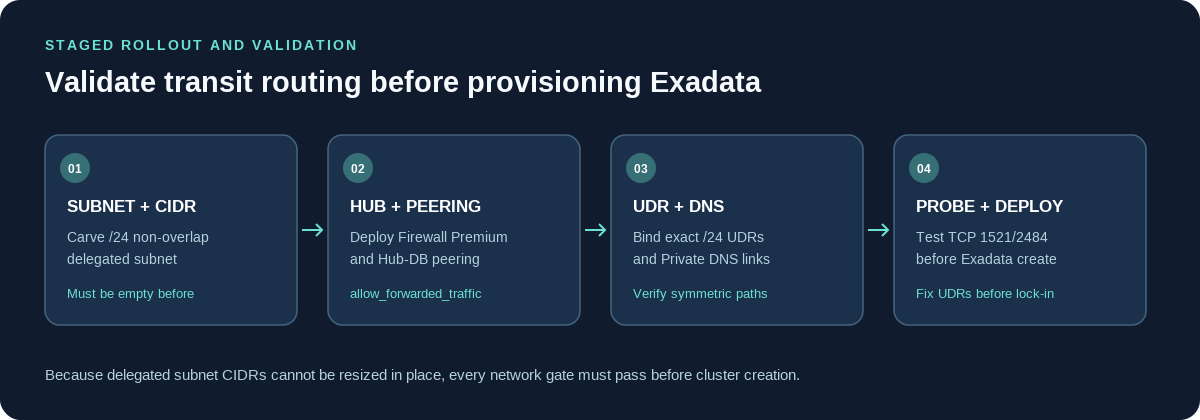
- Gate 1 — Subscription Feature Registration & CIDR Reservation: Register Azure Advanced Network Features (if required by your topology) before creating the delegated subnet, and reserve a non-overlapping
/24CIDR that collides with neither spoke VNets nor on-premises ExpressRoute/VPN prefixes. Rollback: destroy empty subnet before cluster creation. - Gate 2 — Hub Firewall & Bi-Directional Peering: Deploy
AzureFirewallSubnet(/26minimum), Azure Firewall Premium, and bi-directional Hub-to-Database VNet peering withallow_forwarded_traffic = true. Rollback: remove peering links via Terraform. - Gate 3 — Symmetric UDRs, Firewall Rules & Private DNS: Apply exact-prefix UDRs on spokes and return routes toward the firewall, add TCP
1521/2484Network Rules, and link the Private DNS zone to both Hub and Spokes. Rollback: revert Terraform route-table and policy state. - Gate 4 — Pre-Provisioning Probe Validation: Before delegating the subnet permanently to Exadata (using a temporary non-delegated test subnet in the same Database VNet CIDR, since a delegated subnet must remain empty), verify round-trip TCP
1521/2484reachability from a spoke pod/VM through the Hub Firewall and confirm firewall logs record the spoke’s true private IP. Rollback: fix asymmetric routes before invoking Oracle Database@Azure provisioning.
In Practice
Based on Microsoft Azure’s Hub-and-Spoke reference architecture and Oracle Database@Azure’s delegated subnet specification, the following Terraform blocks establish the Hub VNet, Firewall, delegated subnet, bi-directional peering, and DNS records.
# Hub VNet & Azure Firewall Premium
resource "azurerm_virtual_network" "hub" {
  name                = "vnet-oracle-hub-prod"
  resource_group_name = azurerm_resource_group.hub.name
  location            = var.azure_region
  address_space       = ["10.0.0.0/16"]
}

resource "azurerm_subnet" "firewall" {
  name                 = "AzureFirewallSubnet"
  resource_group_name  = azurerm_resource_group.hub.name
  virtual_network_name = azurerm_virtual_network.hub.name
  address_prefixes     = ["10.0.1.0/26"] # /26 minimum required by Azure Firewall
}

resource "azurerm_firewall" "hub" {
  name                = "fw-oracle-hub-prod"
  resource_group_name = azurerm_resource_group.hub.name
  location            = var.azure_region
  sku_tier            = "Premium"
  sku_name            = "AZFW_VNet"

  ip_configuration {
    name                 = "primary"
    subnet_id            = azurerm_subnet.firewall.id
    public_ip_address_id = azurerm_public_ip.firewall.id
  }
}

# Database VNet & Empty /24 Delegated Subnet
resource "azurerm_virtual_network" "database" {
  name                = "vnet-oracle-database-prod"
  resource_group_name = azurerm_resource_group.database.name
  location            = var.azure_region
  address_space       = ["10.200.0.0/16"]
}

resource "azurerm_subnet" "oracle_delegated" {
  name                 = "snet-oracle-exadata-delegated"
  resource_group_name  = azurerm_resource_group.database.name
  virtual_network_name = azurerm_virtual_network.database.name
  address_prefixes     = ["10.200.1.0/24"]

  delegation {
    name = "oracle-database-delegation"
    service_delegation {
      name = "Oracle.Database/networkAttachments"
      actions = [
        "Microsoft.Network/networkinterfaces/*",
        "Microsoft.Network/virtualNetworks/subnets/join/action",
      ]
    }
  }
}
Bi-directional peering and Firewall Network Rules complete the transit path while keeping RFC 1918 source IPs intact:
resource "azurerm_virtual_network_peering" "hub_to_database" {
  name                      = "peer-hub-to-database"
  resource_group_name       = azurerm_resource_group.hub.name
  virtual_network_name      = azurerm_virtual_network.hub.name
  remote_virtual_network_id = azurerm_virtual_network.database.id
  allow_forwarded_traffic   = true
}

resource "azurerm_virtual_network_peering" "database_to_hub" {
  name                      = "peer-database-to-hub"
  resource_group_name       = azurerm_resource_group.database.name
  virtual_network_name      = azurerm_virtual_network.database.name
  remote_virtual_network_id = azurerm_virtual_network.hub.id
  allow_forwarded_traffic   = true
}

resource "azurerm_firewall_policy_rule_collection_group" "oracle" {
  name               = "oracle-database-access"
  firewall_policy_id = azurerm_firewall_policy.hub.id
  priority           = 200

  network_rule_collection {
    name     = "oracle-sqlnet"
    priority = 100
    action   = "Allow"

    rule {
      name                  = "allow-sqlnet-payments"
      source_addresses      = ["10.10.1.0/24"]
      destination_addresses = ["10.200.1.0/24"]
      destination_ports     = ["1521", "2484"]
      protocols             = ["TCP"]
    }
  }
}
Oracle’s Real Application Clusters architecture distributes client connections across Exadata compute nodes using the three SCAN listener IPs assigned from 10.200.1.0/24; referencing the SCAN hostname in Azure Private DNS rather than individual node VIPs keeps JDBC strings stable across rolling patches. In practice, set a low DNS TTL (such as 300 seconds) on the Private DNS A record, link the private DNS zone to both the Hub VNet and every spoke VNet with registration_enabled = false, and configure application connection pools (such as Oracle UCP or HikariCP) with fast connection validation and retry backoff so transient listener handoffs during Exadata patching do not surface as application errors.
Equally important, keep the snet-oracle-exadata-delegated subnet strictly empty prior to cluster creation. Because Azure’s Oracle.Database/networkAttachments delegation reserves the subnet exclusively for OCI-projected network interfaces, placing jump hosts, Azure Bastion, or Private Endpoints inside the delegated subnet causes cluster provisioning validation to fail; all supporting hub infrastructure belongs in separate subnets inside the Hub VNet.
Where It Breaks
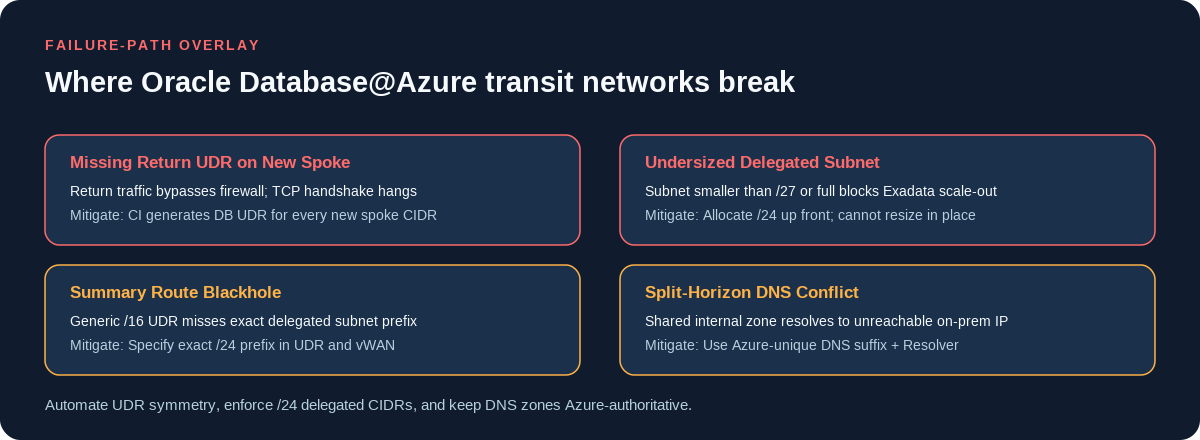
Hub-and-spoke transit architectures fail most often at route-table drift, CIDR sizing, and DNS boundaries.
| Failure Mode | Breaks How | Detect | Mitigate |
|---|---|---|---|
| Missing Return UDR on New Spoke | New spoke added without return route to firewall; asymmetric return drops TCP ACK. | Spoke TCP handshake hangs; firewall logs SYN with no return flow. | Generate return routes via shared Terraform spoke module and CI check. |
| Summary Route Blackhole | Generic /16 UDR fails to steer bare-metal delegated subnet traffic properly. | Packets drop or bypass hub firewall despite VNet-level route entry. | Specify exact /24 delegated subnet CIDR in UDRs and vWAN prefixes. |
| Undersized Delegated Subnet | Subnet smaller than /27 (or full /27) blocks cluster creation or node scale-out. | OCI provisioning fails with insufficient IP addresses in delegated subnet. | Allocate /24 up front; delegated subnet CIDRs cannot resize in place. |
| Split-Horizon DNS Conflict | Shared internal zone resolves SCAN hostname to unreachable on-premises IP. | Intermittent connection timeouts aligned with DNS TTL expiration. | Use an Azure-unique DNS suffix (oracle.corp-azure.internal) + Resolver. |
| Firewall Rule Ordering Shadow | High-priority deny rule blocks SQL*Net before lower-priority allow rule evaluates. | Connections fail with TCP RST while Oracle listener logs show no attempt. | Run automated firewall policy connectivity audits on every PR. |
| Non-Empty Delegated Subnet | Placing a test VM or private endpoint inside the delegated subnet breaks validation. | OCI deployment rejects subnet delegation check. | Keep the delegated subnet strictly empty; test in a sibling subnet first. |
Key Takeaways
- Azure VNet peering is non-transitive; connecting multiple spoke VNets to Oracle Database@Azure securely requires routing through a central Hub Firewall or Azure Virtual WAN with Routing Intent.
- Delegated client subnets (
Oracle.Database/networkAttachments) consume 13 reserved IPs + 3 SCAN IPs + 4 IPs per VM (24 IPs minimum for 2 VMs), making/27the hard minimum and/24the practical production standard since CIDRs cannot expand in place. - Configure SQL*Net (
1521,2484) in Azure Firewall Network Rules rather than Application Rules so private RFC 1918 source IPs pass through without SNAT. - Always specify the exact delegated subnet prefix (such as
/24) in UDRs and Virtual WAN Private Traffic Prefixes rather than relying solely on/16VNet summaries. - Keep the delegated subnet completely empty prior to cluster provisioning and validate symmetric routing from a sibling test subnet first.
What to Do Next
- Problem: Flat VNets and direct N:1 spoke peering to Oracle Database@Azure either expose Exadata to unfiltered lateral traffic or create unmanageable asymmetric routing failures.
- Solution: Isolate the
/24delegated subnet in a dedicated Database VNet peered only to a Hub VNet (or vWAN Hub), enforce symmetric exact-CIDR UDRs through Azure Firewall Premium Network Rules, and resolve SCAN listeners via Azure Private DNS. - Proof: Verify in Azure Firewall logs that test TCP
1521/2484flows from spoke subnets reach the Database VNet symmetrically with the spoke’s original RFC 1918 source IP intact before provisioning the Exadata cluster. - Action: Audit your target Oracle Database@Azure delegated subnet this week: confirm it is at least
/24, completely empty, and paired with exact-prefix UDRs on both the spoke and hub transit paths.
Interactive tools for this topic