
Refreshing Production MongoDB into Dev/Test Without Leaking Production Data
Restoring a raw production MongoDB snapshot directly into a development or staging VPC exposes customer PII and lets lower-environment workers fire live third-party webhooks and billing APIs before any post-boot masking script can finish.
TL;DR
- Problem: Booting production EBS snapshots in lower environments creates an immediate PII exposure window and lets background workers drain live webhook, email, and payment queues.
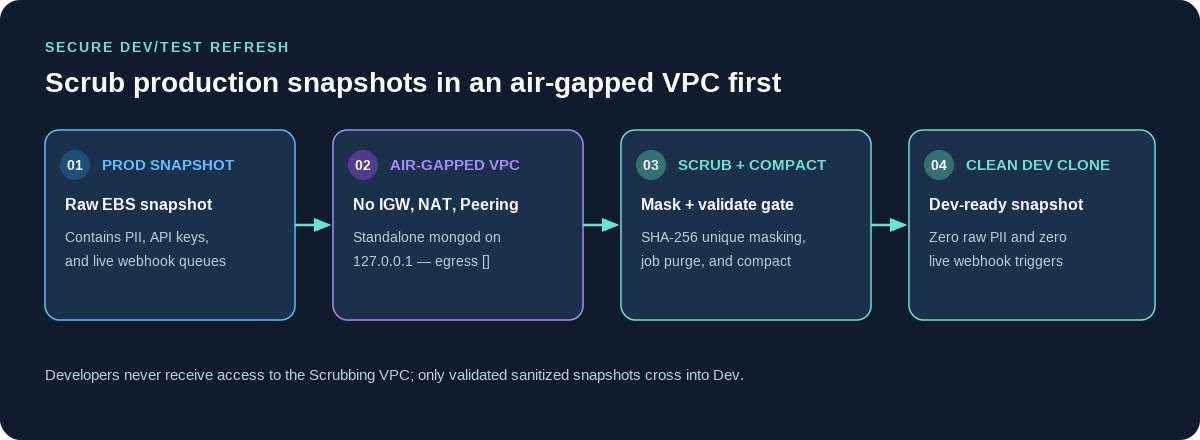
- Answer: Mount the production snapshot inside an air-gapped Scrubbing VPC (no IGW, no NAT, empty egress), run standalone
mongodon127.0.0.1, scrub viabulk_write(ordered=False)with deterministic SHA-256 hashing, runcompact, and snapshot only after a zero-leak gate passes.- Watch out: Scrubbing with
--replSetenabled bloatslocal.oplog.rs, static placeholder emails fail withE11000on unique indexes, and skippingcompactleaves fragmented WiredTiger extents in Dev snapshots.
Situation
Engineering teams running self-managed MongoDB on AWS EC2 often need production-like data shapes in staging and development environments to reproduce cardinality skew, test multi-stage aggregations, and benchmark index builds. Synthetic seed scripts rarely capture real-world document size variance or skewed tenant distributions, so teams restore AWS EBS snapshots of production data into lower environments.
Production databases, however, contain regulated PII (emails, phone numbers, billing addresses) alongside active operational state: pending background job queues, webhook payloads, and third-party API credentials (such as payment, email, or SMS tokens). Moving a production snapshot into a lower environment where developers hold broader IAM/SSH access and microservices run against NAT gateways turns a routine refresh into a security and operational incident.
The Problem
Cloning raw production snapshots into development fails on three concrete security and storage constraints:
- The post-boot exposure window: Restoring a snapshot into a development subnet and running a masking script afterward leaves raw PII and production credentials readable to lower-environment pods, developers, and log aggregators until the script completes—which can take hours on large collections.
- Phantom webhook and API execution: Staging worker containers boot and connect to the restored database immediately. If the database still contains pending job documents or live third-party API keys and the staging subnet has outbound internet access via a NAT Gateway, workers immediately dispatch real charges, emails, or webhooks to external endpoints.
- WiredTiger extent fragmentation under mass updates: Replacing variable-length strings (such as emails or addresses) across millions of documents forces WiredTiger to allocate new
WT_UPDATEdescriptors and disk extents rather than overwriting bytes in place, leaving unallocated holes inside.wtfiles unless compacted.
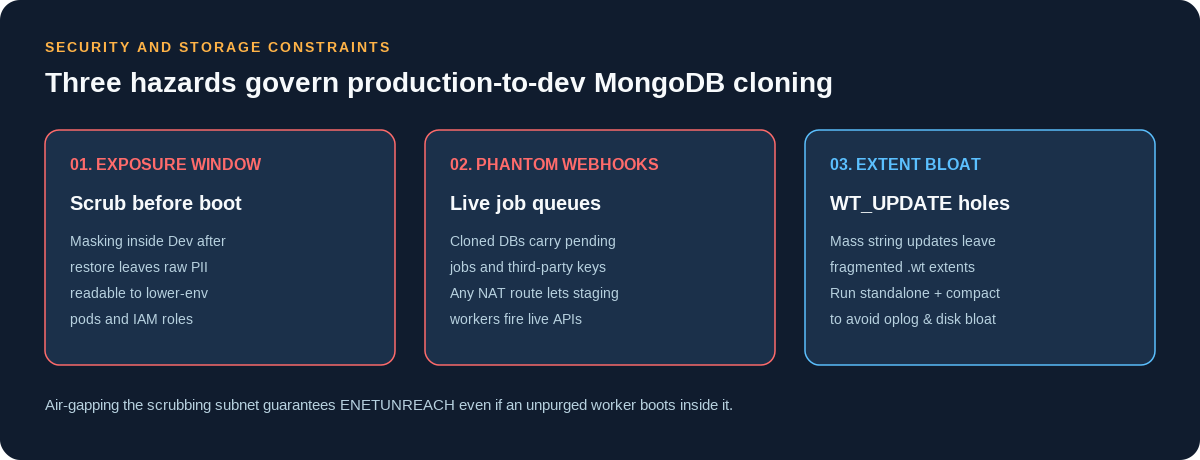
The core engineering question is: How can platform teams automate multi-terabyte production-to-dev MongoDB refreshes while guaranteeing zero PII exposure, zero outbound API calls, and compact developer snapshots?
Options Considered
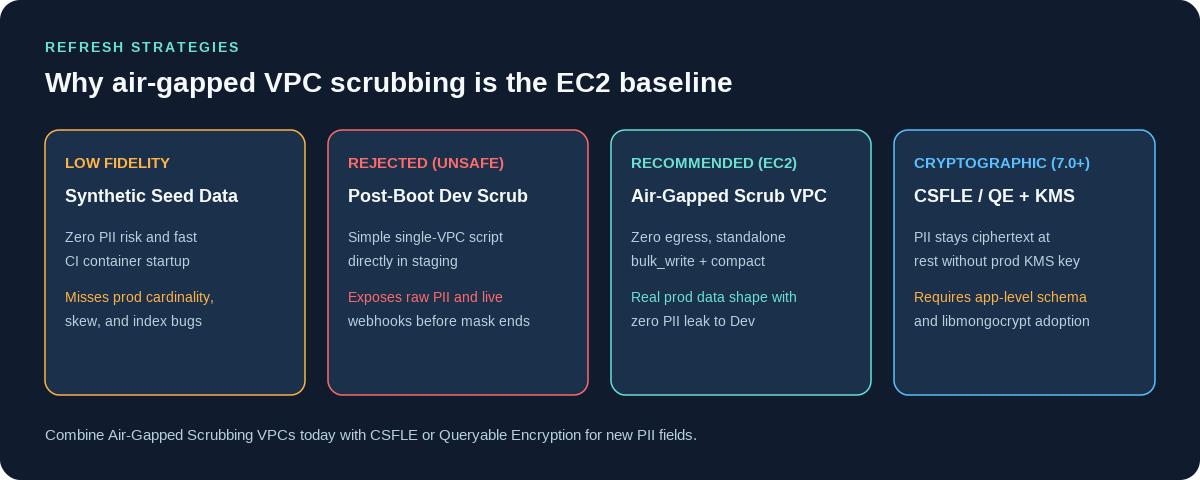
Four approaches exist for populating development and staging MongoDB environments:
| Approach | What It Gets Right | Where It Breaks | Decision |
|---|---|---|---|
| Synthetic Seed Data | Zero PII risk; fast CI startup | Misses production cardinality skew, index selectivity, and edge-case documents | Use for unit/CI tests only |
| Post-Boot Scrubbing in Dev VPC | Simple single-VPC automation | Exposes raw PII and live job queues until masking finishes | Reject |
| Air-Gapped Scrubbing VPC | Zero egress (ENETUNREACH), deterministic masking, compact before Dev sees data | Requires isolated VPC + ephemeral EC2 automation | Recommended for EC2 |
| CSFLE / Queryable Encryption (7.0+) | Sensitive fields remain ciphertext without production KMS key access | Requires application schema changes and libmongocrypt; does not purge job queues | Pair with Scrubbing VPC long-term |
Post-boot scrubbing inside the target Dev VPC is the most common anti-pattern: even a brief race between mongod startup and the masking script lets staging workers read unmasked records or fire queued webhooks. Isolating the entire scrub inside an air-gapped VPC ensures no unmasked snapshot ever reaches a developer-accessible network.
The Air-Gapped Scrubbing Architecture
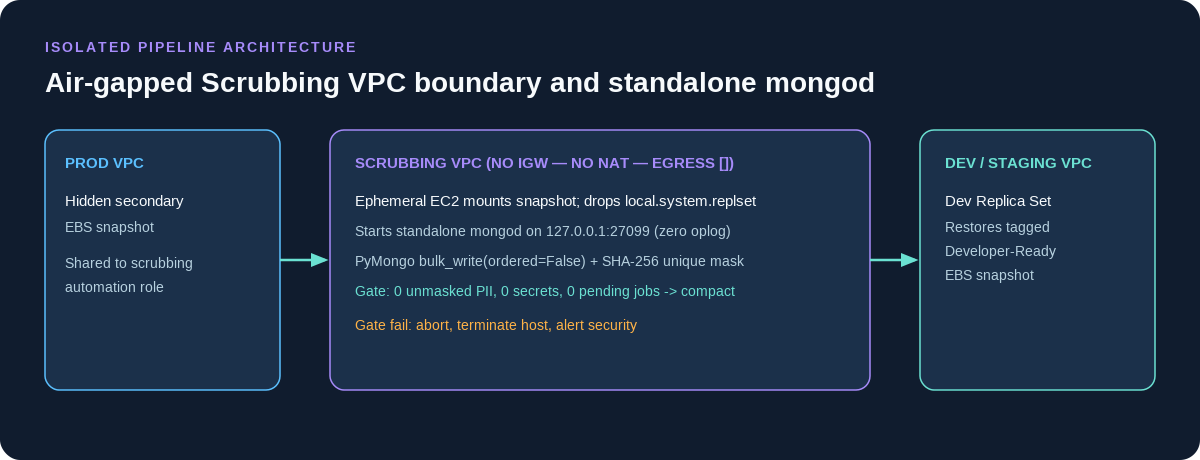
The hardened refresh pipeline inserts an ephemeral, zero-egress Scrubbing VPC between Production EBS snapshots and the target Development VPC.
1. Network Air-Gapping, KMS Key Isolation, and IAM Least Privilege
The Scrubbing VPC contains no Internet Gateway (IGW), no NAT Gateway, and no VPC Peering or Transit Gateway attachments:
- The subnet route table holds only the local VPC CIDR route (for example,
10.50.0.0/16 -> local). - The EC2 security group attaches an empty egress rule set (
egress: []). - Any accidental outbound TCP handshake from a process on the scrubbing host fails immediately at the hypervisor/kernel layer (
ENETUNREACH). - KMS and IAM boundary: Production EBS snapshots are encrypted with a Production AWS KMS Customer Managed Key (CMK). The refresh pipeline copies and re-encrypts the snapshot using a dedicated Scrubbing/Dev KMS key before mounting it in the Scrubbing VPC, and the scrubbing instance’s IAM instance profile is denied access to Production S3 buckets, Secrets Manager, and SQS/SNS endpoints. Only
ec2:CreateSnapshotandec2:CreateTagsfor theDeveloper-Readyoutput snapshot are permitted.
2. Standalone Mode (127.0.0.1) and Sharded Cluster Handling
Boot the scrubbing mongod in standalone mode—without --replSet—bound strictly to 127.0.0.1 on a non-standard port (such as 27099). Before starting, drop local.system.replset if needed so mongod does not attempt to contact production replica set peers, and omit --replSet so mass updates do not write gigabytes of mutations into local.oplog.rs (masking 100 million documents at ~500 bytes per oplog entry would otherwise generate ~50 GB of unnecessary oplog writes and double EBS gp3 write IOPS). For sharded clusters, repeat the standalone scrub on each shard’s hidden-secondary snapshot (and scrub any sensitive metadata in the CSRS snapshot if needed) under the same quiesced snapshot batch before tagging the set for Dev restore; also verify that no PII field being rewritten is part of a collection’s shard key, as mutating shard keys out-of-band on standalone shards would desynchronize config.chunks boundaries.
3. Deterministic Bulk Masking and Compaction (pymongo)
Sequential updateOne calls serialize round-trip latency across millions of documents. Instead, stream _id projections with no_cursor_timeout=True (always closing the cursor in a finally block) and apply batched bulk_write(operations, ordered=False) updates. Use deterministic SHA-256 hashing of _id (or keyed HMAC-SHA256 with a Dev-scoped secret when _id values are enumerable integers or predictable ObjectIds) for unique-indexed fields like email so masking never triggers E11000 duplicate key errors and remains reproducible across refreshes. Afterward, run db.runCommand({ compact: "users" })—which on WiredTiger rewrites B-tree extents in place without requiring 2x free disk space and releases unused blocks back to the OS without blocking normal CRUD—before taking the clean snapshot.
#!/usr/bin/env python3
import argparse, hashlib, sys
from pymongo import MongoClient, UpdateOne

def sanitize(uri, db_name, batch_size, dry_run):
    db = MongoClient(uri, serverSelectionTimeoutMS=5000)[db_name]
    if not dry_run:
        db.api_credentials.update_many({}, {"$set": {"api_key": "MOCKED_DEV_KEY_REDACTED"}})
        db.background_jobs.delete_many({})

    cursor = db.users.find({}, {"_id": 1}, no_cursor_timeout=True)
    ops = []
    try:
        for doc in cursor:
            digest = hashlib.sha256(str(doc["_id"]).encode()).hexdigest()[:12]
            ops.append(UpdateOne({"_id": doc["_id"]}, {"$set": {
                "email": f"user_{digest}@masked-example.internal",
                "phone": "+15550000000",
                "first_name": "SyntheticFirst",
                "last_name": "SyntheticLast",
            }}))
            if len(ops) >= batch_size:
                if not dry_run:
                    db.users.bulk_write(ops, ordered=False)
                ops.clear()
        if ops and not dry_run:
            db.users.bulk_write(ops, ordered=False)
    finally:
        cursor.close()

    if not dry_run:
        db.command({"compact": "users"})
        leaks = db.users.count_documents({"email": {"$not": {"$regex": r"@masked-example\.internal$"}}})
        if leaks > 0:
            sys.exit(f"Audit failed: {leaks} unmasked records detected.")

if __name__ == "__main__":
    p = argparse.ArgumentParser()
    p.add_argument("--uri", default="mongodb://127.0.0.1:27099")
    p.add_argument("--db-name", default="commerce_db")
    p.add_argument("--batch-size", type=int, default=5000)
    p.add_argument("--dry-run", action="store_true")
    a = p.parse_args()
    sanitize(a.uri, a.db_name, a.batch_size, a.dry_run)
4. Pre-Snapshot Regex Audit (mongosh)
Verify zero unmasked emails, phone numbers, API credentials, or pending background jobs remain before shutting down mongod:
const unmaskedEmails = db.users.countDocuments({ email: { $not: /@masked-example\.internal$/ } });
const activeSecrets = db.api_credentials.countDocuments({ api_key: { $not: /^MOCKED_/ } });
const pendingJobs = db.background_jobs.countDocuments({});
if (unmaskedEmails || activeSecrets || pendingJobs) {
  throw new Error("Sanitization audit failed; aborting snapshot.");
}
How It Rolls Out
Run the refresh pipeline in four gated phases so an unverified volume can never be tagged for development use.
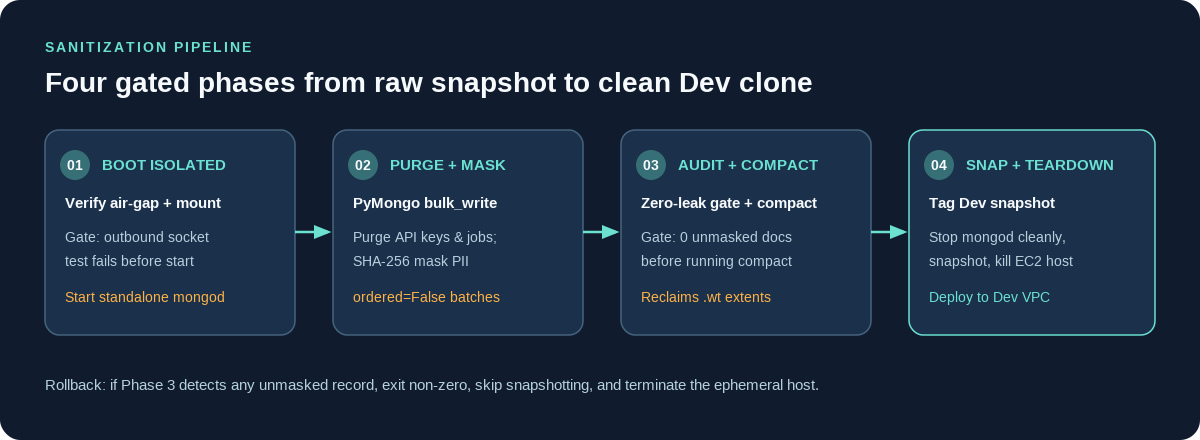
Phase 1: Mount Snapshot in Air-Gapped VPC and Verify Isolation
Launch an ephemeral EC2 host in the Scrubbing VPC, attach the restored production EBS volume, and run an outbound socket probe (socket.create_connection(('api.stripe.com', 443), timeout=2)) before starting mongod.
- Validation gate: The outbound socket test must fail with timeout or
ENETUNREACH. Startmongodin standalone mode on127.0.0.1:27099. - Rollback: If the network probe succeeds, terminate the EC2 instance immediately and fix VPC routing/security groups.
Phase 2: Purge Secrets/Queues, Rotate DB Users, and Execute Bulk Masking
Delete or truncate operational job queues (background_jobs, webhook outboxes), redact third-party API credentials, and drop or replace production database user credentials in admin.system.users (along with config.system.sessions and admin.system.keys) so lower environments authenticate strictly with Dev-only SCRAM credentials. Also drop local.oplog.rs from the restored volume: even though standalone mongod writes no new oplog records, the production snapshot’s local.oplog.rs still retains historical pre-scrub PII mutations until dropped and re-initialized in Dev. If the cluster uses GridFS (*.files and *.chunks), purge or replace binary attachment chunks here as well so unmasked documents or CSVs do not survive outside standard collections. Then run the PyMongo bulk_write(ordered=False) masking pass across all PII collections, checking db.getCollectionNames() against an explicit allowlist/manifest so newly added production collections never slip through unmasked.
- Validation gate: Zero
E11000duplicate key errors, zero unmapped collections outside the manifest, and all batches stay under the 16 MB BSON wire limit. - Rollback: Abort and terminate the ephemeral instance; production snapshots are read-only and unaffected.
Phase 3: Run Zero-Leak Audit Gate and compact
Execute the regex audit script across all masked collections, credential tables, and job queues. Once the audit returns zero leaks, run db.runCommand({ compact: "<collection>" }) on each heavily updated collection to reclaim fragmented WiredTiger extents. Sizing the ephemeral scrubbing EC2 instance with enough RAM so WiredTiger’s cache holds the _id and unique index B-trees avoids EBS read-amplification stalls during bulk_write, and running compact sequentially across every scrubbed collection rewrites sparse leaf pages so the resulting Developer-Ready EBS snapshot does not carry wasted extent blocks into Dev.
- Validation gate:
unmaskedEmails === 0,activeSecrets === 0,pendingJobs === 0, andcompactreturns{ ok: 1 }. - Rollback: If any unmasked record is found, exit non-zero, skip snapshotting, and terminate the instance.
Phase 4: Clean Shutdown, Snapshot Tagging, and Dev Restore
Stop mongod cleanly (db.adminCommand({ shutdown: 1 })) and confirm the process exits 0 so WiredTiger flushes a final checkpoint with zero pending journal recovery, create the new EBS snapshot tagged Environment: Developer-Ready, terminate the scrubbing EC2 instance, and restore the clean snapshot into the Dev VPC.
- Validation gate: Dev replica set boots cleanly with
rs.reconfig()for Dev hostnames and passes smoke queries. - Rollback: Retain the previous
Developer-Readysnapshot tag so Dev can roll back if a schema change breaks staging.
In Practice
Documented WiredTiger, PyMongo, and AWS VPC behaviors explain why each safeguard in this pipeline is necessary:
- Why
bulk_write(ordered=False)outperforms single updates: SingleupdateOnecalls pay a full network round-trip and server write-lock acquisition per document.bulk_write(operations, ordered=False)packs thousands of updates into each wire-protocol batch (bounded bymaxWriteBatchSizeand the 16 MB BSON limit) and allowsmongodto process independent document updates without strict sequential ordering. Keeping the batch size at 5,000–10,000 smallUpdateOnespecs avoids hitting the 16 MB BSON message cap while saturating local NVMe/EBS write throughput without overwhelming WiredTiger’s dirty-cache eviction thresholds. Pairing that stream withno_cursor_timeout=Truepreventsmongod’s default 10-minute idle cursor timeout (cursorTimeoutMillis) from killing long-running scans when a batch stalls on disk compaction or I/O, whiletry ... finally: cursor.close()ensures no server cursor leaks if an exception aborts the run. - Why deterministic SHA-256 masking prevents
E11000failures and preserves cross-collection joins: Productionuserscollections almost always enforce a unique index onemail. Replacing emails with a static string fails immediately on the second document withE11000 duplicate key error. Hashing the immutable_id(hashlib.sha256(str(_id)).hexdigest()[:12]) preserves uniqueness across millions of documents while keeping test fixtures deterministic across refreshes. When secondary collections (such asordersoraudit_logs) denormalizeuser_email, applying the same deterministic hash function keyed byuser_idkeeps cross-collection lookups valid in Dev without storing a reversible mapping table. - Why standalone mode +
compactcontrols snapshot cost: Running updates against a replica set writes every masked field tolocal.oplog.rs, doubling write I/O and inflating the EBS volume. Booting standalone eliminates oplog generation, and runningcompactafterward rewrites fragmented WiredTiger leaf pages so the resultingDeveloper-ReadyEBS snapshot does not carry gigabytes of empty extent holes. Note that if masked strings are significantly longer than original production values, B-tree leaf pages split during masking; keeping synthetic replacement strings close in length to production distributions minimizes extent growth beforecompactruns.
Where It Breaks
| Condition | Breaks How | Detect | Mitigate |
|---|---|---|---|
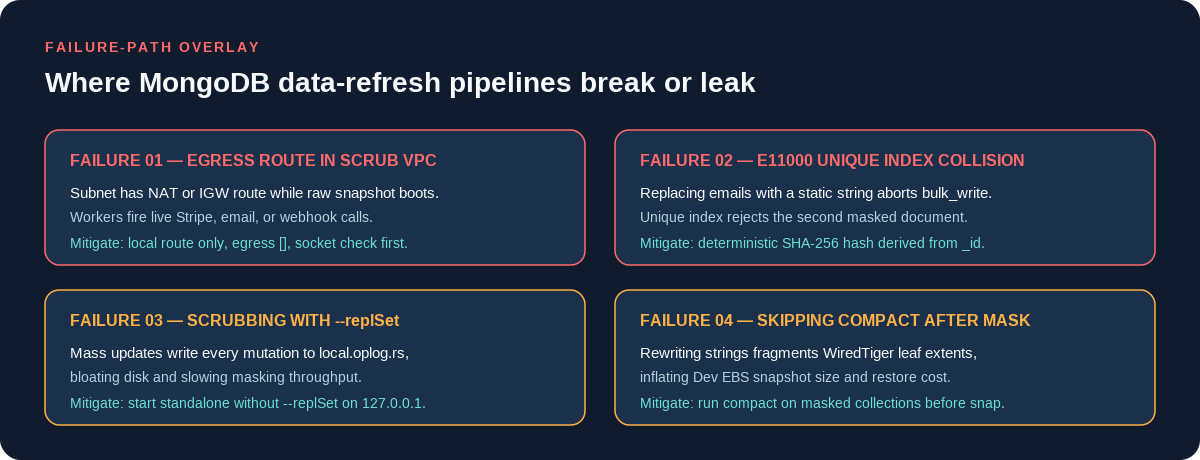
| Scrubbing subnet has IGW or NAT route | Booted workers fire live webhooks or API calls to Stripe/email providers | Outbound socket probe succeeds; VPC Flow Logs show egress | Enforce zero IGW/NAT/peering and egress: [] security group |
| Static placeholder on unique-indexed field | bulk_write aborts on second document with E11000 duplicate key | Scrubber exits with BulkWriteError E11000 | Derive synthetic unique values from SHA-256(_id) |
Running scrubber with --replSet active | Every masked document writes to local.oplog.rs, filling disk | Disk usage spikes during scrub; slow update rate | Boot mongod standalone without --replSet on 127.0.0.1 |
Unclosed no_cursor_timeout=True cursor | Cursor leaks server memory if an exception aborts mid-run | Rising open cursor count in serverStatus().metrics.cursor | Wrap cursor iteration in try ... finally: cursor.close() |
Skipping compact after mass string updates | Variable-length string replacements fragment .wt extents | Clean snapshot size is significantly larger than prod data | Run db.runCommand({ compact: "<coll>" }) before snapshotting |
Stale local.system.replset on Dev boot | Restored Dev node tries to contact production hostnames | mongod stuck in RECOVERING or STARTUP2 | Drop local.system.replset or run rs.reconfig(..., { force: true }) |
| Missing job-queue purge in new collections | Newly added queue collections survive masking and trigger in Dev | Non-zero count in new queue collections after scrub | Audit collection list dynamically in Phase 3 gate |
April 2026 Update
MongoDB 7.0 and 8.0 added native encryption and background compaction capabilities that complement air-gapped scrubbing pipelines:
- Queryable Encryption (QE) equality (7.0) and range queries (8.0): MongoDB 7.0 made Queryable Encryption GA for equality queries, and MongoDB 8.0 added range queries (
$lt,$lte,$gt,$gte) on encrypted numeric and date fields. When combined with Client-Side Field Level Encryption (CSFLE) and separate KMS keys per environment, encrypted PII fields remain unreadable ciphertext in lower environments without access to the production KMS key—though scrubbing job queues and API credentials remains mandatory. - Background compaction (
autoCompact, MongoDB 8.0): MongoDB 8.0 introduceddb.runCommand({ autoCompact: true })for background space reclamation on WiredTiger without blocking normal CRUD, complementing explicitcompactruns at the end of sanitization jobs. - VPC Flow Log and Network Firewall guardrails: Pairing air-gapped scrubbing subnets with automated VPC Flow Log alerts ensures any accidental route-table change that enables egress is caught immediately.
Key Takeaways
- Never scrub production snapshots inside the target Dev VPC: Any delay between
mongodstartup and masking completion exposes raw PII and lets staging workers fire live webhooks. - Enforce physical network isolation first: Use a dedicated Scrubbing VPC with no IGW, no NAT Gateway, empty egress rules, and an explicit outbound socket failure check before starting
mongod. - Run standalone
mongod+bulk_write(ordered=False)+SHA-256(_id): Eliminatelocal.oplog.rsbloat, avoidE11000unique index collisions, and keep masking deterministic. - Gate snapshotting on a zero-leak audit and
compact: Abort and terminate the host if any unmasked PII, API secret, or pending job remains, and compact WiredTiger extents before creating theDeveloper-Readysnapshot.
What to Do Next
- Problem: Check whether your Dev/Staging MongoDB refresh pipeline boots raw production snapshots in a VPC with NAT/IGW access or masks data after Dev pods connect.
- Solution: Provision an air-gapped Scrubbing VPC, run standalone
mongodon127.0.0.1, mask viabulk_write(ordered=False)withSHA-256(_id), validate zero leaks, andcompactbefore snapshotting. - Proof: Verify that an outbound socket probe fails inside the Scrubbing VPC and that the post-scrub regex audit returns
0unmasked records and0pending jobs. - Action: Audit your refresh scripts and staging job-queue collections this week to ensure every credential and webhook queue is purged before any snapshot is tagged
Developer-Ready.