
MongoDB Atlas vs Self-Managed EC2: The Production Engineering Tradeoff
Choosing between self-managed MongoDB on AWS EC2 and MongoDB Atlas is not a simple hosting decision—it is an architectural boundary between full kernel and I/O control with SRE toil versus managed automation where unindexed queries force expensive cluster tier jumps.
TL;DR
- Problem: Lifting and shifting unindexed workloads from EC2 to MongoDB Atlas turns cheap independent EBS
gp3IOPS scaling ($0.005/IOPS-month) into forced compute-and-RAM tier upgrades.- Answer: Run a query selectivity and working-set audit first, model Total Cost of Ownership including SRE operational hours, and choose EC2, Atlas, or a hybrid split per workload.
- Watch out: Atlas abstracts Linux kernel tuning, caps per-node connections by tier, and auto-scales storage up at 90% disk usage without automatic down-scaling.
Situation
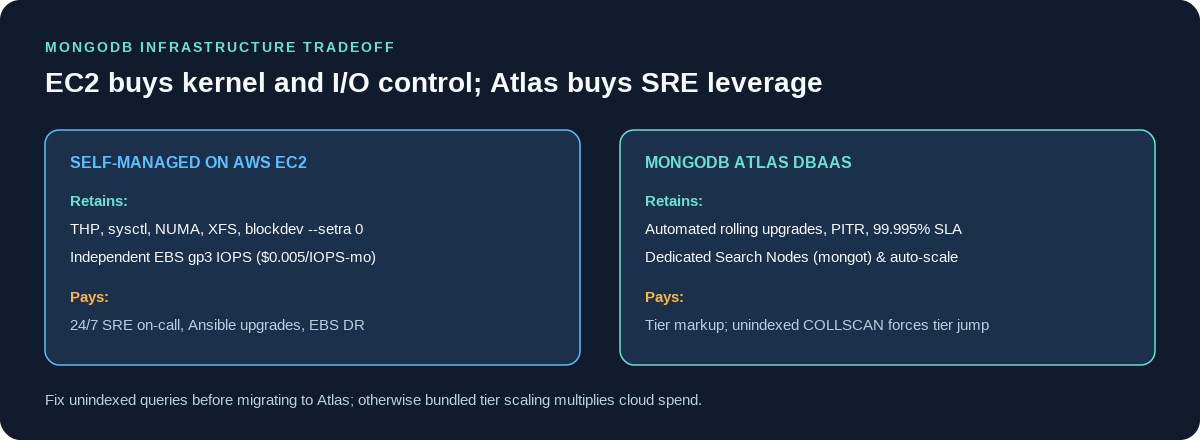
Organizations running multi-terabyte MongoDB Community Edition workloads on AWS EC2 routinely face executive pressure to evaluate MongoDB Atlas. On self-managed EC2, database platform teams own every layer of the stack: provisioning instances, disabling Transparent Huge Pages (THP), tuning vm.swappiness and dirty-page ratios, formatting XFS filesystems, calibrating gp3 or io2 EBS volumes, and maintaining Ansible upgrade playbooks alongside EBS snapshot scripts.
As estates grow across dozens of replica sets, leadership looks to MongoDB Atlas—MongoDB’s managed Database-as-a-Service (DBaaS)—to automate rolling upgrades, point-in-time recovery (PITR), and multi-AZ failover under a 99.995% SLA for M10 and larger clusters. However, moving from raw EC2 to a managed control plane shifts operational boundaries, cost elasticity, and performance tuning levers. What looks like a like-for-like VM swap on a spreadsheet actually exchanges direct OS and storage control for SaaS automation and a bundled tier pricing model.
The Problem
Migrating from self-managed EC2 to MongoDB Atlas exposes four structural constraints that break naive lift-and-shift plans:
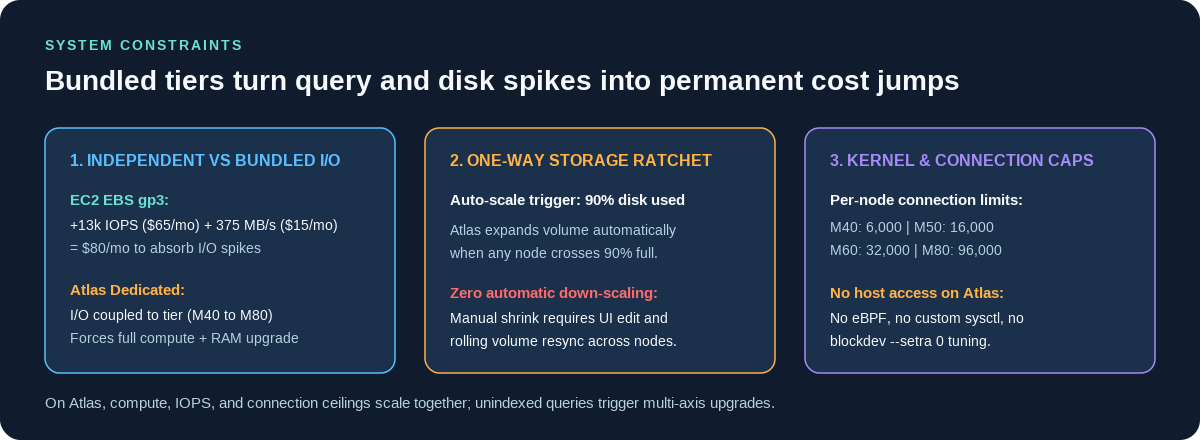
- Bundled Tier I/O vs. Independent EBS Scaling: On AWS EC2 with
gp3volumes, storage capacity ($0.08/GB-month), provisioned IOPS above 3,000 ($0.005/IOPS-month), and throughput above 125 MB/s ($0.040/MB/s-month) scale independently. Masking an unindexed collection scan (COLLSCAN) by adding 13,000 IOPS ($65/month) and 375 MB/s ($15/month) costs$80/monthper volume. On Atlas, compute, RAM, and hypervisor I/O bandwidth are coupled into rigid instance tiers (M40: 4 vCPU / 16 GB RAM, M50: 8 vCPU / 32 GB, M60: 16 vCPU / 64 GB, M80: 32 vCPU / 128 GB). WhenCOLLSCANqueries saturate I/O on an M40, the immediate remedy is upgrading the entire cluster tier, so the cost of the fix is the full tier price difference, not just the extra I/O. Compare against current Atlas pricing for your region before deciding. - One-Way Storage Auto-Scaling Ratchet: Atlas enables storage auto-scaling by default and expands disk volumes automatically whenever any node reaches 90% disk usage. However, storage auto-scaling never shrinks automatically. If a runaway logging loop or bulk backfill triggers expansion, the higher storage bill persists until an operator manually lowers the disk size via the Atlas UI or API, which triggers an in-place data resync and rolling node restart.
- Zero Host OS or Kernel Access: Atlas abstracts the underlying Linux host completely. Engineers cannot SSH into nodes, run eBPF tracing tools (
biosnoop,bpftrace), adjustvm.dirty_ratio, setblockdev --setra 0for WiredTiger random I/O, or install host-level security and compliance daemons. - Tier-Capped Connections and Network Transit Fees: Atlas enforces strict per-node connection limits (6,000 on M40, 16,000 on M50, 32,000 on M60, 96,000 on M80, minus internal management reservations). Meanwhile, connecting application VPCs over AWS PrivateLink adds interface endpoint fees (
~$0.01/hourper AZ) plus$0.01/GBin data processing charges for the first petabyte per month, alongside cross-AZ transfer costs.
How can platform architects evaluate the Total Cost of Ownership, operational leverage, and architectural boundaries between self-managed EC2 and MongoDB Atlas without triggering over-provisioned lift-and-shift migrations?
Options Considered
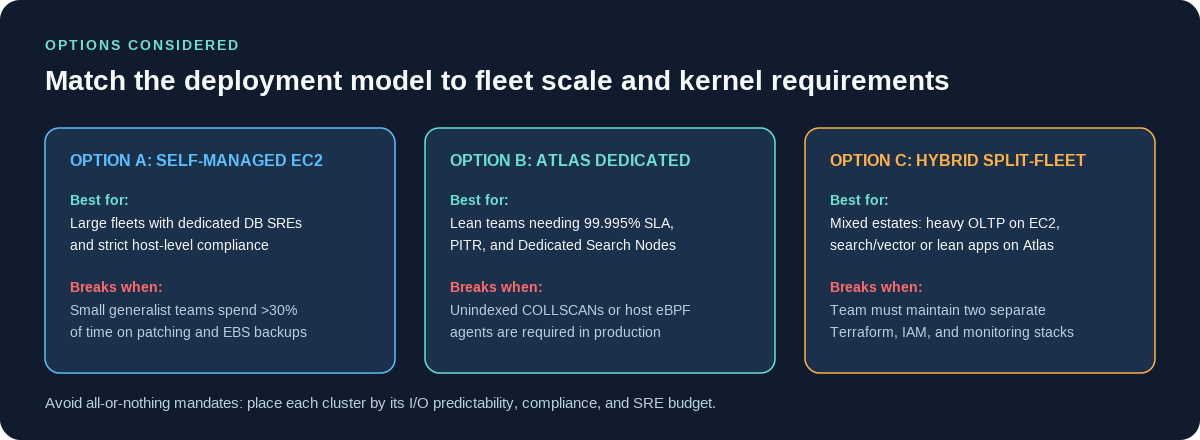
Platform teams evaluating MongoDB hosting on AWS have three viable deployment models, each optimizing a different operational constraint.
| Deployment Model | What It Optimizes | Where It Breaks | Best Fit |
|---|---|---|---|
| Self-Managed on AWS EC2 | Full Linux kernel control, independent EBS gp3 IOPS scaling, zero DBaaS markup | High SRE toil for OS patching, upgrades, quorum repair, and snapshot automation | Large fleets with dedicated DB SREs or strict host-level compliance |
| MongoDB Atlas Dedicated | 99.995% SLA (M10+), automated rolling upgrades, continuous PITR, Dedicated Search Nodes | Unindexed queries force full tier jumps; no root OS access or custom eBPF agents | Lean engineering teams optimizing for delivery speed over infrastructure control |
| Hybrid Split-Fleet | Places each cluster by workload profile (OLTP on EC2, search/lean apps on Atlas) | Operational split: teams must maintain two Terraform, IAM, and monitoring pipelines | Mixed estates with both high-I/O legacy workloads and net-new search/vector apps |
Self-managed EC2 is rejected when generalist DevOps teams lack 24/7 database SRE coverage, because a single botched secondary resync or disk-full outage erases any infrastructure savings. Conversely, all-in Atlas migration is rejected when a fleet carries unindexed COLLSCAN debt or requires custom host-level security agents that Atlas cannot run. A hybrid split-fleet captures the strengths of both models, provided the platform team can absorb maintaining two provisioning and observability paths.
Control Plane and TCO Architecture
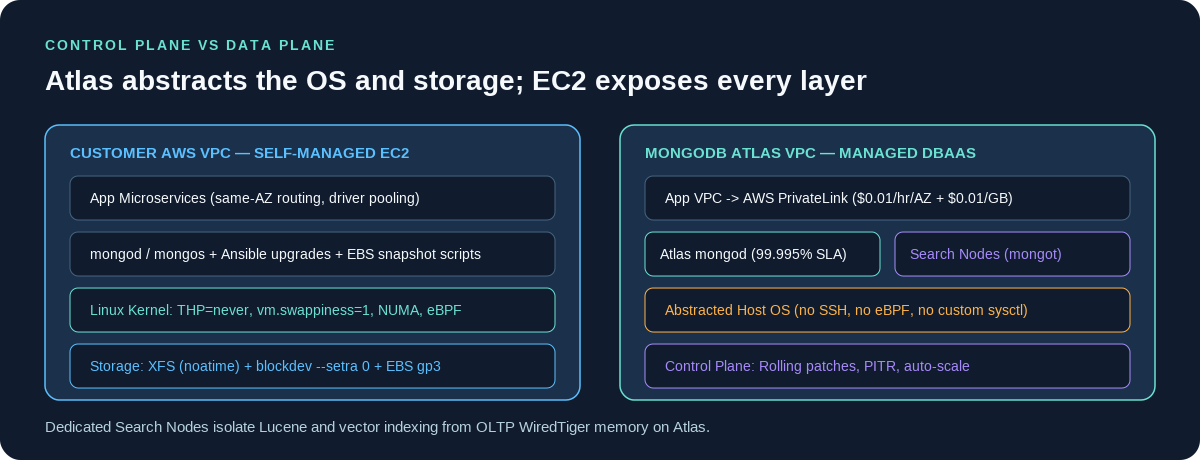
The core architectural distinction between self-managed EC2 and MongoDB Atlas is where the control plane boundary sits.
Control Plane vs. Data Plane Separation
On self-managed EC2, the organization owns both the data plane and the control plane. Platform engineers control EC2 instance families, EBS volume types, Linux kernel parameters, and mongod configuration. That control is mandatory for air-gapped networks, host-level intrusion detection daemons, and custom kernel profiling. The price is continuous lifecycle ownership: CVE patching, minor and major MongoDB version upgrades, backup verification, and hypervisor degradation recovery.
On MongoDB Atlas, MongoDB operates the control plane as a SaaS service while running mongod nodes in managed AWS accounts connected to application VPCs via VPC Peering or AWS PrivateLink. Operators give up SSH and kernel access in exchange for automated rolling binary upgrades, continuous oplog PITR, automated node replacement, compute auto-scaling (including scaleDownEnabled for off-peak contraction), and Dedicated Search Nodes (S10/S20/S30 running mongot) that isolate Atlas Search and Vector Search indexing from transactional WiredTiger memory.
WiredTiger allocates 50% or more of physical RAM on M40 and larger tiers to its internal cache, leaving the remainder for the OS page cache, aggregation sort buffers, and network connections. On self-managed EC2, engineers can inspect dirty-page eviction pressure directly via wiredTiger.cache counters and tune gp3 IOPS independently when checkpoint flushes spike; on Atlas, sustained dirty-page pressure above 20% triggers read/write stalls unless the cluster scales up a tier.
Total Cost of Ownership (TCO) Formulation
Comparing raw EC2 compute invoices against Atlas cluster bills misses both SRE labor and hidden transit costs. A complete annual TCO model compares both sides explicitly:
$$\text{TCO}{\text{Self-Managed}} = C{\text{EC2}} + C_{\text{EBS}} + C_{\text{Network}} + (N_{\text{SRE}} \times S_{\text{SRE}} \times \alpha_{\text{Mongo}}) + C_{\text{Tooling}}$$
$$\text{TCO}{\text{Atlas}} = C{\text{Atlas-Tier}} + C_{\text{Storage-Overage}} + C_{\text{PrivateLink}} + (N_{\text{SRE}} \times S_{\text{SRE}} \times \beta_{\text{Mongo}}) + C_{\text{Support}}$$
In this model, $C_{\text{EC2}}$ reflects compute under 1-year or 3-year Compute Savings Plans, $C_{\text{EBS}}$ captures gp3 capacity plus provisioned IOPS and throughput, and $\alpha_{\text{Mongo}}$ versus $\beta_{\text{Mongo}}$ represent the fraction of SRE capacity consumed by routine database lifecycle operations on EC2 versus Atlas. For small estates, eliminating routine patching and backup toil often outweighs the managed service premium; for massive multi-cluster estates, the recurring tier markup can exceed the cost of funding a dedicated database platform team.
Linux Kernel and Storage Tuning Boundaries
Self-managed EC2 exposes four low-level performance levers documented in MongoDB’s Linux Production Notes that are abstracted away in Atlas:
- Transparent Huge Pages (THP): On MongoDB 7.0 and earlier, WiredTiger’s 4 KB memory allocation patterns suffer fragmentation and latency spikes when Linux coalesces 2 MB huge pages. EC2 operators disable THP at boot (
echo never > /sys/kernel/mm/transparent_hugepage/enabledanddefrag), whereas MongoDB 8.0+ supports THP on specific configurations. - Virtual Memory and Swappiness: Setting
vm.swappiness = 1keeps swap available only as an emergency buffer against the Linux OOM killer while preventing active WiredTiger cache pages from being paged to disk. Tuningvm.dirty_background_ratioandvm.dirty_ratiobounds how much unwritten data accumulates in the OS page cache before synchronous writebacks stall I/O threads:
# /etc/sysctl.d/99-mongodb.conf
vm.dirty_background_ratio = 3
vm.dirty_ratio = 7
vm.swappiness = 1
- NUMA and XFS Mounts: On multi-socket EC2 shapes, launching
mongodwithnumactl --interleave=allprevents single-node memory exhaustion. Data volumes are formatted as XFS and mounted withnoatime,nodiratimeto eliminate unnecessary metadata writes on reads. - Block Device Readahead: Because WiredTiger executes random 4 KB–32 KB reads, large OS readahead values waste EBS bandwidth fetching unused blocks. EC2 operators set
blockdev --setra 0 /dev/nvme1n1(or a low value such as 16–32 sectors) viaudevrules. On Atlas, MongoDB manages AMI, filesystem, and block-device defaults internally.
Workload Telemetry and Selectivity Audit
Before requesting Atlas tier quotes, platform engineers must measure document selectivity (scannedObjects vs. document.returned), WiredTiger cache pressure, and network egress directly from db.serverStatus(). Note that queryExecutor.scanned counts index keys examined, whereas queryExecutor.scannedObjects counts documents examined:
// MongoDB Migration Readiness and Workload Efficiency Audit
const ss = db.serverStatus();
const scannedDocs = ss.metrics.queryExecutor.scannedObjects;
const returnedDocs = ss.metrics.document.returned || 1;
const selectivityRatio = scannedDocs / returnedDocs;

print("Docs Scanned / Returned: " + selectivityRatio.toFixed(2));
if (selectivityRatio > 5.0) {
  print("[WARNING] High COLLSCAN ratio; add ESR compound indexes before Atlas sizing.");
}

const wt = ss.wiredTiger.cache;
const maxGB = (wt["maximum bytes configured"] / 1073741824).toFixed(2);
const dirtyGB = (wt["tracked dirty bytes in the cache"] / 1073741824).toFixed(2);
print("WiredTiger Max Cache (GB): " + maxGB + " | Dirty (GB): " + dirtyGB);

const egressGB = (ss.network.bytesOut / 1073741824).toFixed(2);
print("Cumulative Egress (GB): " + egressGB);
How It Rolls Out
A safe evaluation or migration follows a four-phase readiness gate so unoptimized queries never reach managed tiers.
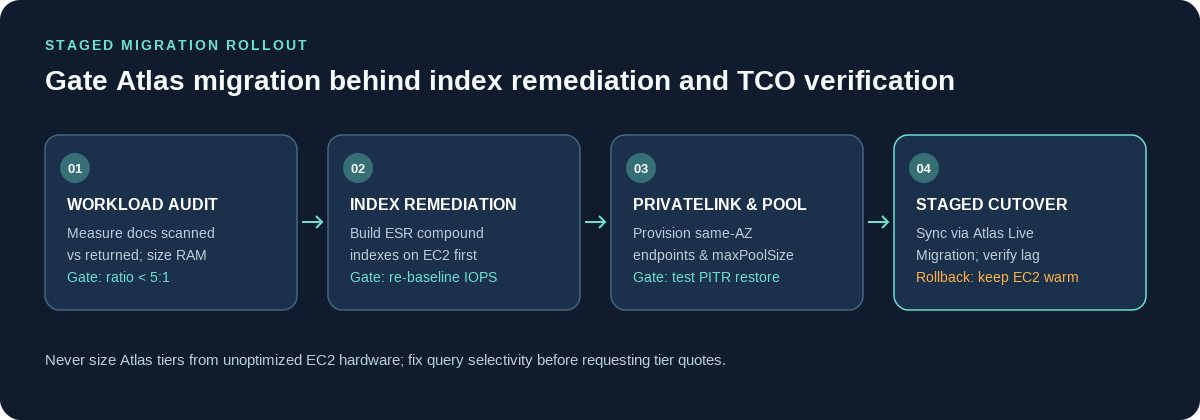
- Phase 1 — Workload and Selectivity Audit: Run the
serverStatus()audit across every candidate replica set. Flag any cluster wherescannedObjects / document.returnedexceeds 5:1, and capture working-set RAM and hourly network egress baselines. Rollback/Gate: Halt sizing for any cluster failing the selectivity threshold. - Phase 2 — Index Remediation on EC2: Refactor offending queries using the Equality-Sort-Range (ESR) rule and build targeted compound indexes while still on EC2, where
gp3IOPS absorb temporary index-build load cheaply. Re-run the audit to confirm reduced disk reads and smaller working-set requirements. - Phase 3 — PrivateLink, Connection Pooling, and Restore Validation: Provision AWS PrivateLink endpoints in the same Availability Zones as application subnets to avoid cross-AZ egress multipliers, configure driver
maxPoolSizebounds within the target tier’s per-node connection cap, and execute a full PITR restore drill in staging. - Phase 4 — Staged Cutover: Replicate data using Atlas Live Migration (
mongomirrorfor self-managed sources), validate replication lag andexplain("executionStats")plans on the target cluster, and switch application connection strings during a maintenance window while keeping the EC2 cluster warm as an immediate fallback.
In Practice
Documented system behavior across AWS EC2, WiredTiger, and MongoDB Atlas explains why lift-and-shift migrations fail when teams skip workload remediation:
- AWS EBS
gp3Decoupling vs. Atlas Tier Coupling: Under documented AWS EBSgp3pricing, volume storage ($0.08/GB-month) is billed separately from provisioned IOPS above 3,000 ($0.005/IOPS-month) and throughput above 125 MB/s ($0.040/MB/s-month). On EC2, a team can absorb an unexpected I/O bottleneck for$80/monthwhile scheduling an index fix. On MongoDB Atlas, I/O capacity is tied to the cluster tier, so unindexed reads force scaling both vCPU and RAM—turning a query bug into a permanent tier-level cost jump. - Atlas Storage Auto-Scaling Behavior: MongoDB Atlas documentation specifies that storage auto-scaling triggers automatically when disk utilization reaches 90% on any node, but never scales storage down automatically after data is deleted or archived via TTL indexes. Shrinking a volume requires a manual configuration edit in Atlas, which provisions smaller disks and performs an in-place data resync with rolling node restarts.
- Search Isolation Pattern with Dedicated Search Nodes: When transactional clusters run Atlas Search or Vector Search on the same nodes as
mongod, Lucene and k-NN indexing compete with WiredTiger for RAM and CPU. The documented Atlas pattern offloads search indexing to Dedicated Search Nodes (mongot), isolating OLTP latency from search spikes. - Pattern Acknowledgment: I have not personally migrated a 50-node estate in a single event, but the documented architectural pattern across MongoDB Production Notes and Atlas sizing guides is consistent: index remediation and working-set right-sizing on EC2 must precede tier selection on Atlas.
Where It Breaks
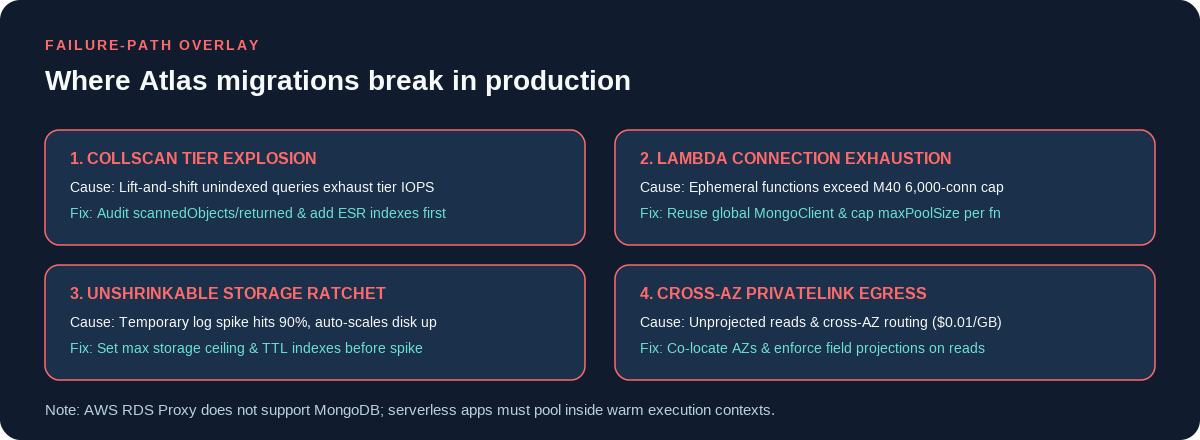
Every hosting model fails under specific operational patterns; the table below maps each failure mode to its detection signal and mitigation.
| Failure Mode | Breaks How | Detect | Mitigate |
|---|---|---|---|
Lift-and-shift of COLLSCAN queries | Unindexed scans exhaust Atlas tier IOPS, forcing emergency M40-to-M80 upgrades | scannedObjects / document.returned > 5 or high pages read into cache | Build ESR compound indexes on EC2 before sizing Atlas tiers |
| Lambda / serverless connection sprawl | Ephemeral functions open direct connections until per-node cap (e.g., 6,000 on M40) is hit | connections.current approaching tier limit; connection reset errors | Reuse global MongoClient across invocations and cap maxPoolSize (RDS Proxy does not support MongoDB) |
| Unbounded storage auto-scaling | Temp log spike hits 90% disk, auto-scales volume up, and never auto-shrinks | Storage utilization alerts or unexpected EBS/Atlas disk bill jump | Set max storage scaling ceilings and enforce TTL indexes on high-churn collections |
| Cross-AZ PrivateLink egress | Unprojected reads traverse AZ boundaries via PrivateLink at $0.01/GB | Rising bytesOut in serverStatus() and AWS DataTransfer-AZ-Bytes billing | Co-locate app subnets and endpoints by AZ; enforce field projections |
| Host compliance or eBPF requirement | Security team mandates root eBPF tracers or host-level IDS daemons | Security architecture review flags lack of SSH/root on Atlas nodes | Keep regulated or kernel-tuned clusters on self-managed EC2 |
| Co-located search and OLTP | $search / $vectorSearch indexing evicts hot OLTP pages from WiredTiger cache | Rising WiredTiger cache eviction stalls during search index rebuilds | Deploy Atlas Dedicated Search Nodes (mongot) to isolate search memory |
Key Takeaways
- Fix query selectivity before pricing Atlas: An unindexed
COLLSCANcosts$80/monthto mask on EBSgp3, but forces a full compute-and-RAM tier jump on MongoDB Atlas. - Model SRE toil honestly in TCO: Self-managed EC2 saves raw infrastructure markup, but only wins financially when the fleet is large enough to justify dedicated database SRE staffing.
- Atlas storage auto-scaling is a one-way ratchet: Disks expand automatically at 90% utilization and never auto-shrink; always configure maximum storage ceilings and TTL policies.
- Serverless connection pooling requires application discipline: AWS RDS Proxy does not support MongoDB, so Lambda functions must reuse a global
MongoClientand boundmaxPoolSizebelow tier limits. - Hybrid split-fleets beat ideological mandates: Keep kernel-tuned, compliance-restricted, or massive I/O clusters on EC2 while moving lean OLTP and search-heavy workloads to Atlas.
What to Do Next
- Problem: Decide whether to retain self-managed MongoDB on AWS EC2 or migrate workloads to MongoDB Atlas without triggering unexpected cloud spend.
- Solution: Run a workload-by-workload TCO and control-boundary evaluation covering compute, EBS
gp3IOPS, PrivateLink transit, and SRE operational hours. - Proof: Execute the
serverStatus()selectivity audit across production replica sets and verifyscannedObjects / document.returnedis below 5:1 before requesting Atlas tier quotes. - Action: Remediate top
COLLSCANqueries with ESR compound indexes this week, then pilot one lean replica set through the four-phase Atlas readiness gate—including a staged PITR restore test—before committing to a broader migration.
Interactive tools for this topic